Earth-Sun-Moon Model Investigation
A free science worksheet ready for your classroom. Open in Kuraplan to grab the print-ready PDF, customize it for your students, or generate a fresh version in seconds.
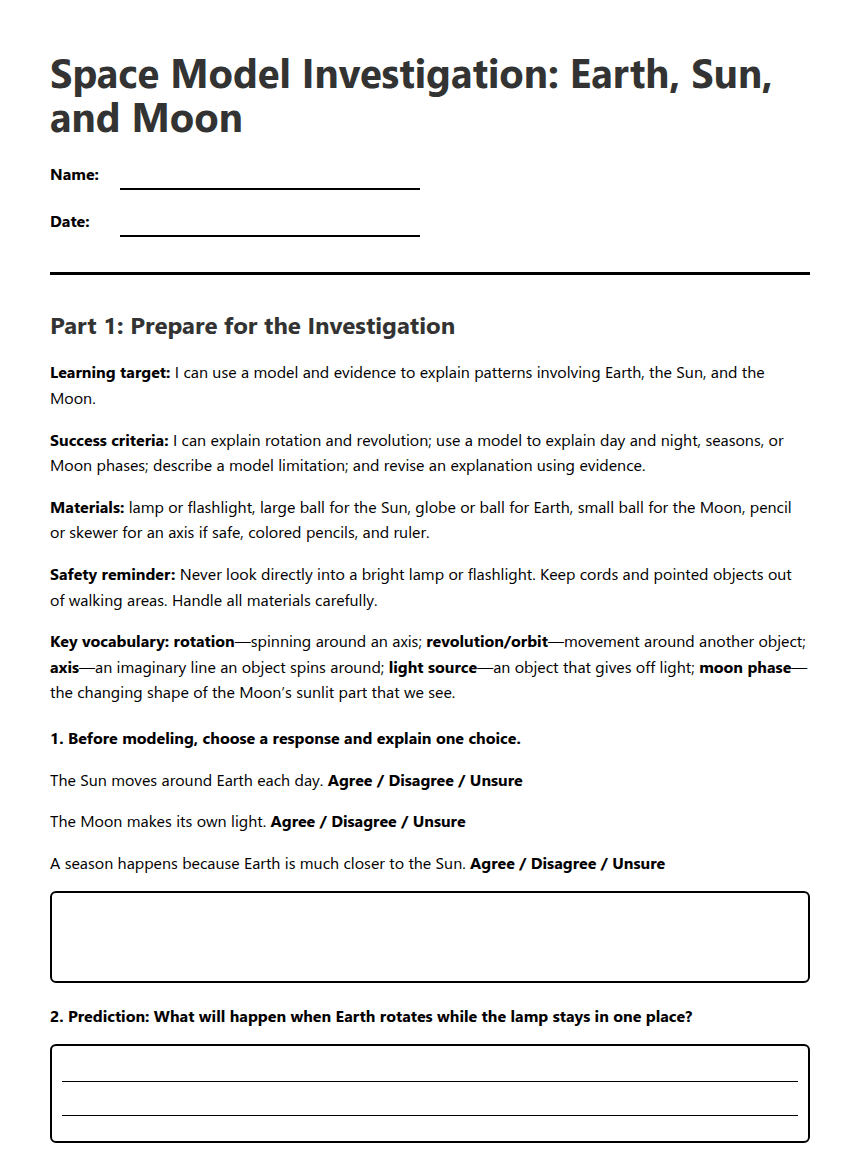
Space Model Investigation: Earth, Sun, and Moon
Part 1: Prepare for the Investigation
Learning target: I can use a model and evidence to explain patterns involving Earth, the Sun, and the Moon.
Success criteria: I can explain rotation and revolution; use a model to explain day and night, seasons, or Moon phases; describe a model limitation; and revise an explanation using evidence.
Materials: lamp or flashlight, large ball for the Sun, globe or ball for Earth, small ball for the Moon, pencil or skewer for an axis if safe, colored pencils, and ruler.
Safety reminder: Never look directly into a bright lamp or flashlight. Keep cords and pointed objects out of walking areas. Handle all materials carefully.
Key vocabulary: rotation—spinning around an axis; revolution/orbit—movement around another object; axis—an imaginary line an object spins around; light source—an object that gives off light; moon phase—the changing shape of the Moon’s sunlit part that we see.
The Sun moves around Earth each day. Agree / Disagree / Unsure
The Moon makes its own light. Agree / Disagree / Unsure
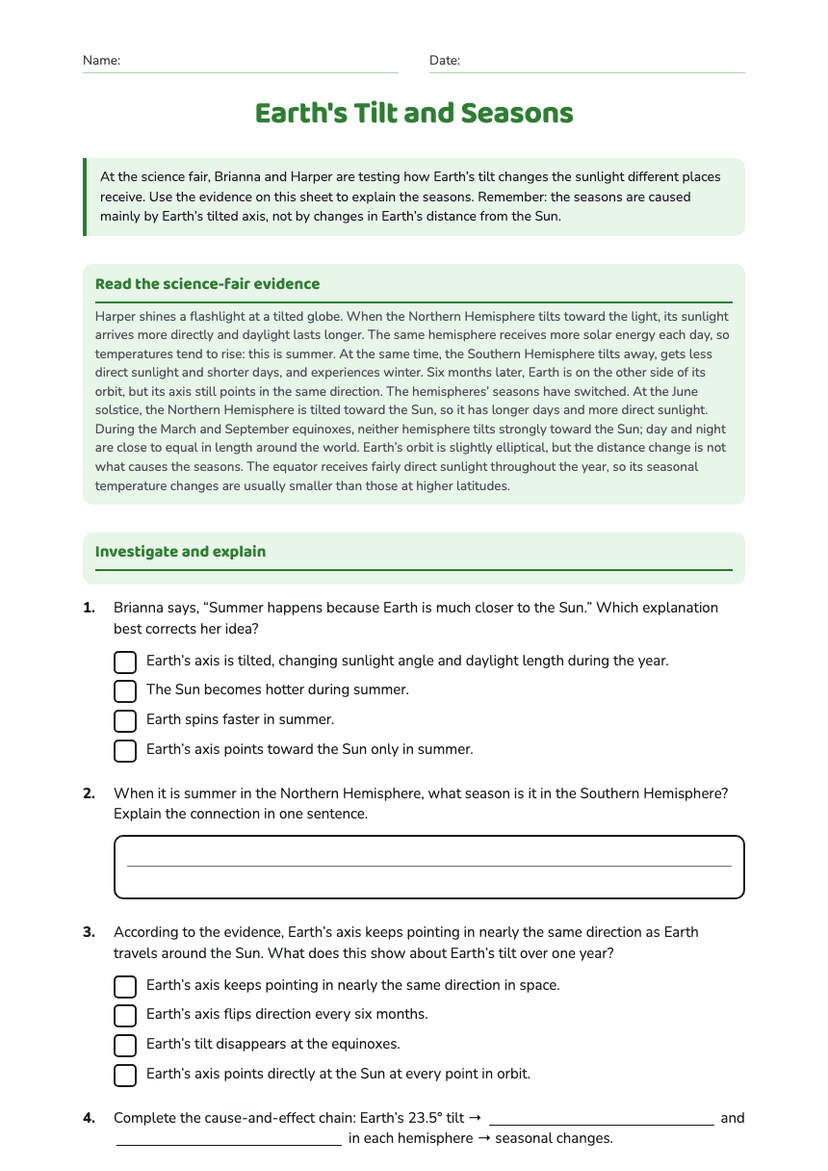
A season happens because Earth is much closer to the Sun. Agree / Disagree / Unsure
Word bank: rotate, orbit, light, shadow, day, night, tilted, reflected, evidence, model
Part 2: Follow the Procedure and Record Evidence
Procedure:
1. Place the lamp in the center. It represents the Sun. Turn it on only when your teacher says.
2. Use the globe or ball as Earth. Mark one spot with a pencil or small sticker.
3. Insert an axis if your teacher provides one. Keep the axis tilted in the same direction.
4. Day and night: Hold Earth near the lamp and slowly rotate it. Watch the marked spot move from light to shadow.
5. Seasons: Move Earth around the lamp while keeping its tilted axis pointing in the same direction. Compare the light received by each hemisphere.
6. Moon phases: Hold the small ball near Earth and move it around Earth. Keep the lamp shining on it. Observe the part that is lit and visible from Earth.
7. Record observations. Use the model as evidence, but remember that it is not to scale.
Investigation A—Day and night: We observed that the marked spot ________________________________.
This pattern is caused by Earth’s __________________________________________.
Investigation B—Seasons or tilted axis: We observed that ____________________________________________.
The tilted axis changes the angle or amount of light because __________________________.
Investigation C—Moon phases: We observed that ______________________________________________.
The Moon appears to change shape because __________________________________________.
It shows ________________________________________________________________.
It does not show ________________________________________________________.
Part 3: Explain, Revise, and Reflect
We observed ____________________. This happens because ____________________.
Our model shows ________________________________________________________.
At first, I thought ____________________. Now I think ____________________ because ____________________.
Rotation is different from revolution because __________________________________________.
One sky pattern I can explain is ____________________. One limitation of our model is ____________________.
Support for diverse learners: Rehearse an answer with a partner before writing. Use the word bank, gestures, labeled drawings, or an oral explanation. You may explain one response aloud to your teacher. Compare objects using “larger than,” “closer to,” or “farther from” if scale is difficult.
Extension challenge: Use a ruler to create a simple scale comparison for two objects or distances in the model. Explain why the model cannot represent all sizes, distances, and speeds at the same scale.
Teacher Answer Guide
1. Sun moves around Earth: disagree. Moon makes its own light: disagree; it reflects sunlight. Seasons happen because Earth is much closer to the Sun: disagree; Earth’s tilted axis changes the angle and amount of sunlight during its revolution.
2–3. Expected evidence: rotation moves a location into and out of light, causing day and night. Earth’s tilted axis and revolution create changing sunlight patterns connected to seasons. The Moon reflects sunlight; its visible sunlit portion changes as it orbits Earth.
4. Diagram should label the light source, objects, axis, lighted and shadowed sides, and motion arrows. Accept accurate variations.
5–6. Accept evidence-based responses. Common limitations include incorrect size, distance, speed, and orbit shape; the lamp may not represent the Sun’s size or the model’s scale.
7–9. Look for accurate use of rotation, revolution/orbit, axis, light source, phase, and evidence. Accept oral, drawn, or written explanations when the science is clear.
About This Worksheet
Free in Kuraplan
Sign up free, grab the PDF, and customize it for your class.
Print-Ready
Formatted for standard paper. Clean layout, easy to read.
AI-Generated
Created with Kuraplan's AI, designed for real classroom use.
For Teachers & Parents
Use in classrooms, for homework, tutoring, or homeschool.
Need a custom version of this worksheet?
Kuraplan's AI generates custom worksheets in seconds — differentiated for every learner, aligned to your curriculum.
Generate Custom Worksheets — Free