Force and Motion Investigations
A free science worksheet ready for your classroom. Open in Kuraplan to grab the print-ready PDF, customize it for your students, or generate a fresh version in seconds.
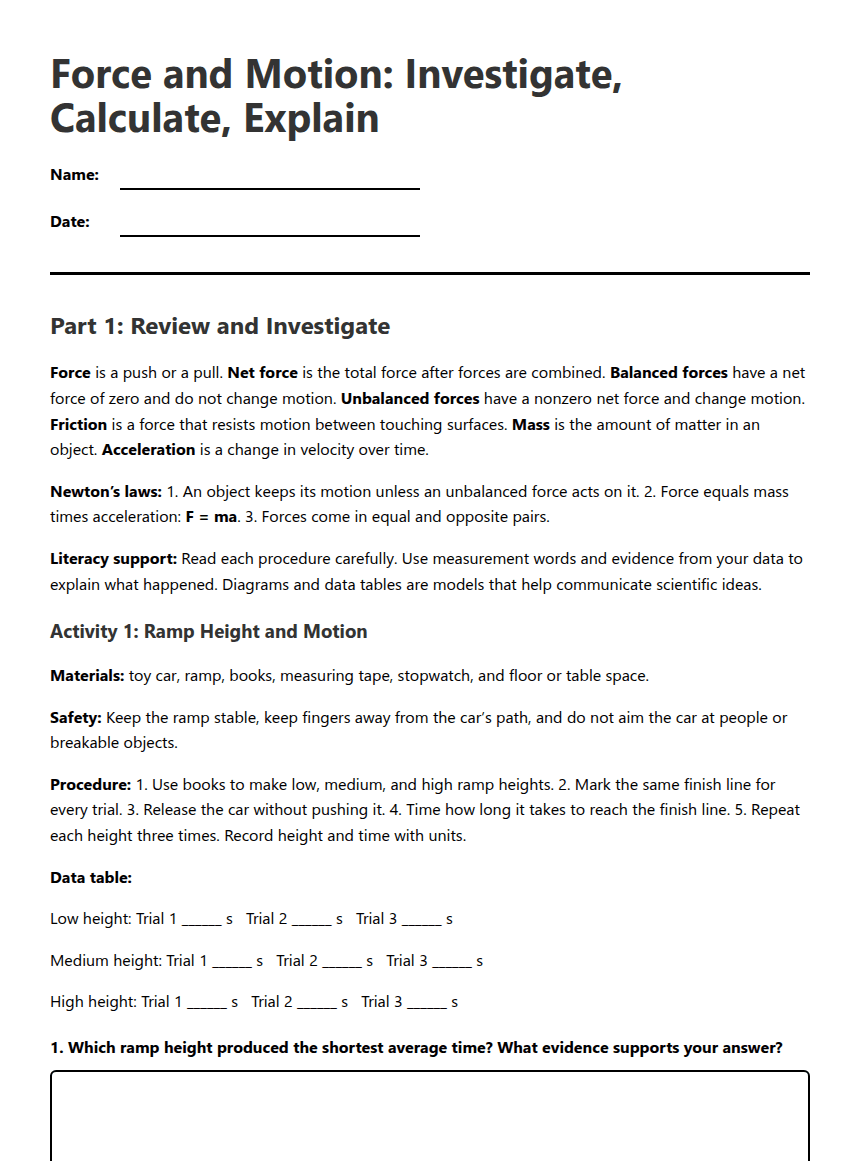
Force and Motion: Investigate, Calculate, Explain
Part 1: Review and Investigate
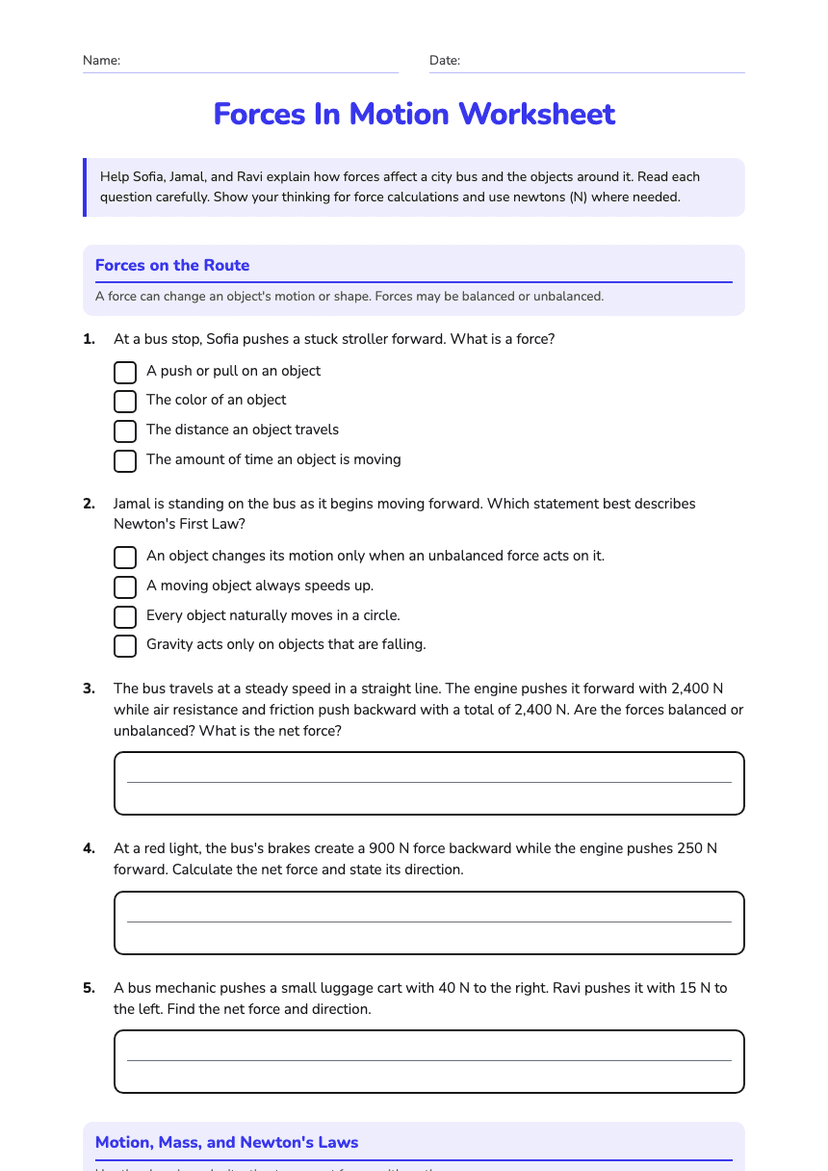
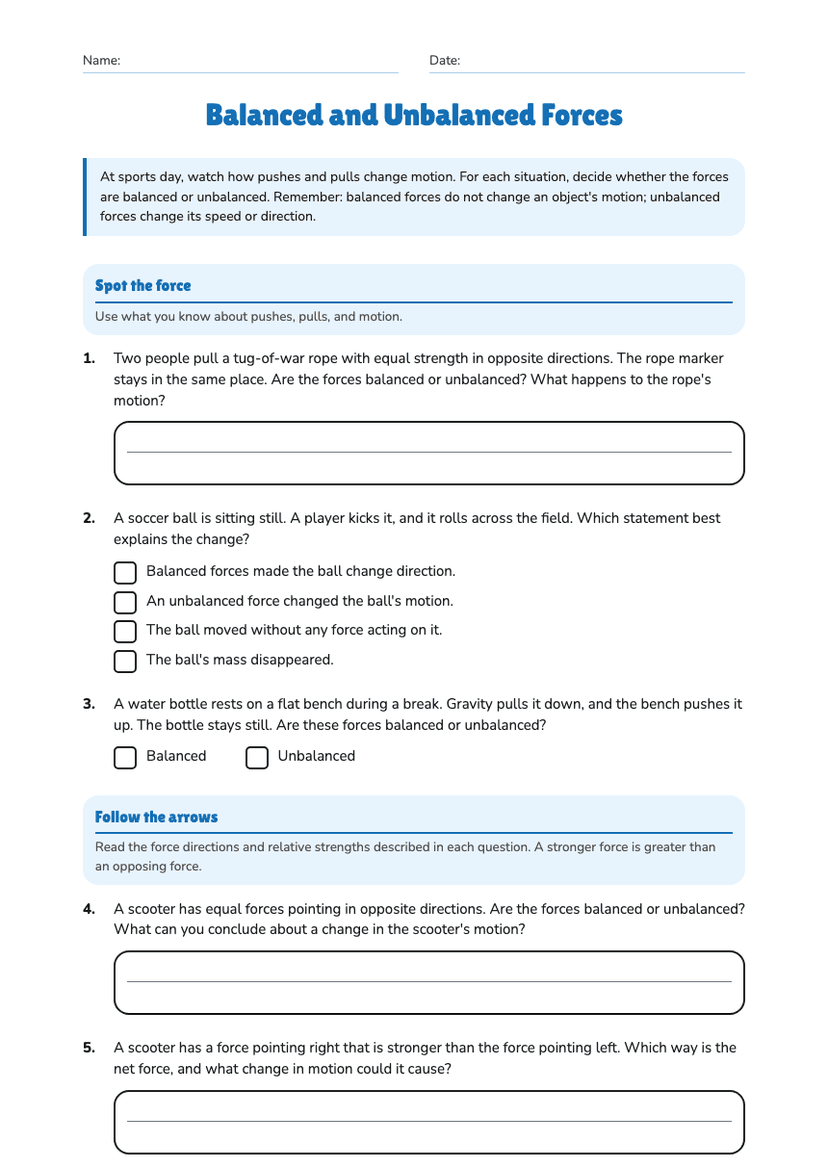
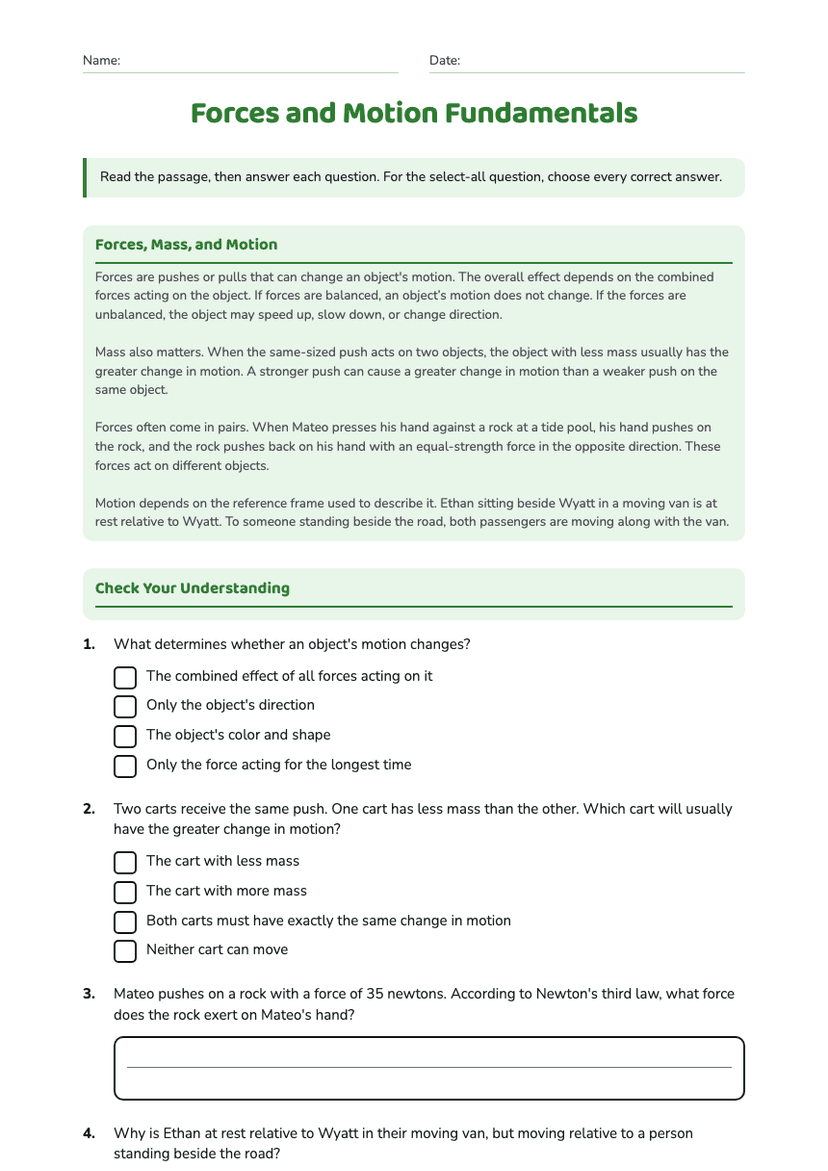
Force is a push or a pull. Net force is the total force after forces are combined. Balanced forces have a net force of zero and do not change motion. Unbalanced forces have a nonzero net force and change motion. Friction is a force that resists motion between touching surfaces. Mass is the amount of matter in an object. Acceleration is a change in velocity over time.
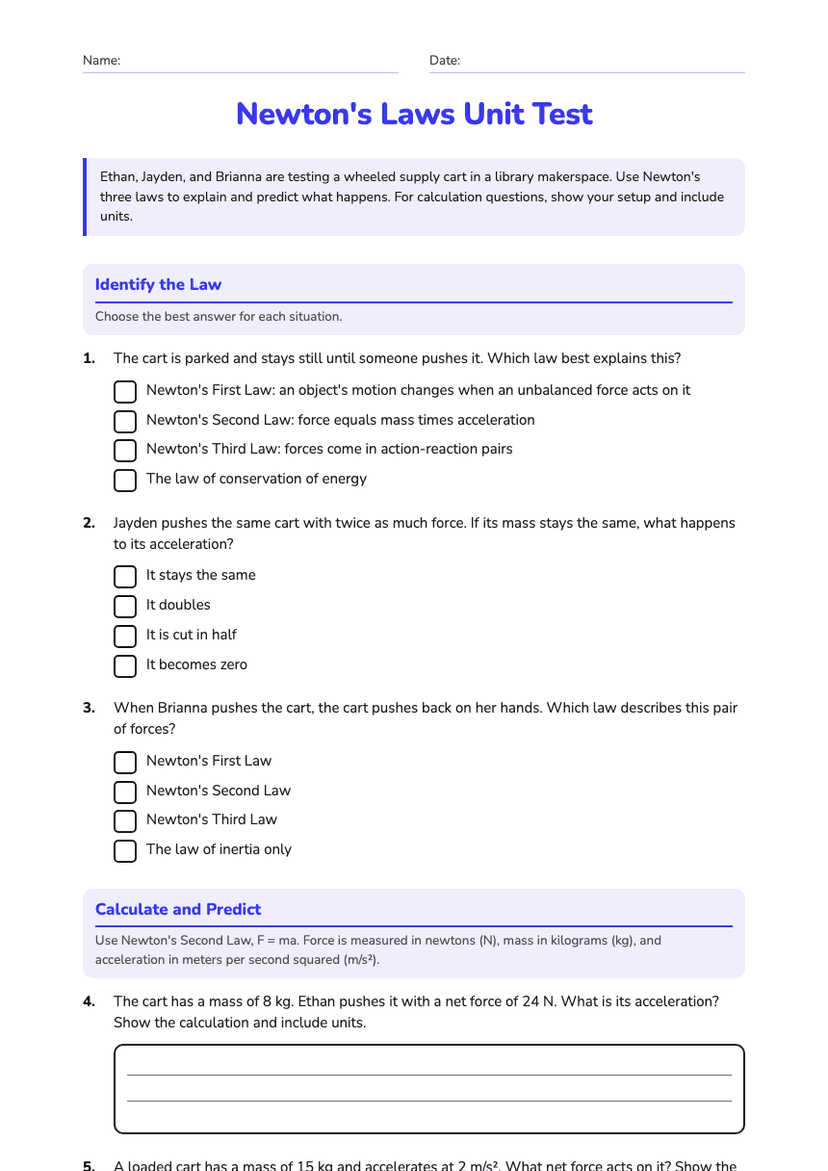
Newton’s laws: 1. An object keeps its motion unless an unbalanced force acts on it. 2. Force equals mass times acceleration: F = ma. 3. Forces come in equal and opposite pairs.
Literacy support: Read each procedure carefully. Use measurement words and evidence from your data to explain what happened. Diagrams and data tables are models that help communicate scientific ideas.
Activity 1: Ramp Height and Motion
Materials: toy car, ramp, books, measuring tape, stopwatch, and floor or table space.
Safety: Keep the ramp stable, keep fingers away from the car’s path, and do not aim the car at people or breakable objects.
Procedure: 1. Use books to make low, medium, and high ramp heights. 2. Mark the same finish line for every trial. 3. Release the car without pushing it. 4. Time how long it takes to reach the finish line. 5. Repeat each height three times. Record height and time with units.
Data table:
Low height: Trial 1 ______ s Trial 2 ______ s Trial 3 ______ s
Medium height: Trial 1 ______ s Trial 2 ______ s Trial 3 ______ s
High height: Trial 1 ______ s Trial 2 ______ s Trial 3 ______ s
Activity 2: Friction Investigation
Predict how the same toy car will move across smooth paper, cardboard, fabric, and sandpaper. Use the same starting push and measure the distance traveled.
Data table:
Smooth paper: Prediction ______ Distance ______ inches
Cardboard: Prediction ______ Distance ______ inches
Fabric: Prediction ______ Distance ______ inches
Sandpaper: Prediction ______ Distance ______ inches
Part 2: Calculate, Diagram, and Explain
Show your work, include units, and round reasonably when needed.
Exit Ticket
Teacher Answer Key
Expected Investigation Results
Activity 1: The high ramp should generally produce the shortest time and greatest speed because gravity provides a larger component of force down the ramp. Results may vary because of release, ramp surface, timing, or car differences. Distance, car, ramp surface, and release method should remain constant.
Activity 2: Smooth paper should usually allow the greatest distance. Sandpaper should usually allow the shortest distance because it creates the most friction. Cardboard and fabric should produce intermediate results. Students should support conclusions with measured distances.
Calculation Answers
4. F = ma = 4 kg × 3 m/s² = 12 N.
5. a = F ÷ m = 50 N ÷ 10 kg = 5 m/s².
6. m = F ÷ a = 36 N ÷ 6 m/s² = 6 kg.
7. F = ma = 2.5 kg × 4 m/s² = 10 N.
8. a = F ÷ m = 18 N ÷ 3 kg = 6 m/s².
9. m = F ÷ a = 80 N ÷ 2 m/s² = 40 kg.
Free-Body Diagram Answers
10: One downward arrow labeled gravity or weight. If air resistance is ignored, there is no upward force shown.
11: Upward normal force, downward gravity, rightward applied force, and leftward friction. The rightward force should be greater than friction if the box is accelerating right.
12: Upward normal force equals downward gravity. Forward driving force equals backward friction and air resistance, so the net force is zero.
Exit Ticket Answers
A: Balanced forces have zero net force and do not change motion; unbalanced forces have a nonzero net force and change motion.
B: Acceleration increases.
C: Smooth paper, because it usually produces the least friction.
D: Accept any evidence-based response, such as a higher ramp producing a shorter travel time or rougher surfaces producing shorter distances.
About This Worksheet
Free in Kuraplan
Sign up free, grab the PDF, and customize it for your class.
Print-Ready
Formatted for standard paper. Clean layout, easy to read.
AI-Generated
Created with Kuraplan's AI, designed for real classroom use.
For Teachers & Parents
Use in classrooms, for homework, tutoring, or homeschool.
Need a custom version of this worksheet?
Kuraplan's AI generates custom worksheets in seconds — differentiated for every learner, aligned to your curriculum.
Generate Custom Worksheets — Free