Circuit Design Challenge
A free science worksheet ready for your classroom. Open in Kuraplan to grab the print-ready PDF, customize it for your students, or generate a fresh version in seconds.
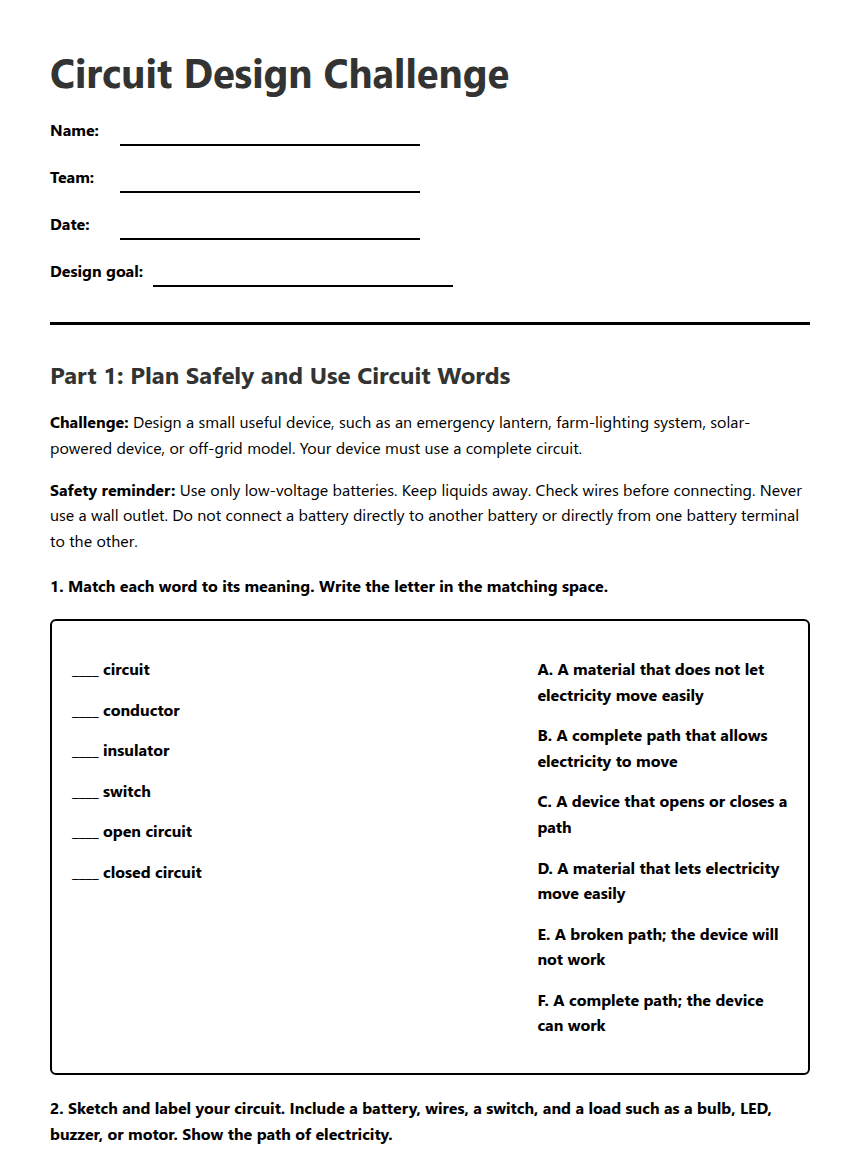
Circuit Design Challenge
Part 1: Plan Safely and Use Circuit Words
Challenge: Design a small useful device, such as an emergency lantern, farm-lighting system, solar-powered device, or off-grid model. Your device must use a complete circuit.
Safety reminder: Use only low-voltage batteries. Keep liquids away. Check wires before connecting. Never use a wall outlet. Do not connect a battery directly to another battery or directly from one battery terminal to the other.
Sentence starter: “I predict the device will __________ because __________.”
Word bank: battery, energy, path, current, load, conductor, insulator, open, closed, bright, dim, series, parallel, renewable, evidence
Success criteria: I can draw a complete circuit, label its parts, follow safety rules, and make a prediction using science words.
Part 2: Build, Test, Improve, and Explain
Team roles: builder, materials manager, recorder, and reporter. Follow the procedure in order: build, check safely, test, record, troubleshoot, improve, and retest.
Trial 1: Switch position: __________ Bulb/LED result: __________ Rating: ____
Observation or evidence: ____________________________________________________________
Trial 2: Switch position: __________ Bulb/LED result: __________ Rating: ____
Observation or evidence: ____________________________________________________________
Trial 3: Switch position: __________ Bulb/LED result: __________ Rating: ____
Observation or evidence: ____________________________________________________________
Trial 4: Switch position: __________ Bulb/LED result: __________ Rating: ____
Observation or evidence: ____________________________________________________________
Our most likely problem was ____________________. We checked it by ____________________.
Sentence starter: “We changed __________. The rating changed from ____ to ____ because __________.”
Success criteria: I can build and troubleshoot safely, record four trials, use evidence to improve my design, and explain my energy choice.
Supports: Use color-coded wires, physical circuit parts, labeled diagrams, partner talk, gestures, or an oral explanation before writing. Ask a partner: “What changed?” and “What evidence do you see?”
Optional challenge: Compare series and parallel circuits, measure operating time or brightness, or recommend an energy system for a remote farm. Include the energy demand, one safety concern, and evidence for your recommendation.
Science reading and recording connection: Follow the steps in order and explain cause and effect (CCSS.ELA-LITERACY.RST.6-8.3). Use your labeled diagram and test records as technical information (CCSS.ELA-LITERACY.RST.6-8.7).
Teacher Answer Key—Final Page
1. Vocabulary: circuit—B; conductor—D; insulator—A; switch—C; open circuit—E; closed circuit—F.
2. Circuit sketch: Accept any clearly labeled complete circuit showing a battery or other power source, a conducting path, a switch, and a load. Wires should connect the parts in one continuous path. Series or parallel designs may be accepted when appropriate.
3. Materials: Answers depend on the planned design. Safe choices include a low-voltage battery, insulated wires, switch, load, and approved test materials.
4. Prediction: Look for the idea that closing the switch completes the path, allowing electrical energy to transfer to the load. Example: “The LED will light because the closed circuit gives current a complete path.”
5. Testing: Students should record four trials with switch position, bulb or LED result, rating, and observations. Accept varied results when they are recorded honestly and explained with evidence.
6. Troubleshooting: Appropriate checks include a broken path, loose connection, reversed LED, dead or disconnected battery, missing component, or incorrect switch position. Students should identify a check and explain what they found.
7–9. Improvement and reflection: Strong responses name a specific change, compare evidence from before and after, and explain whether the prediction was supported. Energy choices should include a reasonable benefit and limitation. Solar and hydroelectric power are renewable; generators commonly use limited fuels but can provide power when sunlight or grid power is unavailable.
Assessment look-fors: complete and labeled circuit; safe low-voltage equipment use; accurate vocabulary; organized trial records; evidence-based troubleshooting; purposeful improvement; and a clear energy recommendation.
About This Worksheet
Free in Kuraplan
Sign up free, grab the PDF, and customize it for your class.
Print-Ready
Formatted for standard paper. Clean layout, easy to read.
AI-Generated
Created with Kuraplan's AI, designed for real classroom use.
For Teachers & Parents
Use in classrooms, for homework, tutoring, or homeschool.
Need a custom version of this worksheet?
Kuraplan's AI generates custom worksheets in seconds — differentiated for every learner, aligned to your curriculum.
Generate Custom Worksheets — FreeMore Science Worksheets
AC and DC Electricity
Free
Understanding Electric Circuits
Free
Simple Electric Circuits
Free
School Design Basics Worksheet
Free
Solar System Vehicle Design
Free
Genetic Experiment Design Worksheet
Free
Theatre Designer Worksheet
Free