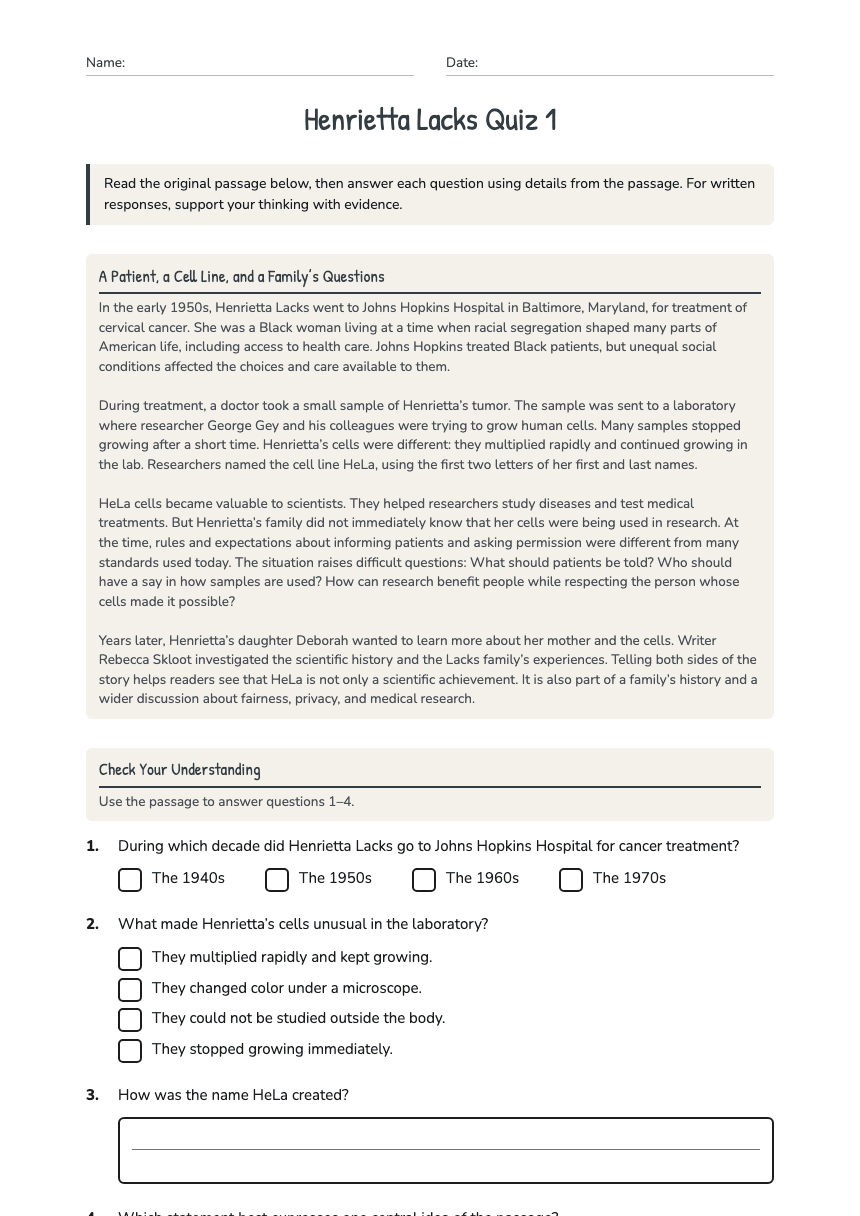
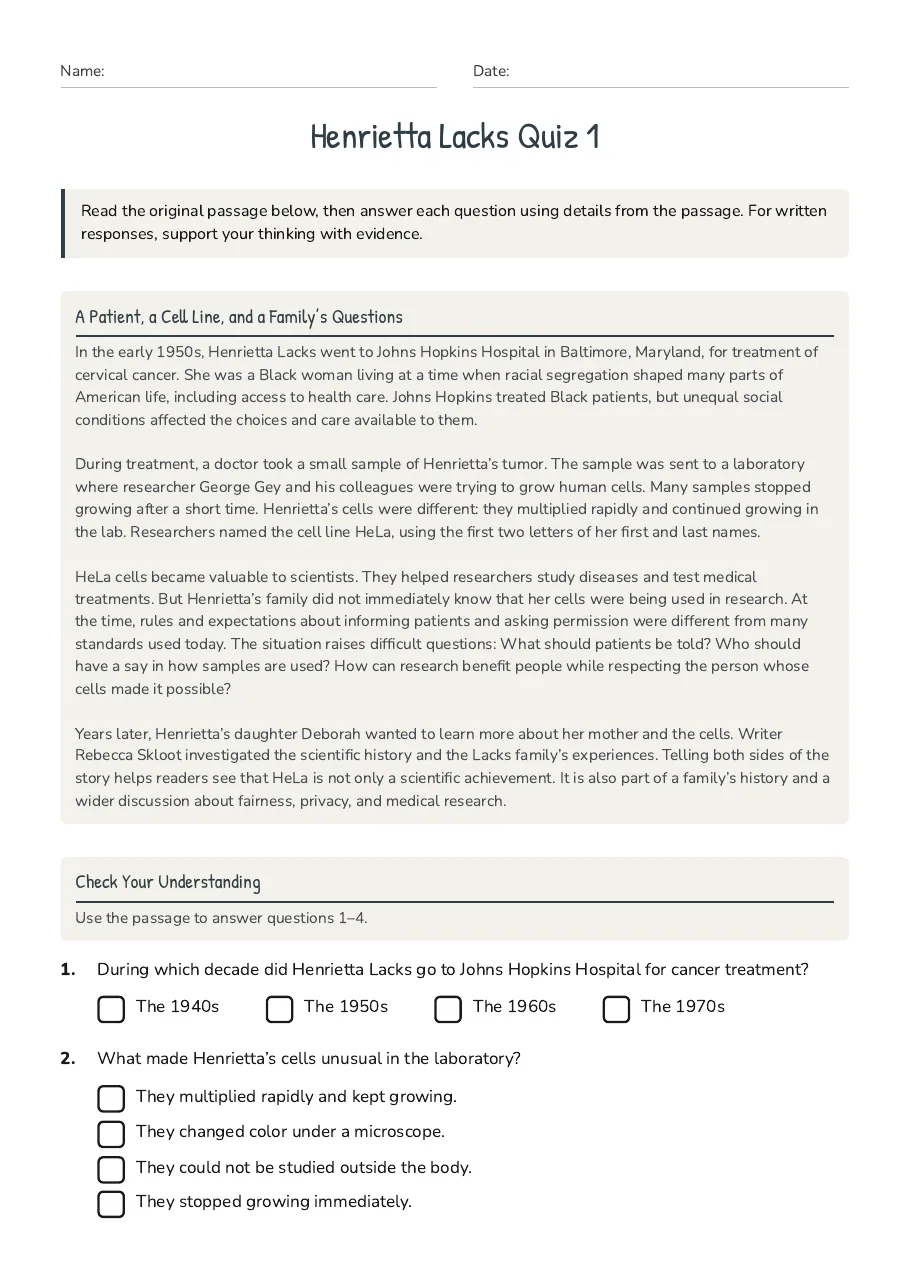
Henrietta Lacks Quiz 1
A free english (ela) worksheet ready for your classroom. Open in Kuraplan to grab the print-ready PDF, customize it for your students, or generate a fresh version in seconds.
Henrietta Lacks Quiz 1
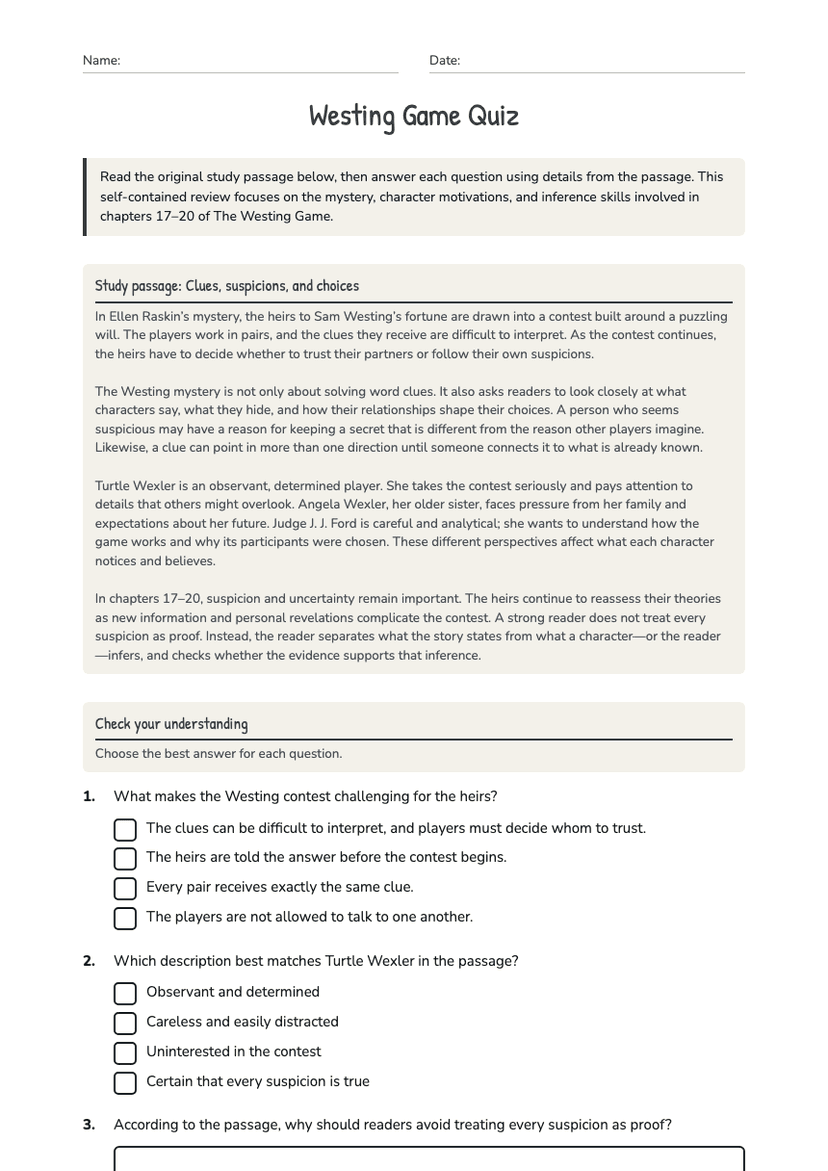
A Patient, a Cell Line, and a Family’s Questions
In the early 1950s, Henrietta Lacks went to Johns Hopkins Hospital in Baltimore, Maryland, for treatment of cervical cancer. She was a Black woman living at a time when racial segregation shaped many parts of American life, including access to health care. Johns Hopkins treated Black patients, but unequal social conditions affected the choices and care available to them. During treatment, a doctor took a small sample of Henrietta’s tumor. The sample was sent to a laboratory where researcher George Gey and his colleagues were trying to grow human cells. Many samples stopped growing after a short time. Henrietta’s cells were different: they multiplied rapidly and continued growing in the lab. Researchers named the cell line HeLa, using the first two letters of her first and last names. HeLa cells became valuable to scientists. They helped researchers study diseases and test medical treatments. But Henrietta’s family did not immediately know that her cells were being used in research. At the time, rules and expectations about informing patients and asking permission were different from many standards used today. The situation raises difficult questions: What should patients be told? Who should have a say in how samples are used? How can research benefit people while respecting the person whose cells made it possible? Years later, Henrietta’s daughter Deborah wanted to learn more about her mother and the cells. Writer Rebecca Skloot investigated the scientific history and the Lacks family’s experiences. Telling both sides of the story helps readers see that HeLa is not only a scientific achievement. It is also part of a family’s history and a wider discussion about fairness, privacy, and medical research.
Check Your Understanding
Use the passage to answer questions 1–4.
- The 1940s
- The 1950s
- The 1960s
- The 1970s
- They multiplied rapidly and kept growing.
- They changed color under a microscope.
- They could not be studied outside the body.
- They stopped growing immediately.
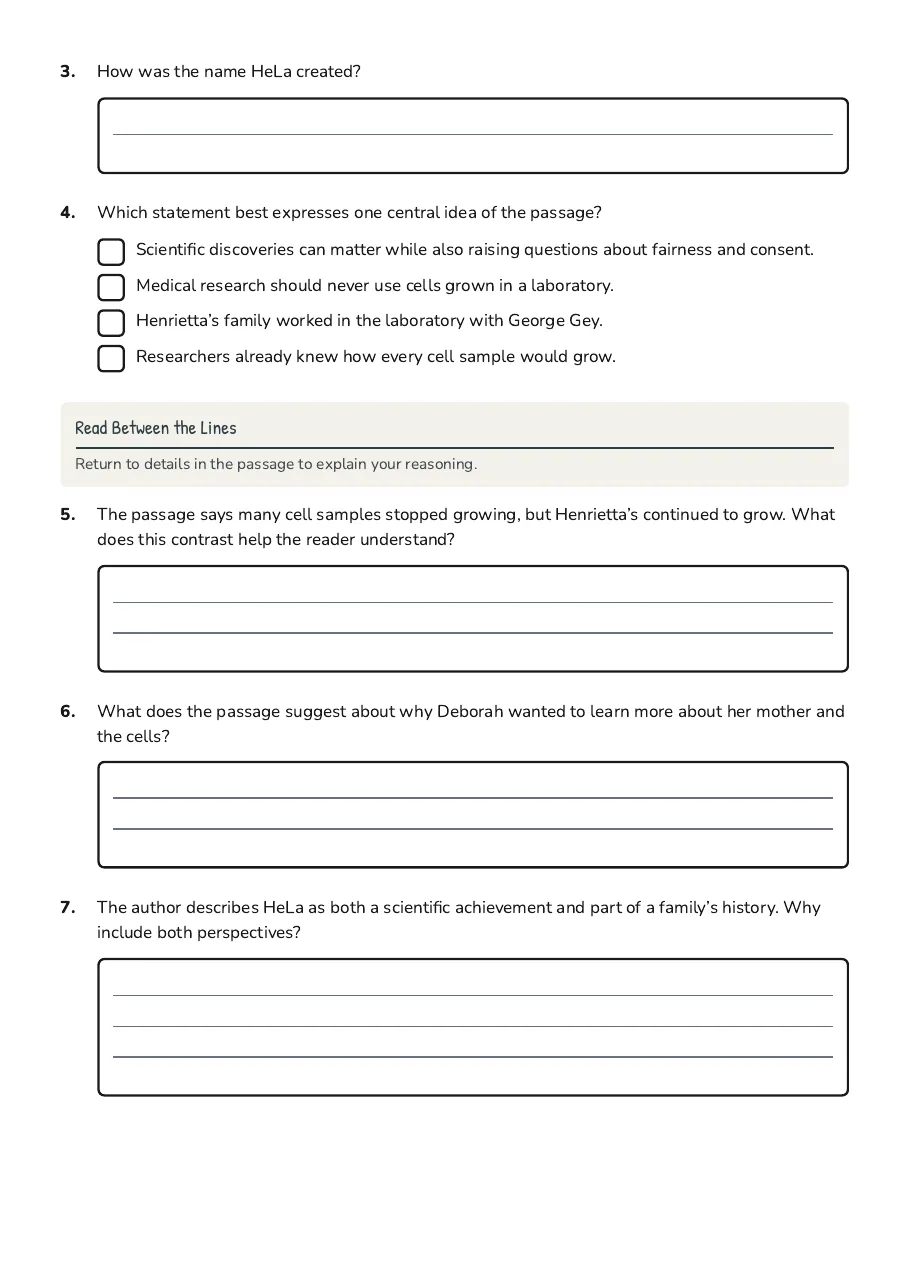
- Scientific discoveries can matter while also raising questions about fairness and consent.
- Medical research should never use cells grown in a laboratory.
- Henrietta’s family worked in the laboratory with George Gey.
- Researchers already knew how every cell sample would grow.
Read Between the Lines
Return to details in the passage to explain your reasoning.
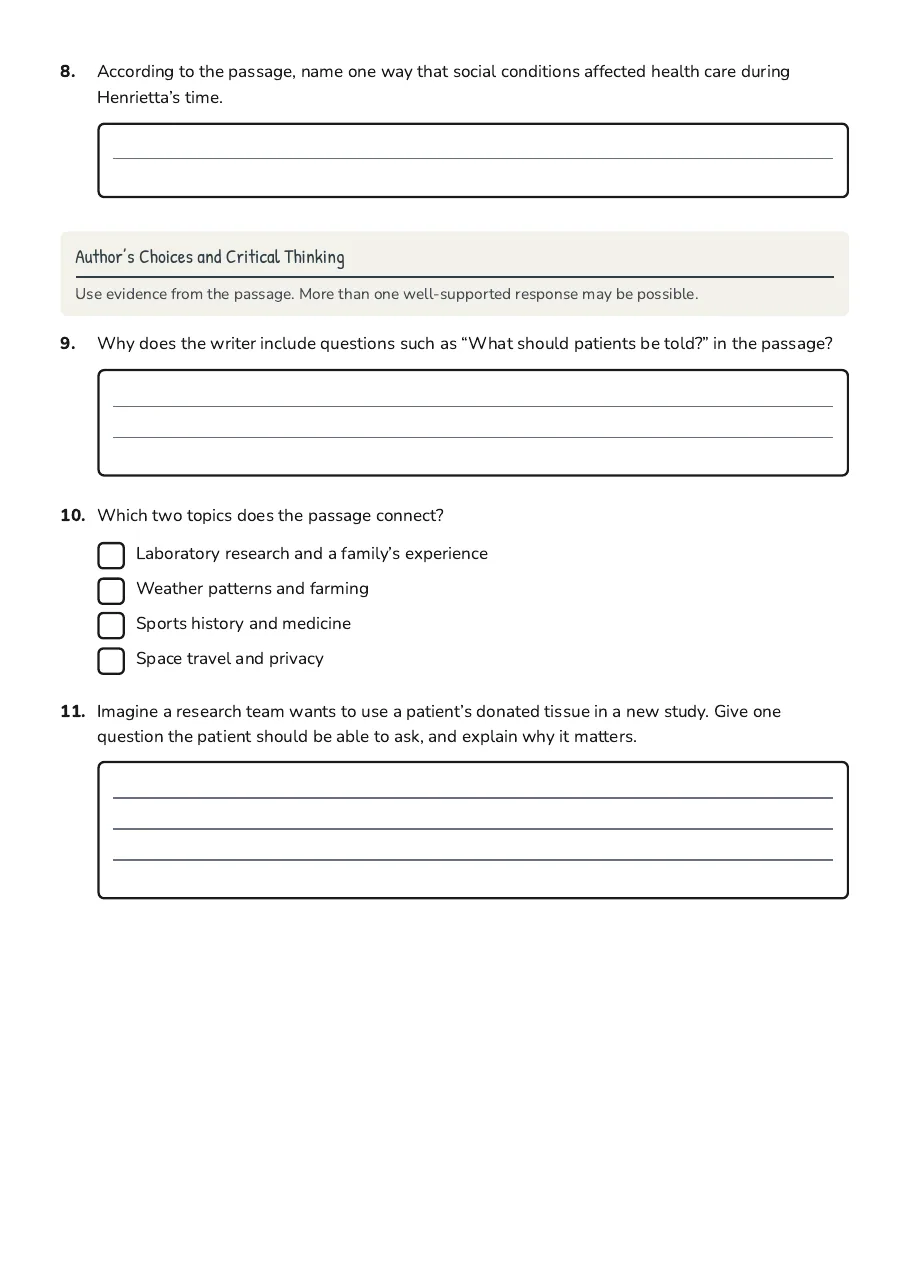
Author’s Choices and Critical Thinking
Use evidence from the passage. More than one well-supported response may be possible.
- Laboratory research and a family’s experience
- Weather patterns and farming
- Sports history and medicine
- Space travel and privacy
3 printable pages
Page 1
Page 2
Page 3
About This Worksheet
Free in Kuraplan
Sign up free, grab the PDF, and customize it for your class.
Print-Ready
Formatted for standard paper. Clean layout, easy to read.
AI-Generated
Created with Kuraplan's AI, designed for real classroom use.
For Teachers & Parents
Use in classrooms, for homework, tutoring, or homeschool.
Need a custom version of this worksheet?
Kuraplan's AI generates custom worksheets in seconds — differentiated for every learner, aligned to your curriculum.
Generate Custom Worksheets — Free