ScienceFreePrintable

Matter and Multiplication Integration

A free science worksheet ready for your classroom. Open in Kuraplan to grab the print-ready PDF, customize it for your students, or generate a fresh version in seconds.
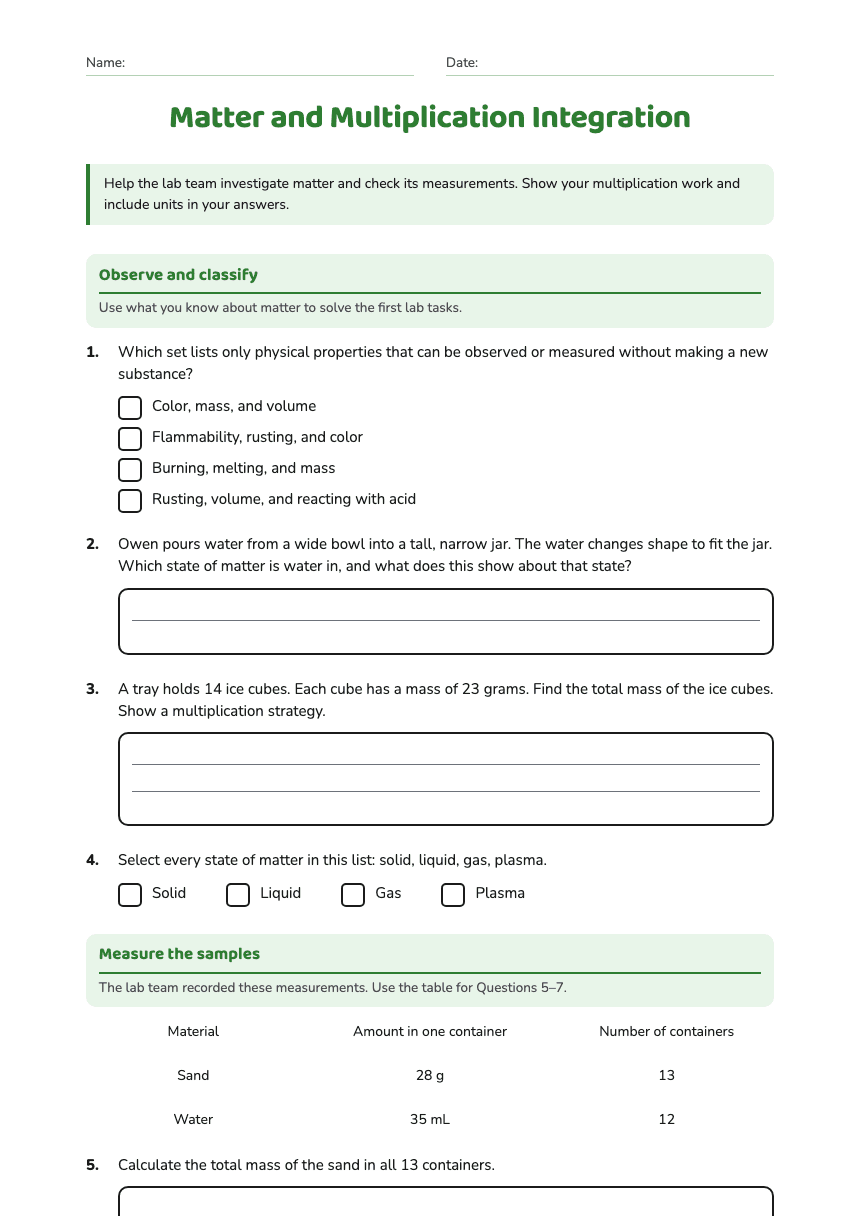
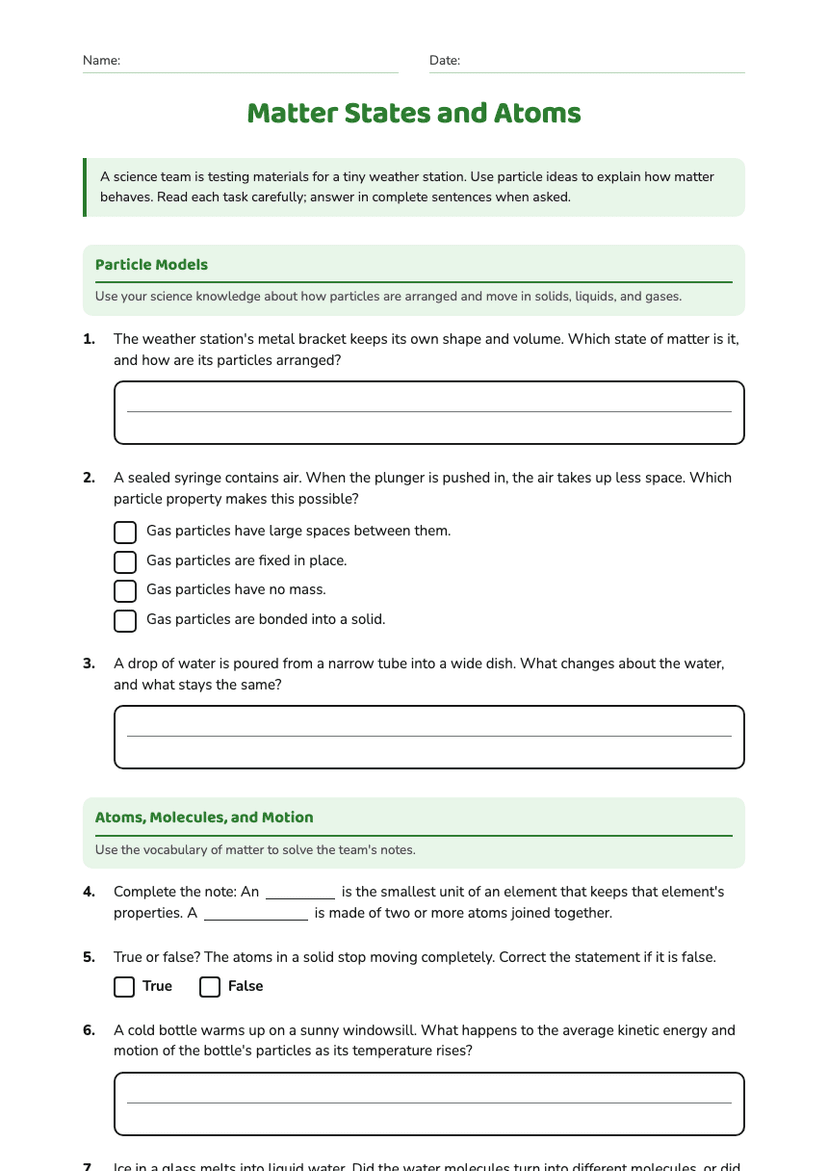
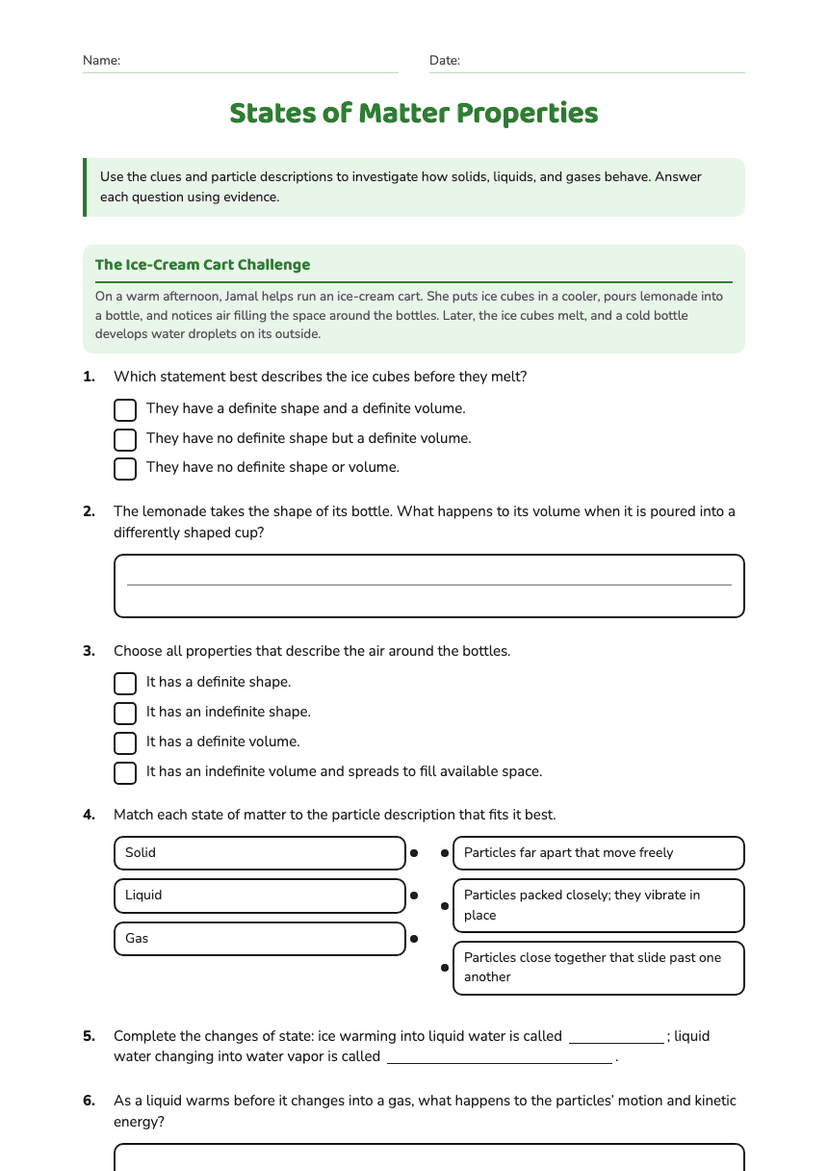
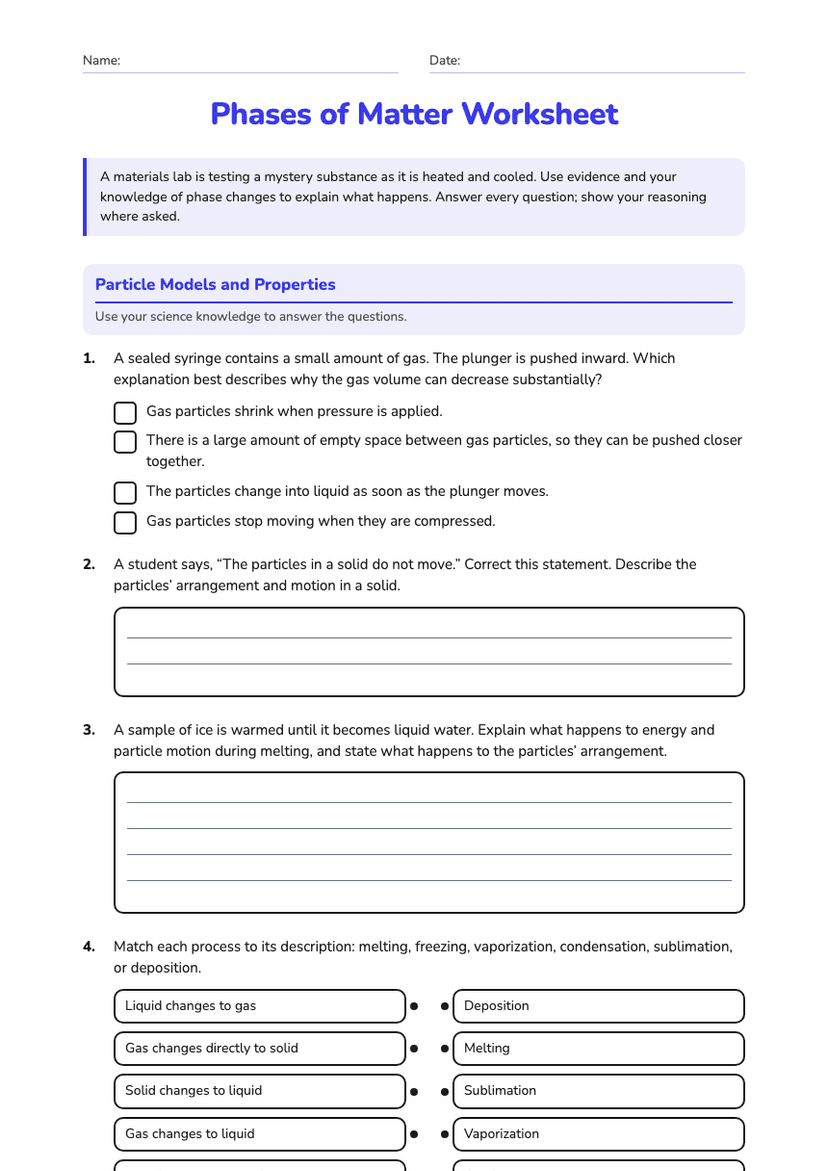
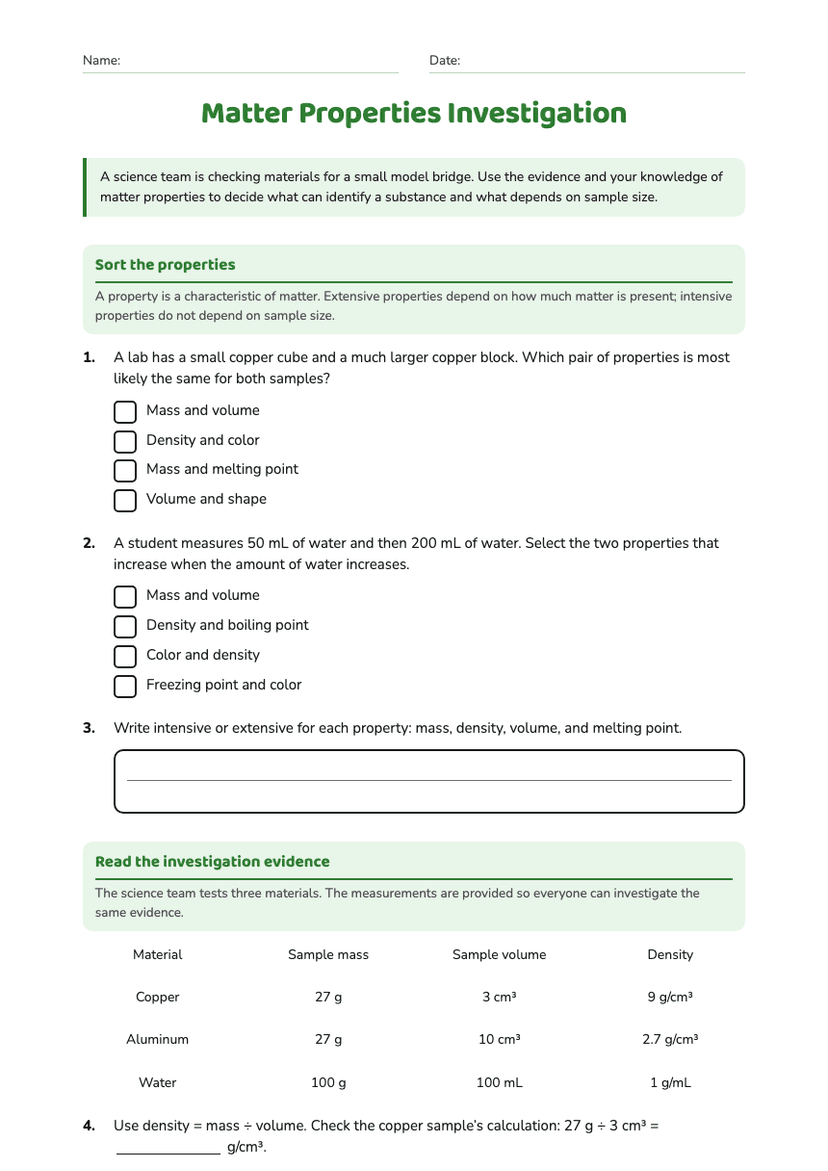
Matter and Multiplication Integration worksheet preview
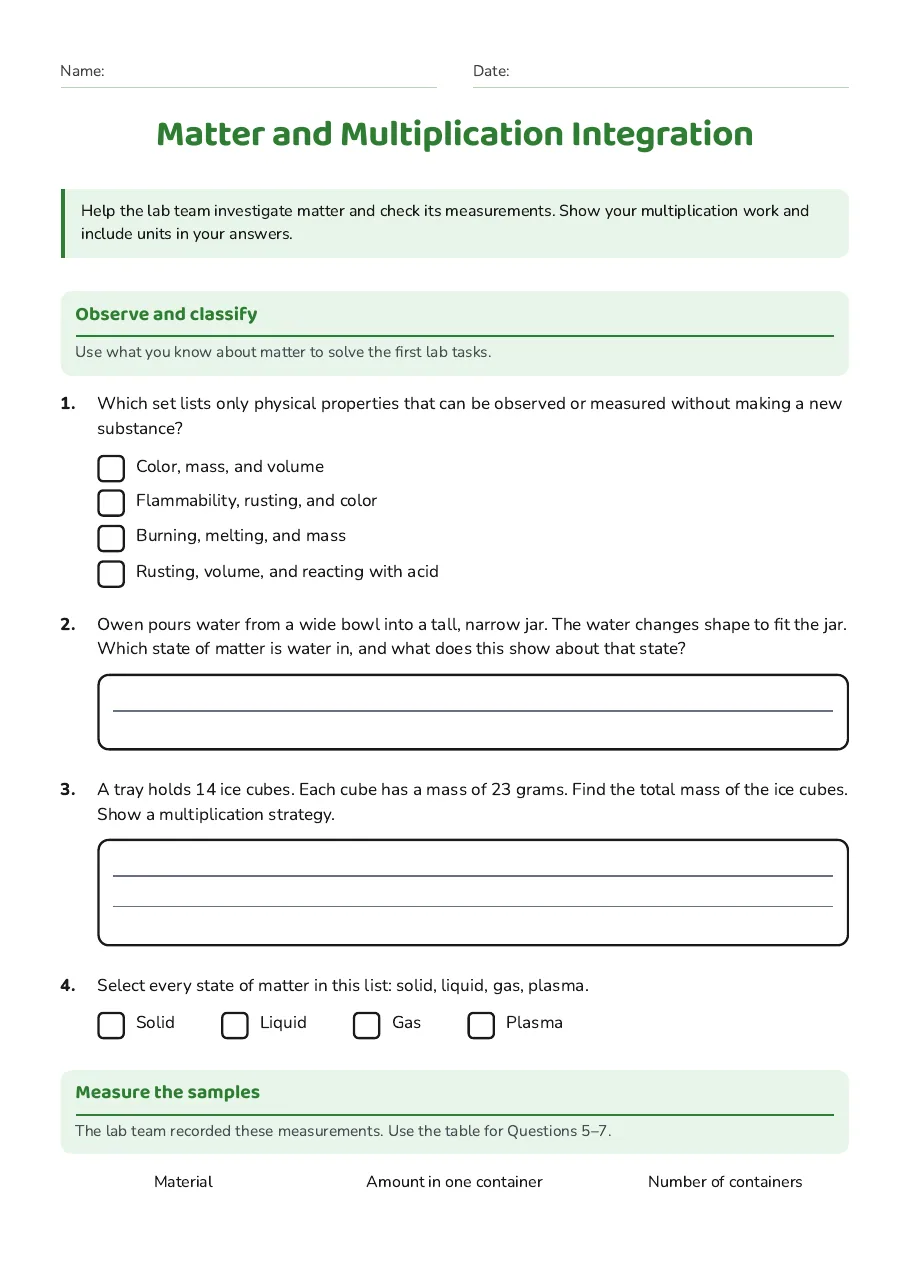
Name:Date:

Matter and Multiplication Integration

Help the lab team investigate matter and check its measurements. Show your multiplication work and include units in your answers.

Observe and classify

Use what you know about matter to solve the first lab tasks.

1.Which set lists only physical properties that can be observed or measured without making a new substance?
  • Color, mass, and volume
  • Flammability, rusting, and color
  • Burning, melting, and mass
  • Rusting, volume, and reacting with acid
2.Owen pours water from a wide bowl into a tall, narrow jar. The water changes shape to fit the jar. Which state of matter is water in, and what does this show about that state?
3.A tray holds 14 ice cubes. Each cube has a mass of 23 grams. Find the total mass of the ice cubes. Show a multiplication strategy.
4.Select every state of matter in this list: solid, liquid, gas, plasma.
  • Solid
  • Liquid
  • Gas
  • Plasma

Measure the samples

The lab team recorded these measurements. Use the table for Questions 5–7.

Material

Amount in one container

Number of containers

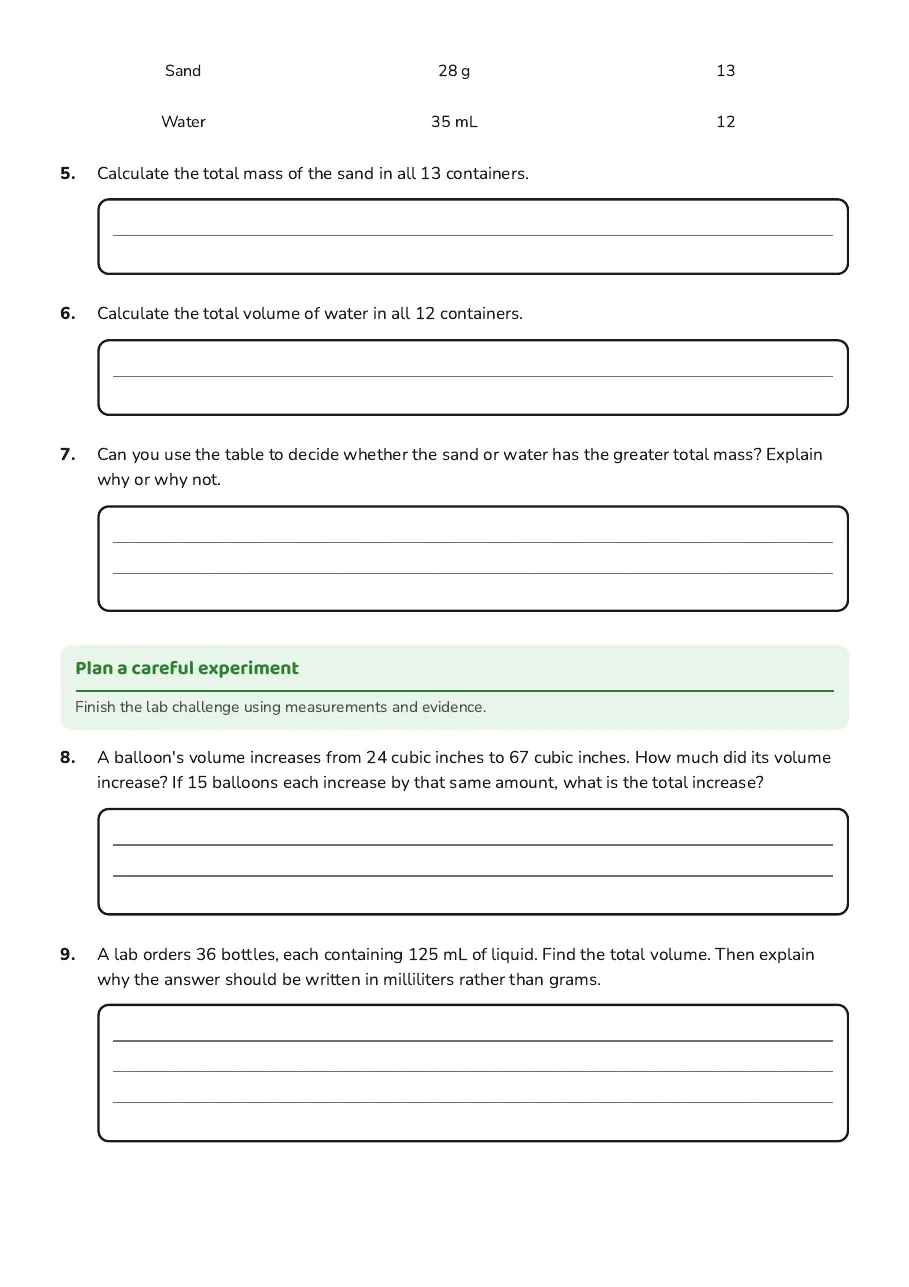
Sand

28 g

13

Water

35 mL

12

5.Calculate the total mass of the sand in all 13 containers.
6.Calculate the total volume of water in all 12 containers.
7.Can you use the table to decide whether the sand or water has the greater total mass? Explain why or why not.

Plan a careful experiment

Finish the lab challenge using measurements and evidence.

8.A balloon's volume increases from 24 cubic inches to 67 cubic inches. How much did its volume increase? If 15 balloons each increase by that same amount, what is the total increase?
9.A lab orders 36 bottles, each containing 125 mL of liquid. Find the total volume. Then explain why the answer should be written in milliliters rather than grams.
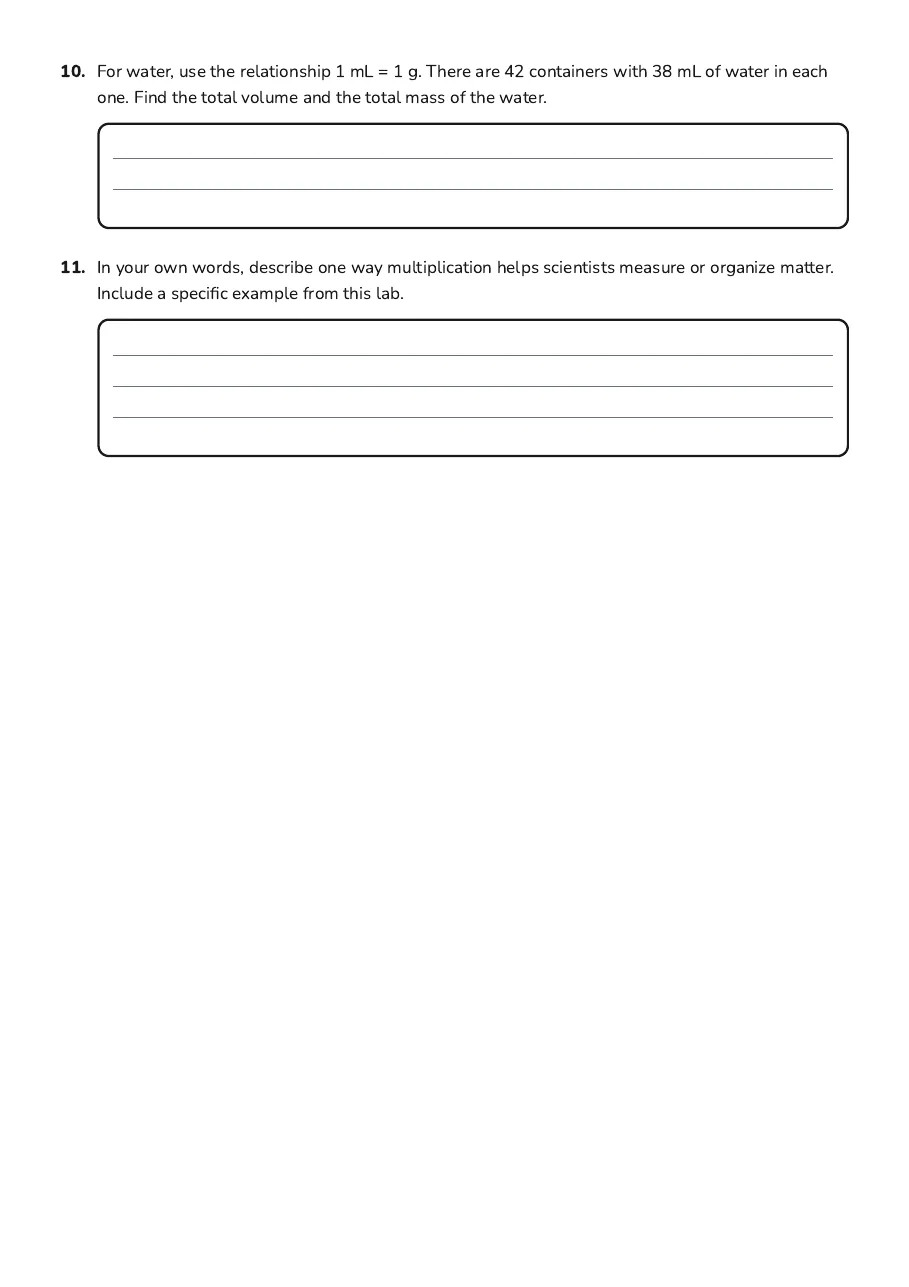
10.For water, use the relationship 1 mL = 1 g. There are 42 containers with 38 mL of water in each one. Find the total volume and the total mass of the water.
11.In your own words, describe one way multiplication helps scientists measure or organize matter. Include a specific example from this lab.

3 printable pages

  • Matter and Multiplication Integration, page 1 of 3: Observe and classify, Measure the samples

    Page 1

  • Matter and Multiplication Integration, page 2 of 3: Plan a careful experiment

    Page 2

  • Matter and Multiplication Integration, page 3 of 3: 10. For water, use the relationship 1 mL = 1 g. There are 42 containers with 38 mL of…

    Page 3

About This Worksheet

Free in Kuraplan

Sign up free, grab the PDF, and customize it for your class.

Print-Ready

Formatted for standard paper. Clean layout, easy to read.

AI-Generated

Created with Kuraplan's AI, designed for real classroom use.

For Teachers & Parents

Use in classrooms, for homework, tutoring, or homeschool.

Need a custom version of this worksheet?

Kuraplan's AI generates custom worksheets in seconds — differentiated for every learner, aligned to your curriculum.

Generate Custom Worksheets — Free
No credit card Curriculum-aligned Under 60 seconds