Matter Changes and Mixtures
A free science worksheet ready for your classroom. Open in Kuraplan to grab the print-ready PDF, customize it for your students, or generate a fresh version in seconds.
Matter Changes and Mixtures
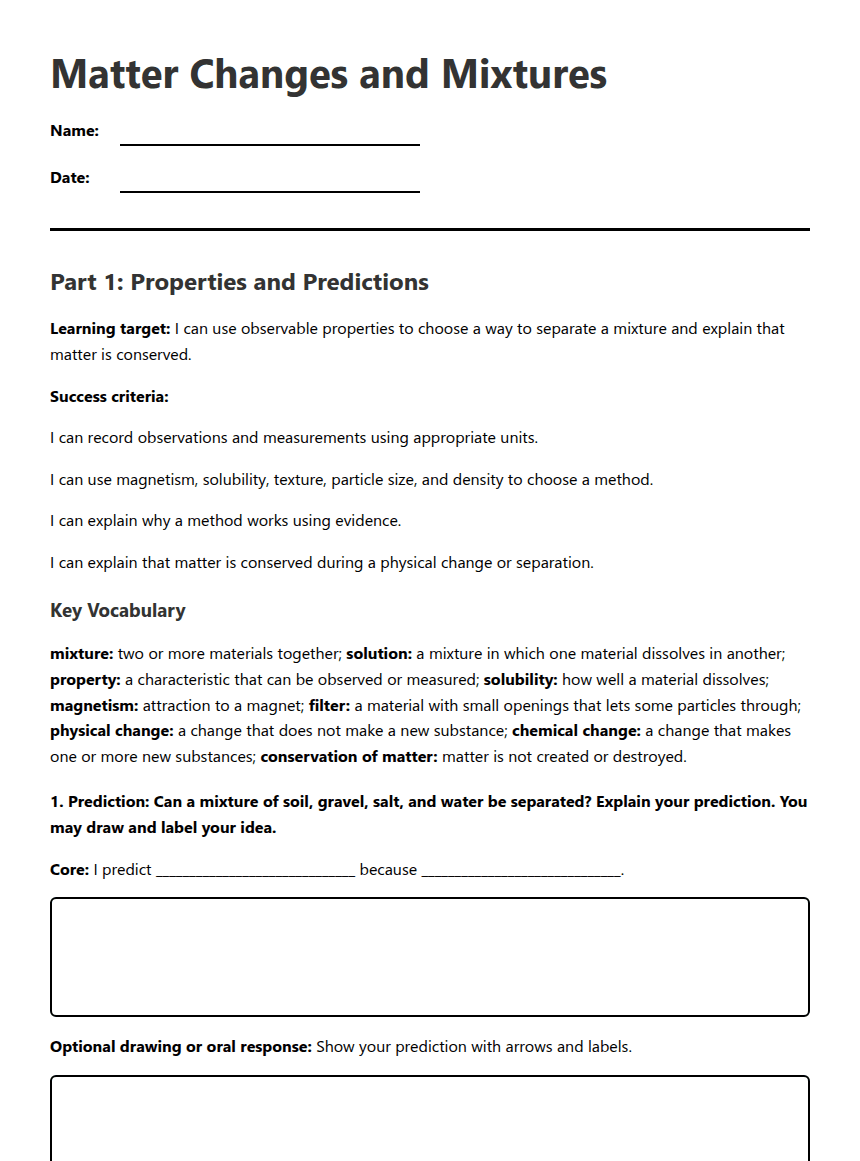
Part 1: Properties and Predictions
Learning target: I can use observable properties to choose a way to separate a mixture and explain that matter is conserved.
Success criteria:
I can record observations and measurements using appropriate units.
I can use magnetism, solubility, texture, particle size, and density to choose a method.
I can explain why a method works using evidence.
I can explain that matter is conserved during a physical change or separation.
Key Vocabulary
mixture: two or more materials together; solution: a mixture in which one material dissolves in another; property: a characteristic that can be observed or measured; solubility: how well a material dissolves; magnetism: attraction to a magnet; filter: a material with small openings that lets some particles through; physical change: a change that does not make a new substance; chemical change: a change that makes one or more new substances; conservation of matter: matter is not created or destroyed.
Core: I predict ______________________________ because ______________________________.
Optional drawing or oral response: Show your prediction with arrows and labels.
Challenge: Explain why one method would not work for salt dissolved in water.
Part 2: Plan, Observe, and Explain
Safety: Follow your teacher’s directions. Do not heat materials yourself. Evaporation may be demonstrated safely by the teacher.
Planning record columns: Step | Method | Material removed or separated | Property used | Prediction
1. ______________ | ______________ | ______________ | ______________ | ______________
2. ______________ | ______________ | ______________ | ______________ | ______________
3. ______________ | ______________ | ______________ | ______________ | ______________
4. ______________ | ______________ | ______________ | ______________ | ______________
Results columns: Step or material | Observation | Measurement and unit | What remained?
1. ______________ | ______________ | ______________ | ______________
2. ______________ | ______________ | ______________ | ______________
3. ______________ | ______________ | ______________ | ______________
4. ______________ | ______________ | ______________ | ______________
My order is: ____________________________________________________________
Core sentence frame: First, I would __________ because __________. Then, I would __________ because __________.
Challenge: Explain how changing the order might affect the results.
Filtering: ____________________ Dissolving: ____________________
Evaporation: ____________________ Rusting: ____________________
Burning: ____________________
How do you know? A physical change ______________________________. A chemical change ______________________________.
Before evaporation: salt in water
After evaporation: salt recovered
Sentence frames: The most useful method was __________. It worked because the mixture had the property __________. My evidence is __________. The matter was conserved because __________.
Oral/drawing support: Tell your explanation to a partner or draw the method with labels.
Support and Extension
Support: Use the vocabulary box, labeled equipment, a partner, a completed example, speech-to-text, drawing, or an oral response. You may record fewer measurements with teacher approval.
Extension: Calculate the percentage of material recovered, justify the most efficient sequence, or compare this separation process with water treatment.
Teacher Answer Key
1. Yes. The materials have different properties, so physical methods can separate them. Answers may vary if supported by reasoning.
2. A: A material is pulled toward a magnet. B: A material dissolves in water. C: Large, rough pieces can be sorted or screened. D: A heavier material sinks to the bottom.
3. Use a magnet; filter; evaporate the water. Filtering does not remove dissolved salt because the salt particles pass through the filter with the water.
4–5. Answers depend on the investigation. Look for a logical method, the correct property, observations, and units such as grams (g), milliliters (mL), centimeters (cm), or degrees Fahrenheit (°F) when appropriate.
6. A sensible order is sorting, settling and decanting, filtering, and evaporation. Accept other orders when the student gives sound evidence. Evaporation is last if the goal is to recover salt.
7. Filtering—physical; dissolving—physical; evaporation—physical; rusting—chemical; burning—chemical. Physical changes do not create a new substance. Chemical changes create one or more new substances.
8. Before evaporation, salt particles should be shown spread throughout the water. After evaporation, salt particles should be shown together as solid salt. The particles still exist.
9. Answers vary. Strong responses name a method and property and use an observation or measurement as evidence. They explain that separating or changing matter does not destroy it.
10. Filtering is a physical change because no new substance is made; materials are separated by particle size.
About This Worksheet
Free in Kuraplan
Sign up free, grab the PDF, and customize it for your class.
Print-Ready
Formatted for standard paper. Clean layout, easy to read.
AI-Generated
Created with Kuraplan's AI, designed for real classroom use.
For Teachers & Parents
Use in classrooms, for homework, tutoring, or homeschool.
Need a custom version of this worksheet?
Kuraplan's AI generates custom worksheets in seconds — differentiated for every learner, aligned to your curriculum.
Generate Custom Worksheets — FreeMore Science Worksheets
Changes Cut and Paste
Free
Matter States and Atoms
Free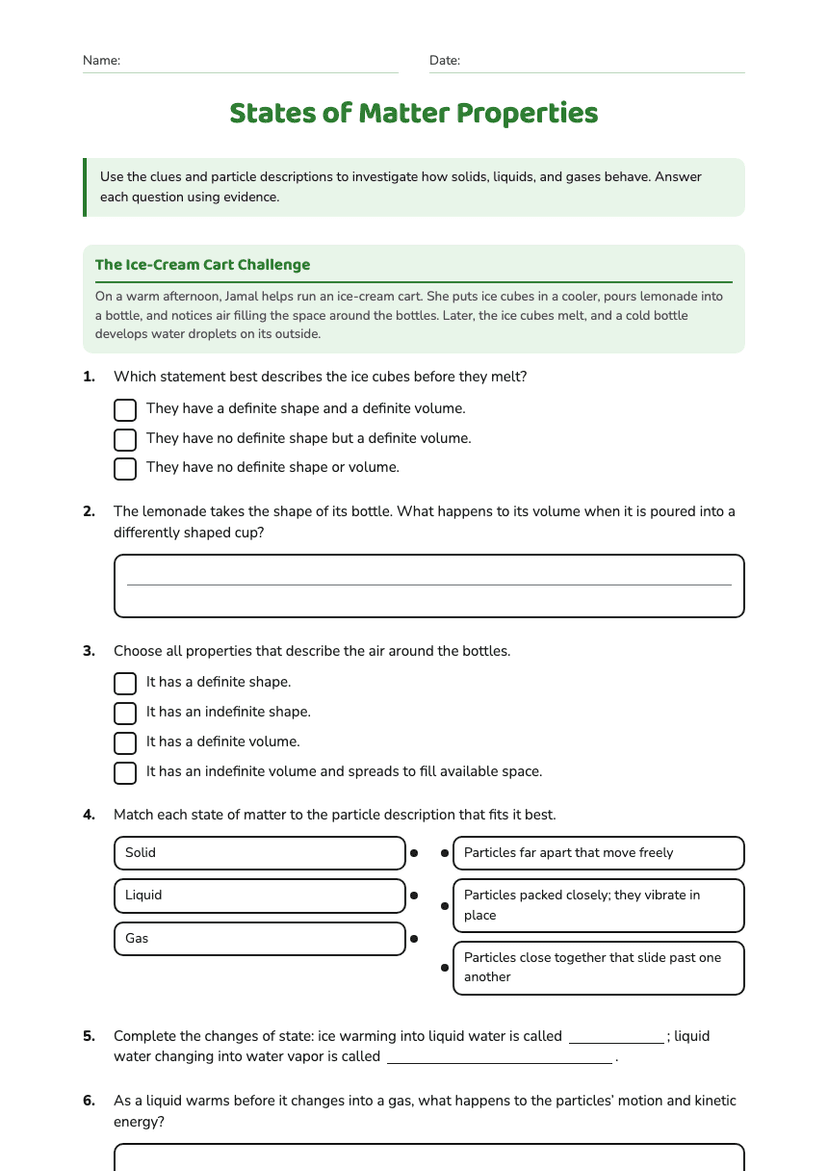
States of Matter Properties
Free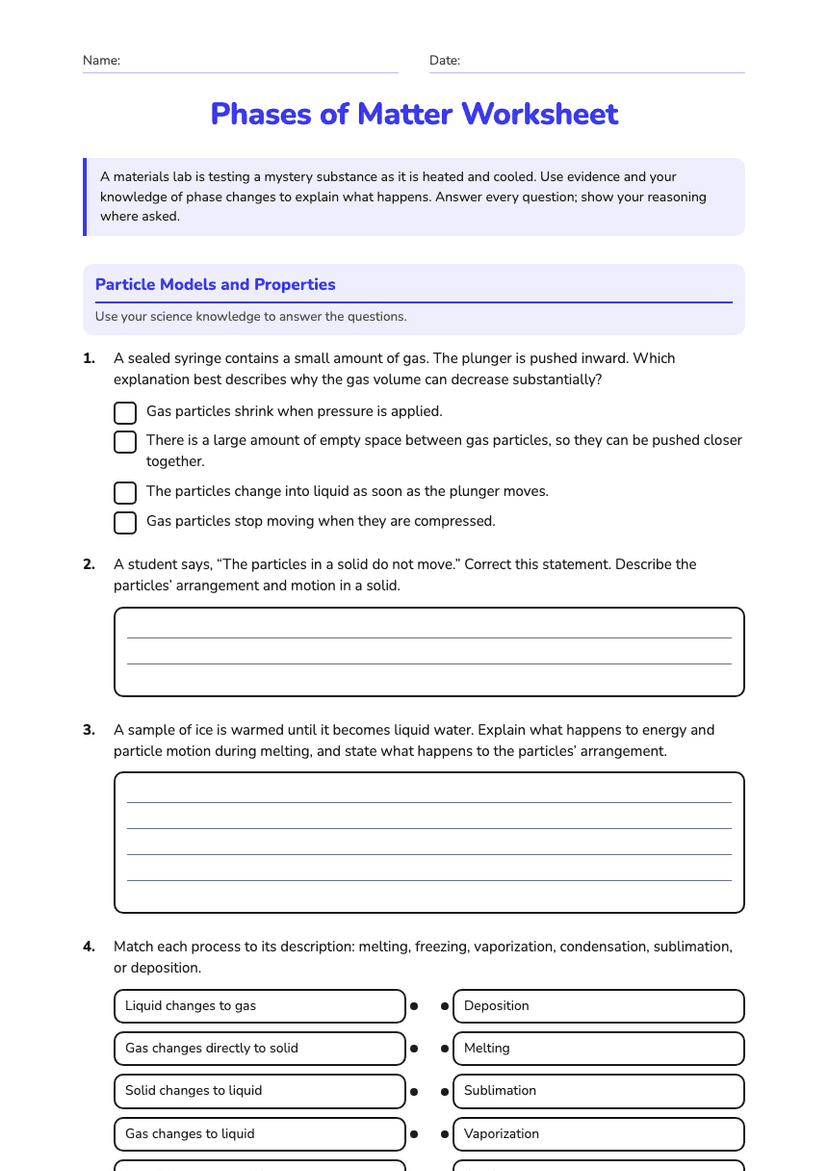
Phases of Matter Worksheet
Free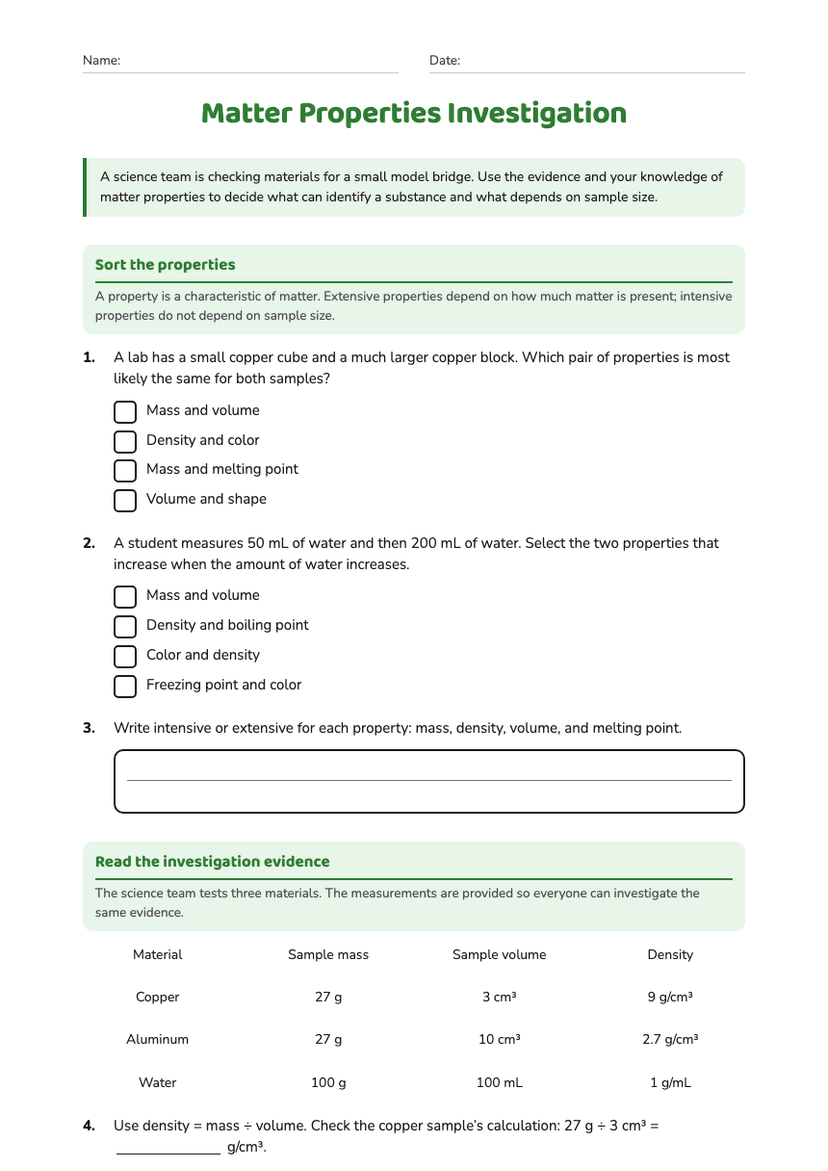
Matter Properties Investigation
Free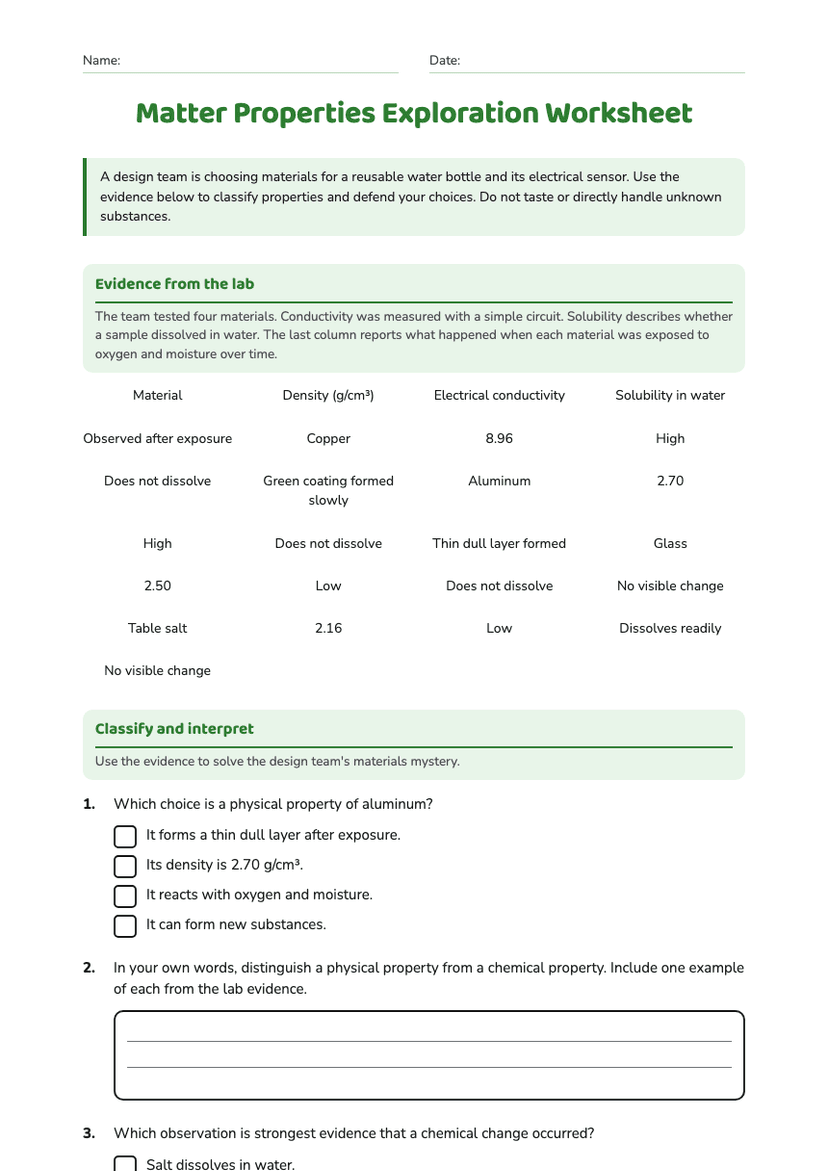
Matter Properties Exploration Worksheet
Free
Matter Changes
Free