ScienceFreePrintable
Natural Selection Probability Quiz
A free science worksheet ready for your classroom. Open in Kuraplan to grab the print-ready PDF, customize it for your students, or generate a fresh version in seconds.
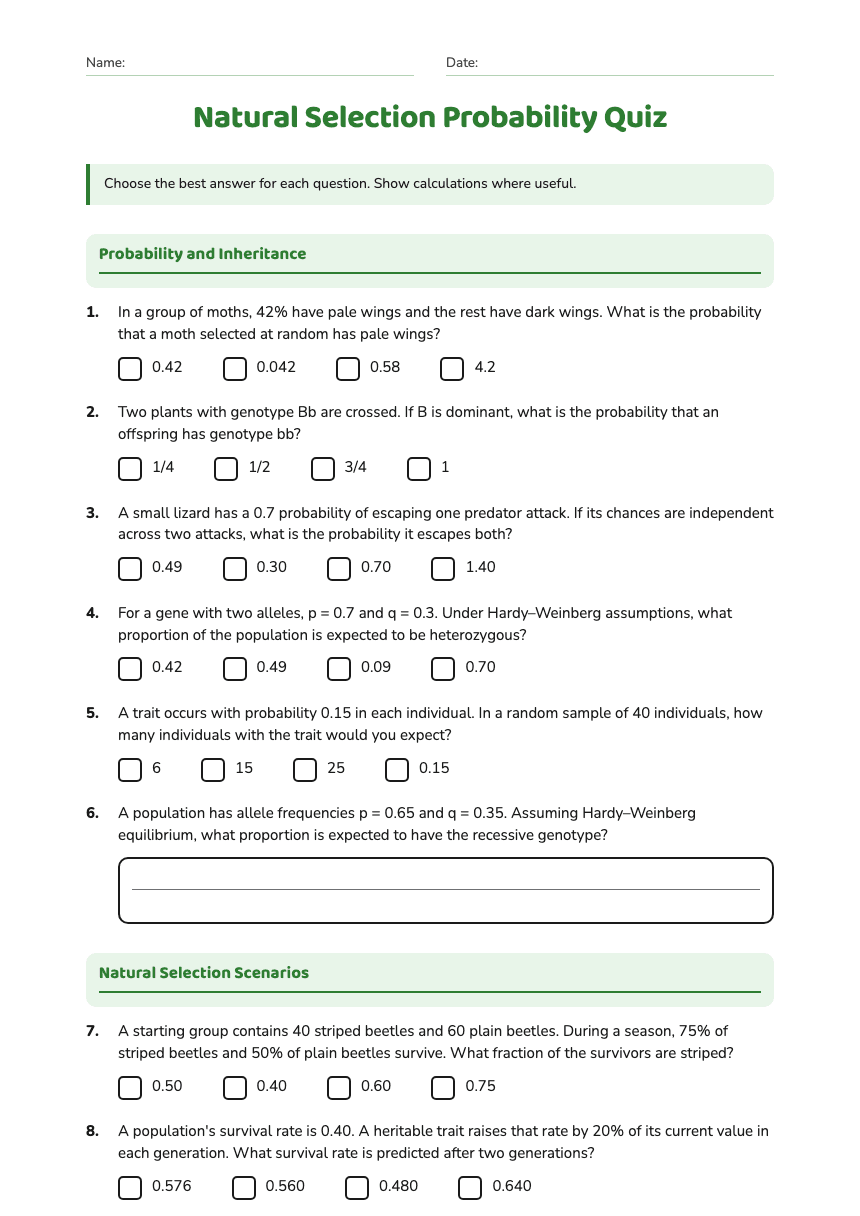
Name:Date:
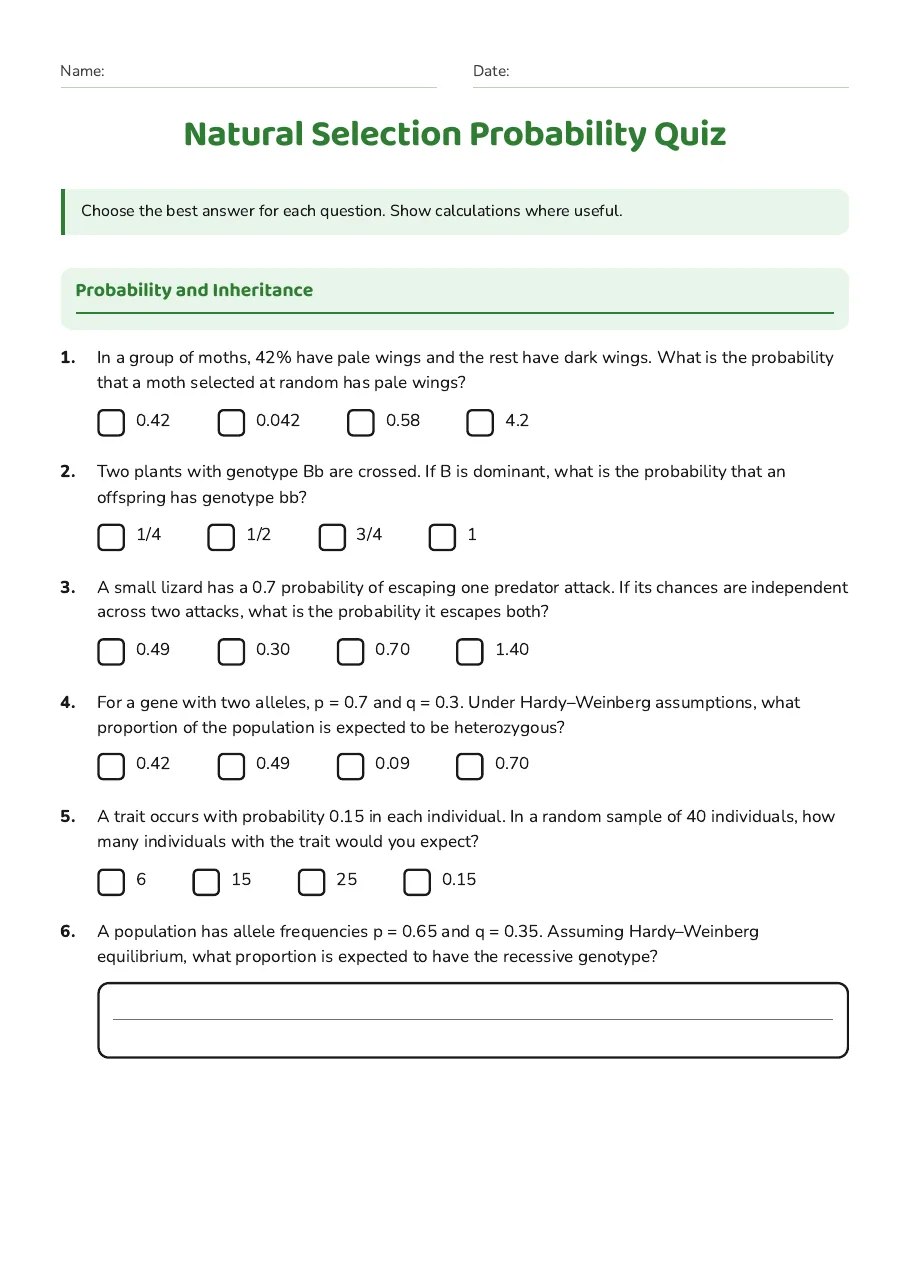
Natural Selection Probability Quiz
Choose the best answer for each question. Show calculations where useful.
Probability and Inheritance
1.In a group of moths, 42% have pale wings and the rest have dark wings. What is the probability that a moth selected at random has pale wings?
- 0.42
- 0.042
- 0.58
- 4.2
2.Two plants with genotype Bb are crossed. If B is dominant, what is the probability that an offspring has genotype bb?
- 1/4
- 1/2
- 3/4
- 1
3.A small lizard has a 0.7 probability of escaping one predator attack. If its chances are independent across two attacks, what is the probability it escapes both?
- 0.49
- 0.30
- 0.70
- 1.40
4.For a gene with two alleles, p = 0.7 and q = 0.3. Under Hardy–Weinberg assumptions, what proportion of the population is expected to be heterozygous?
- 0.42
- 0.49
- 0.09
- 0.70
5.A trait occurs with probability 0.15 in each individual. In a random sample of 40 individuals, how many individuals with the trait would you expect?
- 6
- 15
- 25
- 0.15
6.A population has allele frequencies p = 0.65 and q = 0.35. Assuming Hardy–Weinberg equilibrium, what proportion is expected to have the recessive genotype?
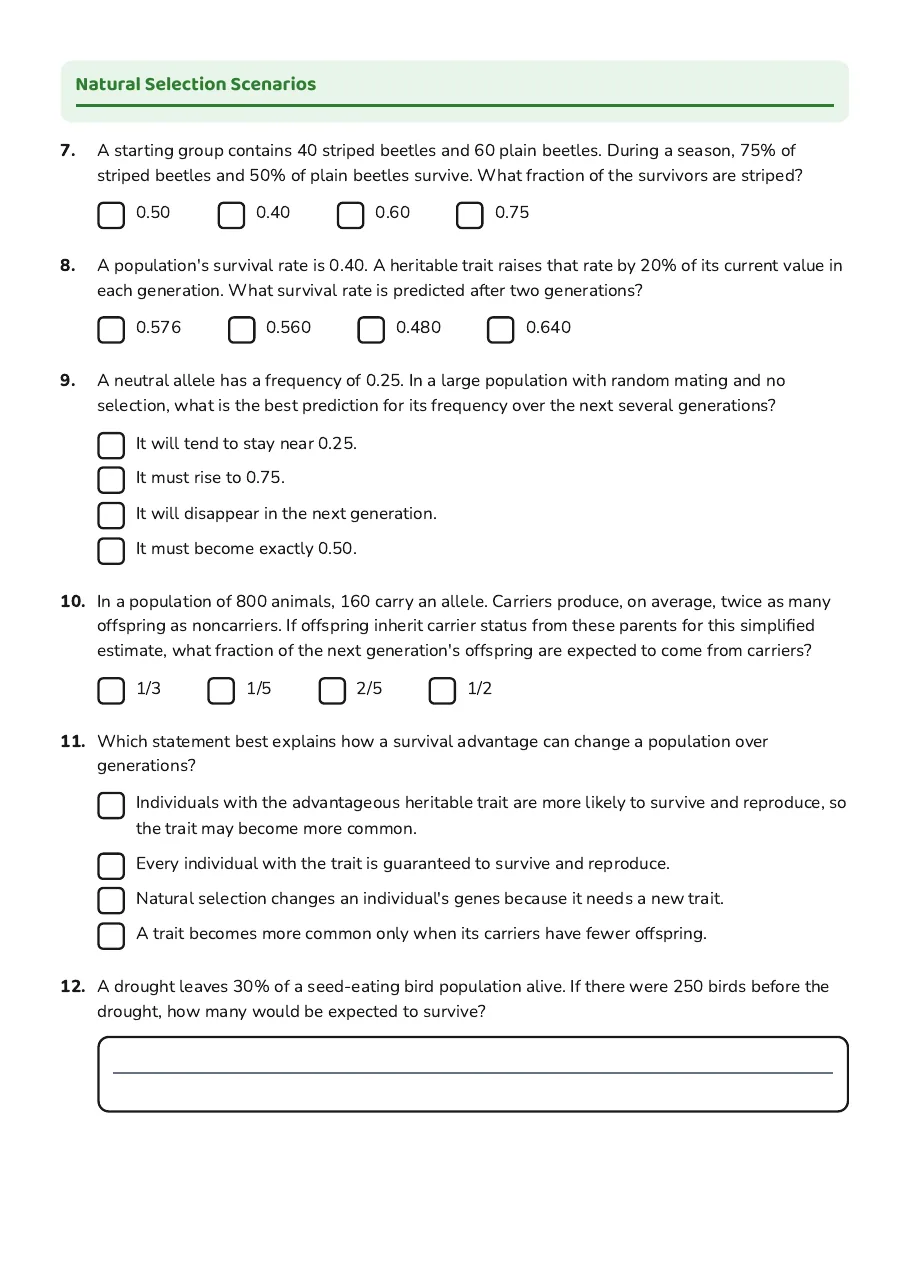
Natural Selection Scenarios
7.A starting group contains 40 striped beetles and 60 plain beetles. During a season, 75% of striped beetles and 50% of plain beetles survive. What fraction of the survivors are striped?
- 0.50
- 0.40
- 0.60
- 0.75
8.A population's survival rate is 0.40. A heritable trait raises that rate by 20% of its current value in each generation. What survival rate is predicted after two generations?
- 0.576
- 0.560
- 0.480
- 0.640
9.A neutral allele has a frequency of 0.25. In a large population with random mating and no selection, what is the best prediction for its frequency over the next several generations?
- It will tend to stay near 0.25.
- It must rise to 0.75.
- It will disappear in the next generation.
- It must become exactly 0.50.
10.In a population of 800 animals, 160 carry an allele. Carriers produce, on average, twice as many offspring as noncarriers. If offspring inherit carrier status from these parents for this simplified estimate, what fraction of the next generation's offspring are expected to come from carriers?
- 1/3
- 1/5
- 2/5
- 1/2
11.Which statement best explains how a survival advantage can change a population over generations?
- Individuals with the advantageous heritable trait are more likely to survive and reproduce, so the trait may become more common.
- Every individual with the trait is guaranteed to survive and reproduce.
- Natural selection changes an individual's genes because it needs a new trait.
- A trait becomes more common only when its carriers have fewer offspring.
12.A drought leaves 30% of a seed-eating bird population alive. If there were 250 birds before the drought, how many would be expected to survive?
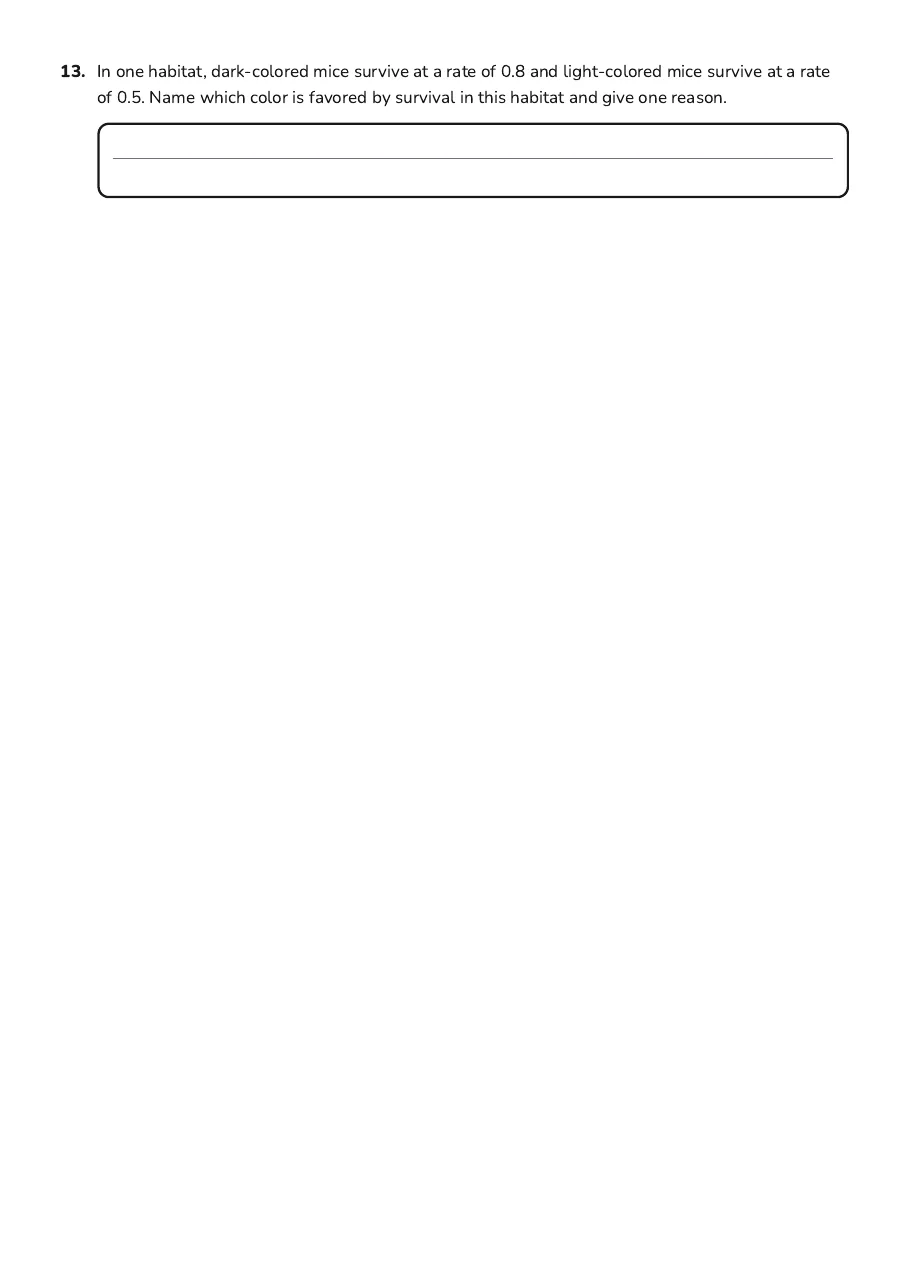
13.In one habitat, dark-colored mice survive at a rate of 0.8 and light-colored mice survive at a rate of 0.5. Name which color is favored by survival in this habitat and give one reason.
3 printable pages
Page 1
Page 2
Page 3
About This Worksheet
Free in Kuraplan
Sign up free, grab the PDF, and customize it for your class.
Print-Ready
Formatted for standard paper. Clean layout, easy to read.
AI-Generated
Created with Kuraplan's AI, designed for real classroom use.
For Teachers & Parents
Use in classrooms, for homework, tutoring, or homeschool.
Need a custom version of this worksheet?
Kuraplan's AI generates custom worksheets in seconds — differentiated for every learner, aligned to your curriculum.
Generate Custom Worksheets — Free No credit card Curriculum-aligned Under 60 seconds
More Science Worksheets
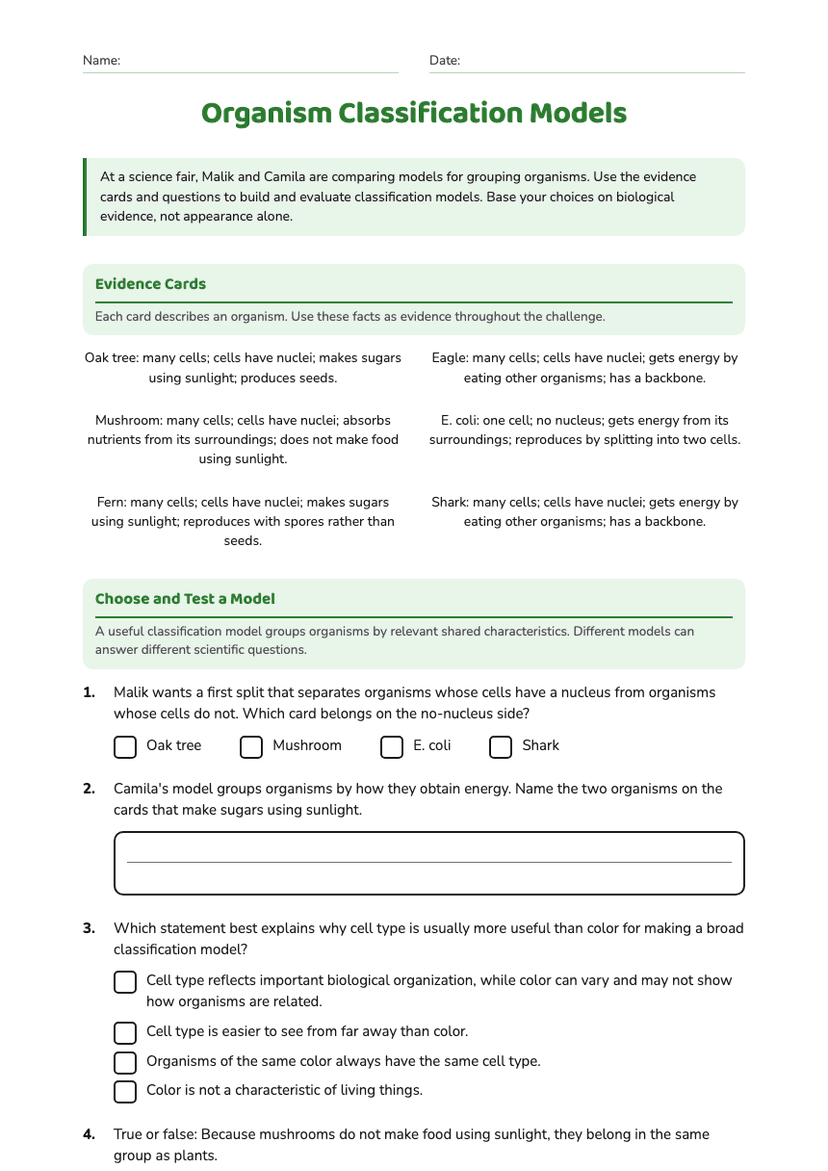
7th Grade
Organism Classification Models
Free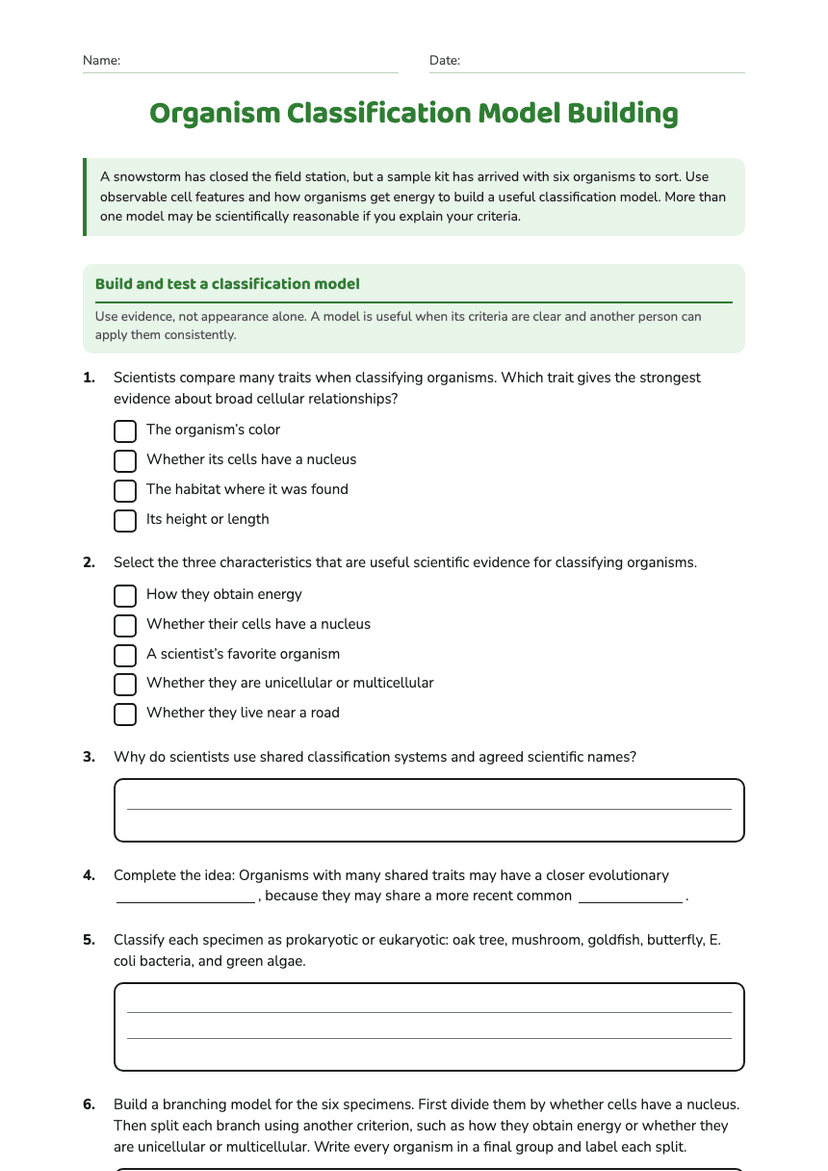
7th Grade
Organism Classification Model Building
Free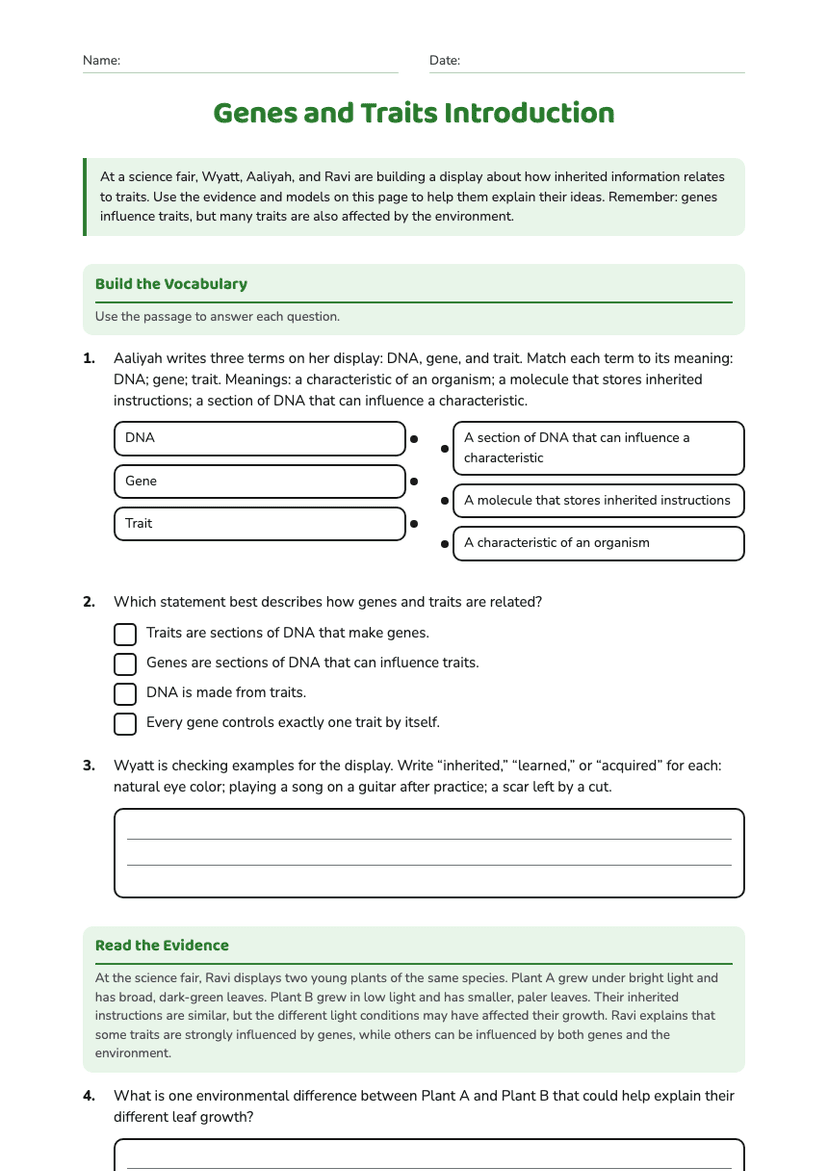
7th Grade
Genes and Traits Introduction
Free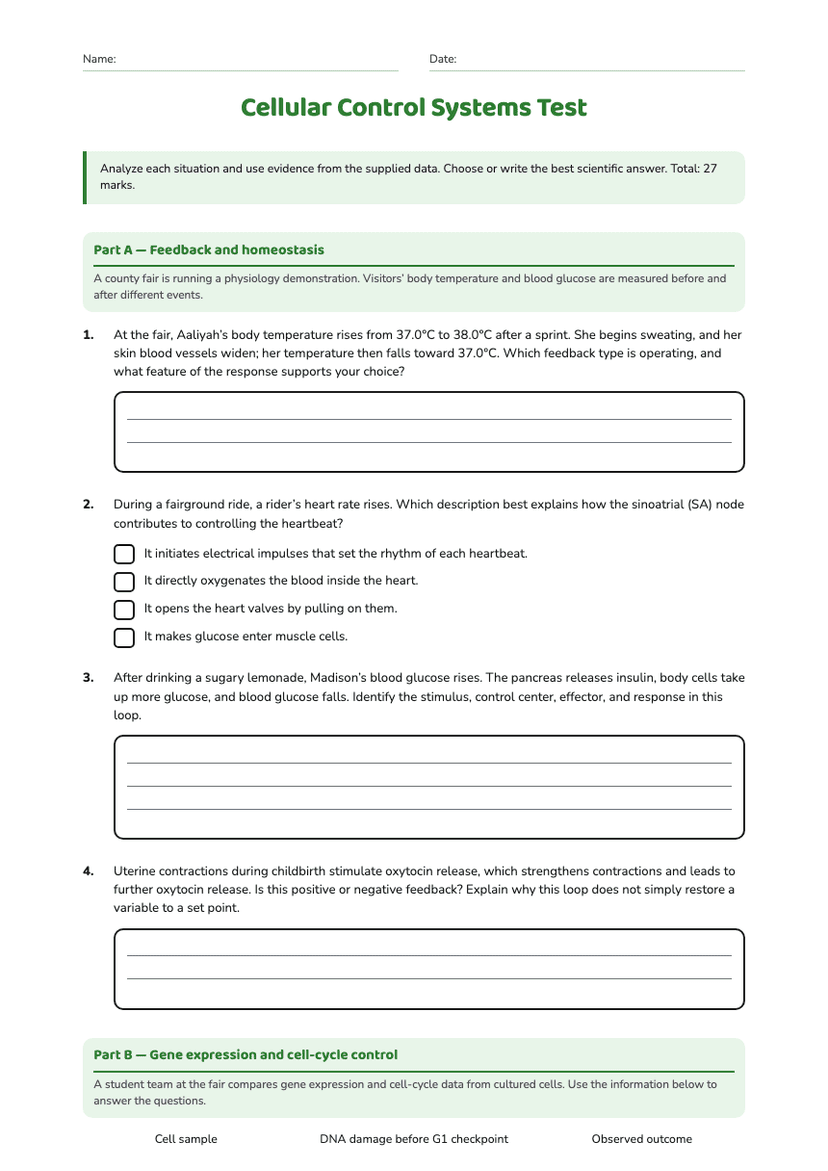
12th Grade
Cellular Control Systems Test
Free
7th Grade
Biological Organization Models
Free
2nd Grade
Plant Life Cycle Worksheet
Free
7th Grade
Reproduction Models Worksheet
Free
7th Grade