Newton's Laws Simplified
A free science worksheet ready for your classroom. Open in Kuraplan to grab the print-ready PDF, customize it for your students, or generate a fresh version in seconds.

Newton's Laws Simplified
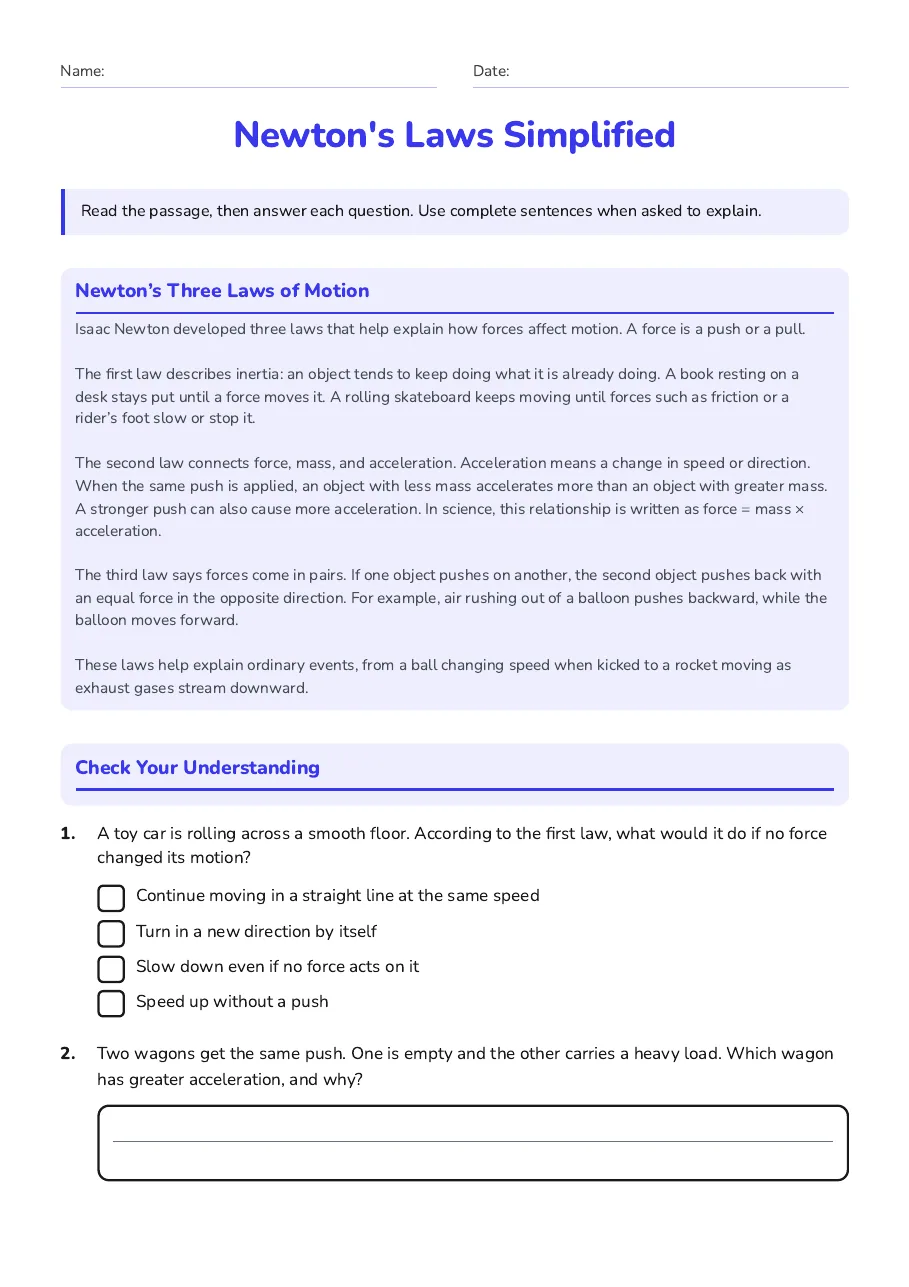
Newton’s Three Laws of Motion
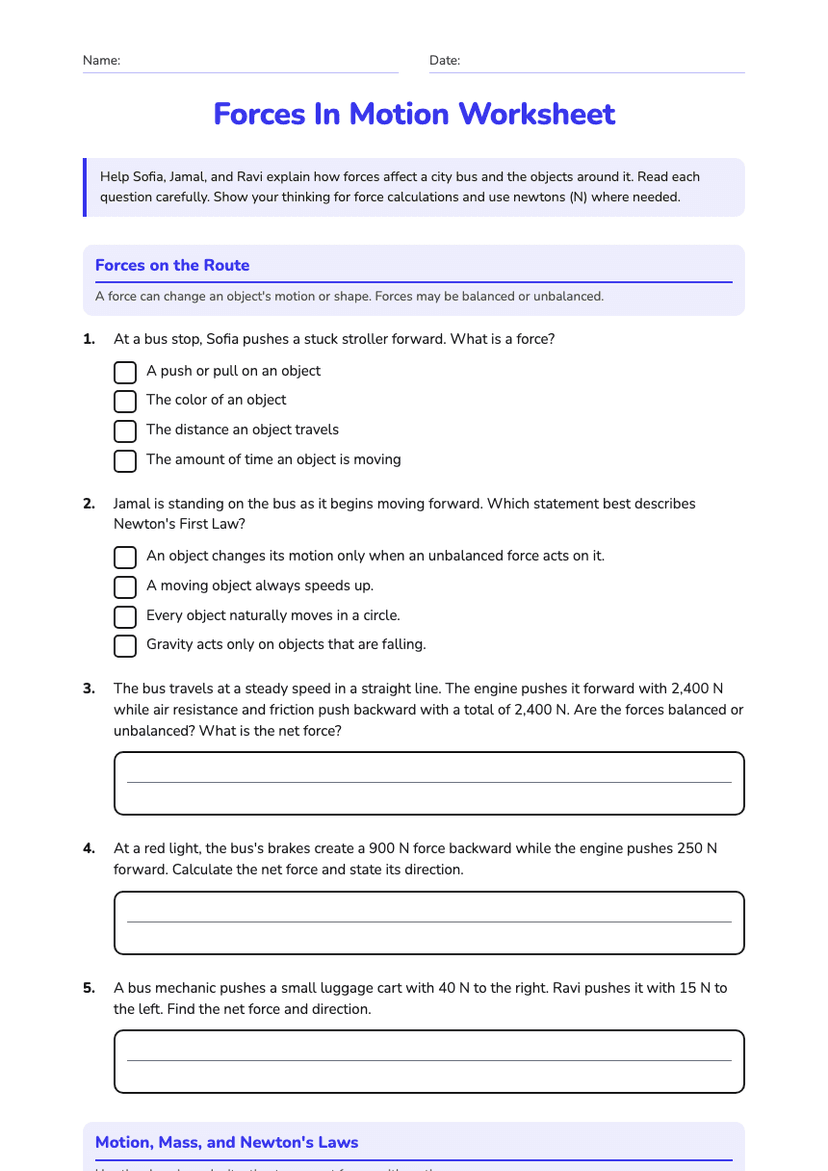
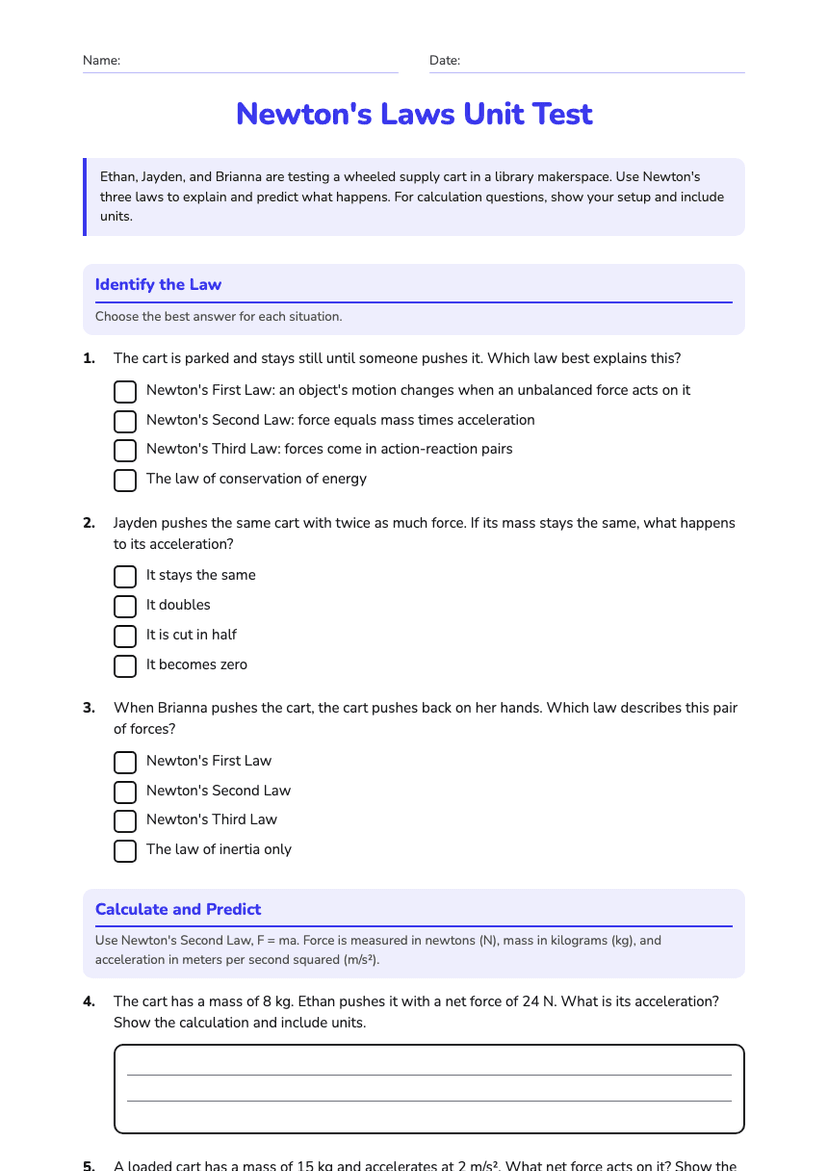
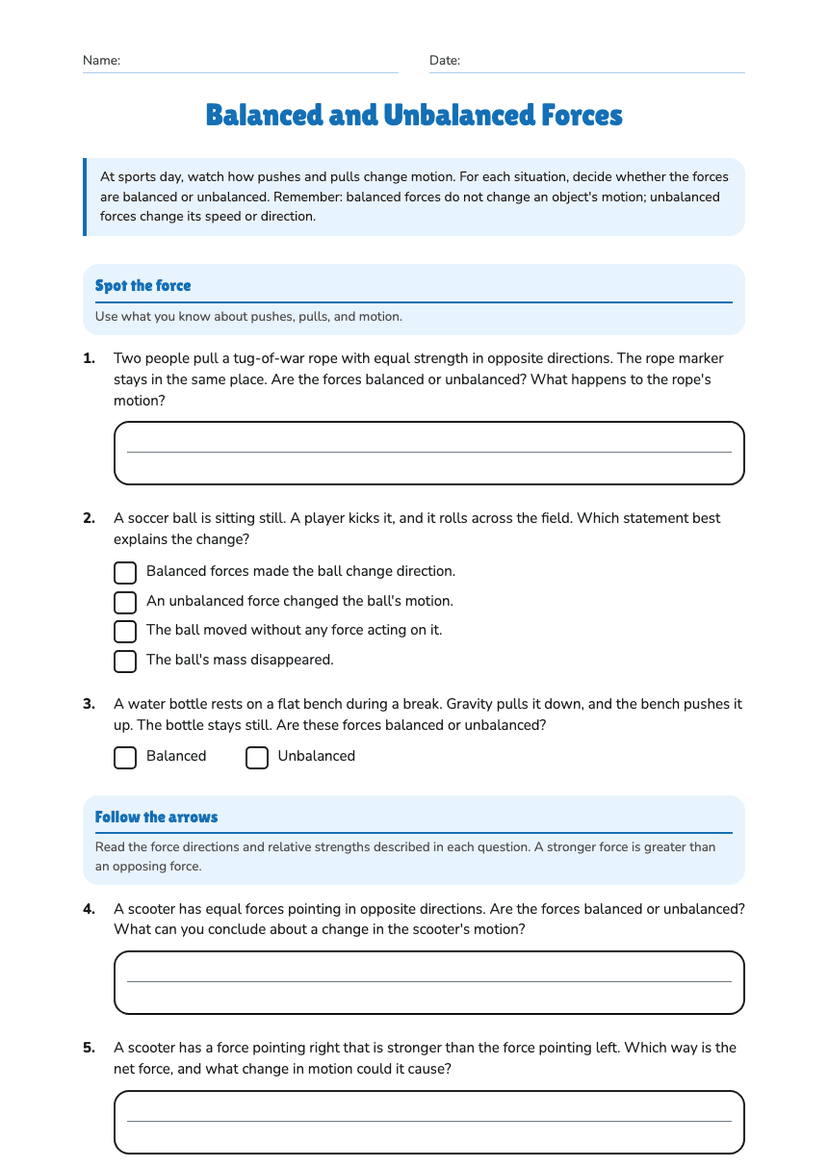
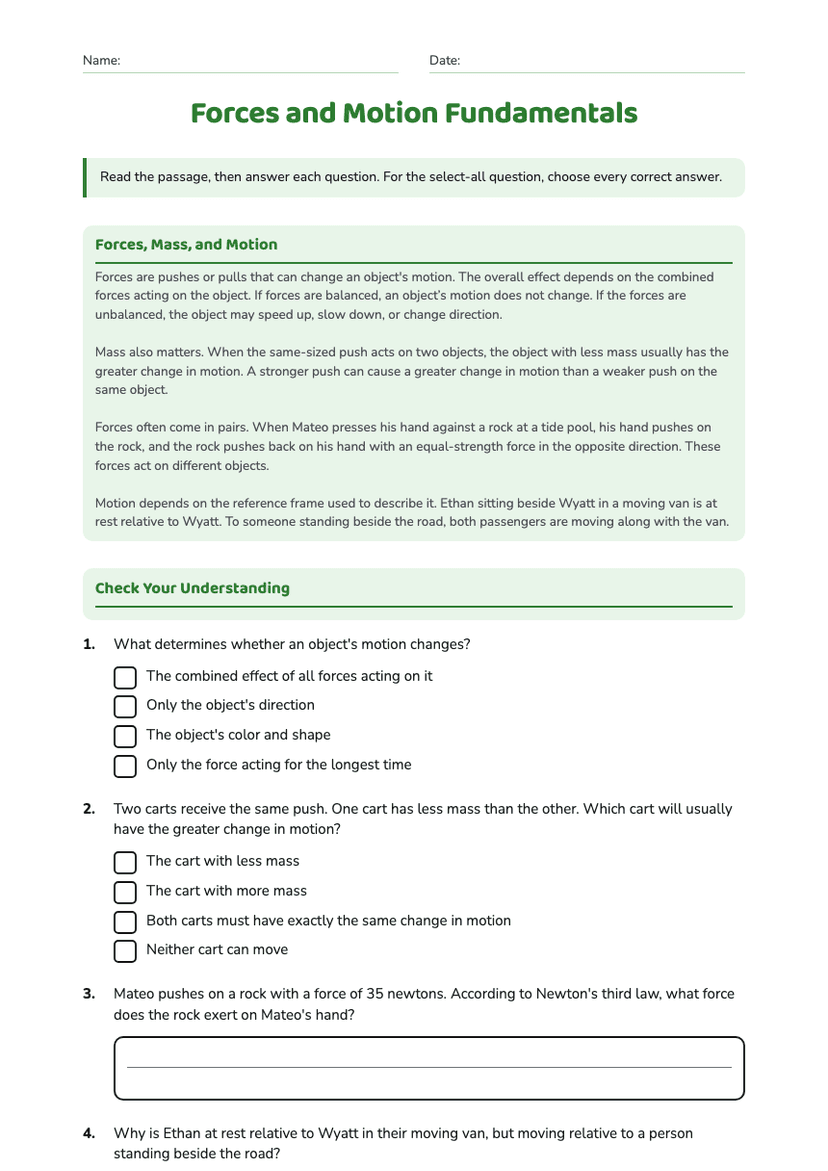
Isaac Newton developed three laws that help explain how forces affect motion. A force is a push or a pull. The first law describes inertia: an object tends to keep doing what it is already doing. A book resting on a desk stays put until a force moves it. A rolling skateboard keeps moving until forces such as friction or a rider’s foot slow or stop it. The second law connects force, mass, and acceleration. Acceleration means a change in speed or direction. When the same push is applied, an object with less mass accelerates more than an object with greater mass. A stronger push can also cause more acceleration. In science, this relationship is written as force = mass × acceleration. The third law says forces come in pairs. If one object pushes on another, the second object pushes back with an equal force in the opposite direction. For example, air rushing out of a balloon pushes backward, while the balloon moves forward. These laws help explain ordinary events, from a ball changing speed when kicked to a rocket moving as exhaust gases stream downward.
Check Your Understanding
- Continue moving in a straight line at the same speed
- Turn in a new direction by itself
- Slow down even if no force acts on it
- Speed up without a push
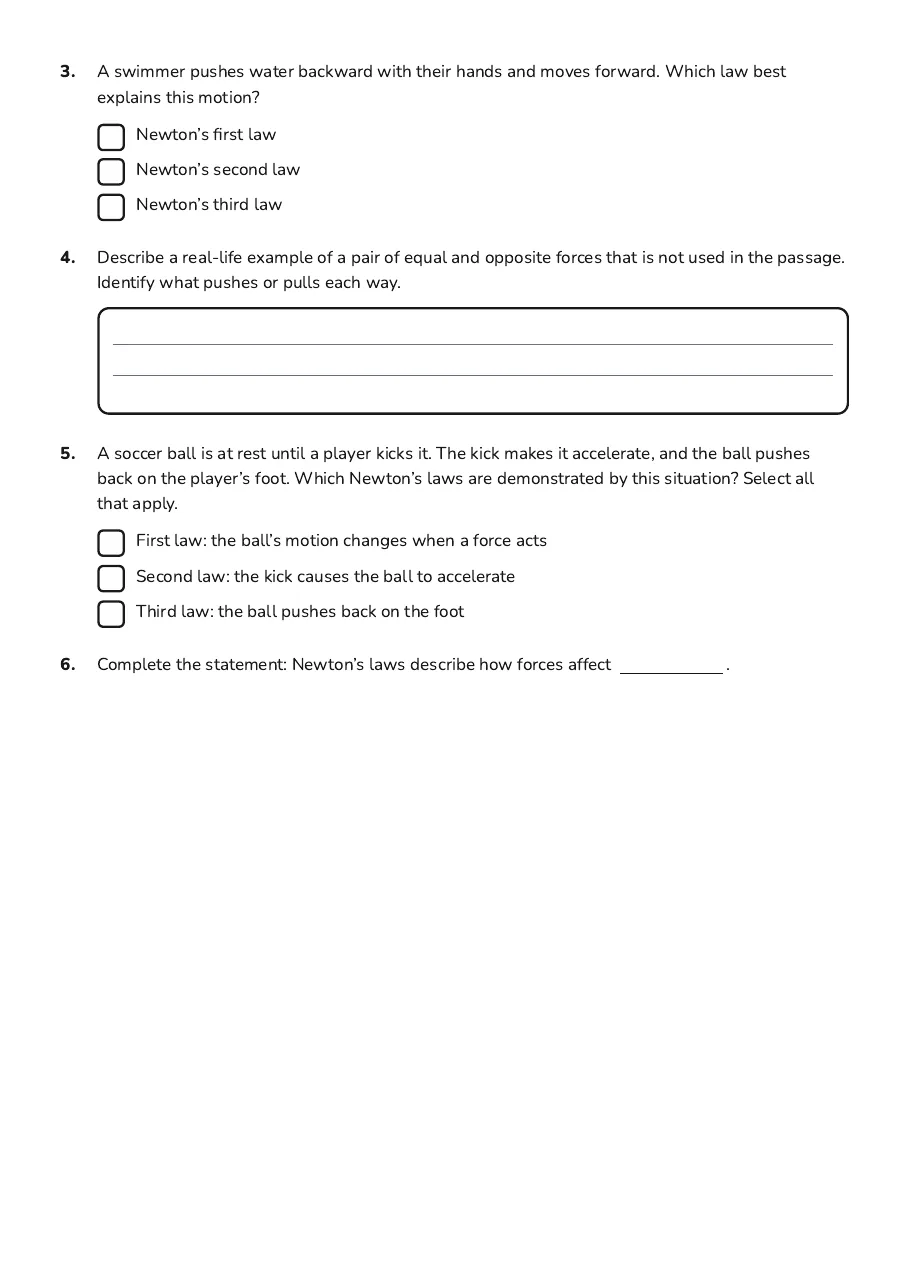
- Newton’s first law
- Newton’s second law
- Newton’s third law
- First law: the ball’s motion changes when a force acts
- Second law: the kick causes the ball to accelerate
- Third law: the ball pushes back on the foot
2 printable pages
Page 1
Page 2
About This Worksheet
Free in Kuraplan
Sign up free, grab the PDF, and customize it for your class.
Print-Ready
Formatted for standard paper. Clean layout, easy to read.
AI-Generated
Created with Kuraplan's AI, designed for real classroom use.
For Teachers & Parents
Use in classrooms, for homework, tutoring, or homeschool.
Need a custom version of this worksheet?
Kuraplan's AI generates custom worksheets in seconds — differentiated for every learner, aligned to your curriculum.
Generate Custom Worksheets — Free