Opium Wars Analysis Worksheet
A free social studies worksheet ready for your classroom. Open in Kuraplan to grab the print-ready PDF, customize it for your students, or generate a fresh version in seconds.
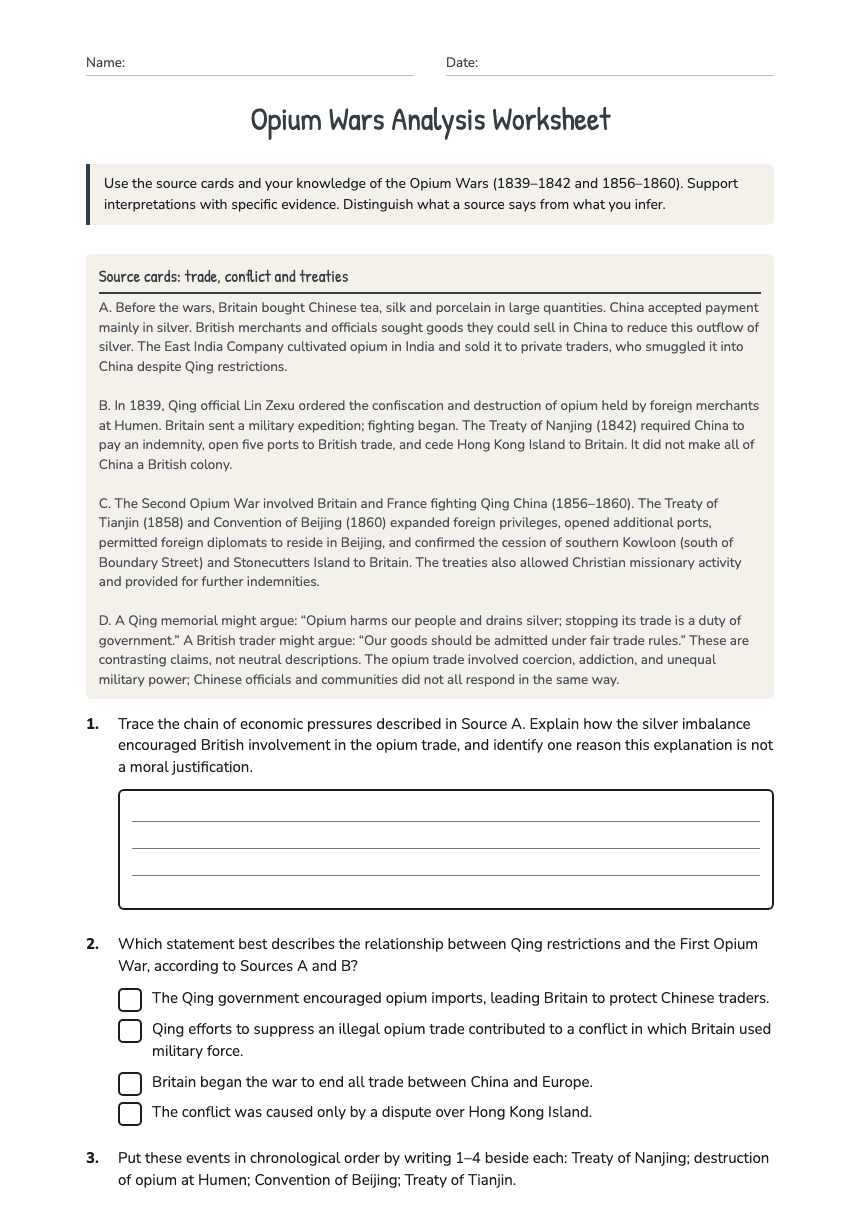
Opium Wars Analysis Worksheet
Source cards: trade, conflict and treaties
A. Before the wars, Britain bought Chinese tea, silk and porcelain in large quantities. China accepted payment mainly in silver. British merchants and officials sought goods they could sell in China to reduce this outflow of silver. The East India Company cultivated opium in India and sold it to private traders, who smuggled it into China despite Qing restrictions. B. In 1839, Qing official Lin Zexu ordered the confiscation and destruction of opium held by foreign merchants at Humen. Britain sent a military expedition; fighting began. The Treaty of Nanjing (1842) required China to pay an indemnity, open five ports to British trade, and cede Hong Kong Island to Britain. It did not make all of China a British colony. C. The Second Opium War involved Britain and France fighting Qing China (1856–1860). The Treaty of Tianjin (1858) and Convention of Beijing (1860) expanded foreign privileges, opened additional ports, permitted foreign diplomats to reside in Beijing, and confirmed the cession of southern Kowloon (south of Boundary Street) and Stonecutters Island to Britain. The treaties also allowed Christian missionary activity and provided for further indemnities. D. A Qing memorial might argue: “Opium harms our people and drains silver; stopping its trade is a duty of government.” A British trader might argue: “Our goods should be admitted under fair trade rules.” These are contrasting claims, not neutral descriptions. The opium trade involved coercion, addiction, and unequal military power; Chinese officials and communities did not all respond in the same way.
- The Qing government encouraged opium imports, leading Britain to protect Chinese traders.
- Qing efforts to suppress an illegal opium trade contributed to a conflict in which Britain used military force.
- Britain began the war to end all trade between China and Europe.
- The conflict was caused only by a dispute over Hong Kong Island.
- China ceded Hong Kong Island to Britain.
- China paid an indemnity to Britain.
- China became entirely a British colony.
- All foreign troops left China permanently.
3 printable pages
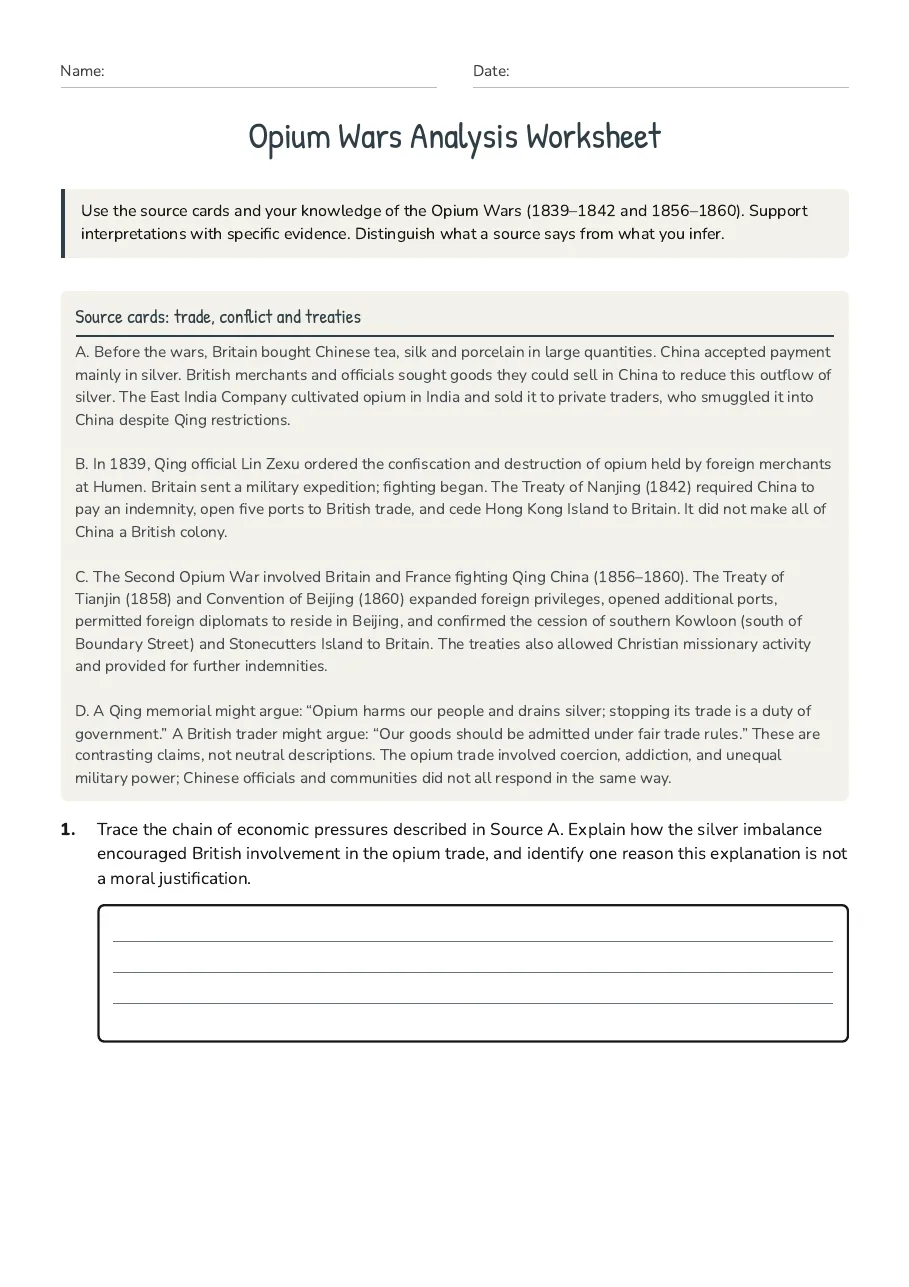
Page 1
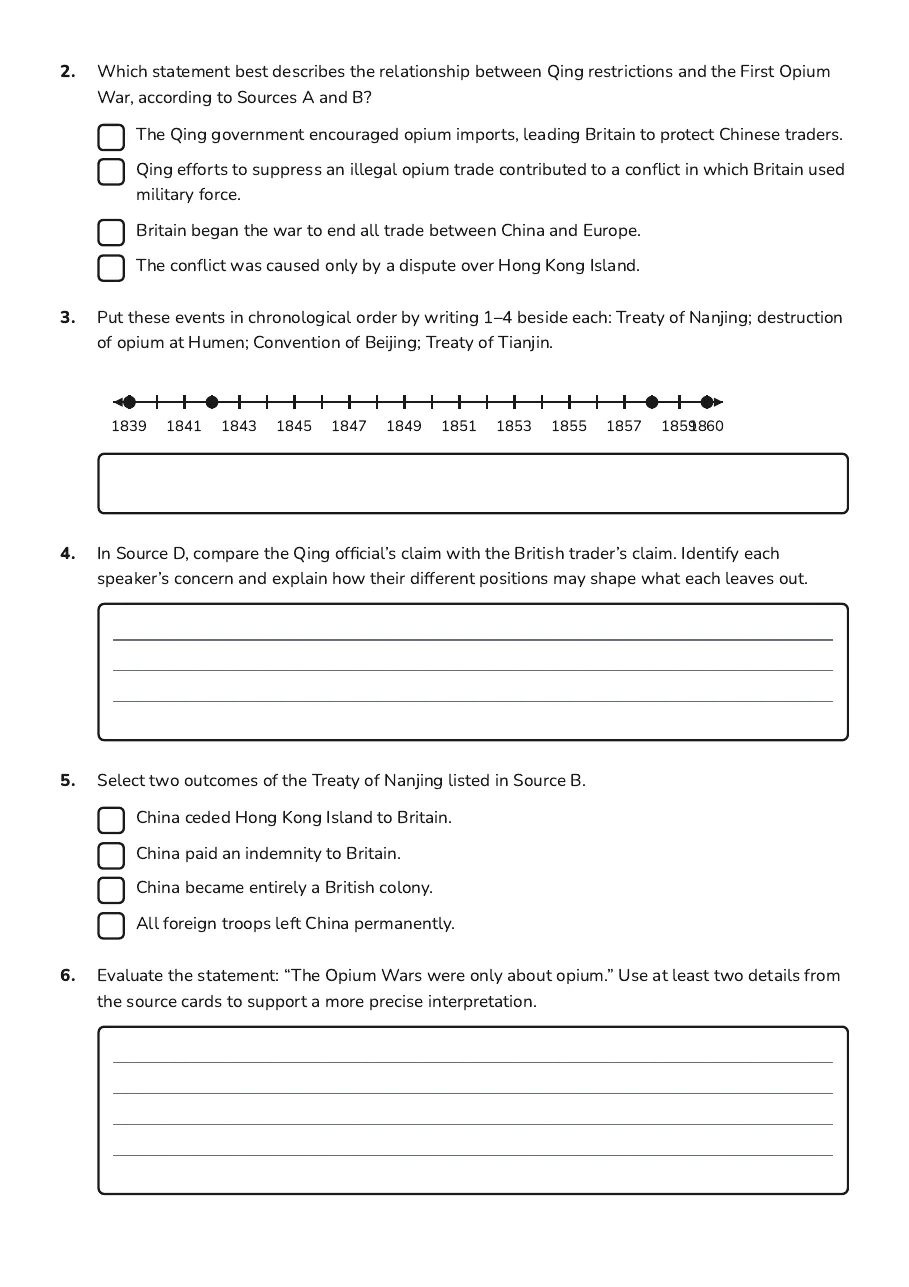
Page 2
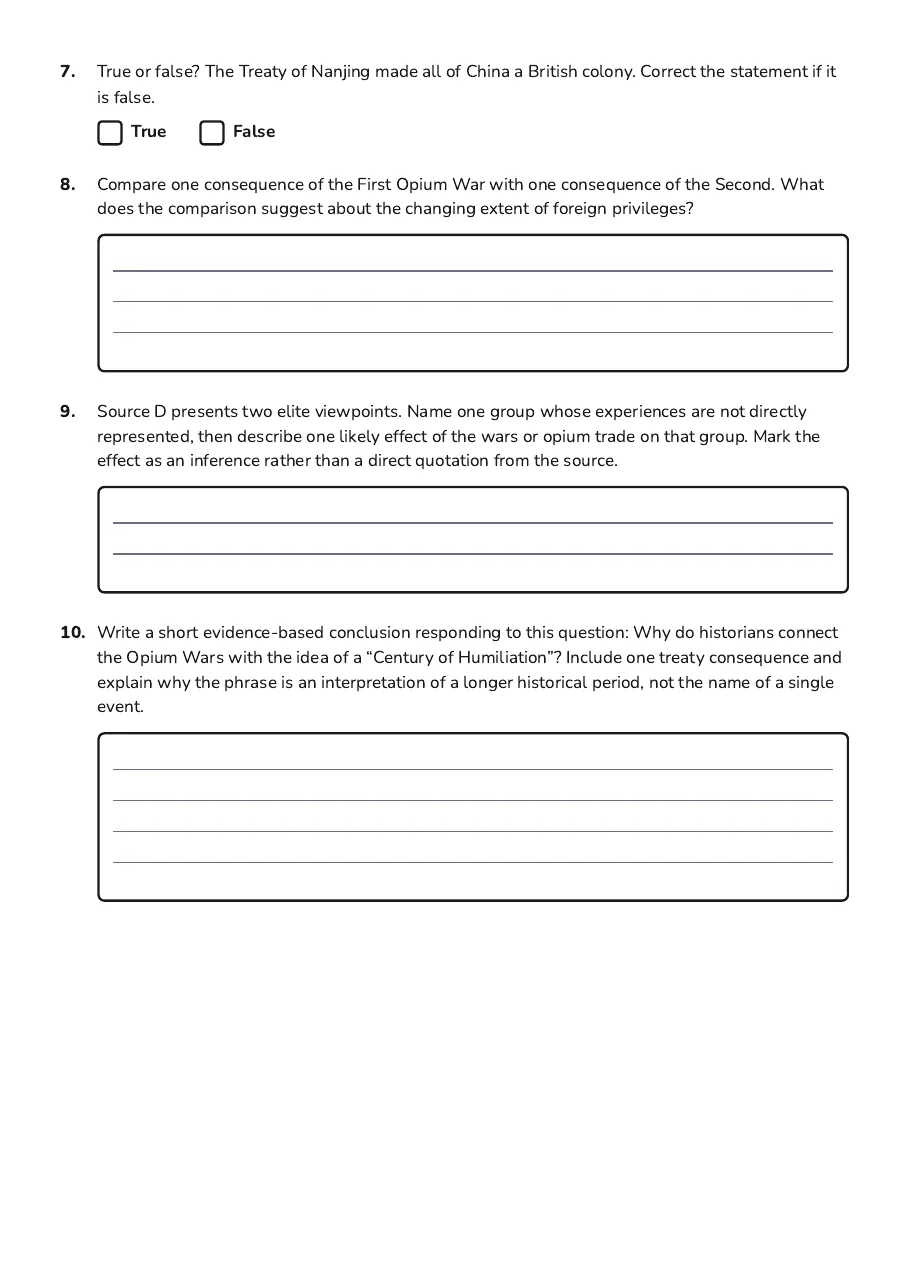
Page 3
About This Worksheet
Free in Kuraplan
Sign up free, grab the PDF, and customize it for your class.
Print-Ready
Formatted for standard paper. Clean layout, easy to read.
AI-Generated
Created with Kuraplan's AI, designed for real classroom use.
For Teachers & Parents
Use in classrooms, for homework, tutoring, or homeschool.
Need a custom version of this worksheet?
Kuraplan's AI generates custom worksheets in seconds — differentiated for every learner, aligned to your curriculum.
Generate Custom Worksheets — Free