Slavery and Industrial Revolution
A free social studies worksheet ready for your classroom. Open in Kuraplan to grab the print-ready PDF, customize it for your students, or generate a fresh version in seconds.
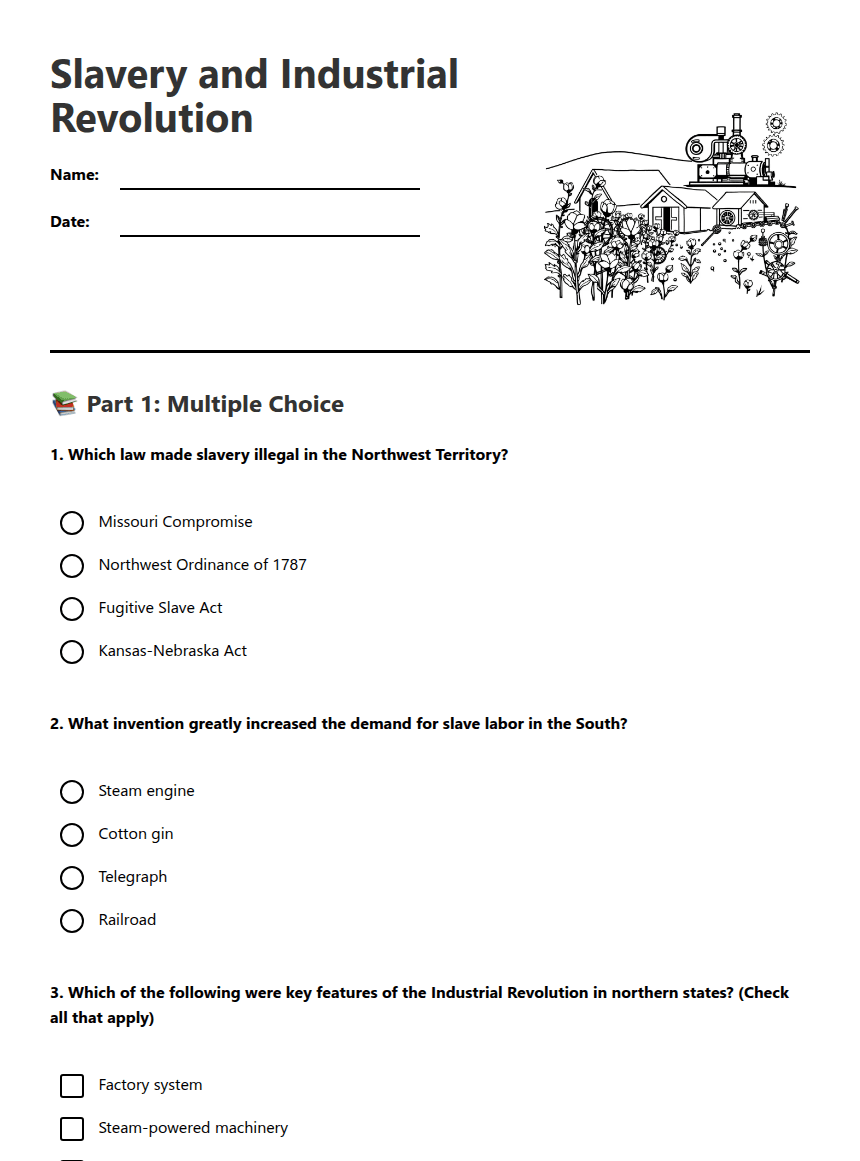
Slavery and Industrial Revolution

📚 Part 1: Multiple Choice
✏️ Part 2: Short Answer Questions
Answer: The Three-Fifths Compromise counted enslaved people as three-fifths of a person for both representation in Congress and taxation purposes. This gave Southern states more political power in the House of Representatives while not granting enslaved people any actual rights or representation.
Answer: Sample responses include: (1) Rapid urbanization as people moved from farms to cities for factory jobs; (2) Growth of a distinct working class; (3) Increased immigration from Europe; (4) Development of distinct social classes; (5) Changes in family structure as work moved outside the home.
Answer: Railroads facilitated industrial growth by transporting raw materials and finished goods quickly and efficiently. They also strengthened slavery by making it easier to transport cotton from Southern plantations to Northern factories and ports, increasing demand for slave labor.
Word bank: factory, putting-out
Answer: factory, putting-out
🤔 Part 3: Critical Thinking
Sample Answer:
North: Industrial economy based on manufacturing, wage labor, and urbanization. Used free labor and immigrant workers. Focused on producing finished goods and had extensive transportation networks.
South: Agricultural economy based on plantation system and cash crops (cotton, tobacco, rice). Relied heavily on enslaved labor. Remained largely rural with fewer cities and less industrial development.
Key differences: (1) Labor systems - free vs. enslaved; (2) Economic focus - manufacturing vs. agriculture; (3) Settlement patterns - urban vs. rural; (4) Social structure - more social mobility in North vs. rigid hierarchy in South.
Sample Answer:
Helped: Factory owners and entrepreneurs gained wealth from increased production. Some workers gained steady employment. Consumers benefited from cheaper, mass-produced goods.
Harmed: Enslaved people faced increased demand for their labor due to the cotton gin. Skilled artisans lost jobs to machines. Factory workers often faced dangerous conditions, long hours, and low wages. Children were exploited in factories.
Examples: The cotton gin increased cotton production but intensified slavery. Steam-powered machinery created jobs but also dangerous working conditions in factories.
About This Worksheet
Free in Kuraplan
Sign up free, grab the PDF, and customize it for your class.
Print-Ready
Formatted for standard paper. Clean layout, easy to read.
AI-Generated
Created with Kuraplan's AI, designed for real classroom use.
For Teachers & Parents
Use in classrooms, for homework, tutoring, or homeschool.
Need a custom version of this worksheet?
Kuraplan's AI generates custom worksheets in seconds — differentiated for every learner, aligned to your curriculum.
Generate Custom Worksheets — FreeMore Social Studies Worksheets
African American History
Free
Ancient India for Kids
Free
World History Quiz Worksheet
Free
Brown v. Board Mosaic
Free
Amish American History Exploration
Free
Amish American History Overview
Free
Amish American History Overview
Free