English (ELA)FreePrintable
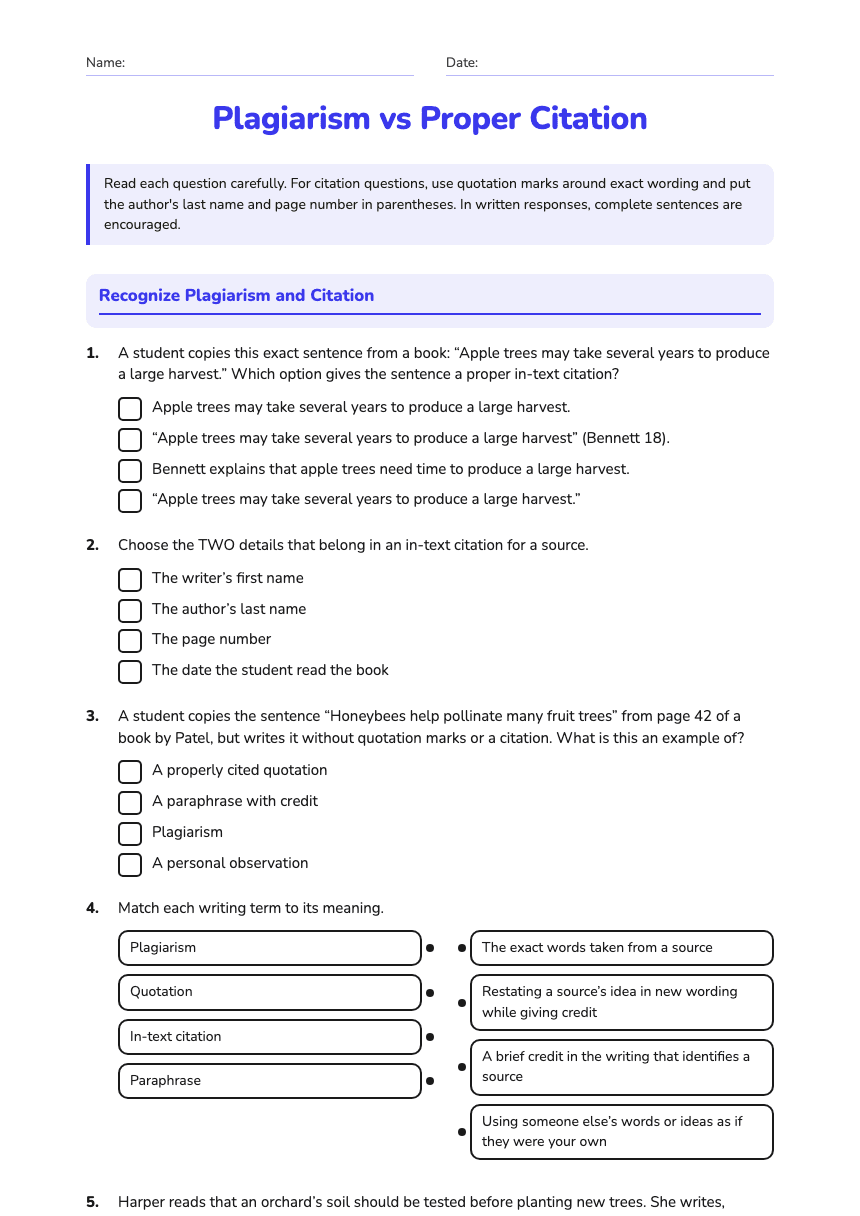
Plagiarism vs Proper Citation
A free english (ela) worksheet ready for your classroom. Open in Kuraplan to grab the print-ready PDF, customize it for your students, or generate a fresh version in seconds.
Name:Date:
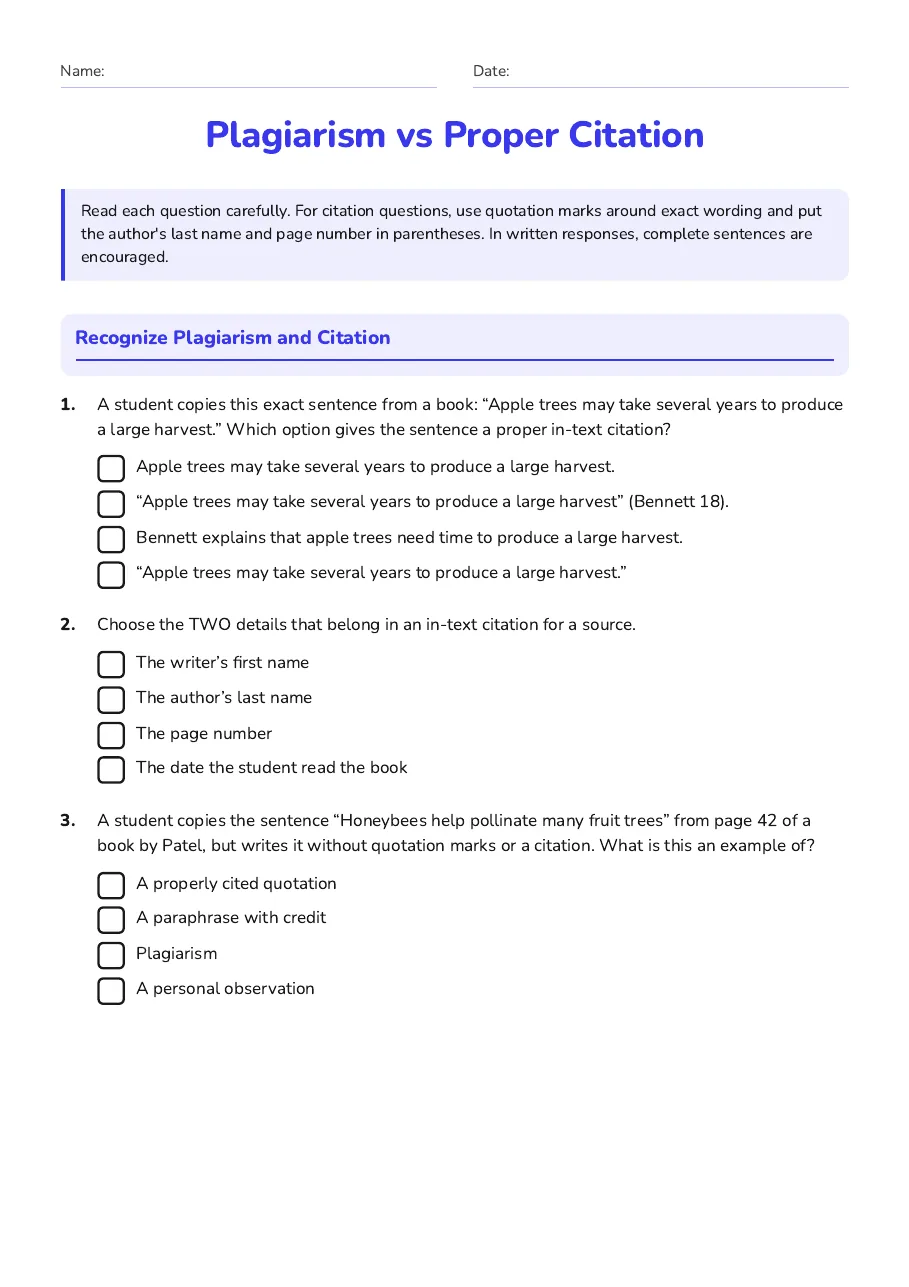
Plagiarism vs Proper Citation
Read each question carefully. For citation questions, use quotation marks around exact wording and put the author's last name and page number in parentheses. In written responses, complete sentences are encouraged.
Recognize Plagiarism and Citation
1.A student copies this exact sentence from a book: “Apple trees may take several years to produce a large harvest.” Which option gives the sentence a proper in-text citation?
- Apple trees may take several years to produce a large harvest.
- “Apple trees may take several years to produce a large harvest” (Bennett 18).
- Bennett explains that apple trees need time to produce a large harvest.
- “Apple trees may take several years to produce a large harvest.”
2.Choose the TWO details that belong in an in-text citation for a source.
- The writer’s first name
- The author’s last name
- The page number
- The date the student read the book
3.A student copies the sentence “Honeybees help pollinate many fruit trees” from page 42 of a book by Patel, but writes it without quotation marks or a citation. What is this an example of?
- A properly cited quotation
- A paraphrase with credit
- Plagiarism
- A personal observation
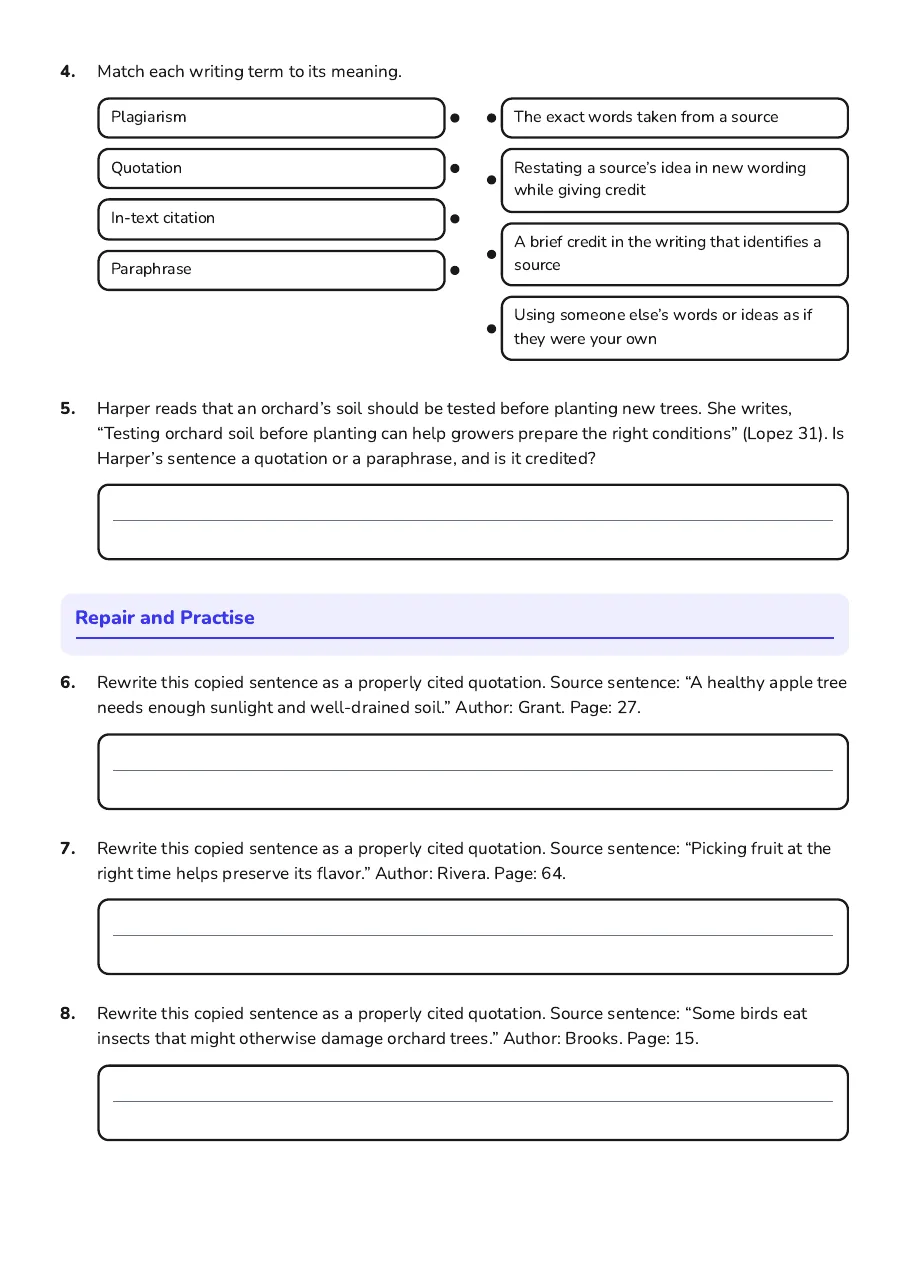
4.Match each writing term to its meaning.
- Plagiarism
- Quotation
- In-text citation
- Paraphrase
- The exact words taken from a source
- Restating a source’s idea in new wording while giving credit
- A brief credit in the writing that identifies a source
- Using someone else’s words or ideas as if they were your own
5.Harper reads that an orchard’s soil should be tested before planting new trees. She writes, “Testing orchard soil before planting can help growers prepare the right conditions” (Lopez 31). Is Harper’s sentence a quotation or a paraphrase, and is it credited?
Repair and Practise
6.Rewrite this copied sentence as a properly cited quotation. Source sentence: “A healthy apple tree needs enough sunlight and well-drained soil.” Author: Grant. Page: 27.
7.Rewrite this copied sentence as a properly cited quotation. Source sentence: “Picking fruit at the right time helps preserve its flavor.” Author: Rivera. Page: 64.
8.Rewrite this copied sentence as a properly cited quotation. Source sentence: “Some birds eat insects that might otherwise damage orchard trees.” Author: Brooks. Page: 15.
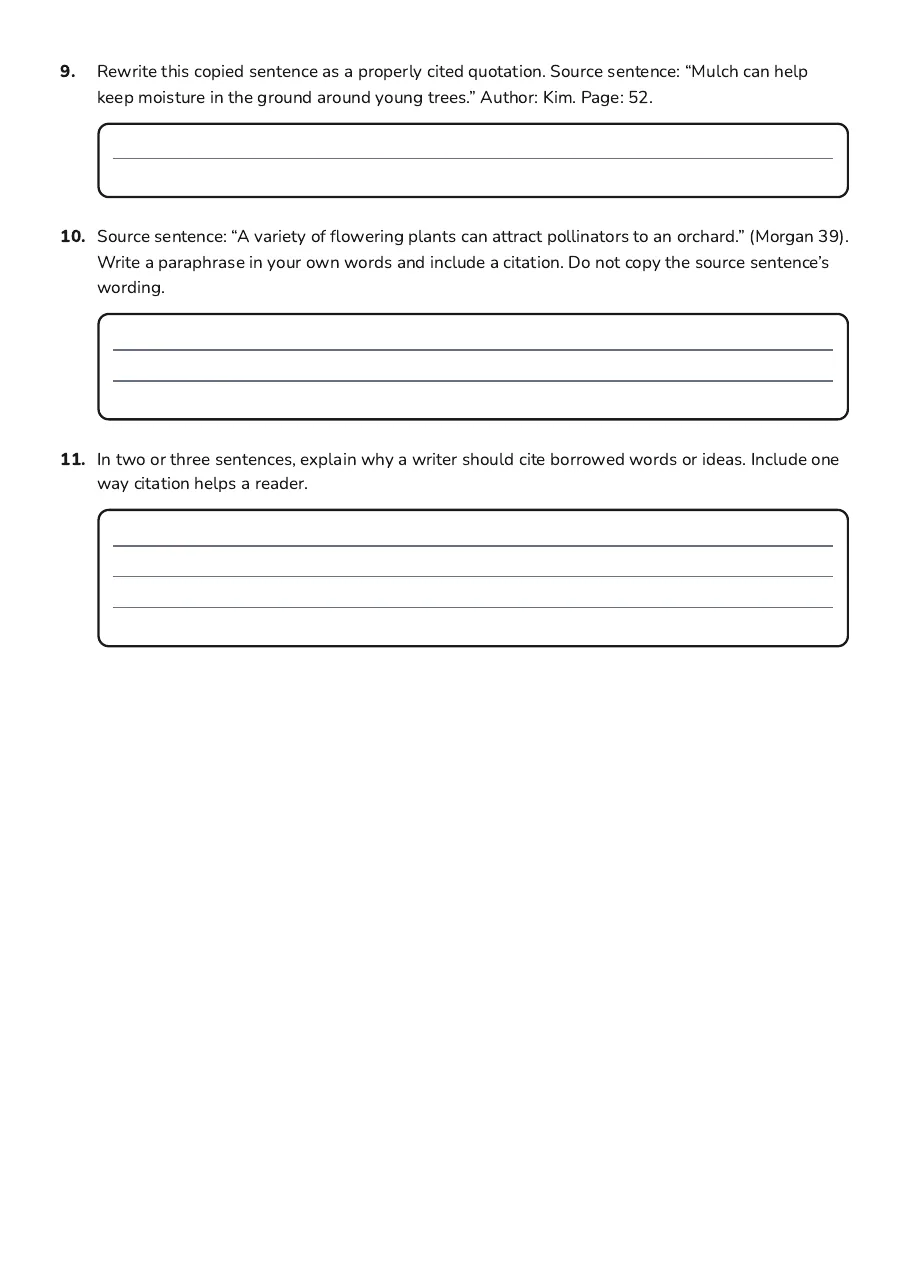
9.Rewrite this copied sentence as a properly cited quotation. Source sentence: “Mulch can help keep moisture in the ground around young trees.” Author: Kim. Page: 52.
10.Source sentence: “A variety of flowering plants can attract pollinators to an orchard.” (Morgan 39). Write a paraphrase in your own words and include a citation. Do not copy the source sentence’s wording.
11.In two or three sentences, explain why a writer should cite borrowed words or ideas. Include one way citation helps a reader.
3 printable pages
Page 1
Page 2
Page 3
About This Worksheet
Free in Kuraplan
Sign up free, grab the PDF, and customize it for your class.
Print-Ready
Formatted for standard paper. Clean layout, easy to read.
AI-Generated
Created with Kuraplan's AI, designed for real classroom use.
For Teachers & Parents
Use in classrooms, for homework, tutoring, or homeschool.
Need a custom version of this worksheet?
Kuraplan's AI generates custom worksheets in seconds — differentiated for every learner, aligned to your curriculum.
Generate Custom Worksheets — Free No credit card Curriculum-aligned Under 60 seconds
More English (ELA) Worksheets
9/11 Heroes Opinion Writing
Free
7th Grade
Informative Paragraph Writing
Free
6th Grade
Expanding Sentences Practice
Free
Figurative Language Station Rotation
Free
Scholarship Application Preparation Worksheet
Free
5th Grade–8th Grade
Stronger Stories Revision Workshop
Free
Grade 5 Opinion Writing
Free