Reading Section Study Guide
A free english (ela) worksheet ready for your classroom. Open in Kuraplan to grab the print-ready PDF, customize it for your students, or generate a fresh version in seconds.
Reading Section Study Guide
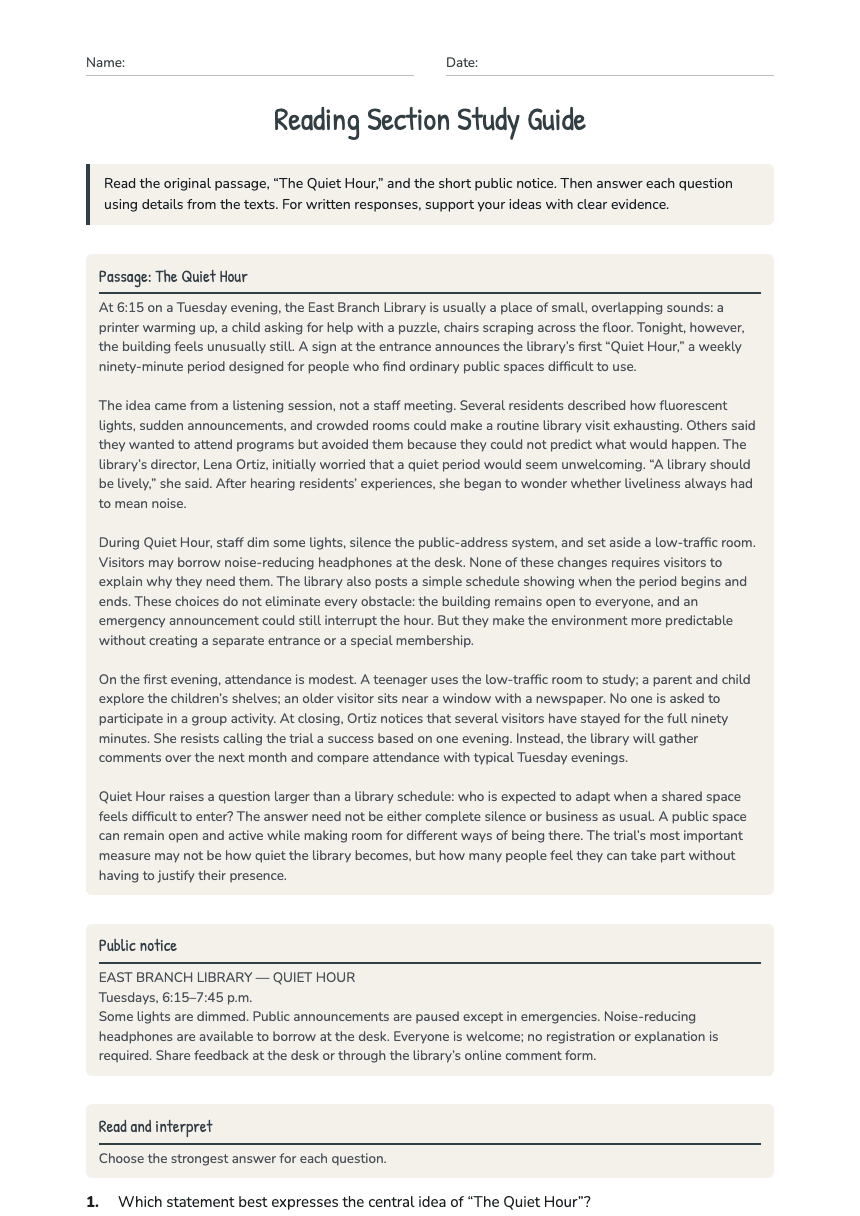
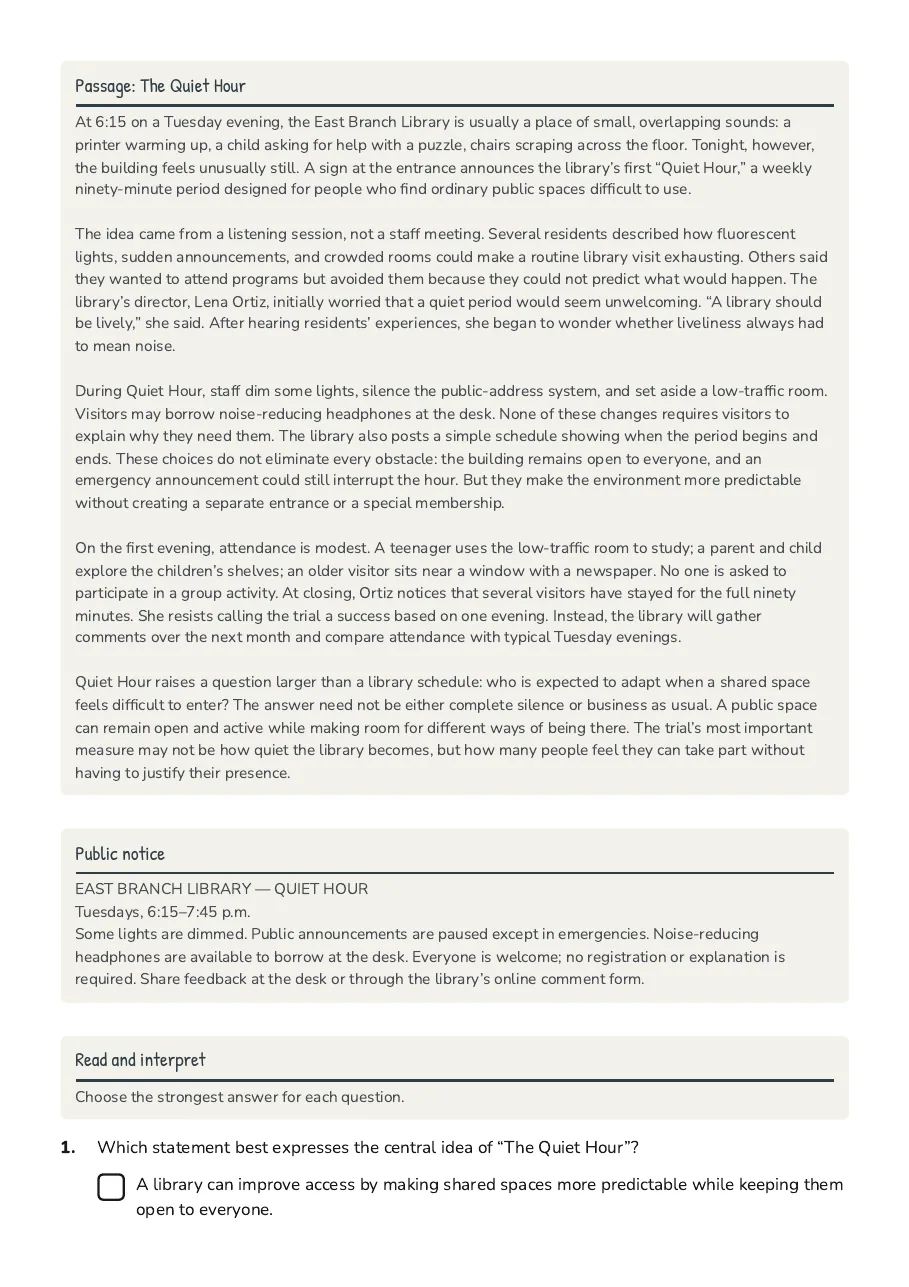
Passage: The Quiet Hour
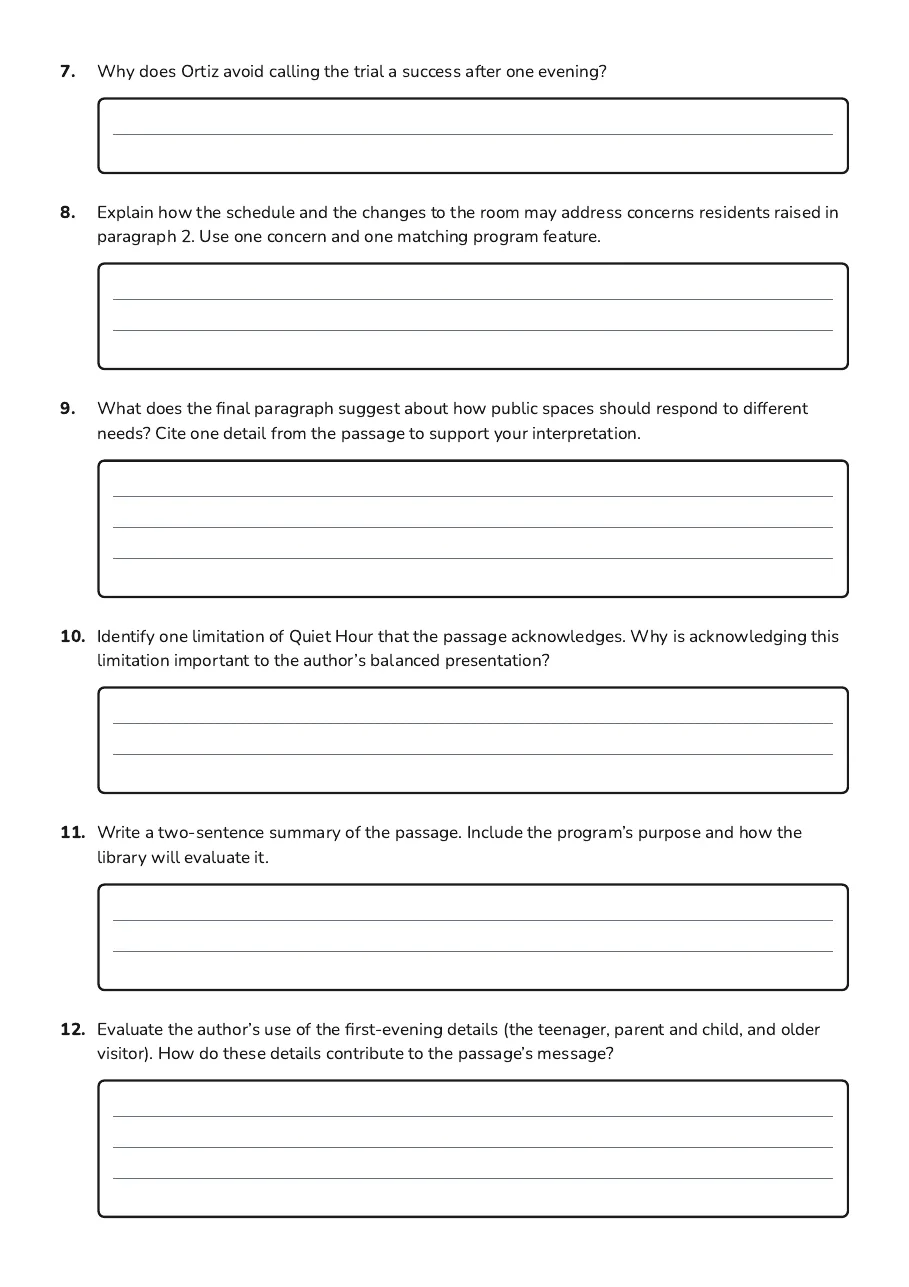
At 6:15 on a Tuesday evening, the East Branch Library is usually a place of small, overlapping sounds: a printer warming up, a child asking for help with a puzzle, chairs scraping across the floor. Tonight, however, the building feels unusually still. A sign at the entrance announces the library’s first “Quiet Hour,” a weekly ninety-minute period designed for people who find ordinary public spaces difficult to use. The idea came from a listening session, not a staff meeting. Several residents described how fluorescent lights, sudden announcements, and crowded rooms could make a routine library visit exhausting. Others said they wanted to attend programs but avoided them because they could not predict what would happen. The library’s director, Lena Ortiz, initially worried that a quiet period would seem unwelcoming. “A library should be lively,” she said. After hearing residents’ experiences, she began to wonder whether liveliness always had to mean noise. During Quiet Hour, staff dim some lights, silence the public-address system, and set aside a low-traffic room. Visitors may borrow noise-reducing headphones at the desk. None of these changes requires visitors to explain why they need them. The library also posts a simple schedule showing when the period begins and ends. These choices do not eliminate every obstacle: the building remains open to everyone, and an emergency announcement could still interrupt the hour. But they make the environment more predictable without creating a separate entrance or a special membership. On the first evening, attendance is modest. A teenager uses the low-traffic room to study; a parent and child explore the children’s shelves; an older visitor sits near a window with a newspaper. No one is asked to participate in a group activity. At closing, Ortiz notices that several visitors have stayed for the full ninety minutes. She resists calling the trial a success based on one evening. Instead, the library will gather comments over the next month and compare attendance with typical Tuesday evenings. Quiet Hour raises a question larger than a library schedule: who is expected to adapt when a shared space feels difficult to enter? The answer need not be either complete silence or business as usual. A public space can remain open and active while making room for different ways of being there. The trial’s most important measure may not be how quiet the library becomes, but how many people feel they can take part without having to justify their presence.
Public notice
EAST BRANCH LIBRARY — QUIET HOUR Tuesdays, 6:15–7:45 p.m. Some lights are dimmed. Public announcements are paused except in emergencies. Noise-reducing headphones are available to borrow at the desk. Everyone is welcome; no registration or explanation is required. Share feedback at the desk or through the library’s online comment form.
Read and interpret
Choose the strongest answer for each question.
- A library can improve access by making shared spaces more predictable while keeping them open to everyone.
- Libraries should replace lively activities with silence.
- Visitors should explain their needs before using public resources.
- One successful evening proves that a new program works.
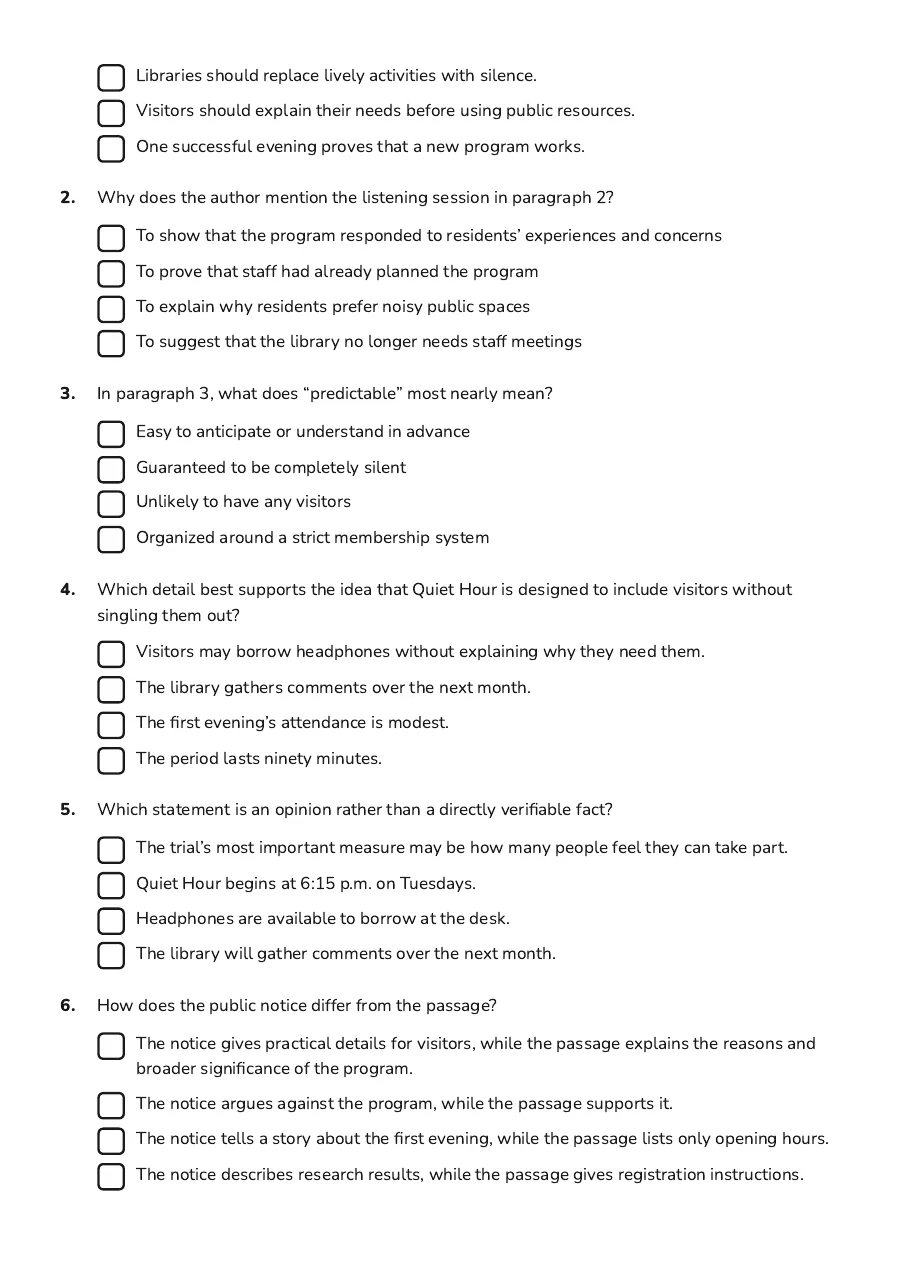
- To show that the program responded to residents’ experiences and concerns
- To prove that staff had already planned the program
- To explain why residents prefer noisy public spaces
- To suggest that the library no longer needs staff meetings
- Easy to anticipate or understand in advance
- Guaranteed to be completely silent
- Unlikely to have any visitors
- Organized around a strict membership system
- Visitors may borrow headphones without explaining why they need them.
- The library gathers comments over the next month.
- The first evening’s attendance is modest.
- The period lasts ninety minutes.
- The trial’s most important measure may be how many people feel they can take part.
- Quiet Hour begins at 6:15 p.m. on Tuesdays.
- Headphones are available to borrow at the desk.
- The library will gather comments over the next month.
- The notice gives practical details for visitors, while the passage explains the reasons and broader significance of the program.
- The notice argues against the program, while the passage supports it.
- The notice tells a story about the first evening, while the passage lists only opening hours.
- The notice describes research results, while the passage gives registration instructions.
4 printable pages
Page 1
Page 2
Page 3
Page 4
About This Worksheet
Free in Kuraplan
Sign up free, grab the PDF, and customize it for your class.
Print-Ready
Formatted for standard paper. Clean layout, easy to read.
AI-Generated
Created with Kuraplan's AI, designed for real classroom use.
For Teachers & Parents
Use in classrooms, for homework, tutoring, or homeschool.
Need a custom version of this worksheet?
Kuraplan's AI generates custom worksheets in seconds — differentiated for every learner, aligned to your curriculum.
Generate Custom Worksheets — Free