Reading Section Study Guide
A free english (ela) worksheet ready for your classroom. Open in Kuraplan to grab the print-ready PDF, customize it for your students, or generate a fresh version in seconds.
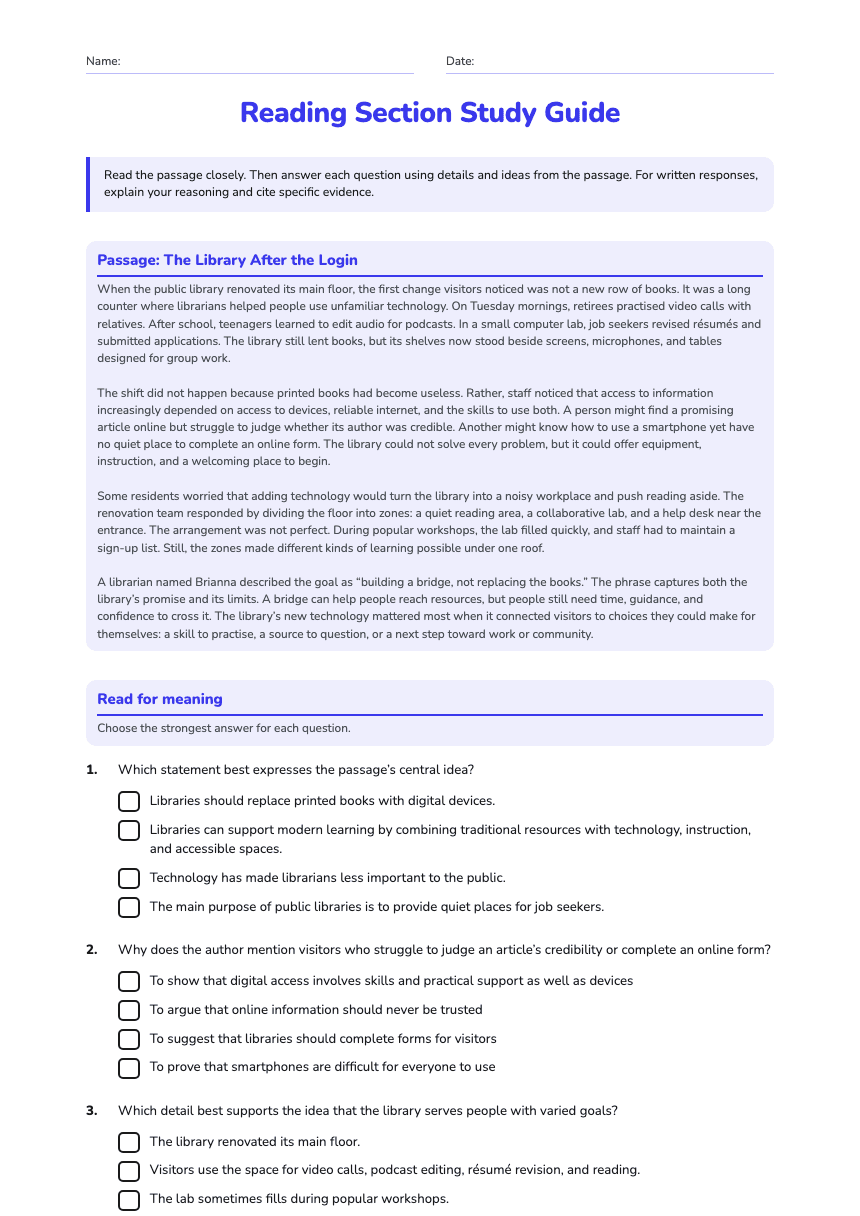
Reading Section Study Guide
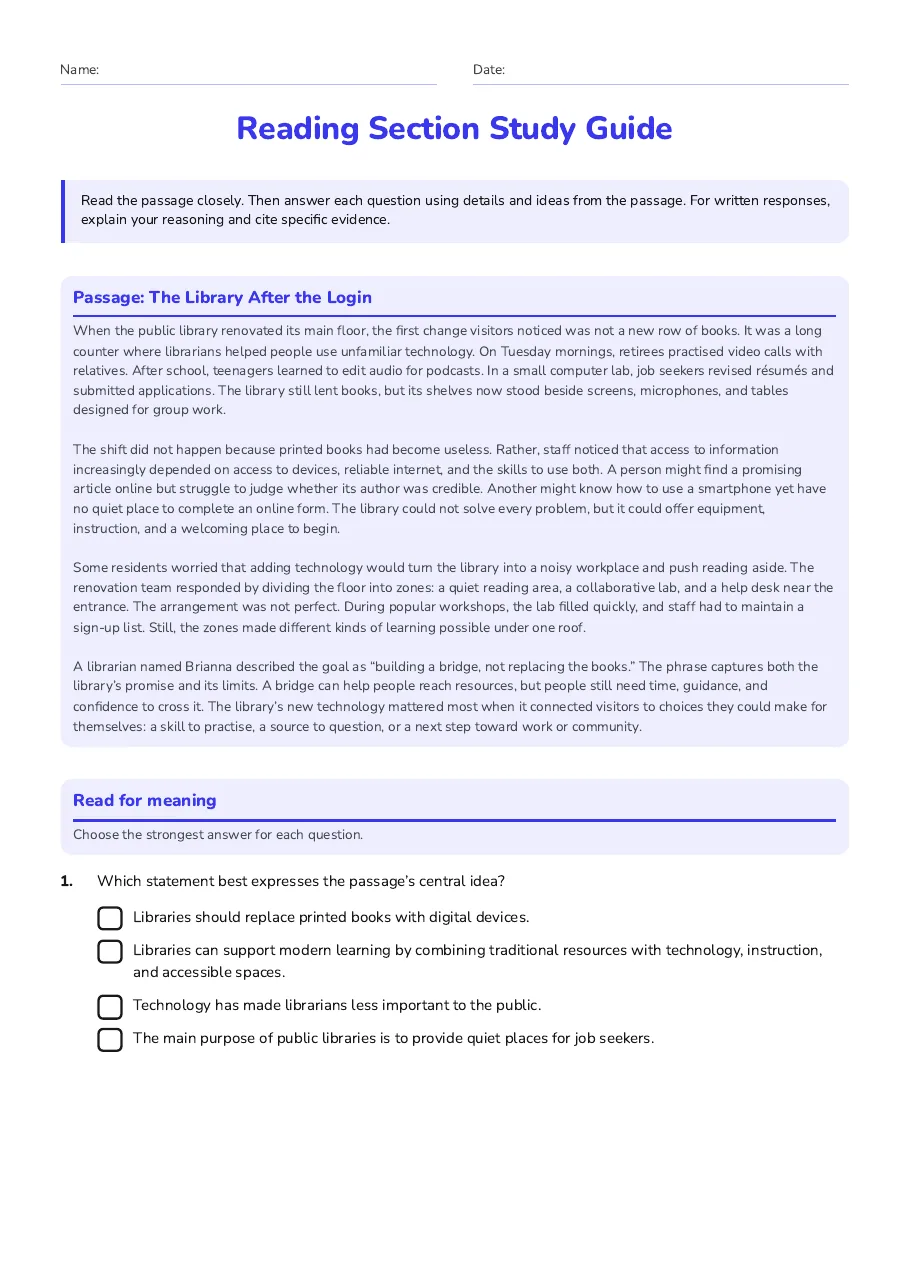
Passage: The Library After the Login
When the public library renovated its main floor, the first change visitors noticed was not a new row of books. It was a long counter where librarians helped people use unfamiliar technology. On Tuesday mornings, retirees practised video calls with relatives. After school, teenagers learned to edit audio for podcasts. In a small computer lab, job seekers revised résumés and submitted applications. The library still lent books, but its shelves now stood beside screens, microphones, and tables designed for group work. The shift did not happen because printed books had become useless. Rather, staff noticed that access to information increasingly depended on access to devices, reliable internet, and the skills to use both. A person might find a promising article online but struggle to judge whether its author was credible. Another might know how to use a smartphone yet have no quiet place to complete an online form. The library could not solve every problem, but it could offer equipment, instruction, and a welcoming place to begin. Some residents worried that adding technology would turn the library into a noisy workplace and push reading aside. The renovation team responded by dividing the floor into zones: a quiet reading area, a collaborative lab, and a help desk near the entrance. The arrangement was not perfect. During popular workshops, the lab filled quickly, and staff had to maintain a sign-up list. Still, the zones made different kinds of learning possible under one roof. A librarian named Brianna described the goal as “building a bridge, not replacing the books.” The phrase captures both the library’s promise and its limits. A bridge can help people reach resources, but people still need time, guidance, and confidence to cross it. The library’s new technology mattered most when it connected visitors to choices they could make for themselves: a skill to practise, a source to question, or a next step toward work or community.
Read for meaning
Choose the strongest answer for each question.
- Libraries should replace printed books with digital devices.
- Libraries can support modern learning by combining traditional resources with technology, instruction, and accessible spaces.
- Technology has made librarians less important to the public.
- The main purpose of public libraries is to provide quiet places for job seekers.
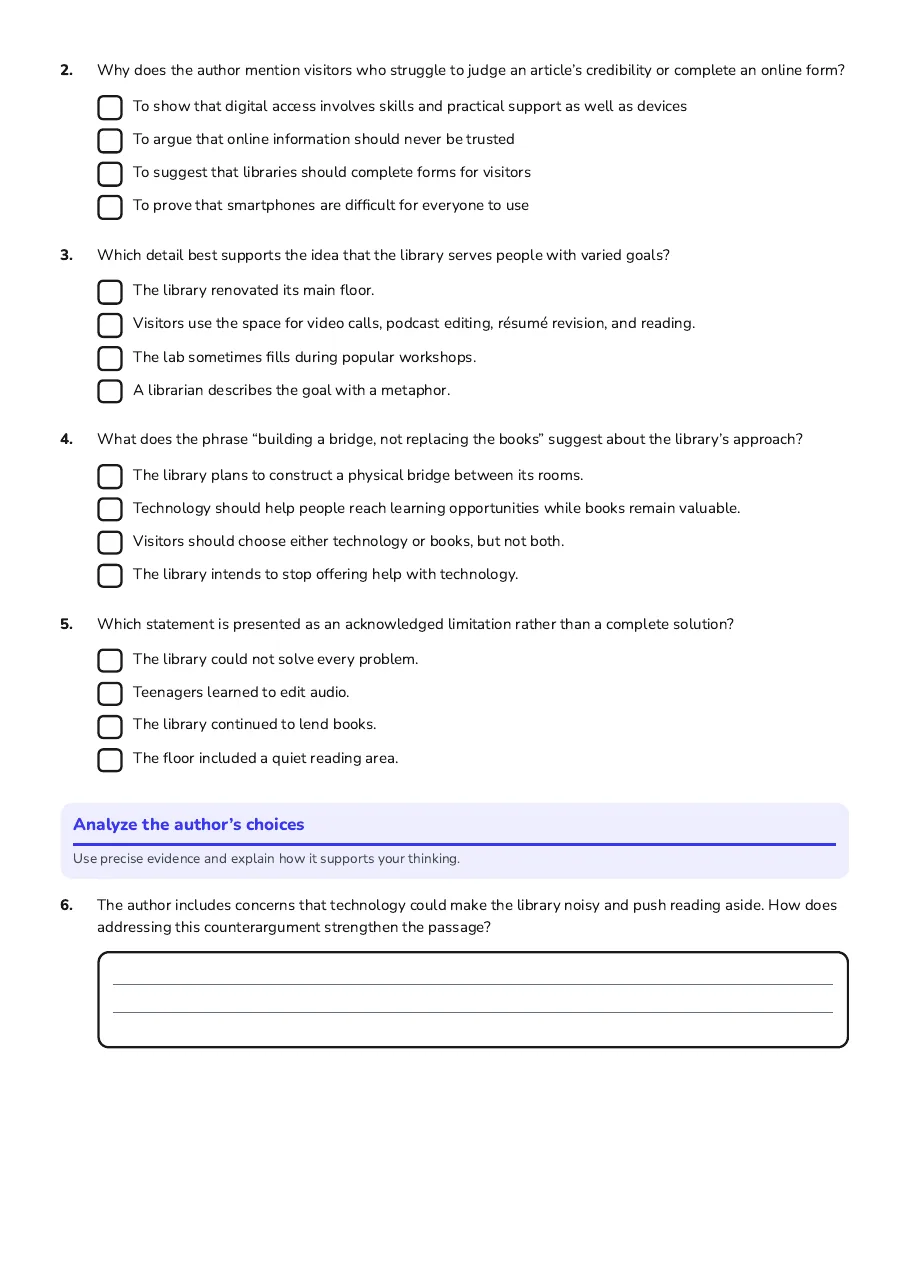
- To show that digital access involves skills and practical support as well as devices
- To argue that online information should never be trusted
- To suggest that libraries should complete forms for visitors
- To prove that smartphones are difficult for everyone to use
- The library renovated its main floor.
- Visitors use the space for video calls, podcast editing, résumé revision, and reading.
- The lab sometimes fills during popular workshops.
- A librarian describes the goal with a metaphor.
- The library plans to construct a physical bridge between its rooms.
- Technology should help people reach learning opportunities while books remain valuable.
- Visitors should choose either technology or books, but not both.
- The library intends to stop offering help with technology.
- The library could not solve every problem.
- Teenagers learned to edit audio.
- The library continued to lend books.
- The floor included a quiet reading area.
Analyze the author’s choices
Use precise evidence and explain how it supports your thinking.
3 printable pages
Page 1
Page 2
Page 3
About This Worksheet
Free in Kuraplan
Sign up free, grab the PDF, and customize it for your class.
Print-Ready
Formatted for standard paper. Clean layout, easy to read.
AI-Generated
Created with Kuraplan's AI, designed for real classroom use.
For Teachers & Parents
Use in classrooms, for homework, tutoring, or homeschool.
Need a custom version of this worksheet?
Kuraplan's AI generates custom worksheets in seconds — differentiated for every learner, aligned to your curriculum.
Generate Custom Worksheets — Free