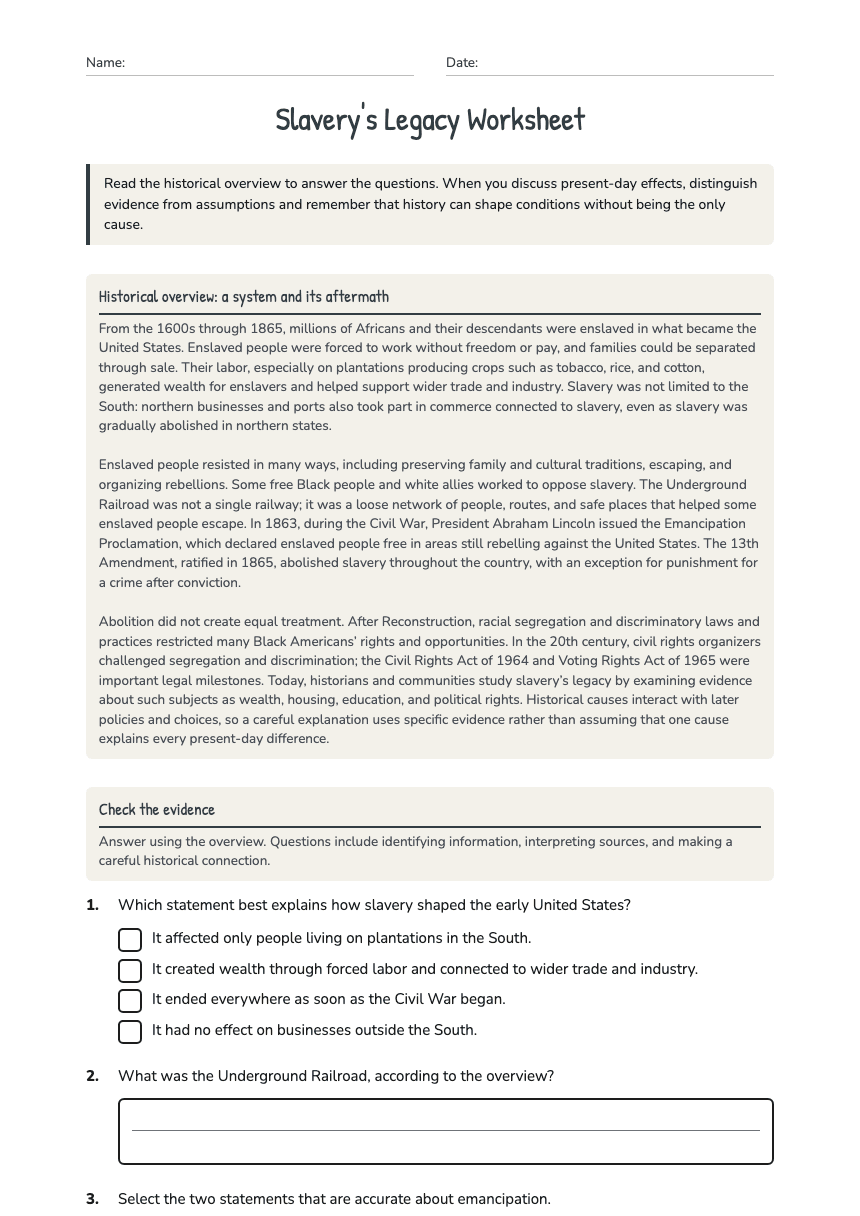
Slavery's Legacy Worksheet
A free social studies worksheet ready for your classroom. Open in Kuraplan to grab the print-ready PDF, customize it for your students, or generate a fresh version in seconds.
Slavery's Legacy Worksheet
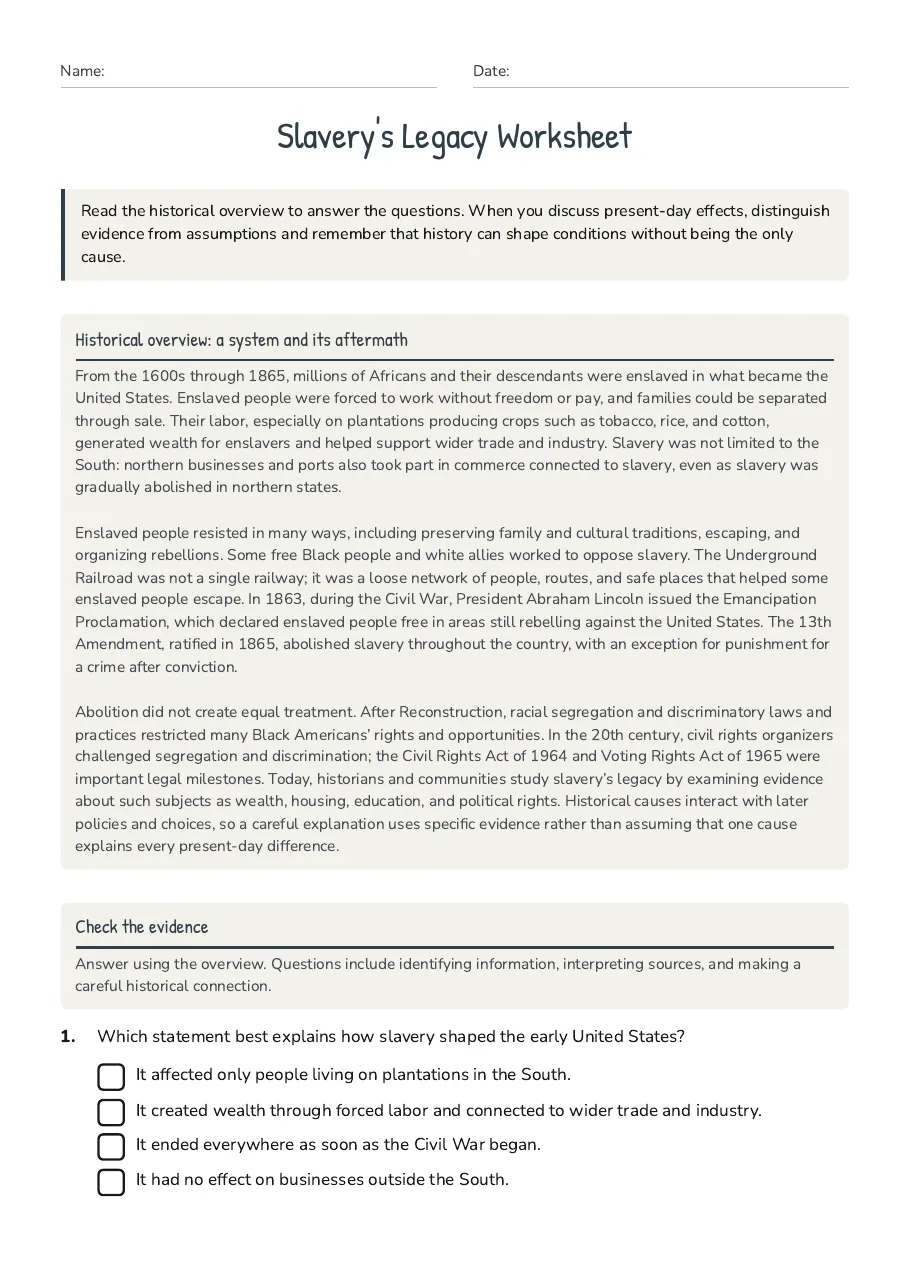
Historical overview: a system and its aftermath
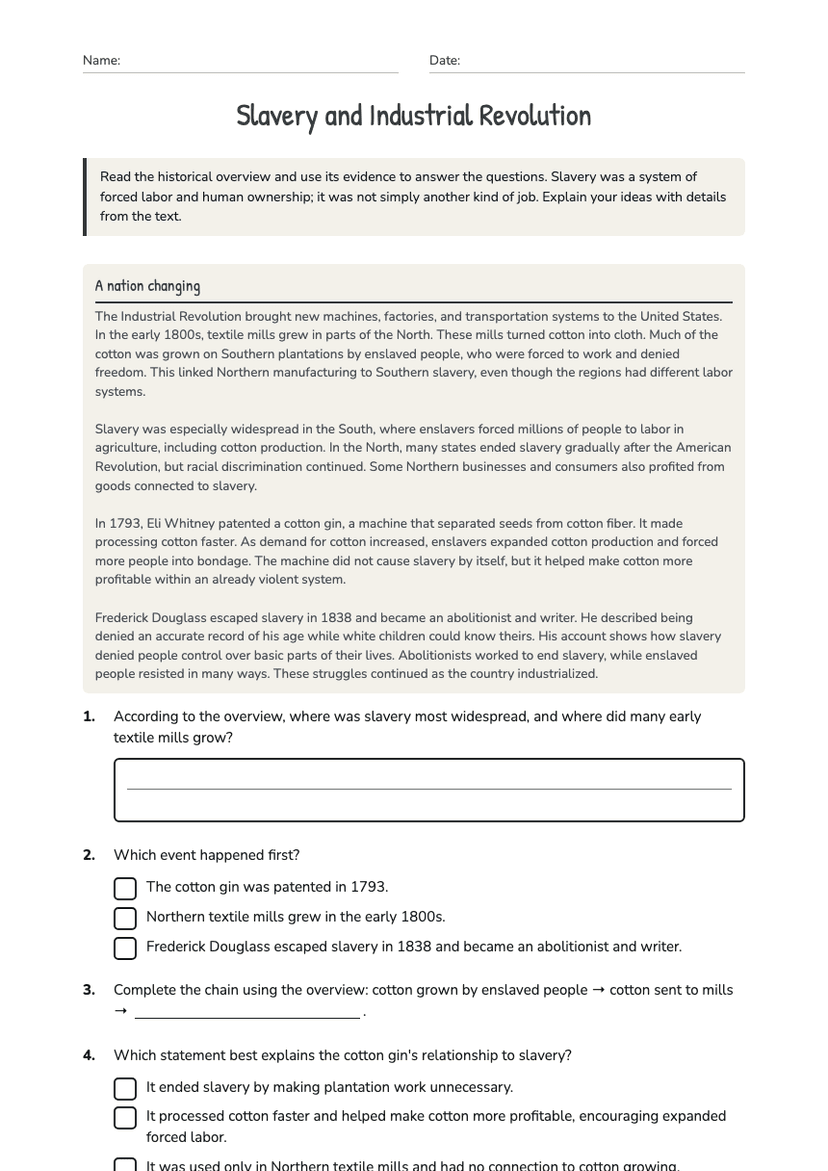
From the 1600s through 1865, millions of Africans and their descendants were enslaved in what became the United States. Enslaved people were forced to work without freedom or pay, and families could be separated through sale. Their labor, especially on plantations producing crops such as tobacco, rice, and cotton, generated wealth for enslavers and helped support wider trade and industry. Slavery was not limited to the South: northern businesses and ports also took part in commerce connected to slavery, even as slavery was gradually abolished in northern states. Enslaved people resisted in many ways, including preserving family and cultural traditions, escaping, and organizing rebellions. Some free Black people and white allies worked to oppose slavery. The Underground Railroad was not a single railway; it was a loose network of people, routes, and safe places that helped some enslaved people escape. In 1863, during the Civil War, President Abraham Lincoln issued the Emancipation Proclamation, which declared enslaved people free in areas still rebelling against the United States. The 13th Amendment, ratified in 1865, abolished slavery throughout the country, with an exception for punishment for a crime after conviction. Abolition did not create equal treatment. After Reconstruction, racial segregation and discriminatory laws and practices restricted many Black Americans’ rights and opportunities. In the 20th century, civil rights organizers challenged segregation and discrimination; the Civil Rights Act of 1964 and Voting Rights Act of 1965 were important legal milestones. Today, historians and communities study slavery’s legacy by examining evidence about such subjects as wealth, housing, education, and political rights. Historical causes interact with later policies and choices, so a careful explanation uses specific evidence rather than assuming that one cause explains every present-day difference.
Check the evidence
Answer using the overview. Questions include identifying information, interpreting sources, and making a careful historical connection.
- It affected only people living on plantations in the South.
- It created wealth through forced labor and connected to wider trade and industry.
- It ended everywhere as soon as the Civil War began.
- It had no effect on businesses outside the South.
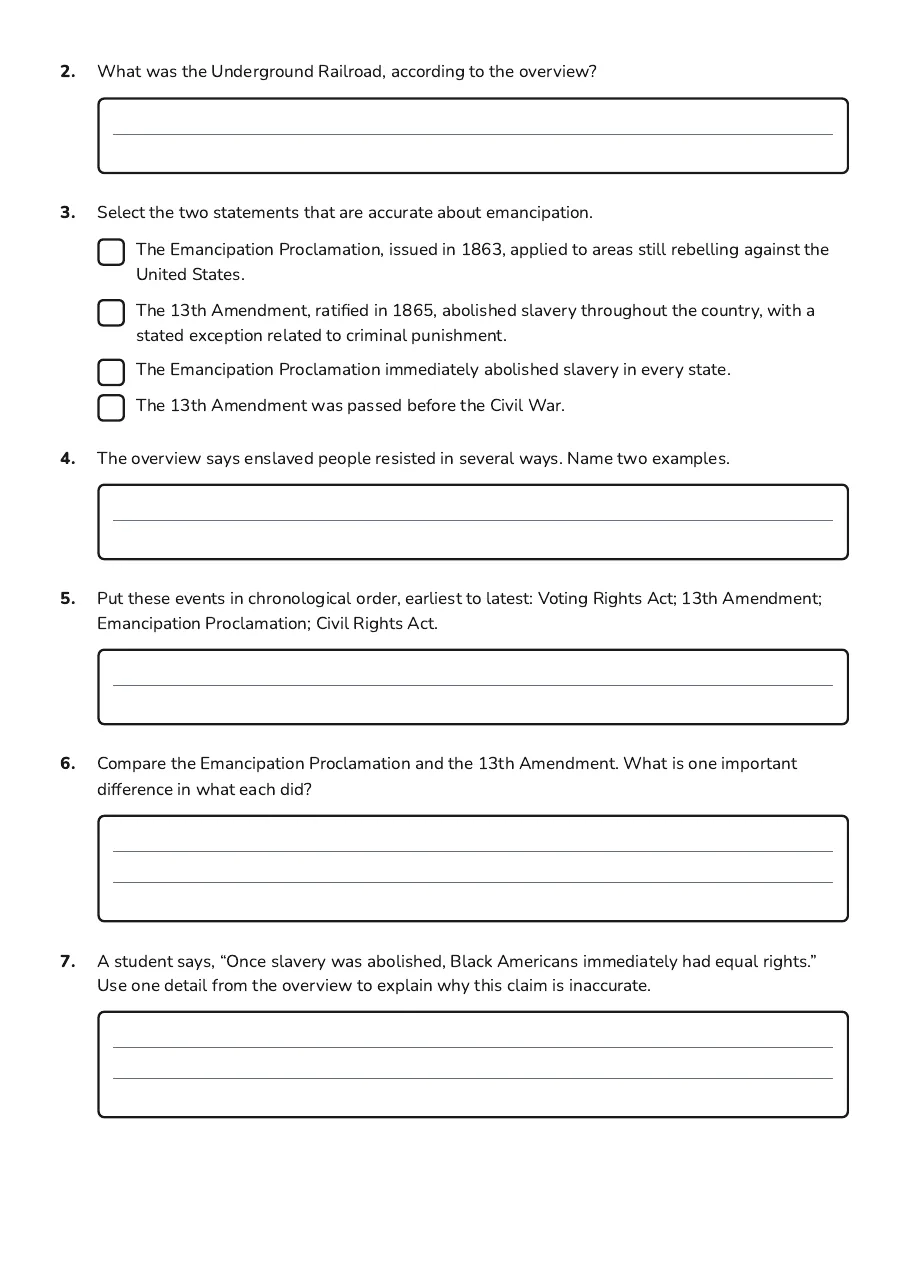
- The Emancipation Proclamation, issued in 1863, applied to areas still rebelling against the United States.
- The 13th Amendment, ratified in 1865, abolished slavery throughout the country, with a stated exception related to criminal punishment.
- The Emancipation Proclamation immediately abolished slavery in every state.
- The 13th Amendment was passed before the Civil War.
3 printable pages
Page 1
Page 2
Page 3
About This Worksheet
Free in Kuraplan
Sign up free, grab the PDF, and customize it for your class.
Print-Ready
Formatted for standard paper. Clean layout, easy to read.
AI-Generated
Created with Kuraplan's AI, designed for real classroom use.
For Teachers & Parents
Use in classrooms, for homework, tutoring, or homeschool.
Need a custom version of this worksheet?
Kuraplan's AI generates custom worksheets in seconds — differentiated for every learner, aligned to your curriculum.
Generate Custom Worksheets — Free