STEMFreePrintable

Solar System Vehicle Design

A free stem worksheet ready for your classroom. Open in Kuraplan to grab the print-ready PDF, customize it for your students, or generate a fresh version in seconds.
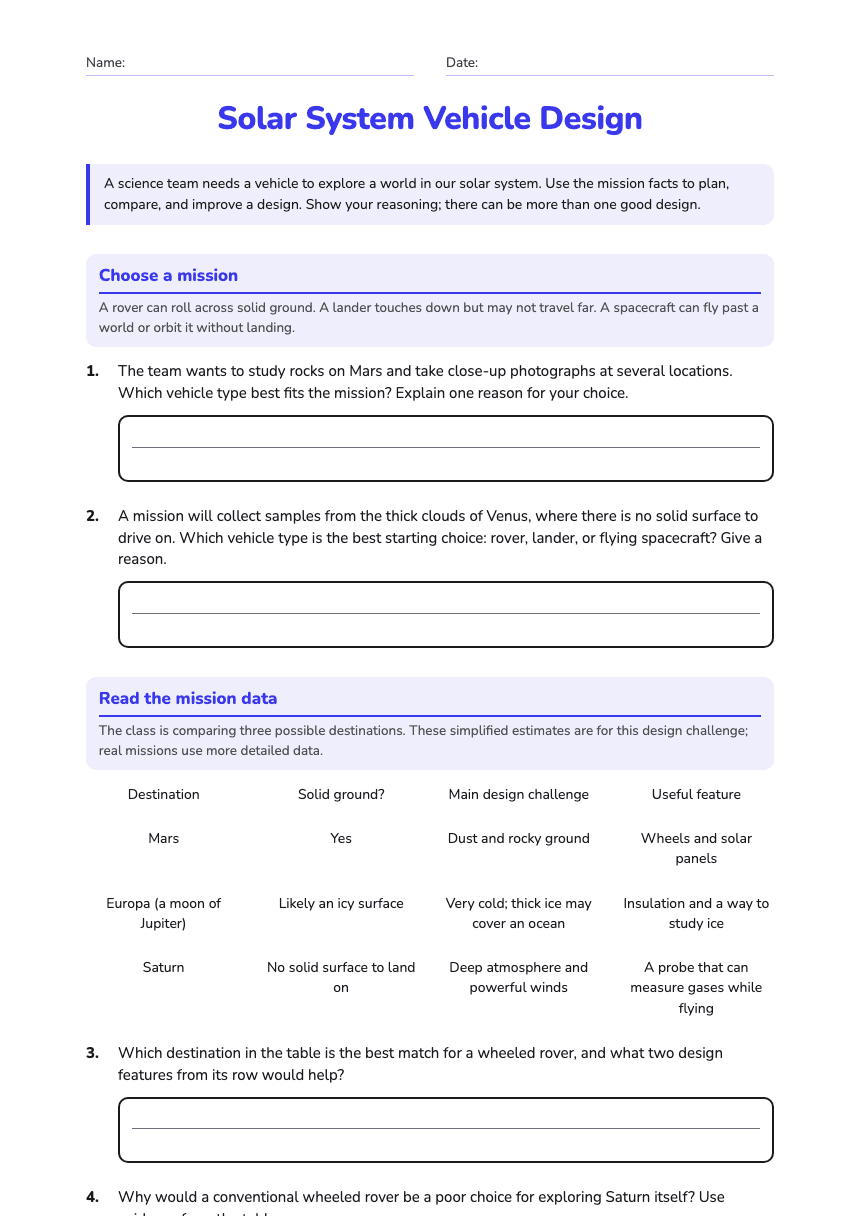
Solar System Vehicle Design worksheet preview
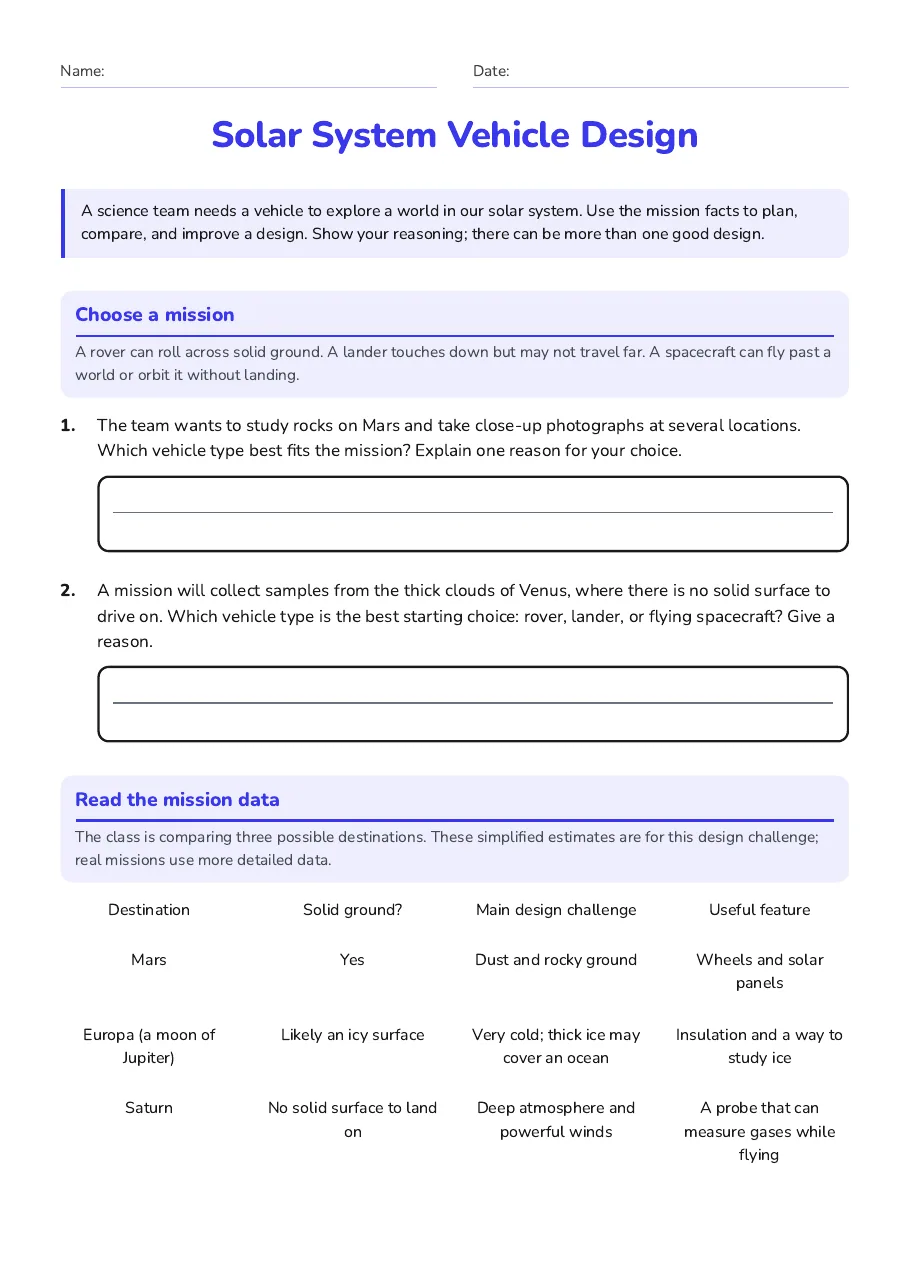
Name:Date:

Solar System Vehicle Design

A science team needs a vehicle to explore a world in our solar system. Use the mission facts to plan, compare, and improve a design. Show your reasoning; there can be more than one good design.

Choose a mission

A rover can roll across solid ground. A lander touches down but may not travel far. A spacecraft can fly past a world or orbit it without landing.

1.The team wants to study rocks on Mars and take close-up photographs at several locations. Which vehicle type best fits the mission? Explain one reason for your choice.
2.A mission will collect samples from the thick clouds of Venus, where there is no solid surface to drive on. Which vehicle type is the best starting choice: rover, lander, or flying spacecraft? Give a reason.

Read the mission data

The class is comparing three possible destinations. These simplified estimates are for this design challenge; real missions use more detailed data.

Destination

Solid ground?

Main design challenge

Useful feature

Mars

Yes

Dust and rocky ground

Wheels and solar panels

Europa (a moon of Jupiter)

Likely an icy surface

Very cold; thick ice may cover an ocean

Insulation and a way to study ice

Saturn

No solid surface to land on

Deep atmosphere and powerful winds

A probe that can measure gases while flying

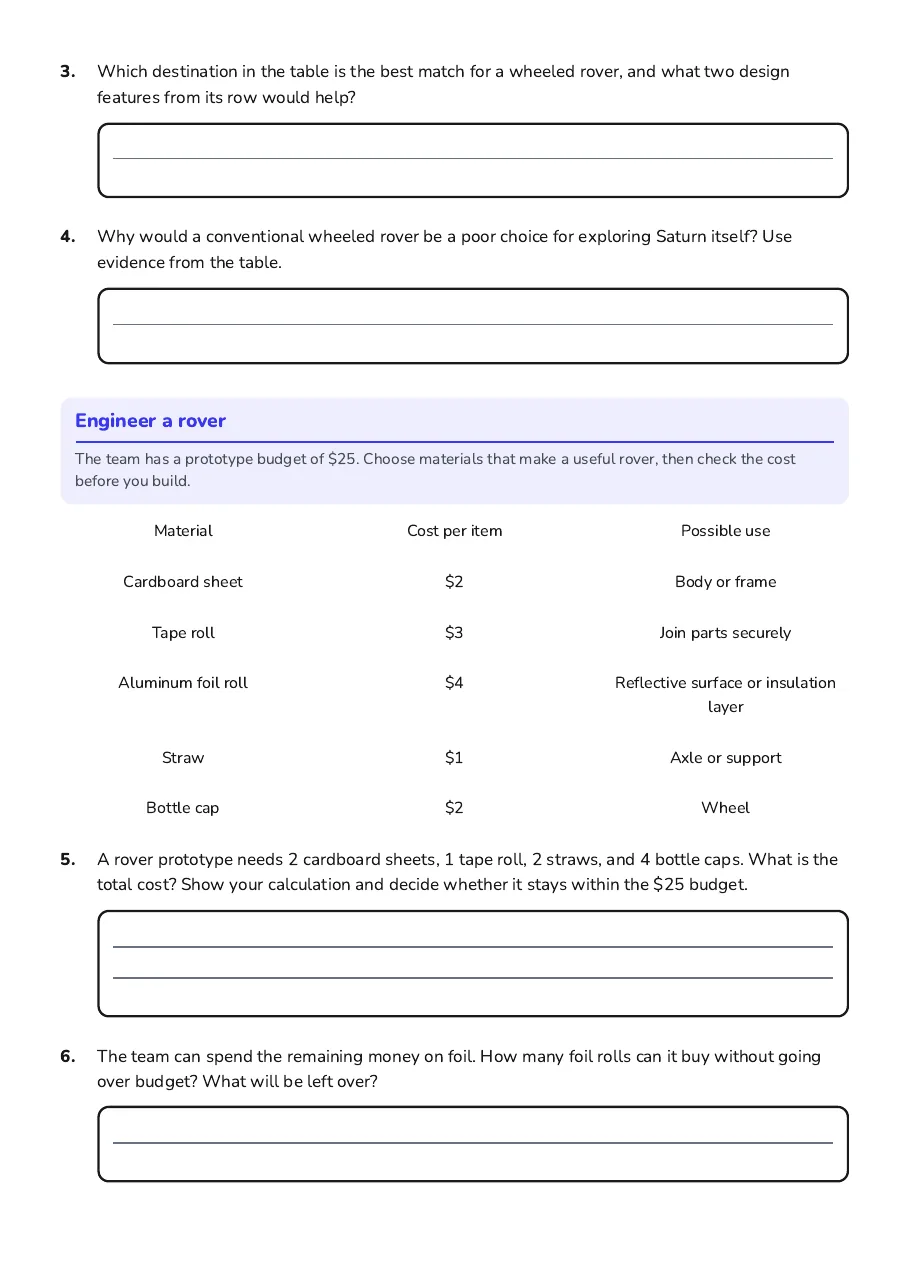
3.Which destination in the table is the best match for a wheeled rover, and what two design features from its row would help?
4.Why would a conventional wheeled rover be a poor choice for exploring Saturn itself? Use evidence from the table.

Engineer a rover

The team has a prototype budget of $25. Choose materials that make a useful rover, then check the cost before you build.

Material

Cost per item

Possible use

Cardboard sheet

$2

Body or frame

Tape roll

$3

Join parts securely

Aluminum foil roll

$4

Reflective surface or insulation layer

Straw

$1

Axle or support

Bottle cap

$2

Wheel

5.A rover prototype needs 2 cardboard sheets, 1 tape roll, 2 straws, and 4 bottle caps. What is the total cost? Show your calculation and decide whether it stays within the $25 budget.
6.The team can spend the remaining money on foil. How many foil rolls can it buy without going over budget? What will be left over?
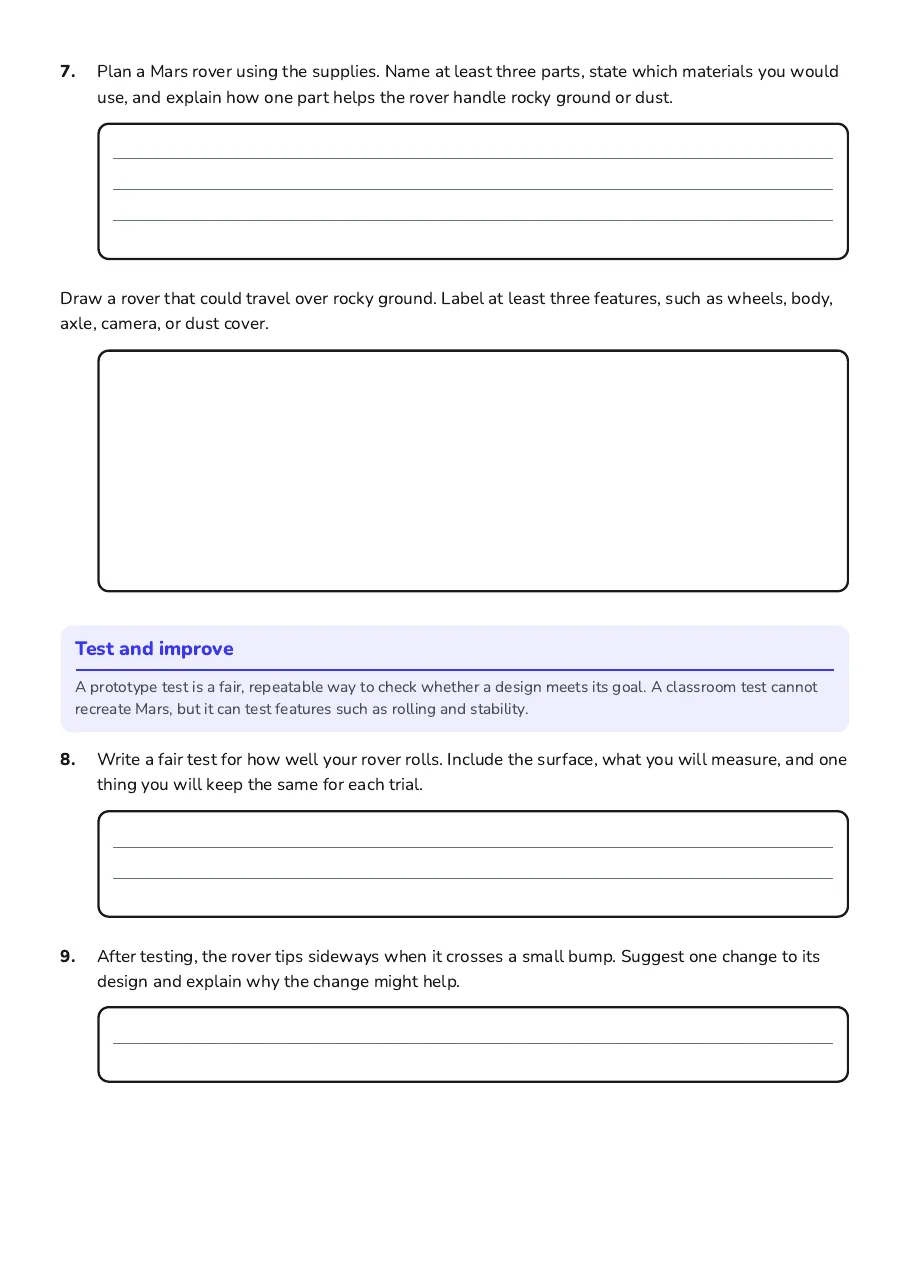
7.Plan a Mars rover using the supplies. Name at least three parts, state which materials you would use, and explain how one part helps the rover handle rocky ground or dust.
Draw a rover that could travel over rocky ground. Label at least three features, such as wheels, body, axle, camera, or dust cover.

Test and improve

A prototype test is a fair, repeatable way to check whether a design meets its goal. A classroom test cannot recreate Mars, but it can test features such as rolling and stability.

8.Write a fair test for how well your rover rolls. Include the surface, what you will measure, and one thing you will keep the same for each trial.
9.After testing, the rover tips sideways when it crosses a small bump. Suggest one change to its design and explain why the change might help.

3 printable pages

  • Solar System Vehicle Design, page 1 of 3: Choose a mission, Read the mission data

    Page 1

  • Solar System Vehicle Design, page 2 of 3: Engineer a rover

    Page 2

  • Solar System Vehicle Design, page 3 of 3: Test and improve

    Page 3

About This Worksheet

Free in Kuraplan

Sign up free, grab the PDF, and customize it for your class.

Print-Ready

Formatted for standard paper. Clean layout, easy to read.

AI-Generated

Created with Kuraplan's AI, designed for real classroom use.

For Teachers & Parents

Use in classrooms, for homework, tutoring, or homeschool.

Need a custom version of this worksheet?

Kuraplan's AI generates custom worksheets in seconds — differentiated for every learner, aligned to your curriculum.

Generate Custom Worksheets — Free
No credit card Curriculum-aligned Under 60 seconds