English (ELA)FreePrintable
Text Structures with Legos
A free english (ela) worksheet ready for your classroom. Open in Kuraplan to grab the print-ready PDF, customize it for your students, or generate a fresh version in seconds.
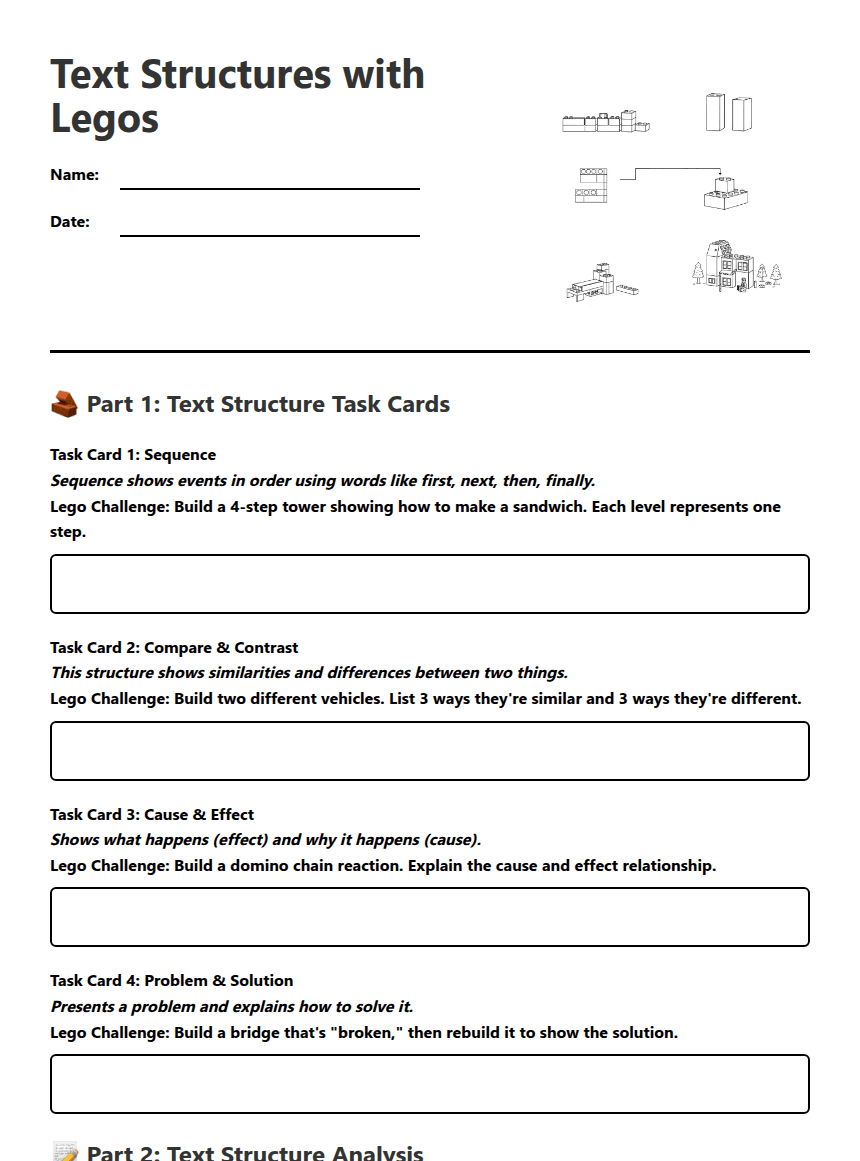
Text Structures with Legos
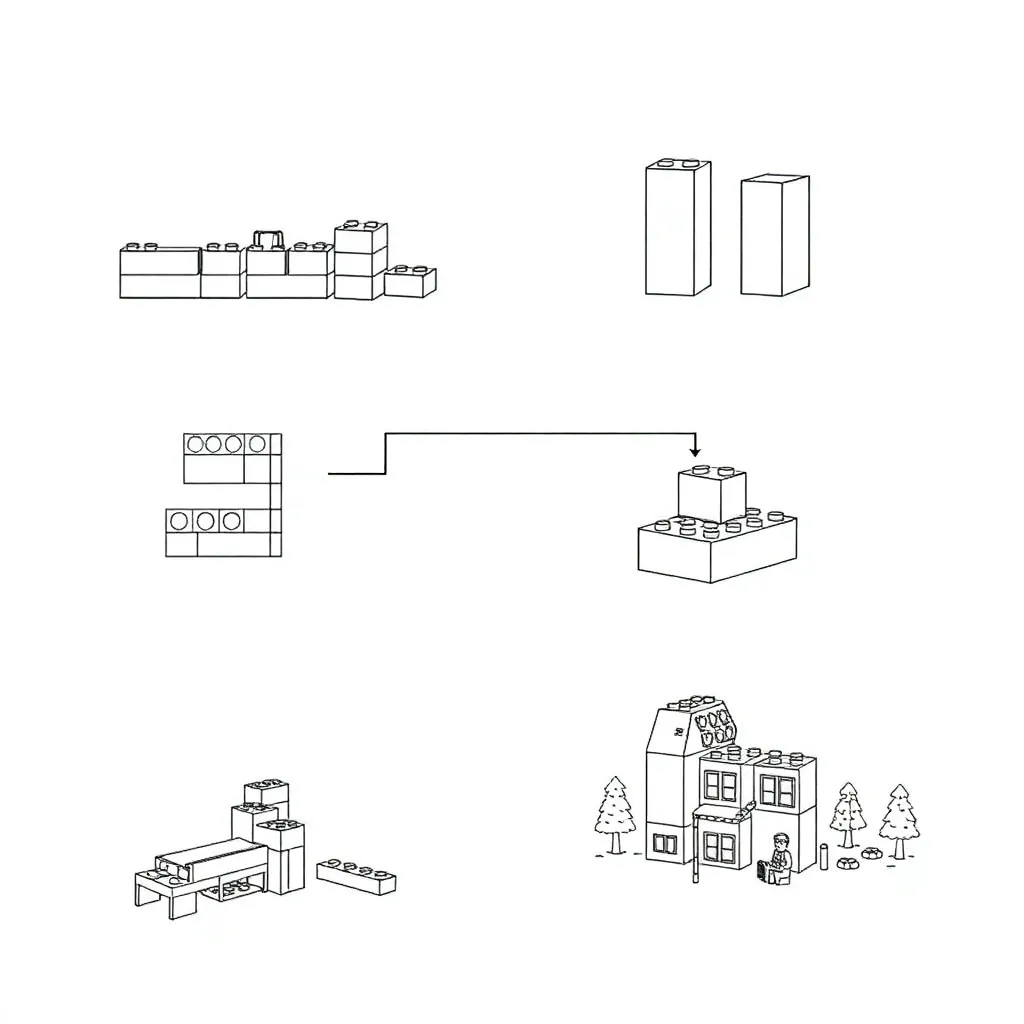
📋 Learning Objectives
🎯 What You'll Learn Today:
- STAAR Reading: Identify and analyze different text structures using signal words
- STAAR Writing: Use evidence from texts to support your analysis
- TELPAS Speaking: Explain your Lego models using academic vocabulary
- TELPAS Writing: Write clear explanations with sentence frames and evidence
- Critical Thinking: Connect visual models to text organization patterns
🧱 Part 1: Build Text Structures with Legos
Instructions: Your teacher will assign your group ONE task card below. Build a Lego model that shows your text structure. After building, discuss the question stems with your group and prepare to present your model to the class using academic vocabulary.
🔄 Important Reminder: After building your model, use the question stems in your task card to discuss and write about how your Lego creation demonstrates the text structure. Be ready to explain your thinking using the sentence frames provided.
Task Card 1: Sequence Structure
Shows events in order using signal words like first, next, then, finally.
Your Challenge: Build a model that shows steps in order. Your model should clearly show how sequence works.
STAAR-Aligned Question Stems (Discuss and Write About):
Shows events in order using signal words like first, next, then, finally.
Your Challenge: Build a model that shows steps in order. Your model should clearly show how sequence works.
STAAR-Aligned Question Stems (Discuss and Write About):
- Why is sequence structure important when explaining a process or telling about events? How does your Lego model show this importance?
- What signal words help readers recognize when a text uses sequence structure? How would you explain these clues to another student using your model?
- How does organizing information in sequence help readers understand what they're reading? What would happen if the steps in your model were mixed up?
- "Sequence structure is important because _____, and my model shows this by _____"
- "Signal words like _____ help readers understand _____"
- "My model demonstrates sequence by _____ which helps readers _____"
Task Card 2: Compare & Contrast Structure
Shows similarities and differences using signal words like similarly, however, in contrast, whereas.
Your Challenge: Build two models that show how things are alike and different.
STAAR-Aligned Question Stems (Discuss and Write About):
Shows similarities and differences using signal words like similarly, however, in contrast, whereas.
Your Challenge: Build two models that show how things are alike and different.
STAAR-Aligned Question Stems (Discuss and Write About):
- How does compare and contrast structure help readers understand the relationship between two or more things? What does your Lego model teach us about this?
- What clues in a text tell you that an author is comparing and contrasting? How would you use your model to explain these clues?
- Why might an author choose to organize information by showing similarities and differences? How does your model make this purpose clear?
- "Compare and contrast structure helps readers by _____, as shown in my model when _____"
- "Authors use signal words like _____ to show _____, which my model demonstrates by _____"
- "My model shows that comparing and contrasting is useful because _____"
Task Card 3: Cause & Effect Structure
Shows what happens and why using signal words like because, therefore, as a result, due to.
Your Challenge: Build a model that shows what causes something to happen and what the effect is.
STAAR-Aligned Question Stems (Discuss and Write About):
Shows what happens and why using signal words like because, therefore, as a result, due to.
Your Challenge: Build a model that shows what causes something to happen and what the effect is.
STAAR-Aligned Question Stems (Discuss and Write About):
- How does cause and effect structure help readers understand why events happen? What does your Lego model show about this connection?
- What clues would tell you a text is organized by cause and effect? How does your model help explain these signal words?
- Why is it important for readers to understand the relationship between causes and effects? How does your model make this relationship clear?
- "Cause and effect structure helps readers understand _____, and my model shows this by _____"
- "Signal words like _____ indicate _____, which my model demonstrates through _____"
- "Understanding cause and effect is important because _____, as my model shows when _____"
Task Card 4: Problem & Solution Structure
Shows challenges and how to fix them using signal words like problem, solution, resolve, address, overcome.
Your Challenge: Build a model that clearly shows a problem and its solution.
STAAR-Aligned Question Stems (Discuss and Write About):
Shows challenges and how to fix them using signal words like problem, solution, resolve, address, overcome.
Your Challenge: Build a model that clearly shows a problem and its solution.
STAAR-Aligned Question Stems (Discuss and Write About):
- How does the problem and solution structure help a reader understand the text? What does your Lego model teach us about this organization?
- What signal words and phrases help readers identify when a text presents problems and solutions? How would you use your model to teach these clues?
- Why might an author choose to organize information by showing problems and their solutions? How does your model demonstrate this purpose?
- "Problem and solution structure helps readers by _____, which my model shows through _____"
- "Authors use words like _____ to signal _____, and my model demonstrates this by _____"
- "My model shows that presenting problems and solutions is effective because _____"
Task Card 5: Description Structure
Gives detailed information about a topic using signal words like for example, specifically, characteristics include, features are.
Your Challenge: Build a detailed model that shows many features of one topic.
STAAR-Aligned Question Stems (Discuss and Write About):
Gives detailed information about a topic using signal words like for example, specifically, characteristics include, features are.
Your Challenge: Build a detailed model that shows many features of one topic.
STAAR-Aligned Question Stems (Discuss and Write About):
- How does descriptive structure help readers learn about a topic? What does your Lego model show about how description works?
- What signal words help readers recognize when an author is using descriptive structure? How would you explain these clues using your model?
- Why is descriptive structure useful for helping readers understand complex topics? How does your model make this clear?
- "Descriptive structure helps readers by _____, and my model demonstrates this through _____"
- "Signal words like _____ show that an author is _____, which my model illustrates by _____"
- "My model shows that description is useful because _____ which helps readers _____"
📝 Part 2: Text Structure Practice
1. Signal Words Practice: A text explains how climate change affects polar bears, then compares Arctic conditions from 1990 to 2020, followed by proposed solutions. Which combination of text structures is used?
Cause/Effect → Compare/Contrast → Problem/Solution
Sequence → Description → Cause/Effect
Problem/Solution → Sequence → Compare/Contrast
Description → Cause/Effect → Sequence
2. Academic Language: Which signal word groups show advanced academic language? (Select all that apply)
"Furthermore, consequently, therefore"
"First, next, finally"
"Although, however, nevertheless"
"For instance, specifically, particularly"
3. Writing Practice: Write a paragraph about your Lego model. Use your assigned text structure and answer the question stems from your task card. Use at least three signal words that match your text structure.
Requirements:
- Answer at least one question stem from your task card
- Use signal words correctly
- Explain how your model demonstrates the text structure
- Use the sentence frames provided in your task card
🎯 Part 3: Advanced Challenge
4. Multi-Structure Challenge: Create a new Lego model that combines two different text structures. Write about your model using question stems from two different task cards. Explain why authors might combine text structures in their writing.
5. Design Challenge: Create a new Lego challenge for other students that teaches one text structure. Include question stems and sentence frames to help them.
Text Structure Focus: ___________________
Challenge Description: ___________________
6. Reflection: Which text structure was easiest to build with Legos? Which was hardest? How did building with Legos help you understand text structures better than just reading about them? Use the question stems from the task cards to support your answer.
📚 STAAR & TELPAS Connection
📌 Why This Matters:
STAAR Reading: You practiced identifying text structures and analyzing how they help readers understand texts.
STAAR Writing: You learned to explain your thinking and use evidence in your writing.
TELPAS: You developed academic vocabulary, used sentence frames, and practiced explaining your thinking clearly.
Real Life: Understanding how texts are organized helps you read and write more effectively in all subjects.
STAAR Reading: You practiced identifying text structures and analyzing how they help readers understand texts.
STAAR Writing: You learned to explain your thinking and use evidence in your writing.
TELPAS: You developed academic vocabulary, used sentence frames, and practiced explaining your thinking clearly.
Real Life: Understanding how texts are organized helps you read and write more effectively in all subjects.
✍️ Extended Writing: Text Structure Analysis
Final Writing Task: Choose your best Lego model. Write a detailed explanation (3-4 paragraphs) that analyzes how your model demonstrates text structure. Answer the question stems from your task card and explain why this text structure is effective for communicating ideas.
Requirements:
🚀 Sentence Starters to Help You:
Requirements:
- Write 3-4 paragraphs (150+ words total)
- Use academic vocabulary from the task cards
- Answer at least 2 question stems from your task card
- Use sentence frames to help organize your writing
- Explain how your model shows the text structure
- Use transition words and signal words correctly
🚀 Sentence Starters to Help You:
- Introduction: "My Lego model demonstrates _____ text structure by..."
- Evidence: "This structure helps readers understand _____ because..."
- Analysis: "My model shows that this text structure is effective because..."
- Conclusion: "Building with Legos helped me understand..."
Self-Check: Review your writing using this checklist.
I clearly explained my text structure
I answered question stems from my task card
I used academic vocabulary correctly
I explained how my Lego model demonstrates the text structure
I used signal words and transition words
My writing is at least 150 words
I checked my grammar and spelling
About This Worksheet
Free in Kuraplan
Sign up free, grab the PDF, and customize it for your class.
Print-Ready
Formatted for standard paper. Clean layout, easy to read.
AI-Generated
Created with Kuraplan's AI, designed for real classroom use.
For Teachers & Parents
Use in classrooms, for homework, tutoring, or homeschool.
Need a custom version of this worksheet?
Kuraplan's AI generates custom worksheets in seconds — differentiated for every learner, aligned to your curriculum.
Generate Custom Worksheets — Free No credit card Curriculum-aligned Under 60 seconds
More English (ELA) Worksheets
9th Grade
Theme and Textual Evidence
Free
3rd Grade
The Magic Marker Mystery Worksheet
Free
6th Grade
Magic Marker Mystery Quiz
Free
6th Grade
The Magic Marker Mystery Worksheet
Free
6th Grade
Text Evidence and Inference Assessment
Free
6th Grade
Citing Evidence and Inferences
Free
6th Grade
Preview, Predict, Read”】【
Free
6th Grade–8th Grade