AC and DC Electricity
A free science worksheet ready for your classroom. Open in Kuraplan to grab the print-ready PDF, customize it for your students, or generate a fresh version in seconds.
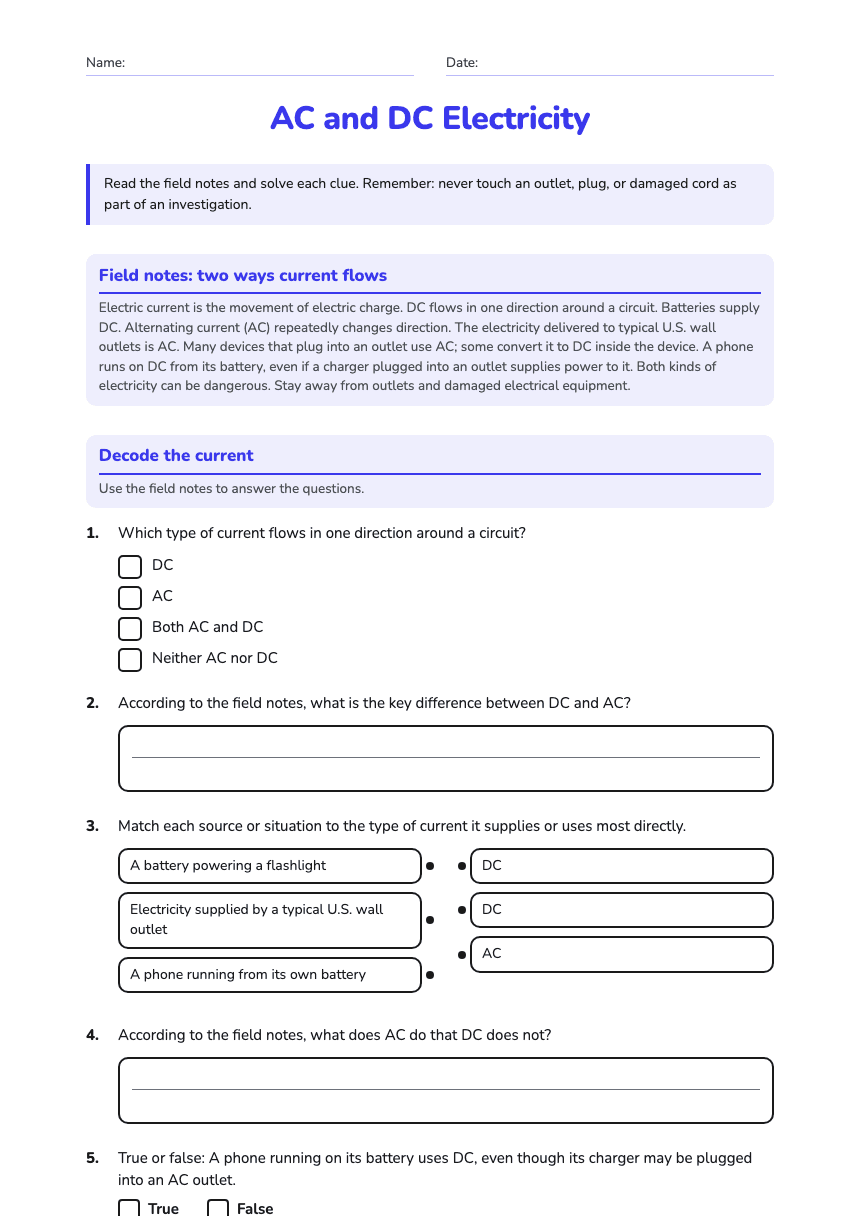
AC and DC Electricity
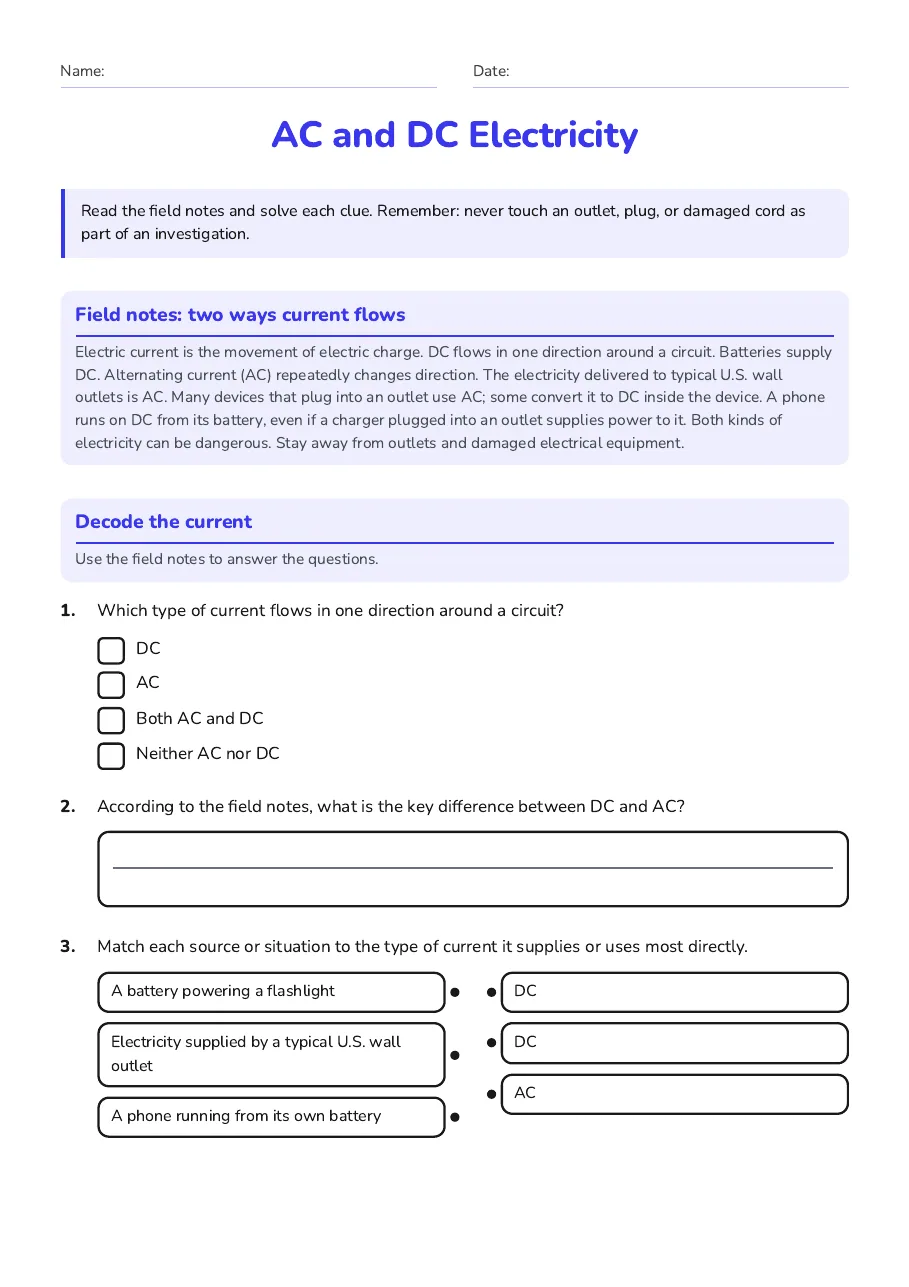
Field notes: two ways current flows
Electric current is the movement of electric charge. DC flows in one direction around a circuit. Batteries supply DC. Alternating current (AC) repeatedly changes direction. The electricity delivered to typical U.S. wall outlets is AC. Many devices that plug into an outlet use AC; some convert it to DC inside the device. A phone runs on DC from its battery, even if a charger plugged into an outlet supplies power to it. Both kinds of electricity can be dangerous. Stay away from outlets and damaged electrical equipment.
Decode the current
Use the field notes to answer the questions.
- DC
- AC
- Both AC and DC
- Neither AC nor DC
- A battery powering a flashlight
- Electricity supplied by a typical U.S. wall outlet
- A phone running from its own battery
- DC
- DC
- AC
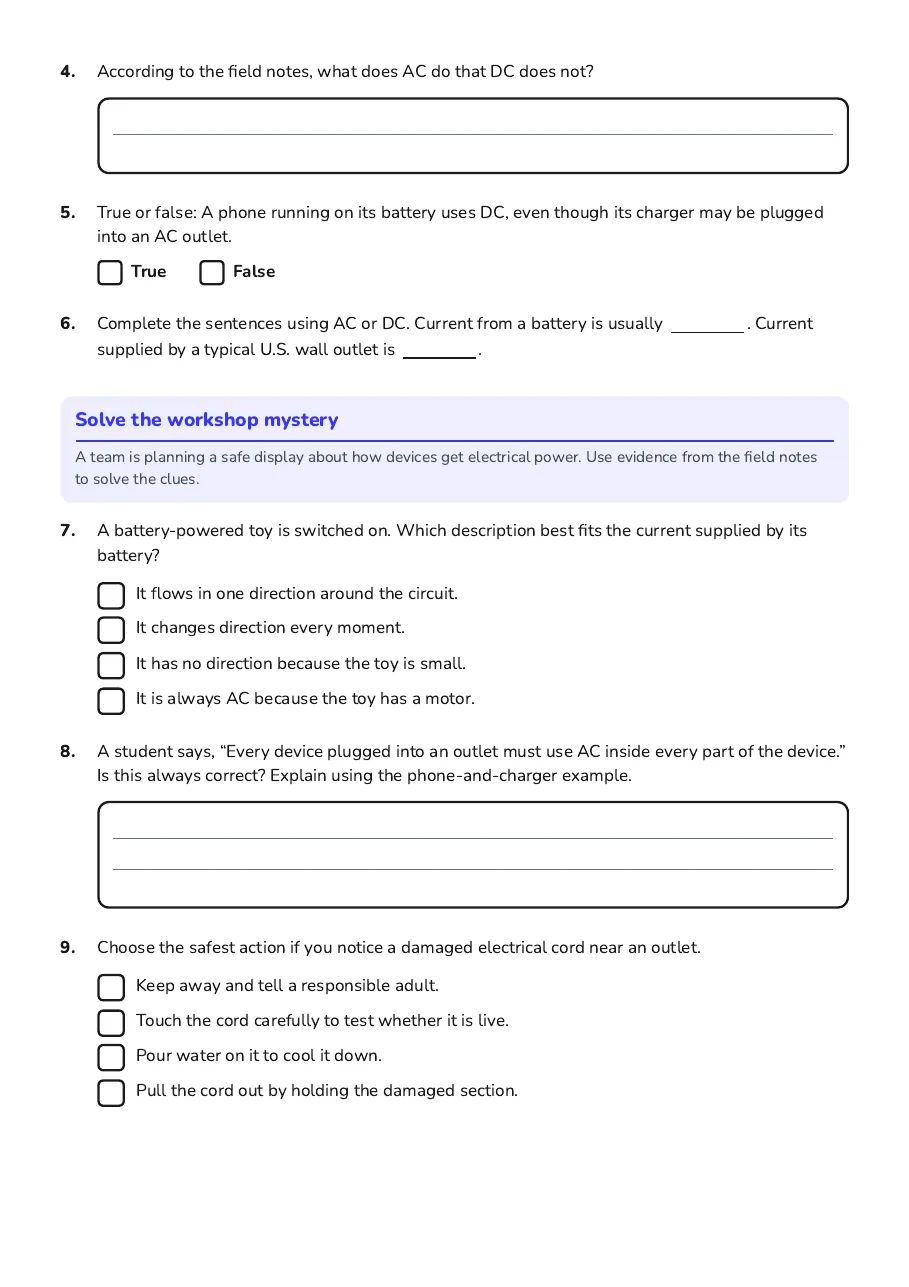
Solve the workshop mystery
A team is planning a safe display about how devices get electrical power. Use evidence from the field notes to solve the clues.
- It flows in one direction around the circuit.
- It changes direction every moment.
- It has no direction because the toy is small.
- It is always AC because the toy has a motor.
- Keep away and tell a responsible adult.
- Touch the cord carefully to test whether it is live.
- Pour water on it to cool it down.
- Pull the cord out by holding the damaged section.
3 printable pages
Page 1
Page 2
Page 3
About This Worksheet
Free in Kuraplan
Sign up free, grab the PDF, and customize it for your class.
Print-Ready
Formatted for standard paper. Clean layout, easy to read.
AI-Generated
Created with Kuraplan's AI, designed for real classroom use.
For Teachers & Parents
Use in classrooms, for homework, tutoring, or homeschool.
Need a custom version of this worksheet?
Kuraplan's AI generates custom worksheets in seconds — differentiated for every learner, aligned to your curriculum.
Generate Custom Worksheets — Free