ScienceFreePrintable
AC/DC Circuits Worksheet
A free science worksheet ready for your classroom. Open in Kuraplan to grab the print-ready PDF, customize it for your students, or generate a fresh version in seconds.
Name:Date:
AC/DC Circuits Worksheet
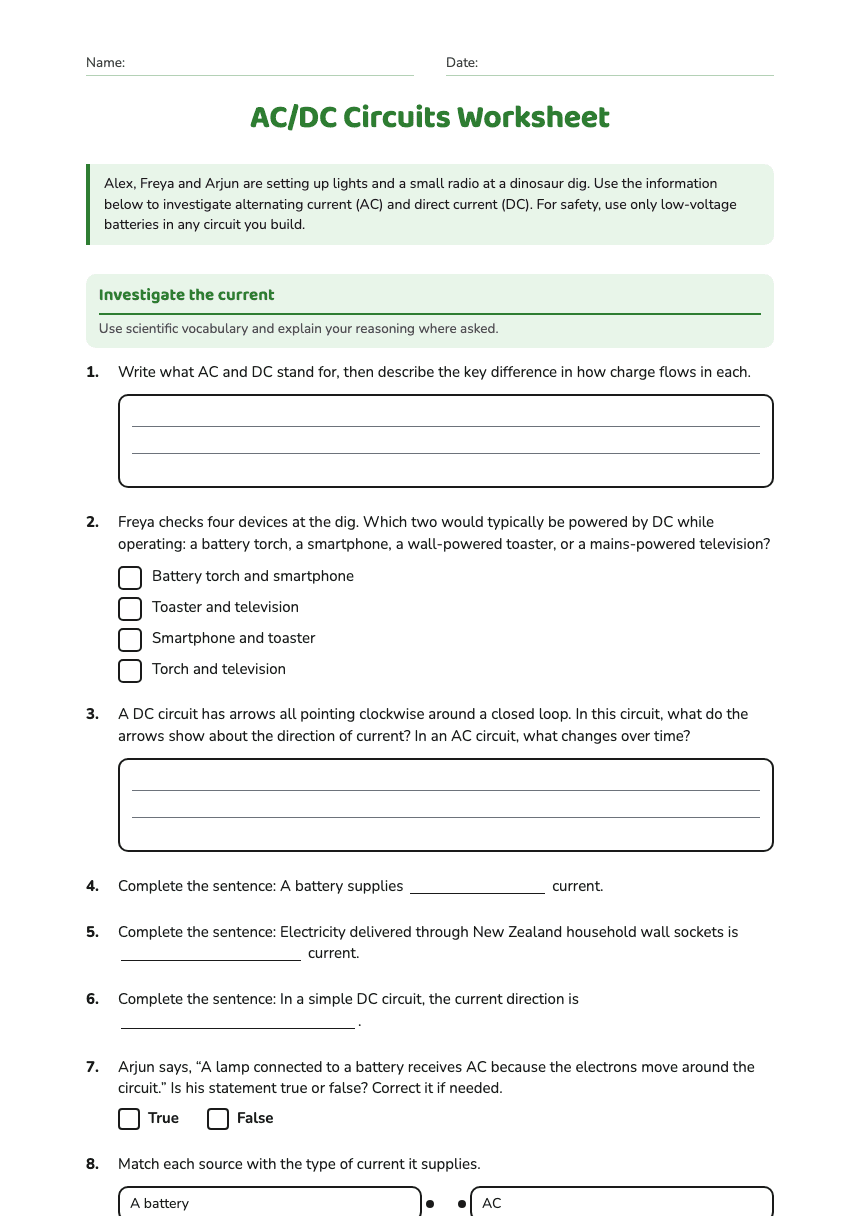
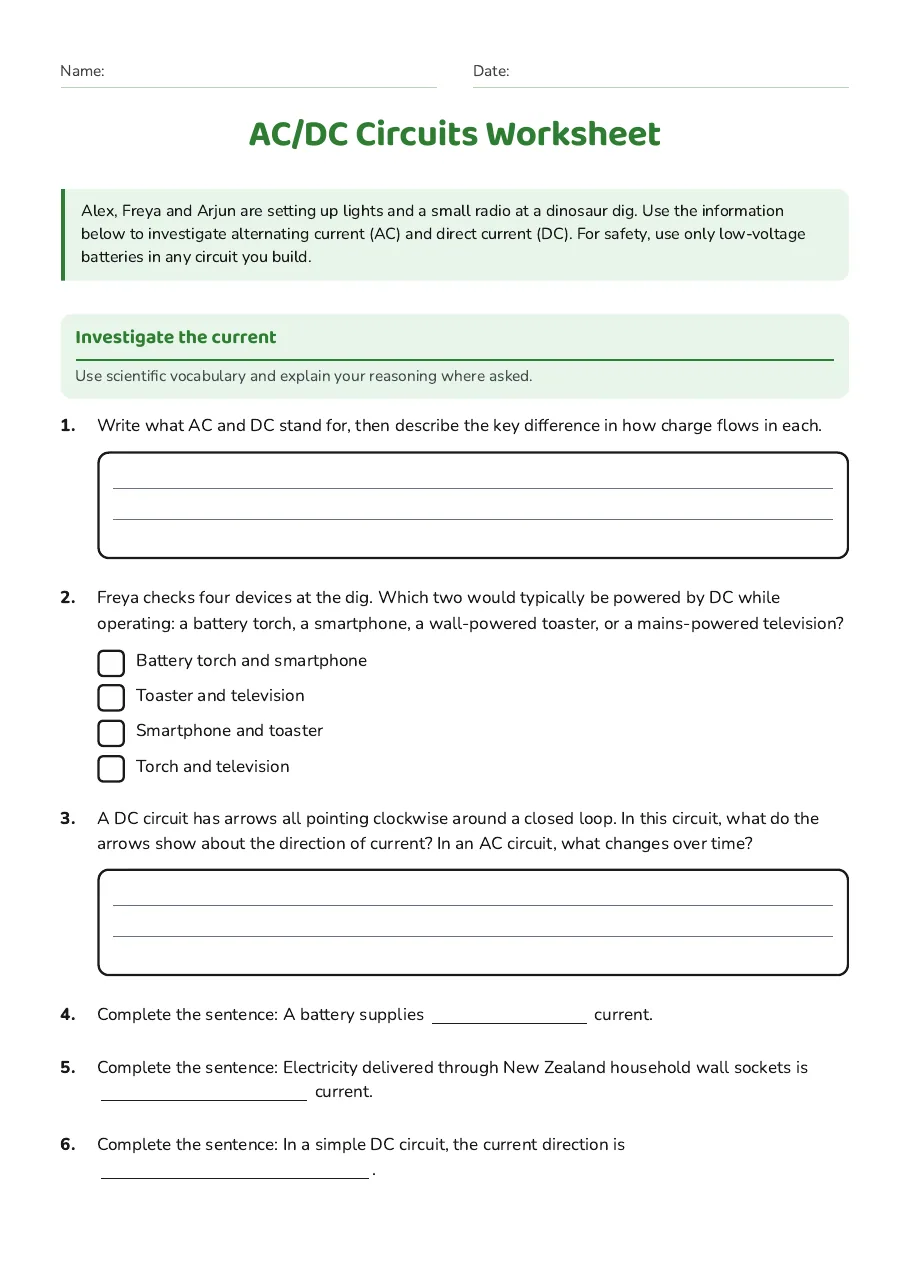
Alex, Freya and Arjun are setting up lights and a small radio at a dinosaur dig. Use the information below to investigate alternating current (AC) and direct current (DC). For safety, use only low-voltage batteries in any circuit you build.
Investigate the current
Use scientific vocabulary and explain your reasoning where asked.
1.Write what AC and DC stand for, then describe the key difference in how charge flows in each.
2.Freya checks four devices at the dig. Which two would typically be powered by DC while operating: a battery torch, a smartphone, a wall-powered toaster, or a mains-powered television?
- Battery torch and smartphone
- Toaster and television
- Smartphone and toaster
- Torch and television
3.A DC circuit has arrows all pointing clockwise around a closed loop. In this circuit, what do the arrows show about the direction of current? In an AC circuit, what changes over time?
4.Complete the sentence: A battery supplies current.
5.Complete the sentence: Electricity delivered through New Zealand household wall sockets is current.
6.Complete the sentence: In a simple DC circuit, the current direction is .
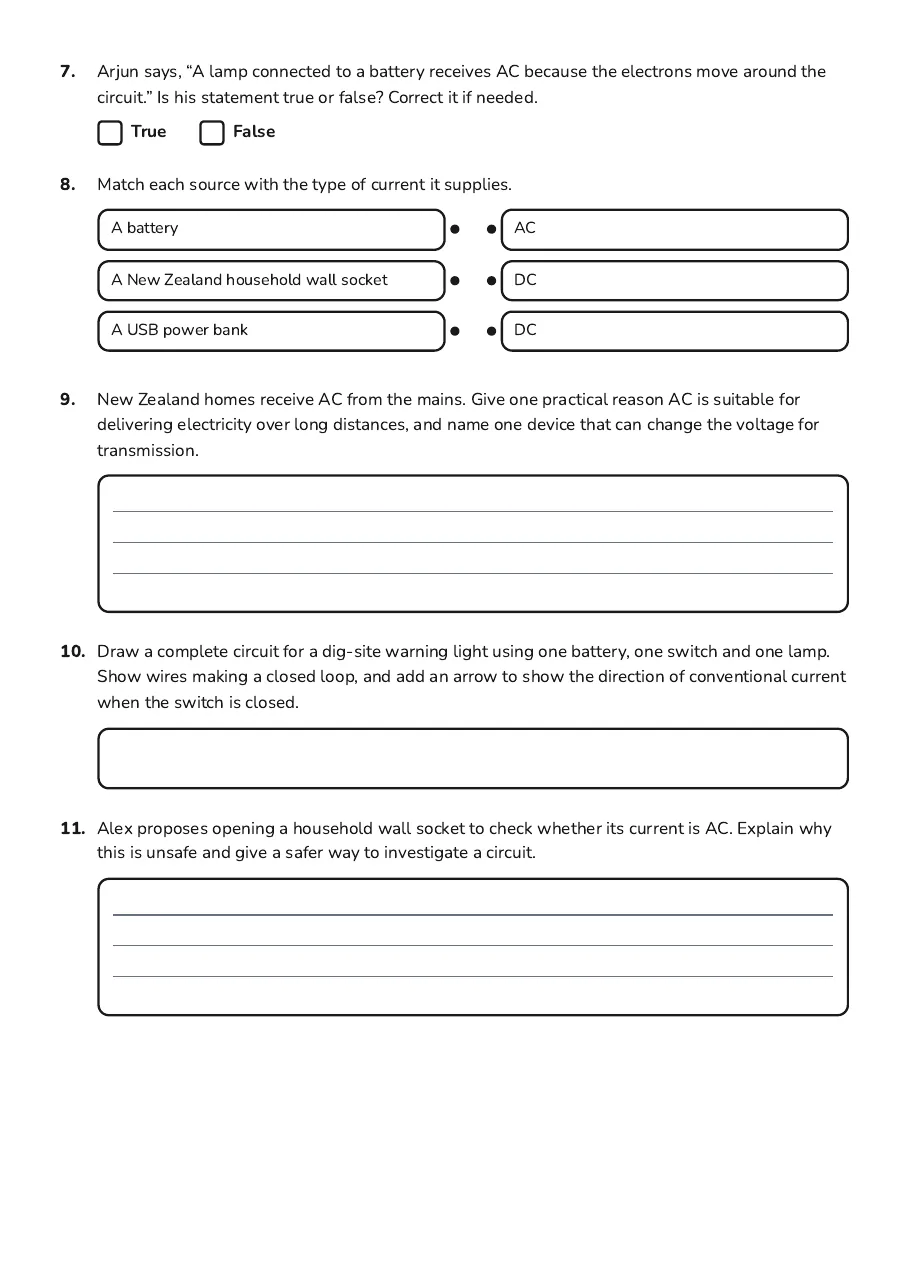
7.Arjun says, “A lamp connected to a battery receives AC because the electrons move around the circuit.” Is his statement true or false? Correct it if needed.
TrueFalse
8.Match each source with the type of current it supplies.
- A battery
- A New Zealand household wall socket
- A USB power bank
- AC
- DC
- DC
9.New Zealand homes receive AC from the mains. Give one practical reason AC is suitable for delivering electricity over long distances, and name one device that can change the voltage for transmission.
10.Draw a complete circuit for a dig-site warning light using one battery, one switch and one lamp. Show wires making a closed loop, and add an arrow to show the direction of conventional current when the switch is closed.
11.Alex proposes opening a household wall socket to check whether its current is AC. Explain why this is unsafe and give a safer way to investigate a circuit.
2 printable pages
Page 1
Page 2
About This Worksheet
Free in Kuraplan
Sign up free, grab the PDF, and customize it for your class.
Print-Ready
Formatted for standard paper. Clean layout, easy to read.
AI-Generated
Created with Kuraplan's AI, designed for real classroom use.
For Teachers & Parents
Use in classrooms, for homework, tutoring, or homeschool.
Need a custom version of this worksheet?
Kuraplan's AI generates custom worksheets in seconds — differentiated for every learner, aligned to your curriculum.
Generate Custom Worksheets — Free No credit card Curriculum-aligned Under 60 seconds
More Science Worksheets
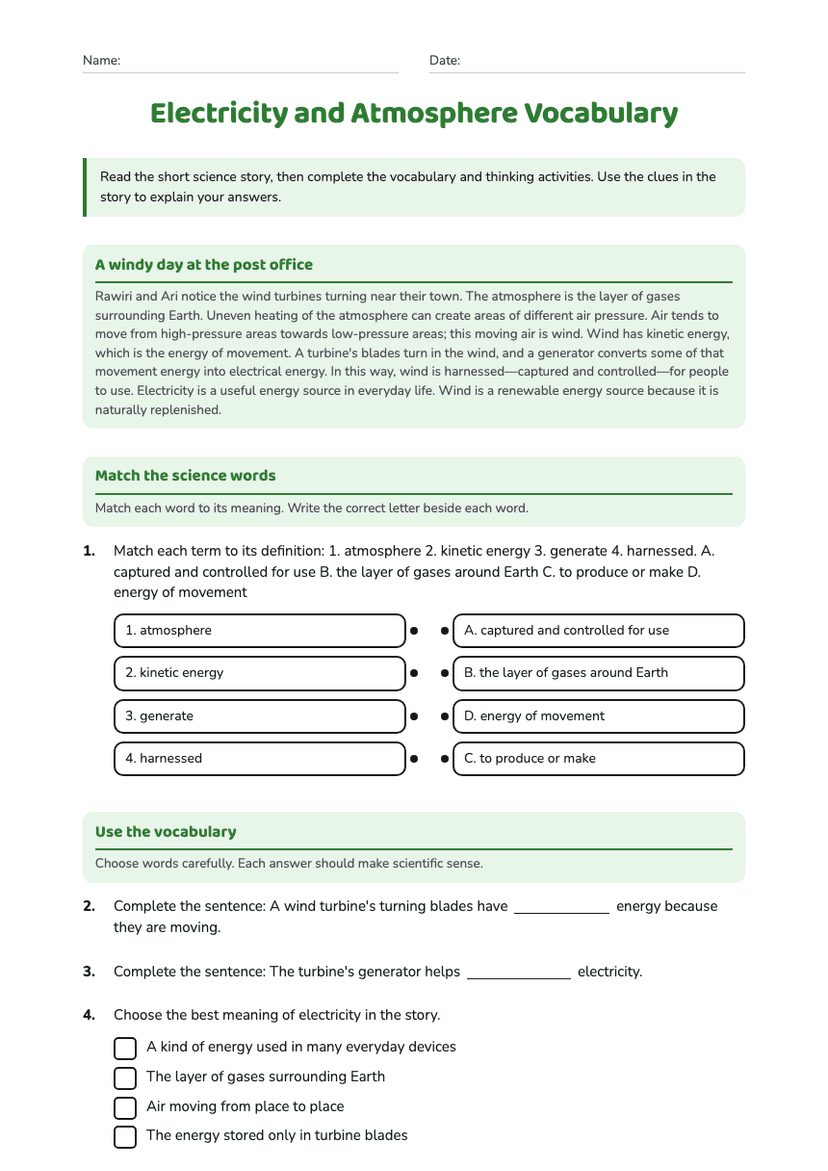
Electricity and Atmosphere Vocabulary
Free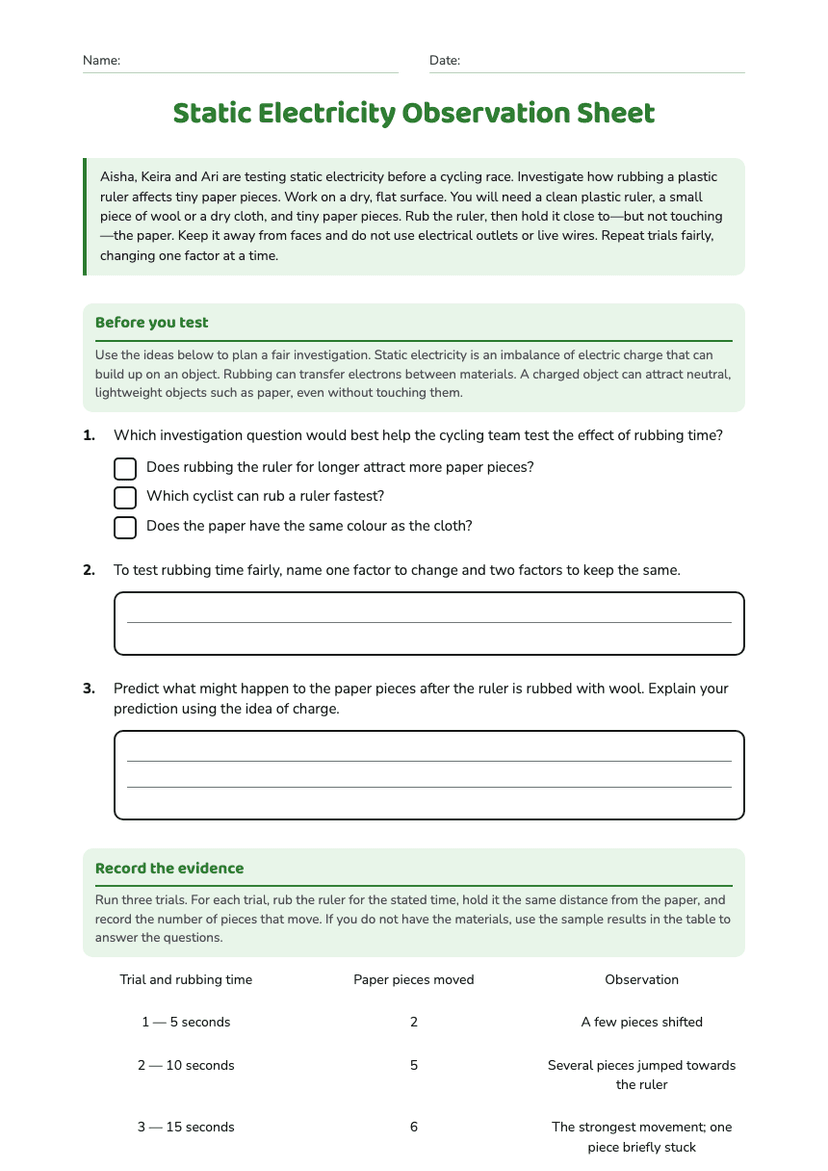
Year 7–8
Static Electricity Observation Sheet
Free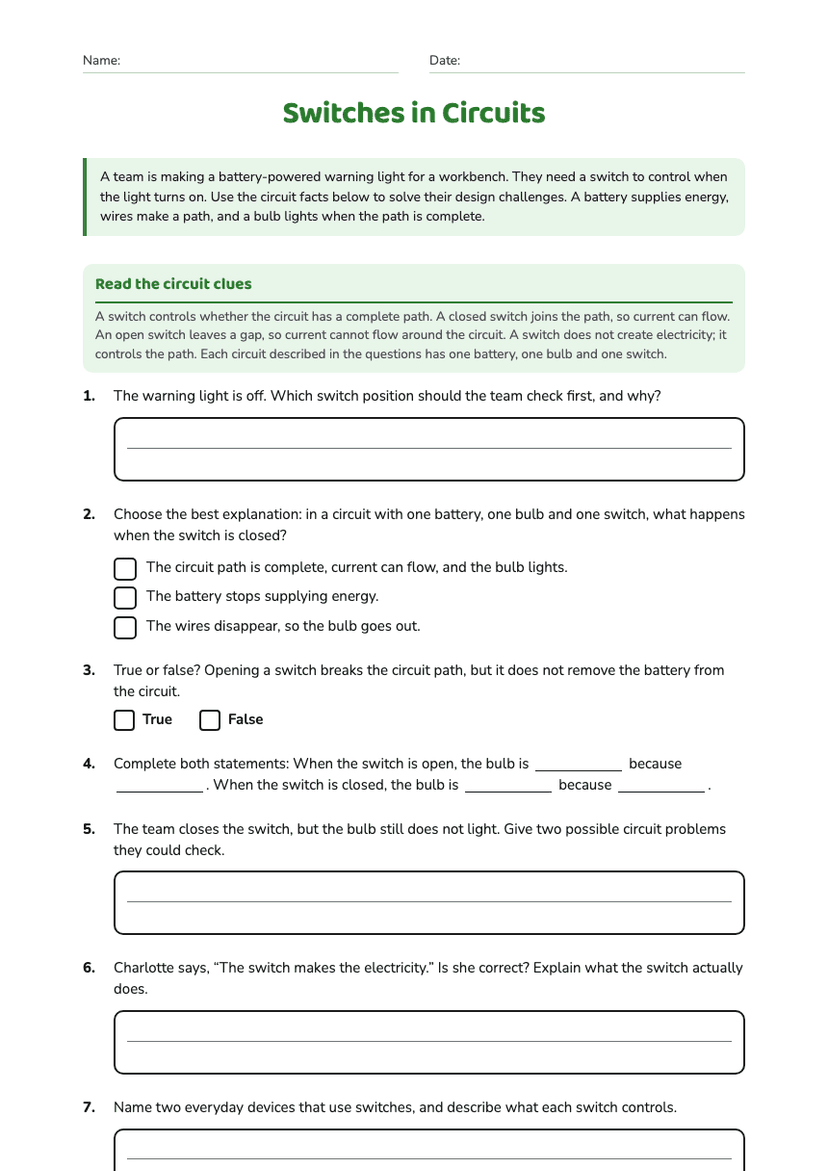
Year 5–6
Switches in Circuits
Free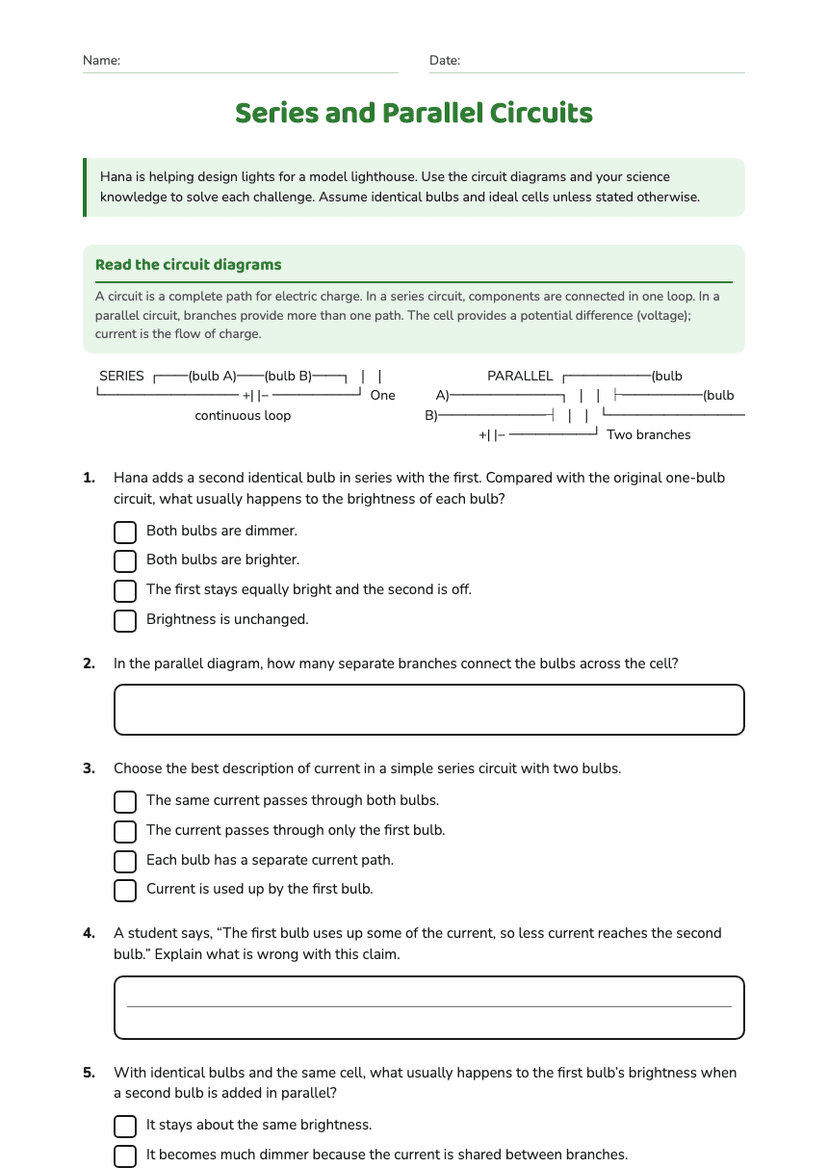
Year 7–8
Series and Parallel Circuits
Free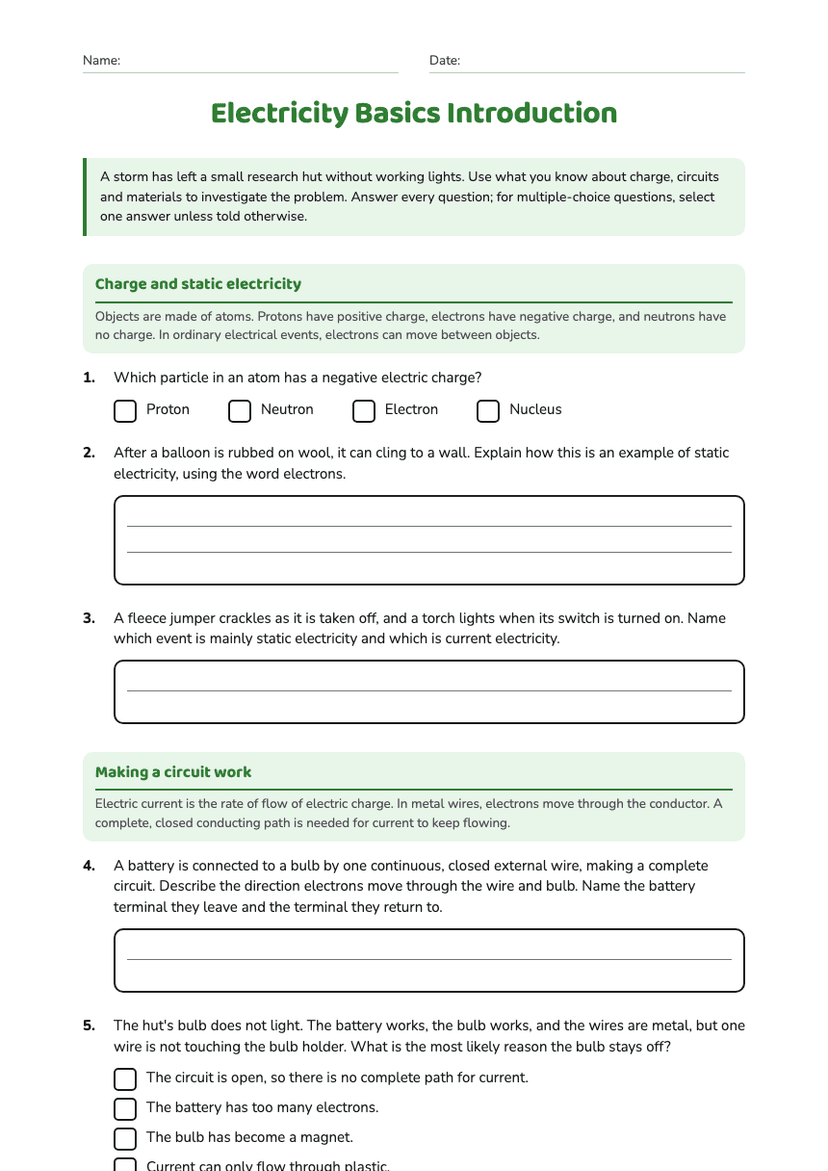
Year 8
Electricity Basics Introduction
Free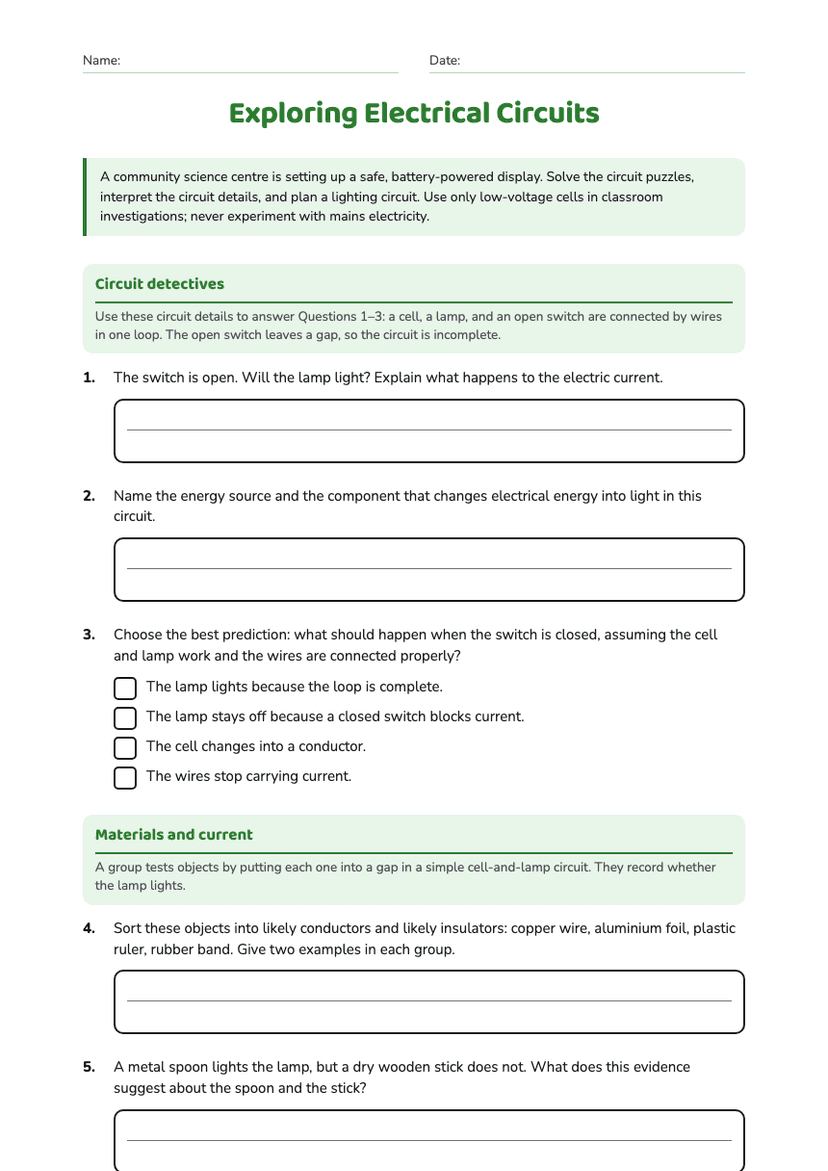
Year 8
Exploring Electrical Circuits
Free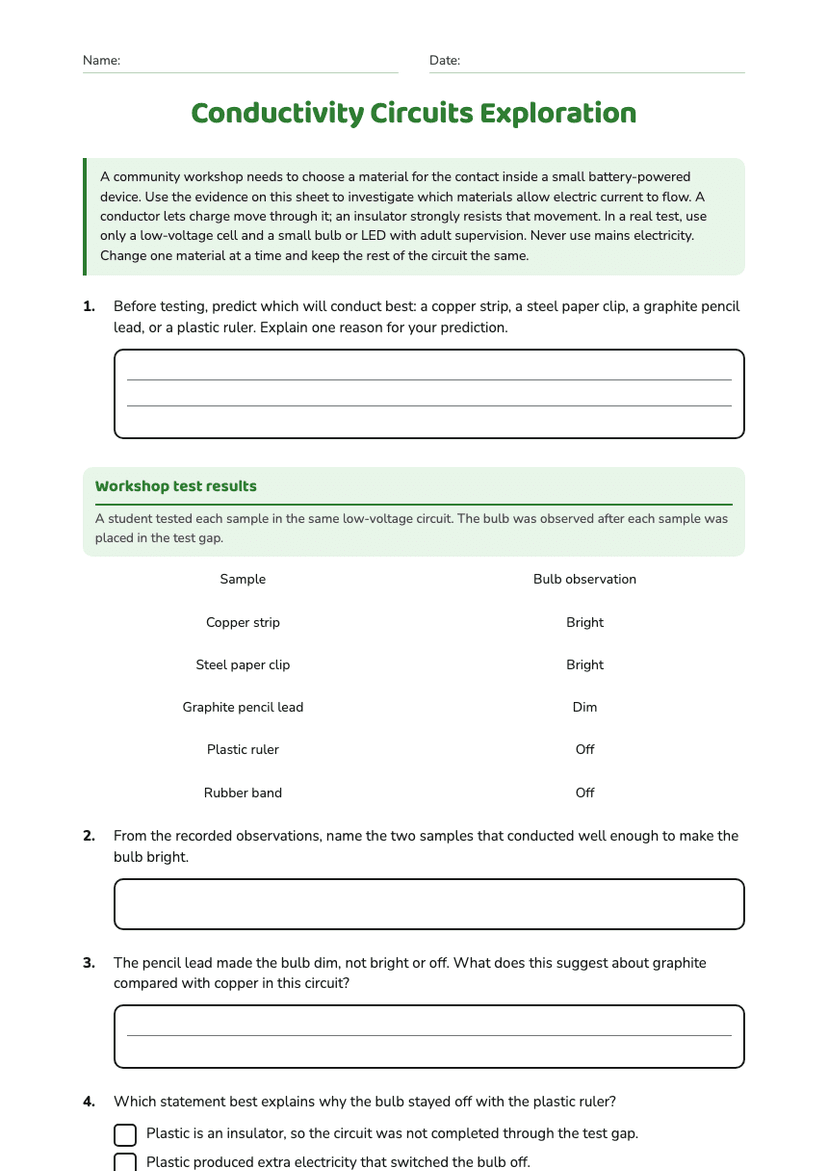
Year 8
Conductivity Circuits Exploration
Free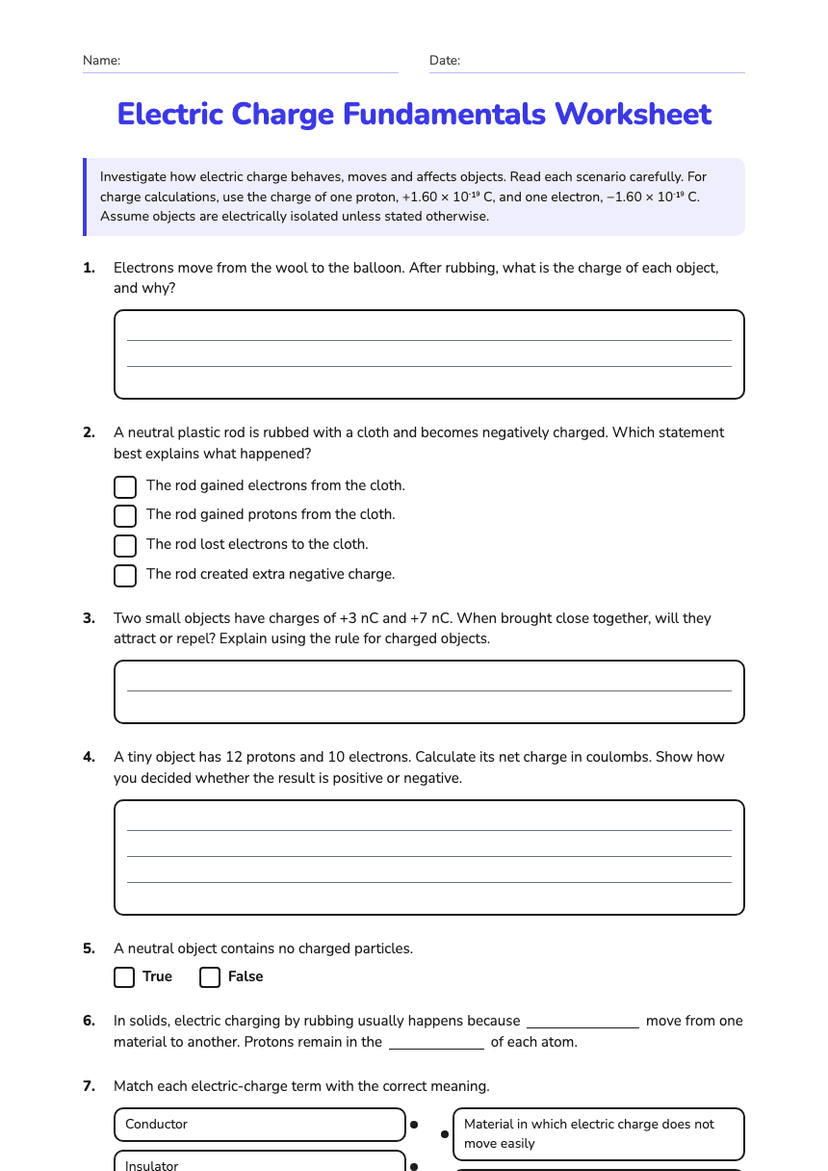
Year 10