Ancient Greece Geography Culture
A free social studies worksheet ready for your classroom. Open in Kuraplan to grab the print-ready PDF, customize it for your students, or generate a fresh version in seconds.
Ancient Greece Geography Culture
📖 Part 1: Reading Passages
Passage A: Geography of Ancient Greece
Ancient Greece was a land of rugged mountains, sparkling seas, and scattered islands. The tall mountains, like Mount Olympus, divided Greece into separate regions called city-states. These natural barriers made it difficult for Greeks to travel and communicate with each other by land. However, Greece was surrounded by the Mediterranean Sea, which became like a highway for Greek sailors and traders. The rocky coastline created many natural harbors perfect for ships. Greece's location between Europe, Asia, and Africa made it an ideal place for trade. The mountainous terrain meant there was little farmland, so Greeks had to rely on the sea for food and trade to survive.
Passage B: Cultural Contributions of Ancient Greece
Ancient Greece gave the world many ideas and traditions we still use today. The Greeks invented democracy in Athens, where citizens could vote on important decisions. Greek philosophers like Socrates and Plato asked big questions about life and how people should behave. The Greeks also created the Olympic Games to honor their gods and celebrate athletic achievement. Greek architects built beautiful temples with tall columns that we still copy in government buildings today. Greek theater gave us both comedy and tragedy, and their myths and stories continue to inspire movies and books. Many English words come from ancient Greek, especially in science and medicine.
📝 Part 2: Reading Comprehension
📊 Part 3: Graphic Organizer
Directions: Use information from both passages to fill in the chart below. List at least 3 items in each column.
Geography
How did geography shape ancient Greece?
Cultural Legacy
What Greek ideas do we still use today?
About This Worksheet
Free in Kuraplan
Sign up free, grab the PDF, and customize it for your class.
Print-Ready
Formatted for standard paper. Clean layout, easy to read.
AI-Generated
Created with Kuraplan's AI, designed for real classroom use.
For Teachers & Parents
Use in classrooms, for homework, tutoring, or homeschool.
Need a custom version of this worksheet?
Kuraplan's AI generates custom worksheets in seconds — differentiated for every learner, aligned to your curriculum.
Generate Custom Worksheets — FreeMore Social Studies Worksheets
Create Your Map Legend
Free
Town Map Detectives
Free
Rivers Shape Civilizations
Free
Continents: Maps and Globes
Free
Native American Regions Map
Free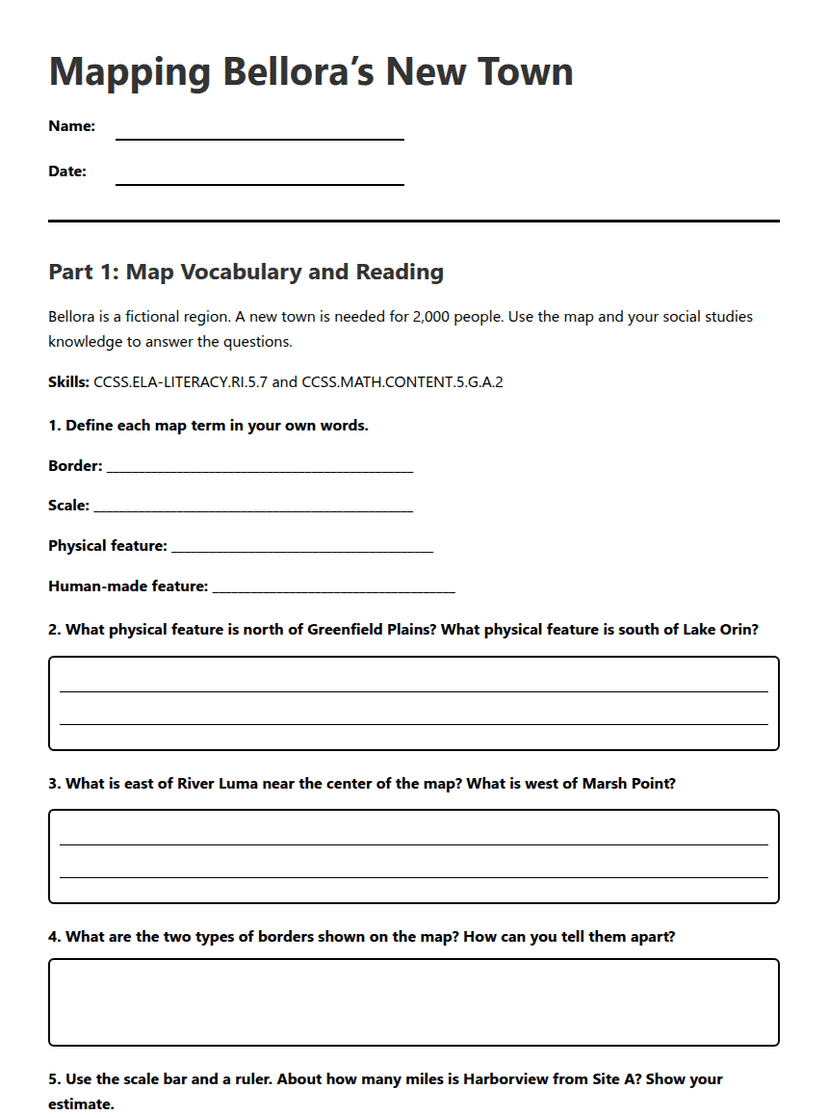
Mapping Bellora’s New Town
Free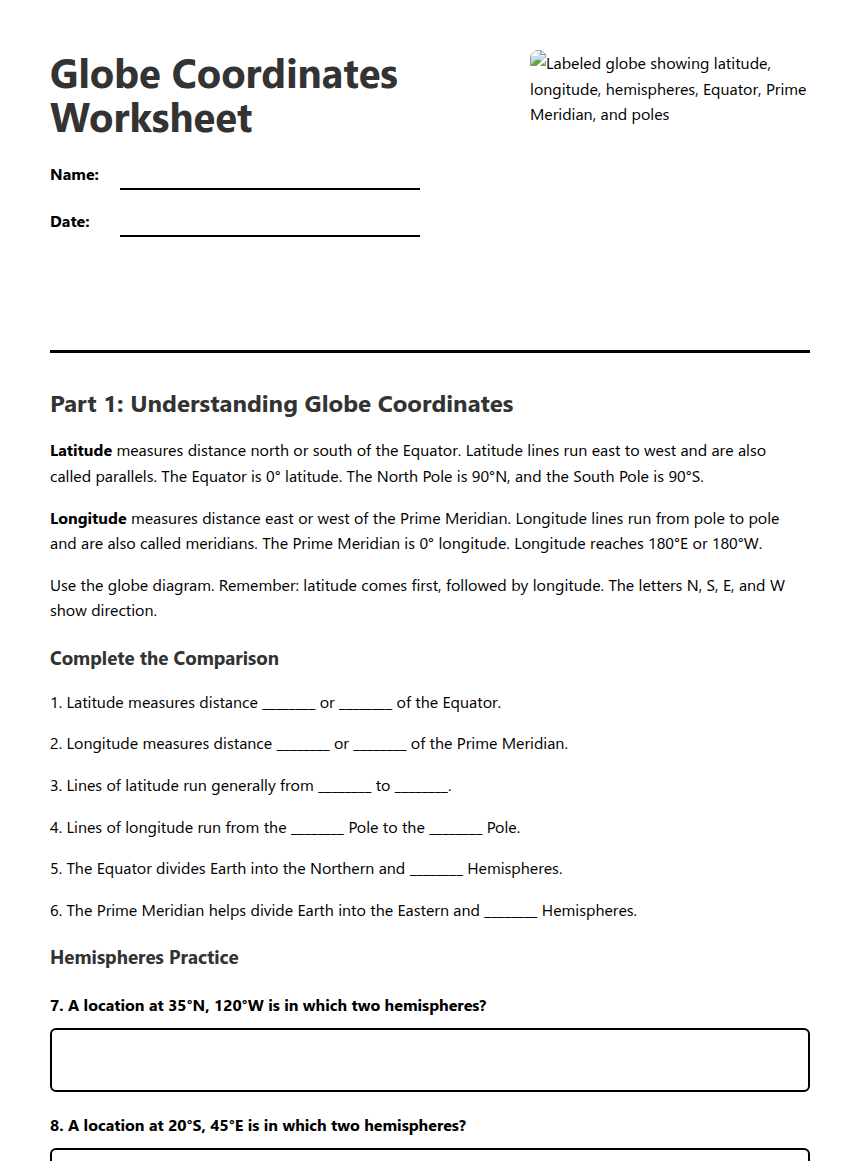
Globe Coordinates Worksheet
Free