ScienceFreePrintable

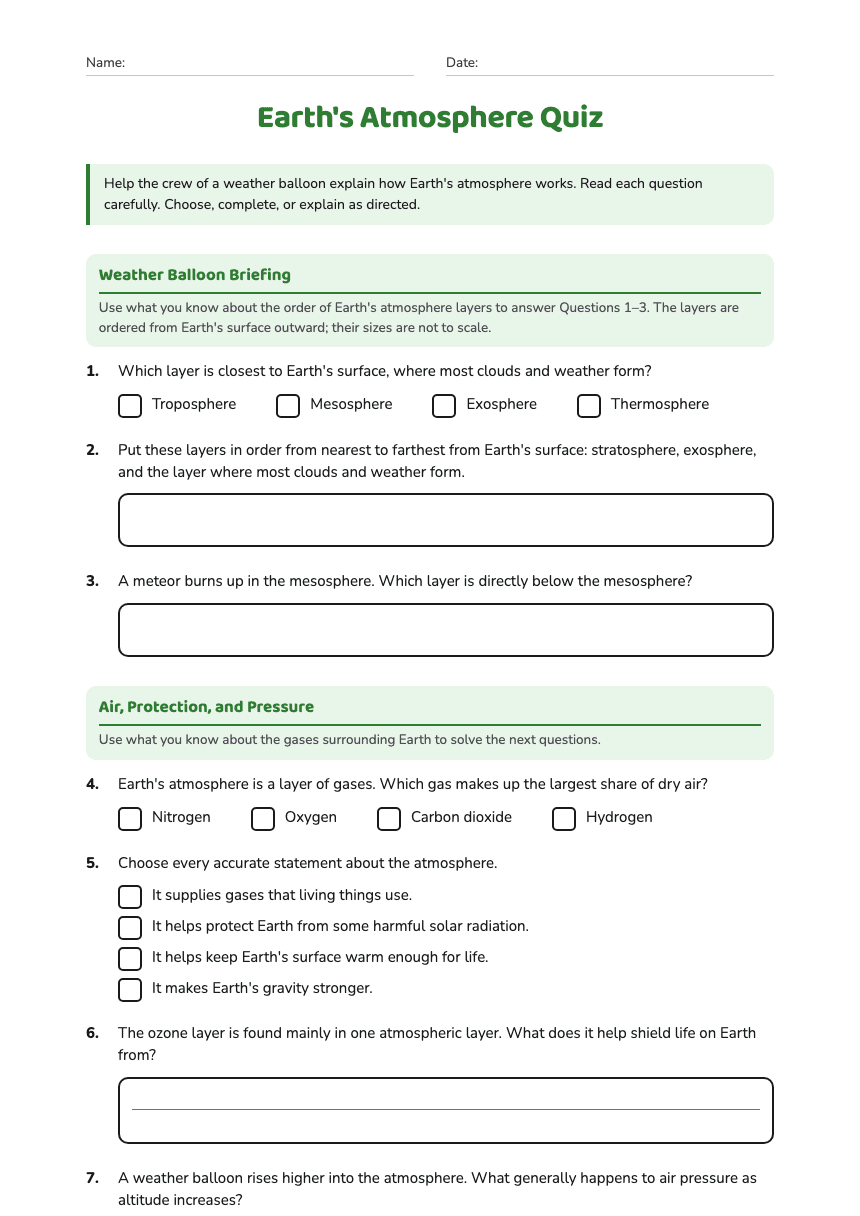
Earth's Atmosphere Quiz

A free science worksheet ready for your classroom. Open in Kuraplan to grab the print-ready PDF, customize it for your students, or generate a fresh version in seconds.
Earth's Atmosphere Quiz worksheet preview
Name:Date:

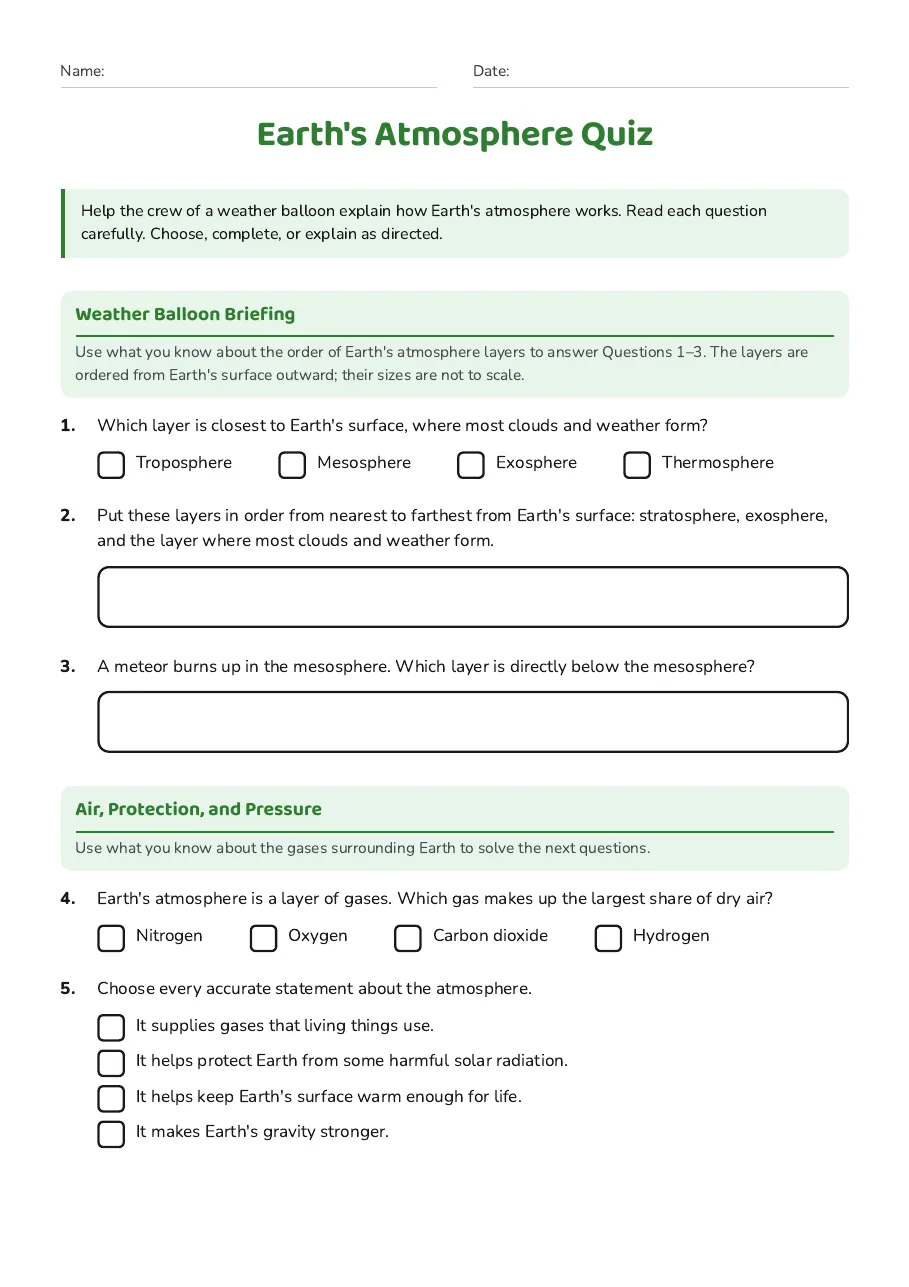
Earth's Atmosphere Quiz

Help the crew of a weather balloon explain how Earth's atmosphere works. Read each question carefully. Choose, complete, or explain as directed.

Weather Balloon Briefing

Use what you know about the order of Earth's atmosphere layers to answer Questions 1–3. The layers are ordered from Earth's surface outward; their sizes are not to scale.

1.Which layer is closest to Earth's surface, where most clouds and weather form?
  • Troposphere
  • Mesosphere
  • Exosphere
  • Thermosphere
2.Put these layers in order from nearest to farthest from Earth's surface: stratosphere, exosphere, and the layer where most clouds and weather form.
3.A meteor burns up in the mesosphere. Which layer is directly below the mesosphere?

Air, Protection, and Pressure

Use what you know about the gases surrounding Earth to solve the next questions.

4.Earth's atmosphere is a layer of gases. Which gas makes up the largest share of dry air?
  • Nitrogen
  • Oxygen
  • Carbon dioxide
  • Hydrogen
5.Choose every accurate statement about the atmosphere.
  • It supplies gases that living things use.
  • It helps protect Earth from some harmful solar radiation.
  • It helps keep Earth's surface warm enough for life.
  • It makes Earth's gravity stronger.
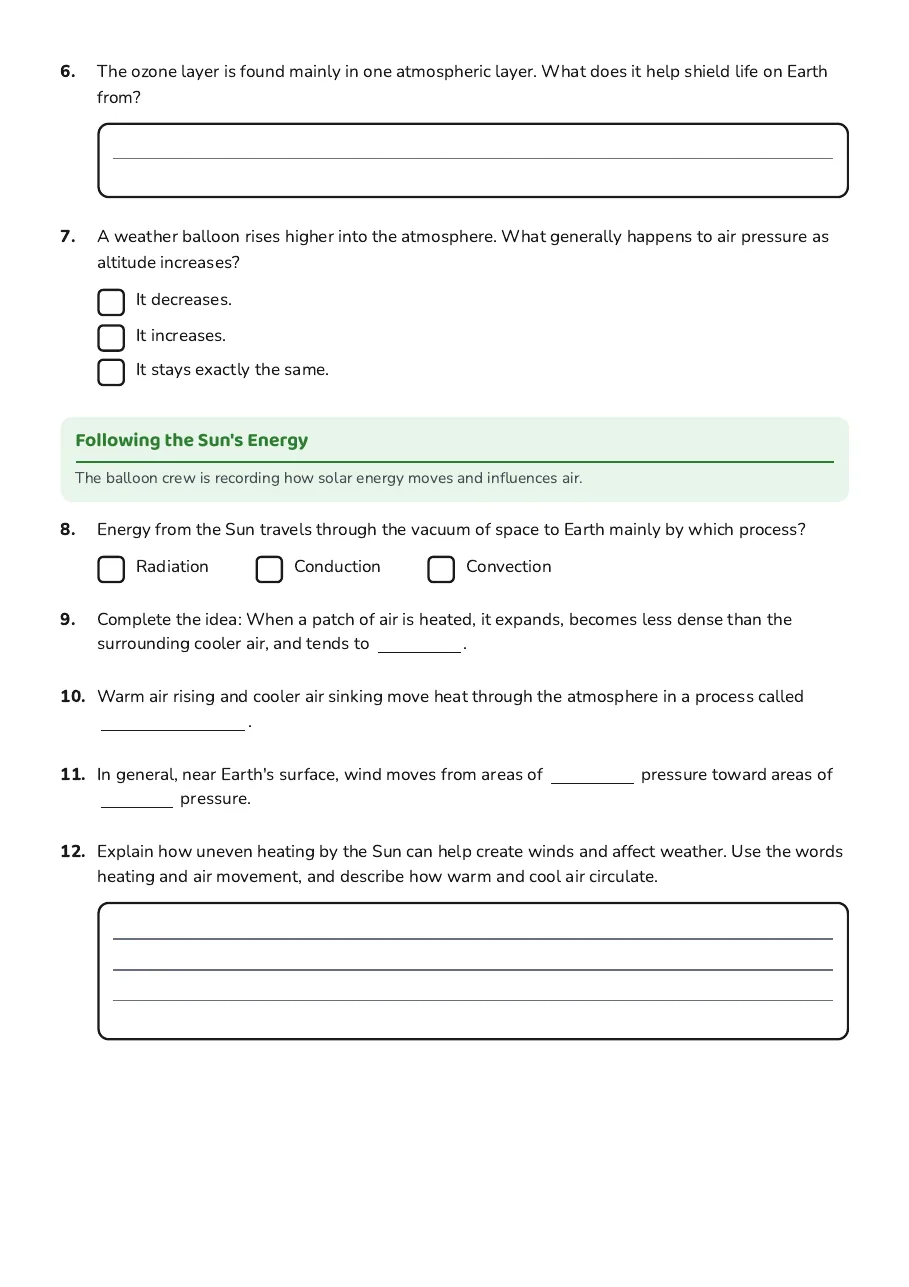
6.The ozone layer is found mainly in one atmospheric layer. What does it help shield life on Earth from?
7.A weather balloon rises higher into the atmosphere. What generally happens to air pressure as altitude increases?
  • It decreases.
  • It increases.
  • It stays exactly the same.

Following the Sun's Energy

The balloon crew is recording how solar energy moves and influences air.

8.Energy from the Sun travels through the vacuum of space to Earth mainly by which process?
  • Radiation
  • Conduction
  • Convection
9.Complete the idea: When a patch of air is heated, it expands, becomes less dense than the surrounding cooler air, and tends to .
10.Warm air rising and cooler air sinking move heat through the atmosphere in a process called .
11.In general, near Earth's surface, wind moves from areas of pressure toward areas of pressure.
12.Explain how uneven heating by the Sun can help create winds and affect weather. Use the words heating and air movement, and describe how warm and cool air circulate.

2 printable pages

  • Earth's Atmosphere Quiz, page 1 of 2: Weather Balloon Briefing, Air, Protection, and Pressure

    Page 1

  • Earth's Atmosphere Quiz, page 2 of 2: Following the Sun's Energy

    Page 2

About This Worksheet

Free in Kuraplan

Sign up free, grab the PDF, and customize it for your class.

Print-Ready

Formatted for standard paper. Clean layout, easy to read.

AI-Generated

Created with Kuraplan's AI, designed for real classroom use.

For Teachers & Parents

Use in classrooms, for homework, tutoring, or homeschool.

Need a custom version of this worksheet?

Kuraplan's AI generates custom worksheets in seconds — differentiated for every learner, aligned to your curriculum.

Generate Custom Worksheets — Free

No credit card Curriculum-aligned Under 60 seconds