Eclipses: Light & Shadow
A free science worksheet ready for your classroom. Open in Kuraplan to grab the print-ready PDF, customize it for your students, or generate a fresh version in seconds.
Eclipses: Light & Shadow
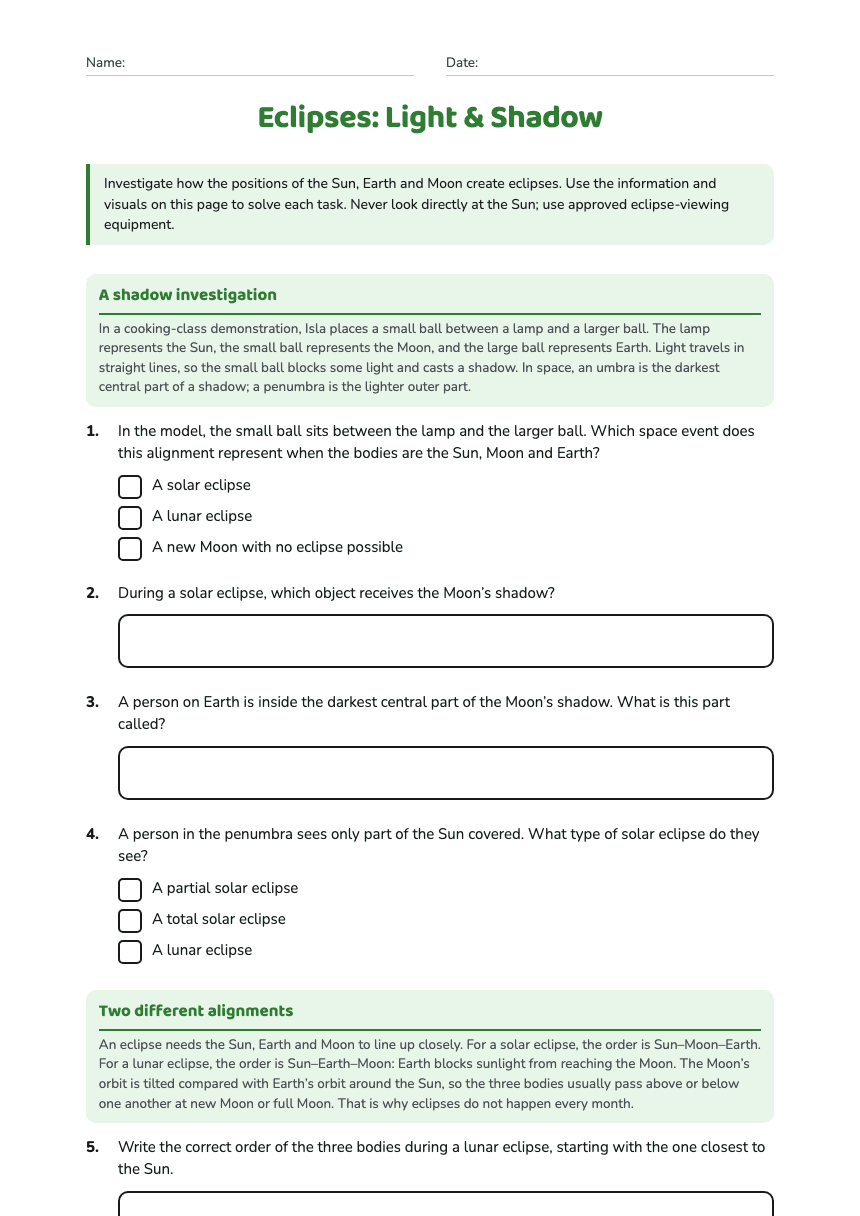
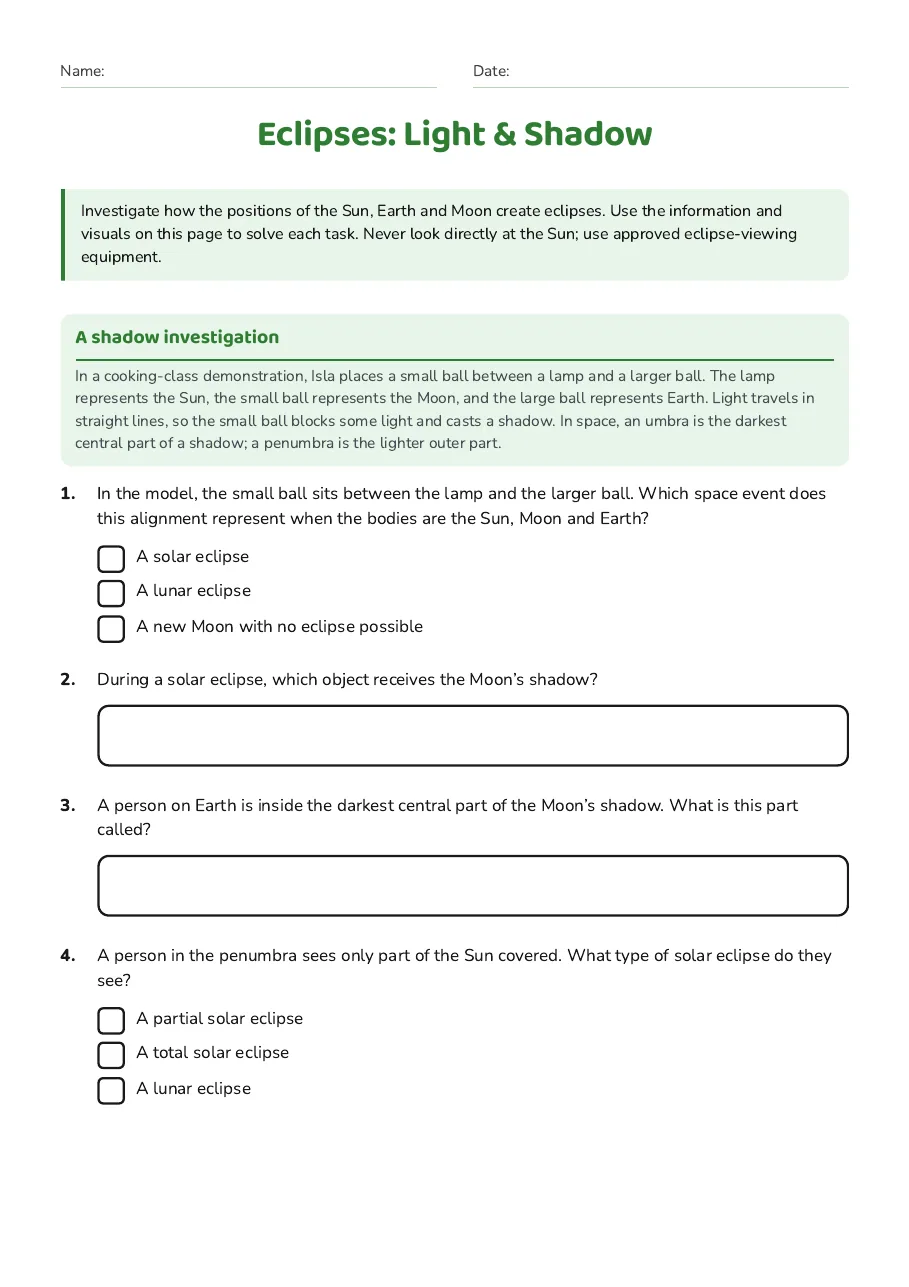
A shadow investigation
In a cooking-class demonstration, Isla places a small ball between a lamp and a larger ball. The lamp represents the Sun, the small ball represents the Moon, and the large ball represents Earth. Light travels in straight lines, so the small ball blocks some light and casts a shadow. In space, an umbra is the darkest central part of a shadow; a penumbra is the lighter outer part.
- A solar eclipse
- A lunar eclipse
- A new Moon with no eclipse possible
- A partial solar eclipse
- A total solar eclipse
- A lunar eclipse
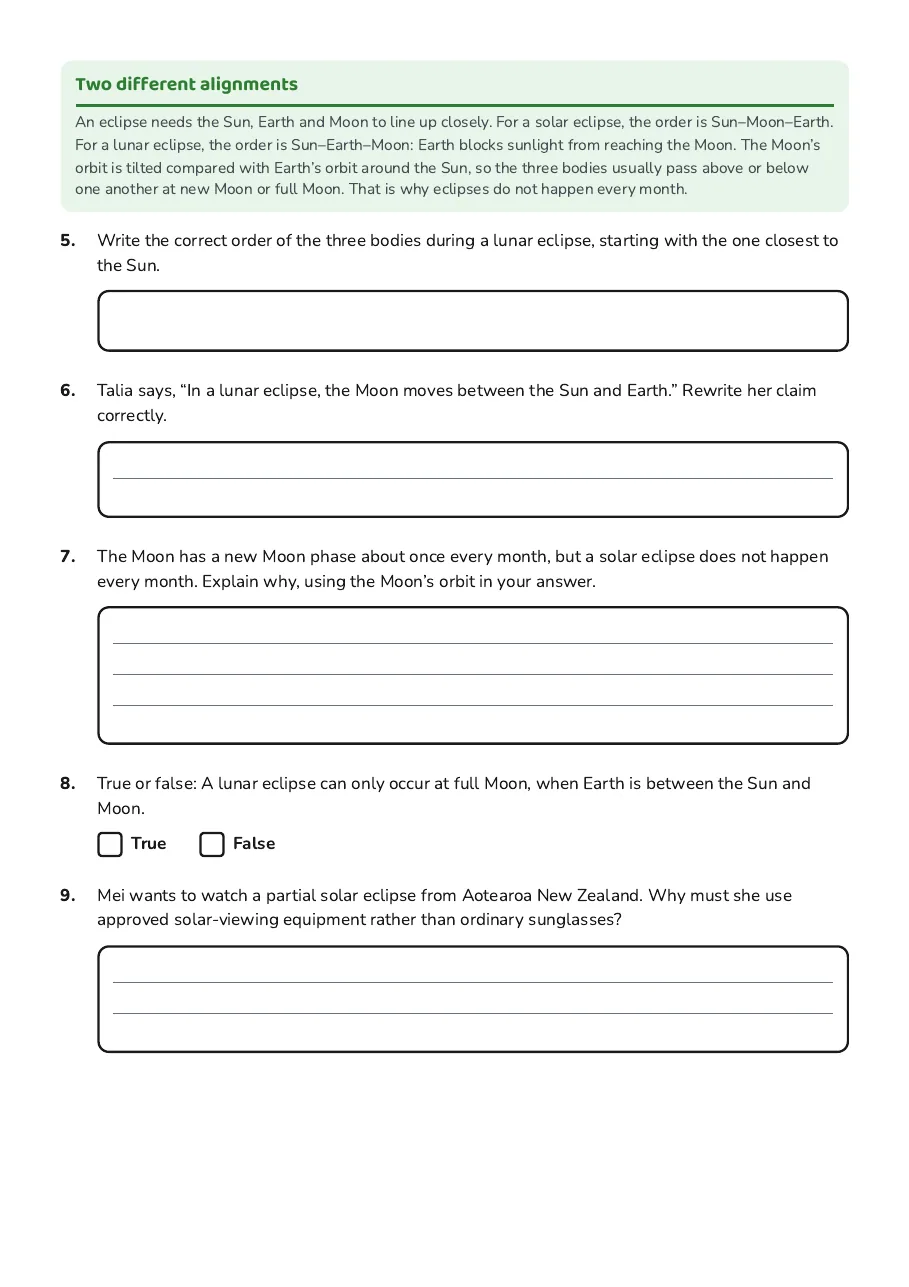
Two different alignments
An eclipse needs the Sun, Earth and Moon to line up closely. For a solar eclipse, the order is Sun–Moon–Earth. For a lunar eclipse, the order is Sun–Earth–Moon: Earth blocks sunlight from reaching the Moon. The Moon’s orbit is tilted compared with Earth’s orbit around the Sun, so the three bodies usually pass above or below one another at new Moon or full Moon. That is why eclipses do not happen every month.
2 printable pages
Page 1
Page 2
About This Worksheet
Free in Kuraplan
Sign up free, grab the PDF, and customize it for your class.
Print-Ready
Formatted for standard paper. Clean layout, easy to read.
AI-Generated
Created with Kuraplan's AI, designed for real classroom use.
For Teachers & Parents
Use in classrooms, for homework, tutoring, or homeschool.
Need a custom version of this worksheet?
Kuraplan's AI generates custom worksheets in seconds — differentiated for every learner, aligned to your curriculum.
Generate Custom Worksheets — Free