BusinessFreePrintable

Effective vs Defective Habits

A free business worksheet ready for your classroom. Open in Kuraplan to grab the print-ready PDF, customize it for your students, or generate a fresh version in seconds.
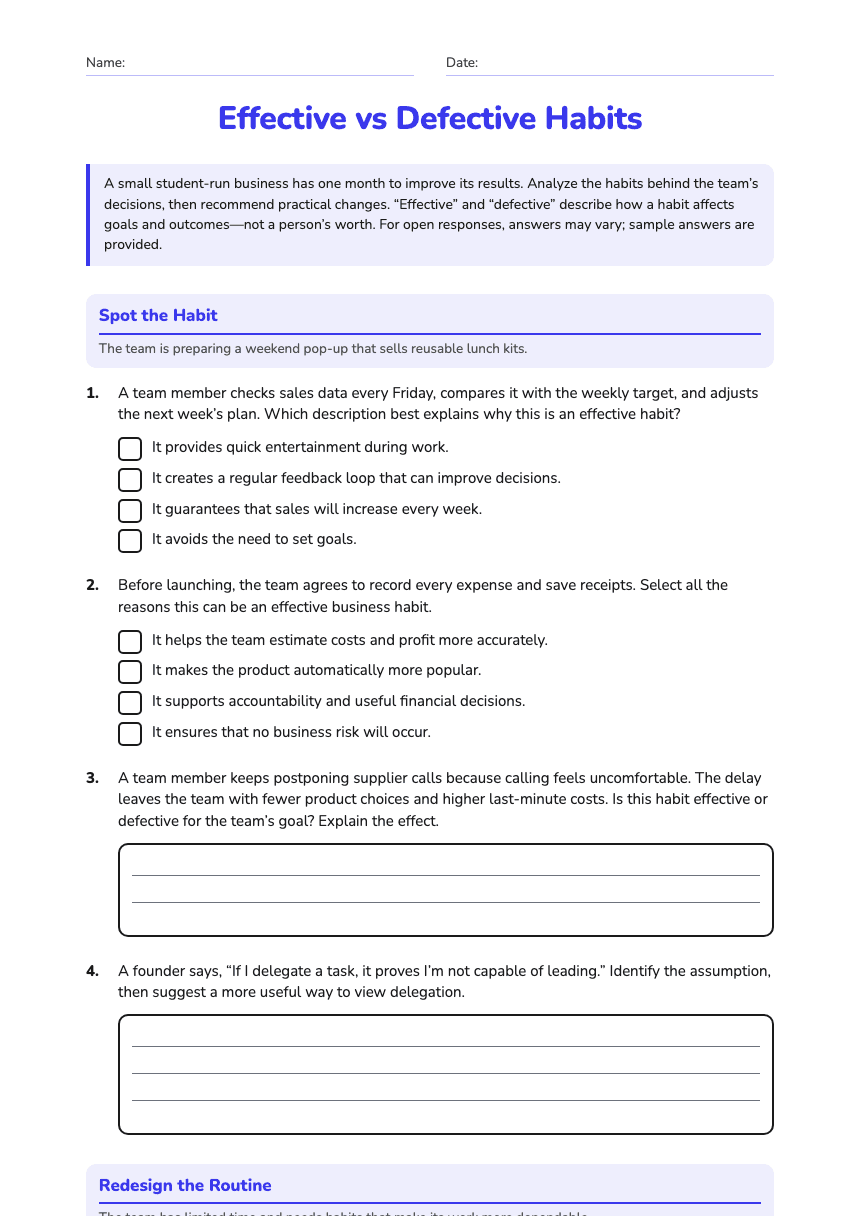
Effective vs Defective Habits worksheet preview
Name:Date:

Effective vs Defective Habits

A small student-run business has one month to improve its results. Analyze the habits behind the team’s decisions, then recommend practical changes. “Effective” and “defective” describe how a habit affects goals and outcomes—not a person’s worth. For open responses, answers may vary; sample answers are provided.

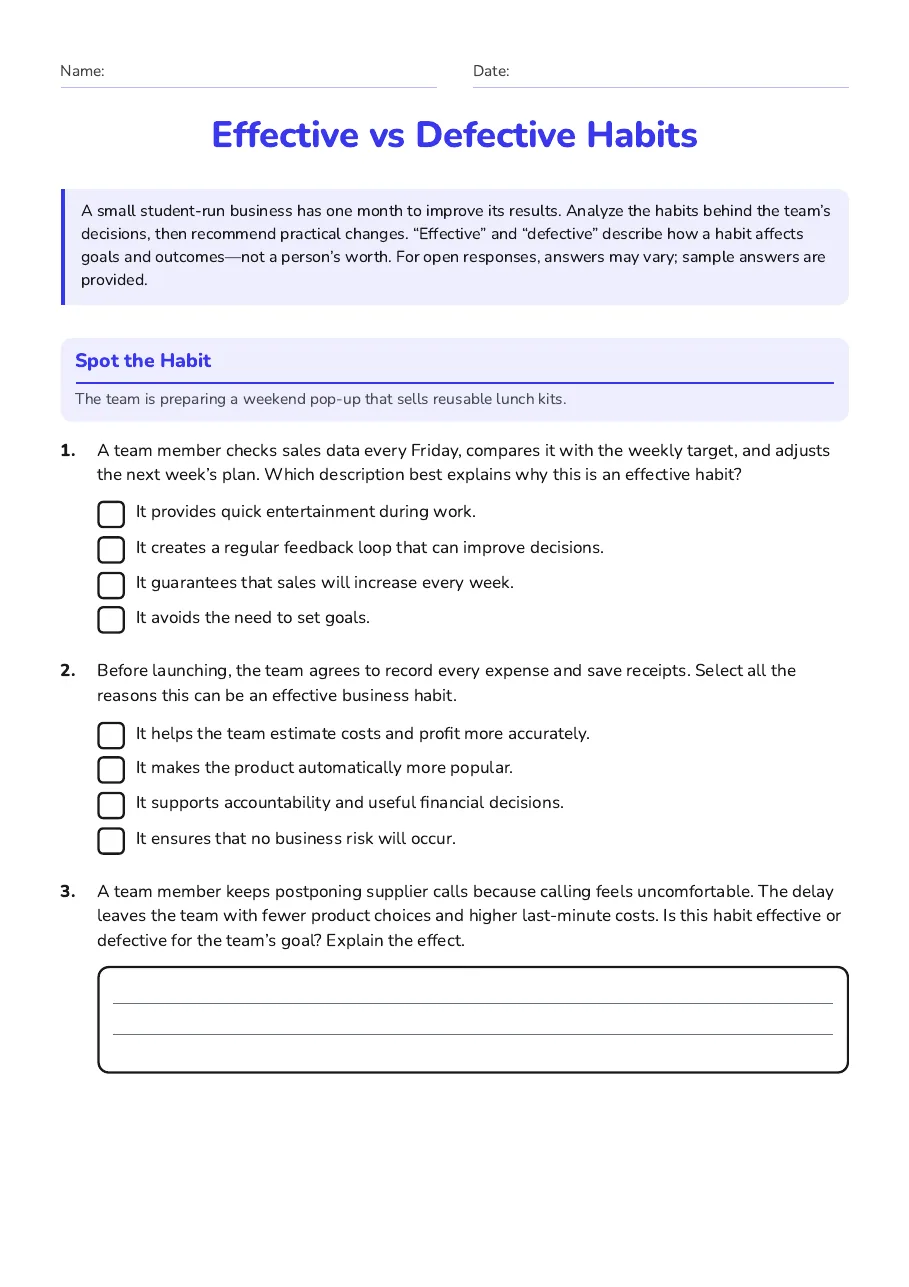
Spot the Habit

The team is preparing a weekend pop-up that sells reusable lunch kits.

1.A team member checks sales data every Friday, compares it with the weekly target, and adjusts the next week’s plan. Which description best explains why this is an effective habit?
  • It provides quick entertainment during work.
  • It creates a regular feedback loop that can improve decisions.
  • It guarantees that sales will increase every week.
  • It avoids the need to set goals.
2.Before launching, the team agrees to record every expense and save receipts. Select all the reasons this can be an effective business habit.
  • It helps the team estimate costs and profit more accurately.
  • It makes the product automatically more popular.
  • It supports accountability and useful financial decisions.
  • It ensures that no business risk will occur.
3.A team member keeps postponing supplier calls because calling feels uncomfortable. The delay leaves the team with fewer product choices and higher last-minute costs. Is this habit effective or defective for the team’s goal? Explain the effect.
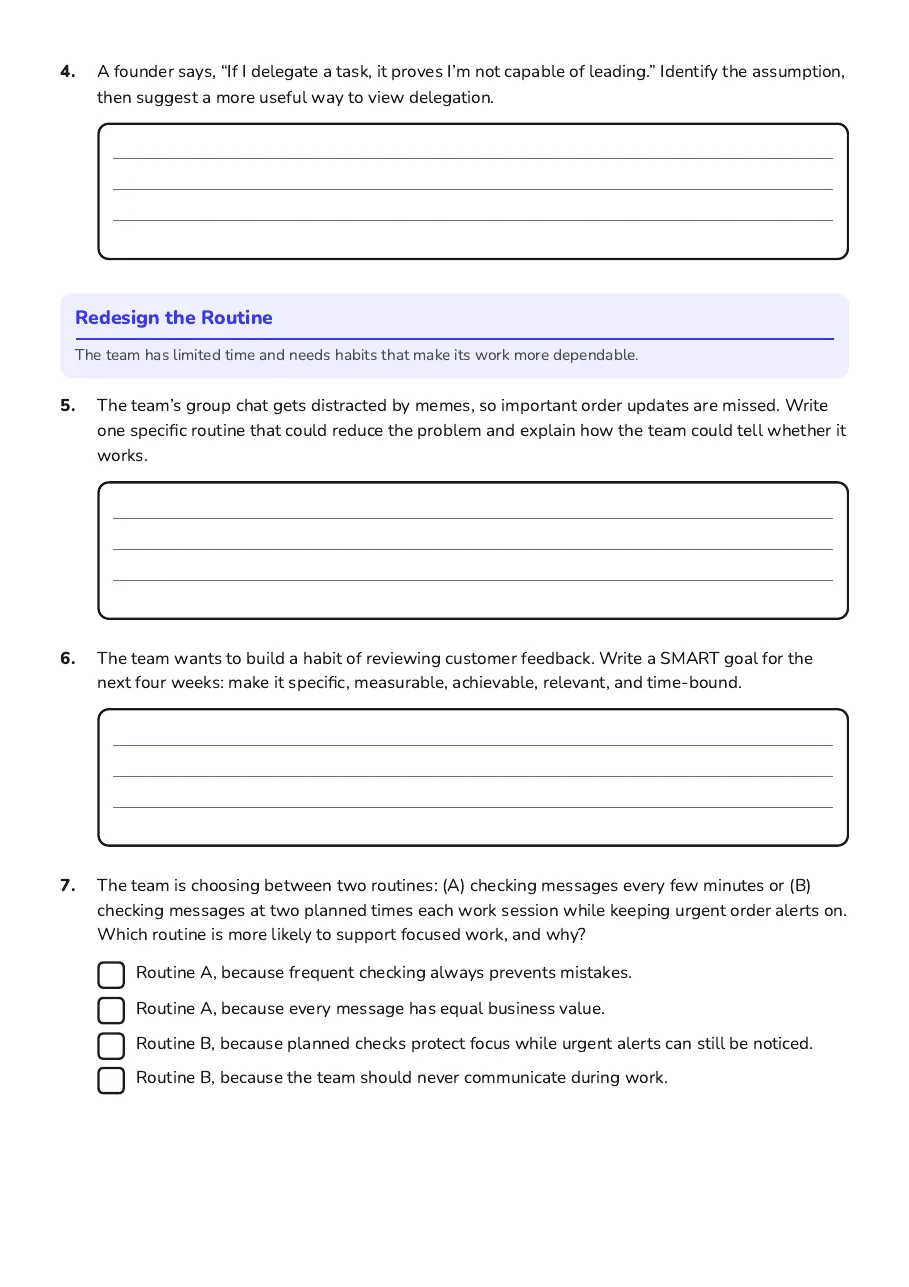
4.A founder says, “If I delegate a task, it proves I’m not capable of leading.” Identify the assumption, then suggest a more useful way to view delegation.

Redesign the Routine

The team has limited time and needs habits that make its work more dependable.

5.The team’s group chat gets distracted by memes, so important order updates are missed. Write one specific routine that could reduce the problem and explain how the team could tell whether it works.
6.The team wants to build a habit of reviewing customer feedback. Write a SMART goal for the next four weeks: make it specific, measurable, achievable, relevant, and time-bound.
7.The team is choosing between two routines: (A) checking messages every few minutes or (B) checking messages at two planned times each work session while keeping urgent order alerts on. Which routine is more likely to support focused work, and why?
  • Routine A, because frequent checking always prevents mistakes.
  • Routine A, because every message has equal business value.
  • Routine B, because planned checks protect focus while urgent alerts can still be noticed.
  • Routine B, because the team should never communicate during work.
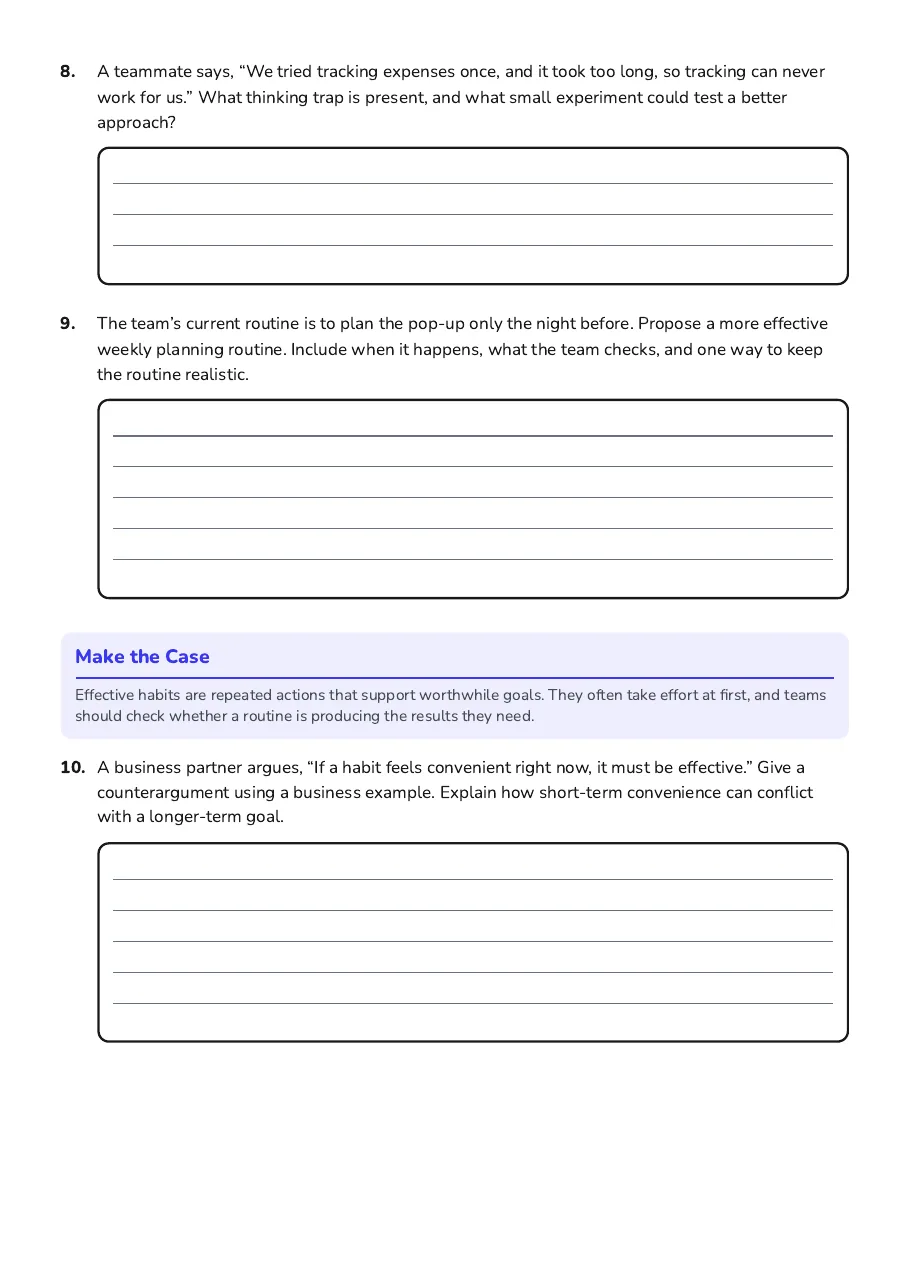
8.A teammate says, “We tried tracking expenses once, and it took too long, so tracking can never work for us.” What thinking trap is present, and what small experiment could test a better approach?
9.The team’s current routine is to plan the pop-up only the night before. Propose a more effective weekly planning routine. Include when it happens, what the team checks, and one way to keep the routine realistic.

Make the Case

Effective habits are repeated actions that support worthwhile goals. They often take effort at first, and teams should check whether a routine is producing the results they need.

10.A business partner argues, “If a habit feels convenient right now, it must be effective.” Give a counterargument using a business example. Explain how short-term convenience can conflict with a longer-term goal.

3 printable pages

  • Effective vs Defective Habits, page 1 of 3: Spot the Habit

    Page 1

  • Effective vs Defective Habits, page 2 of 3: Redesign the Routine

    Page 2

  • Effective vs Defective Habits, page 3 of 3: Make the Case

    Page 3

About This Worksheet

Free in Kuraplan

Sign up free, grab the PDF, and customize it for your class.

Print-Ready

Formatted for standard paper. Clean layout, easy to read.

AI-Generated

Created with Kuraplan's AI, designed for real classroom use.

For Teachers & Parents

Use in classrooms, for homework, tutoring, or homeschool.

Need a custom version of this worksheet?

Kuraplan's AI generates custom worksheets in seconds — differentiated for every learner, aligned to your curriculum.

Generate Custom Worksheets — Free
No credit card Curriculum-aligned Under 60 seconds

Explore more free resources