Exploring Screened Out
A free english (ela) worksheet ready for your classroom. Open in Kuraplan to grab the print-ready PDF, customize it for your students, or generate a fresh version in seconds.
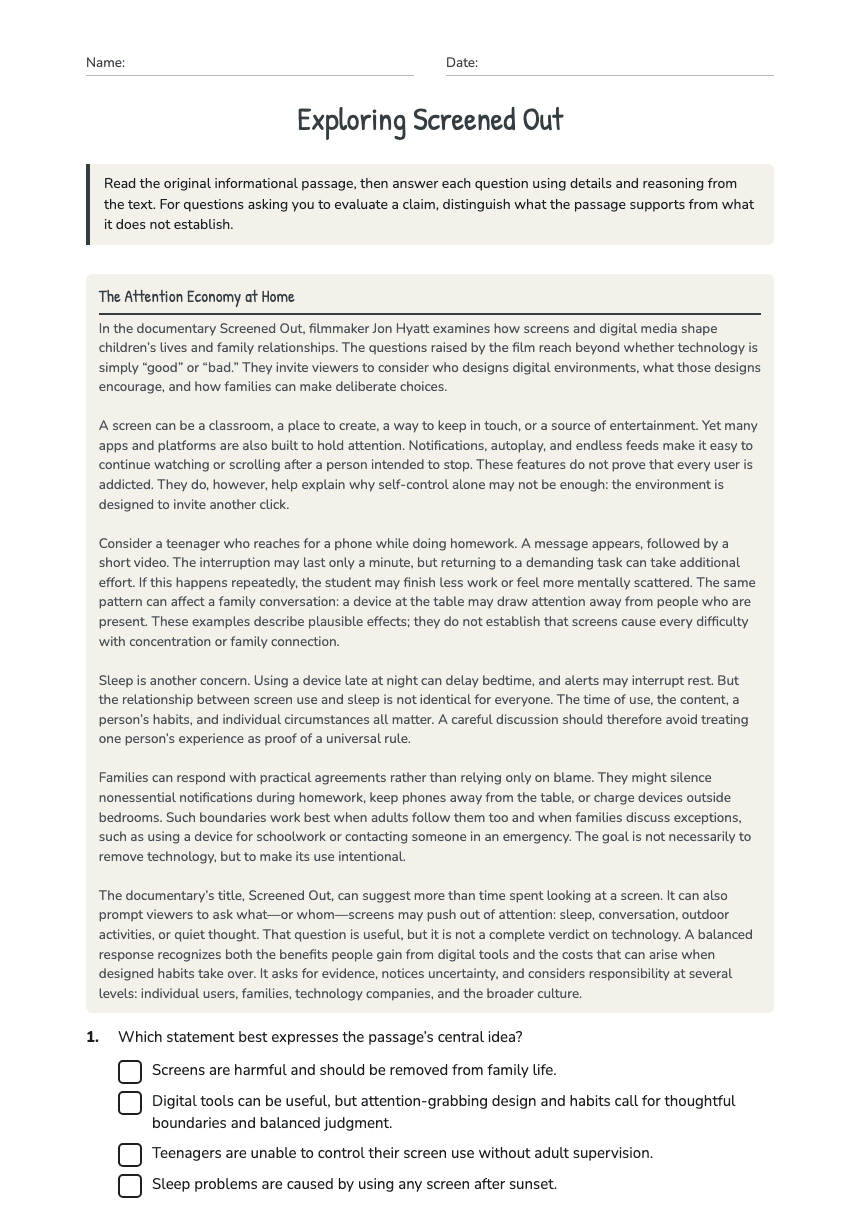
Exploring Screened Out
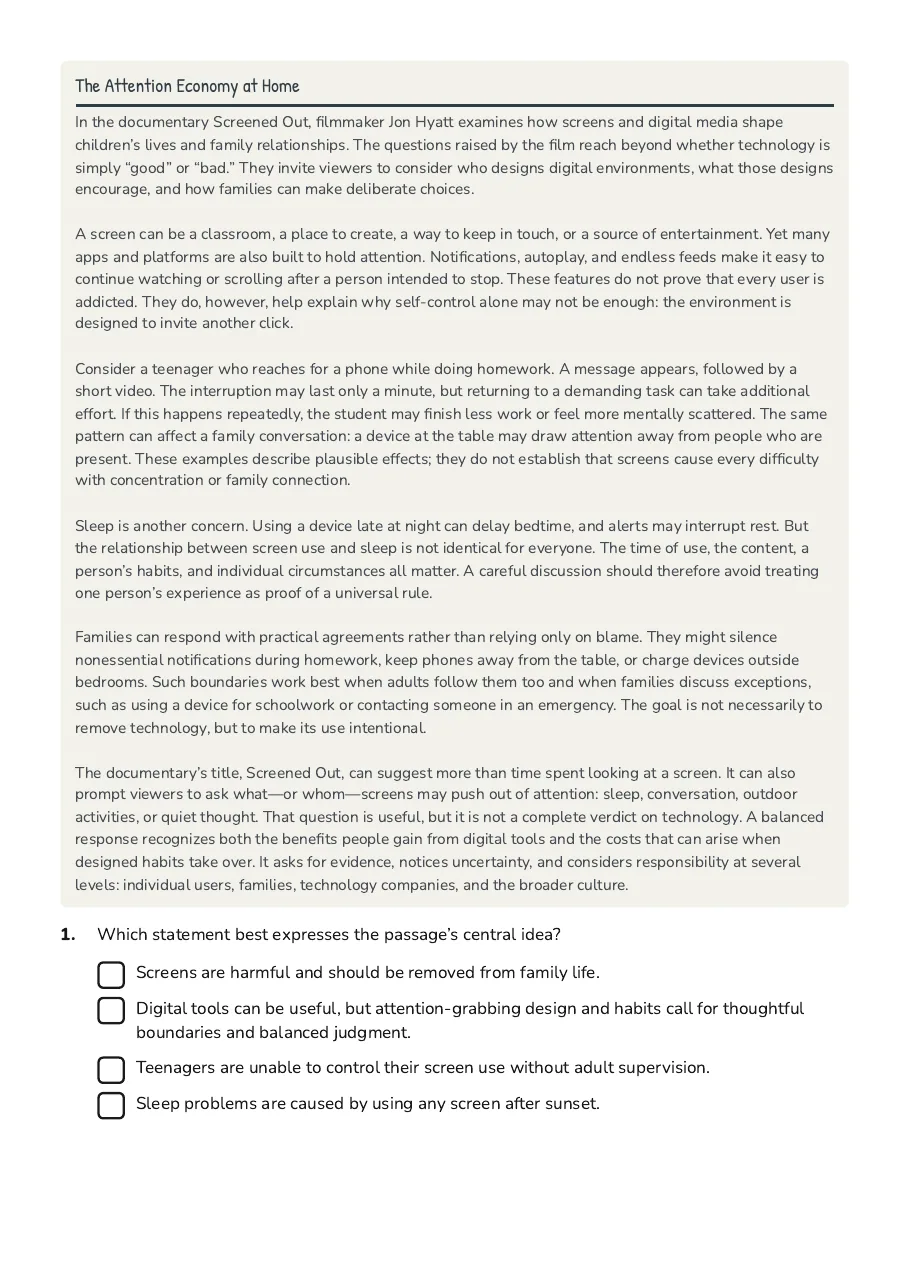
The Attention Economy at Home
In the documentary Screened Out, filmmaker Jon Hyatt examines how screens and digital media shape children’s lives and family relationships. The questions raised by the film reach beyond whether technology is simply “good” or “bad.” They invite viewers to consider who designs digital environments, what those designs encourage, and how families can make deliberate choices. A screen can be a classroom, a place to create, a way to keep in touch, or a source of entertainment. Yet many apps and platforms are also built to hold attention. Notifications, autoplay, and endless feeds make it easy to continue watching or scrolling after a person intended to stop. These features do not prove that every user is addicted. They do, however, help explain why self-control alone may not be enough: the environment is designed to invite another click. Consider a teenager who reaches for a phone while doing homework. A message appears, followed by a short video. The interruption may last only a minute, but returning to a demanding task can take additional effort. If this happens repeatedly, the student may finish less work or feel more mentally scattered. The same pattern can affect a family conversation: a device at the table may draw attention away from people who are present. These examples describe plausible effects; they do not establish that screens cause every difficulty with concentration or family connection. Sleep is another concern. Using a device late at night can delay bedtime, and alerts may interrupt rest. But the relationship between screen use and sleep is not identical for everyone. The time of use, the content, a person’s habits, and individual circumstances all matter. A careful discussion should therefore avoid treating one person’s experience as proof of a universal rule. Families can respond with practical agreements rather than relying only on blame. They might silence nonessential notifications during homework, keep phones away from the table, or charge devices outside bedrooms. Such boundaries work best when adults follow them too and when families discuss exceptions, such as using a device for schoolwork or contacting someone in an emergency. The goal is not necessarily to remove technology, but to make its use intentional. The documentary’s title, Screened Out, can suggest more than time spent looking at a screen. It can also prompt viewers to ask what—or whom—screens may push out of attention: sleep, conversation, outdoor activities, or quiet thought. That question is useful, but it is not a complete verdict on technology. A balanced response recognizes both the benefits people gain from digital tools and the costs that can arise when designed habits take over. It asks for evidence, notices uncertainty, and considers responsibility at several levels: individual users, families, technology companies, and the broader culture.
- Screens are harmful and should be removed from family life.
- Digital tools can be useful, but attention-grabbing design and habits call for thoughtful boundaries and balanced judgment.
- Teenagers are unable to control their screen use without adult supervision.
- Sleep problems are caused by using any screen after sunset.
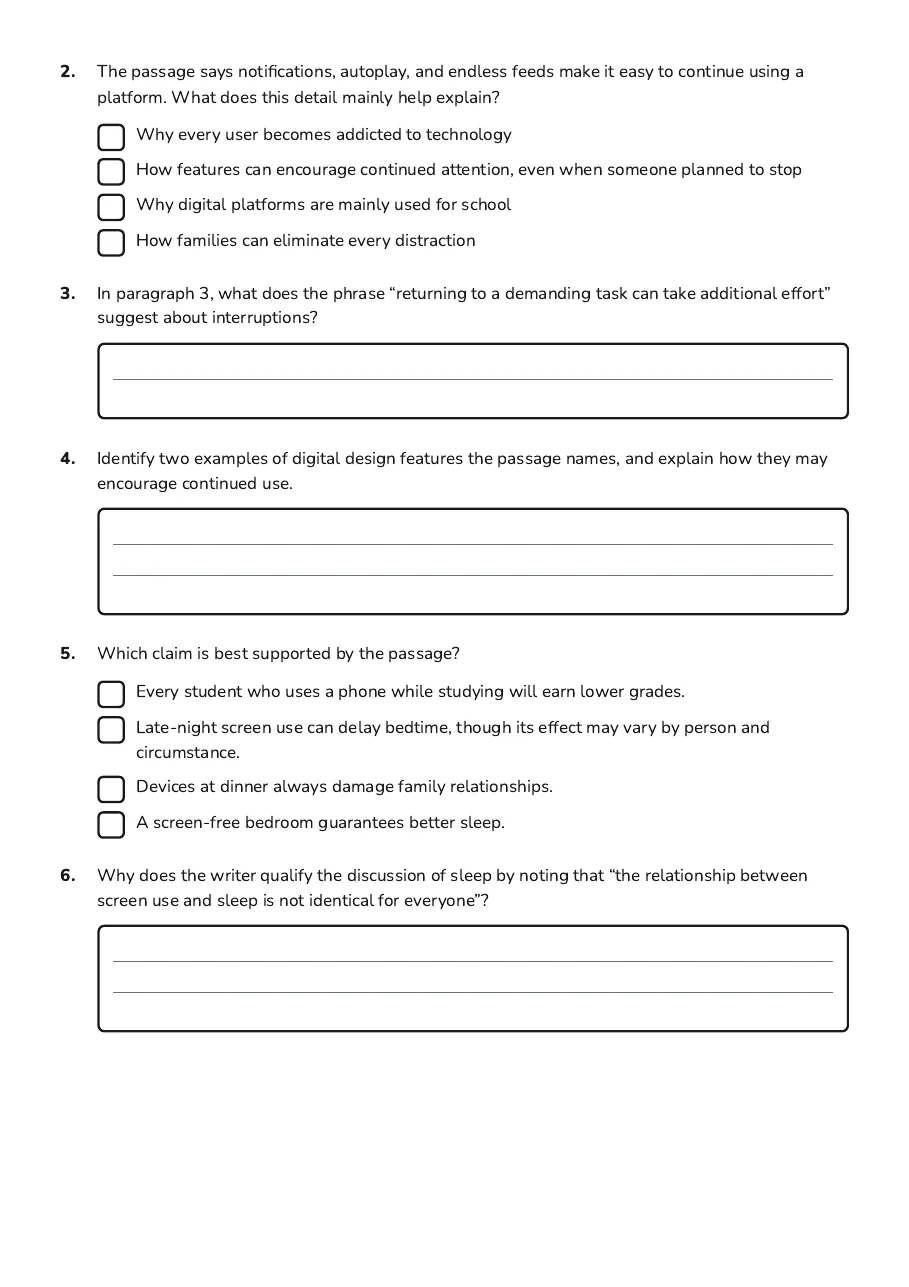
- Why every user becomes addicted to technology
- How features can encourage continued attention, even when someone planned to stop
- Why digital platforms are mainly used for school
- How families can eliminate every distraction
- Every student who uses a phone while studying will earn lower grades.
- Late-night screen use can delay bedtime, though its effect may vary by person and circumstance.
- Devices at dinner always damage family relationships.
- A screen-free bedroom guarantees better sleep.
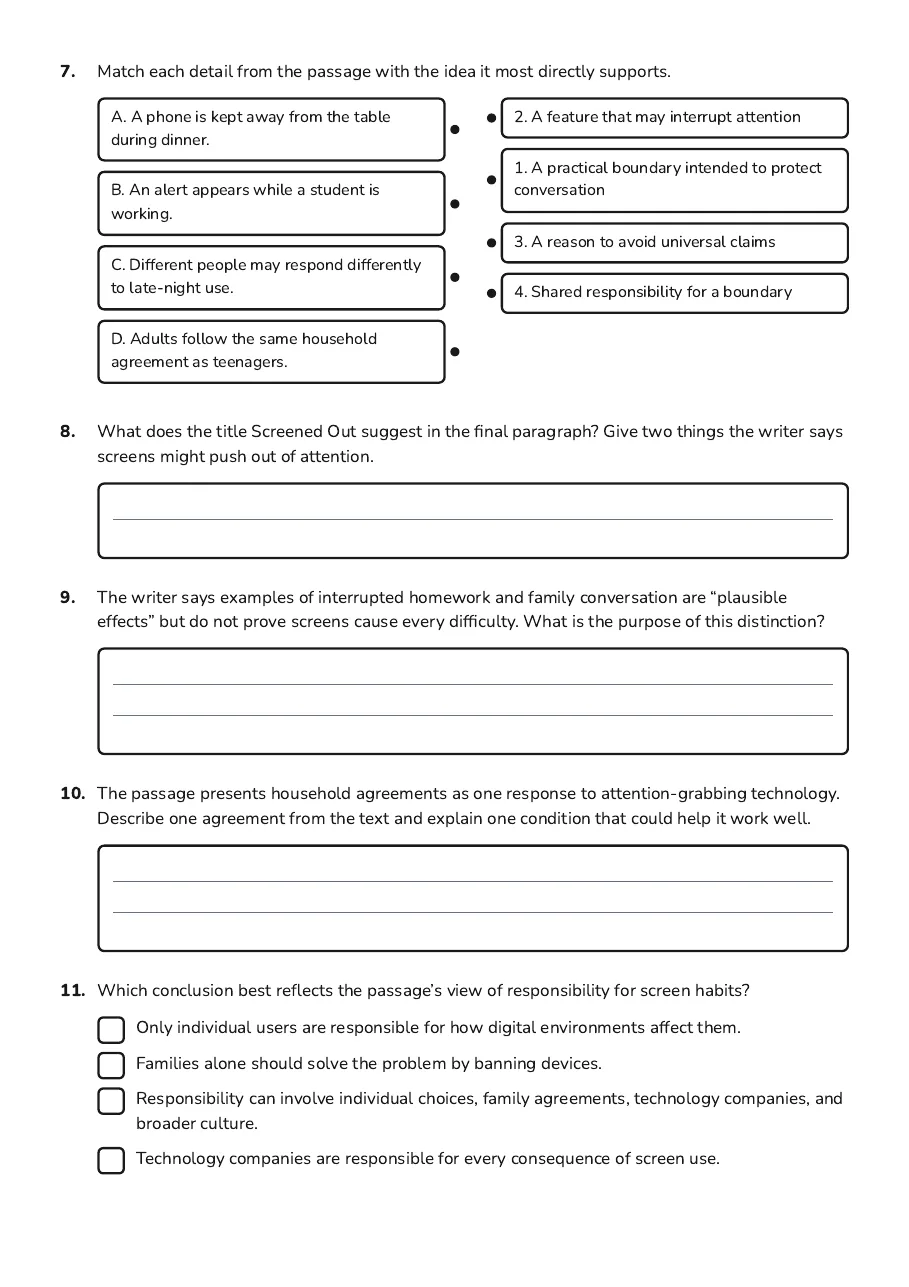
- A. A phone is kept away from the table during dinner.
- B. An alert appears while a student is working.
- C. Different people may respond differently to late-night use.
- D. Adults follow the same household agreement as teenagers.
- 2. A feature that may interrupt attention
- 1. A practical boundary intended to protect conversation
- 3. A reason to avoid universal claims
- 4. Shared responsibility for a boundary
- Only individual users are responsible for how digital environments affect them.
- Families alone should solve the problem by banning devices.
- Responsibility can involve individual choices, family agreements, technology companies, and broader culture.
- Technology companies are responsible for every consequence of screen use.
5 printable pages

Page 1
Page 2
Page 3
Page 4

Page 5
About This Worksheet
Free in Kuraplan
Sign up free, grab the PDF, and customize it for your class.
Print-Ready
Formatted for standard paper. Clean layout, easy to read.
AI-Generated
Created with Kuraplan's AI, designed for real classroom use.
For Teachers & Parents
Use in classrooms, for homework, tutoring, or homeschool.
Need a custom version of this worksheet?
Kuraplan's AI generates custom worksheets in seconds — differentiated for every learner, aligned to your curriculum.
Generate Custom Worksheets — Free