Exploring Sound Waves
A free science worksheet ready for your classroom. Open in Kuraplan to grab the print-ready PDF, customize it for your students, or generate a fresh version in seconds.
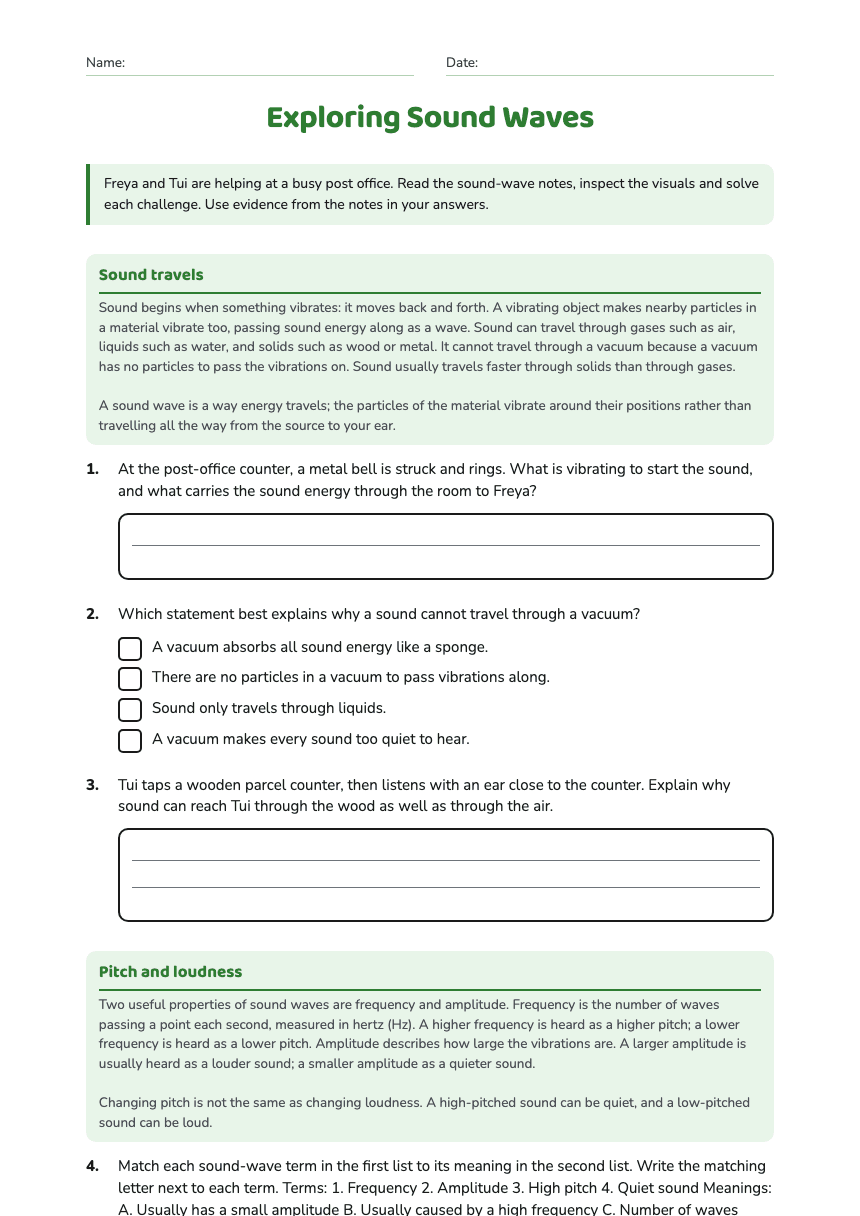
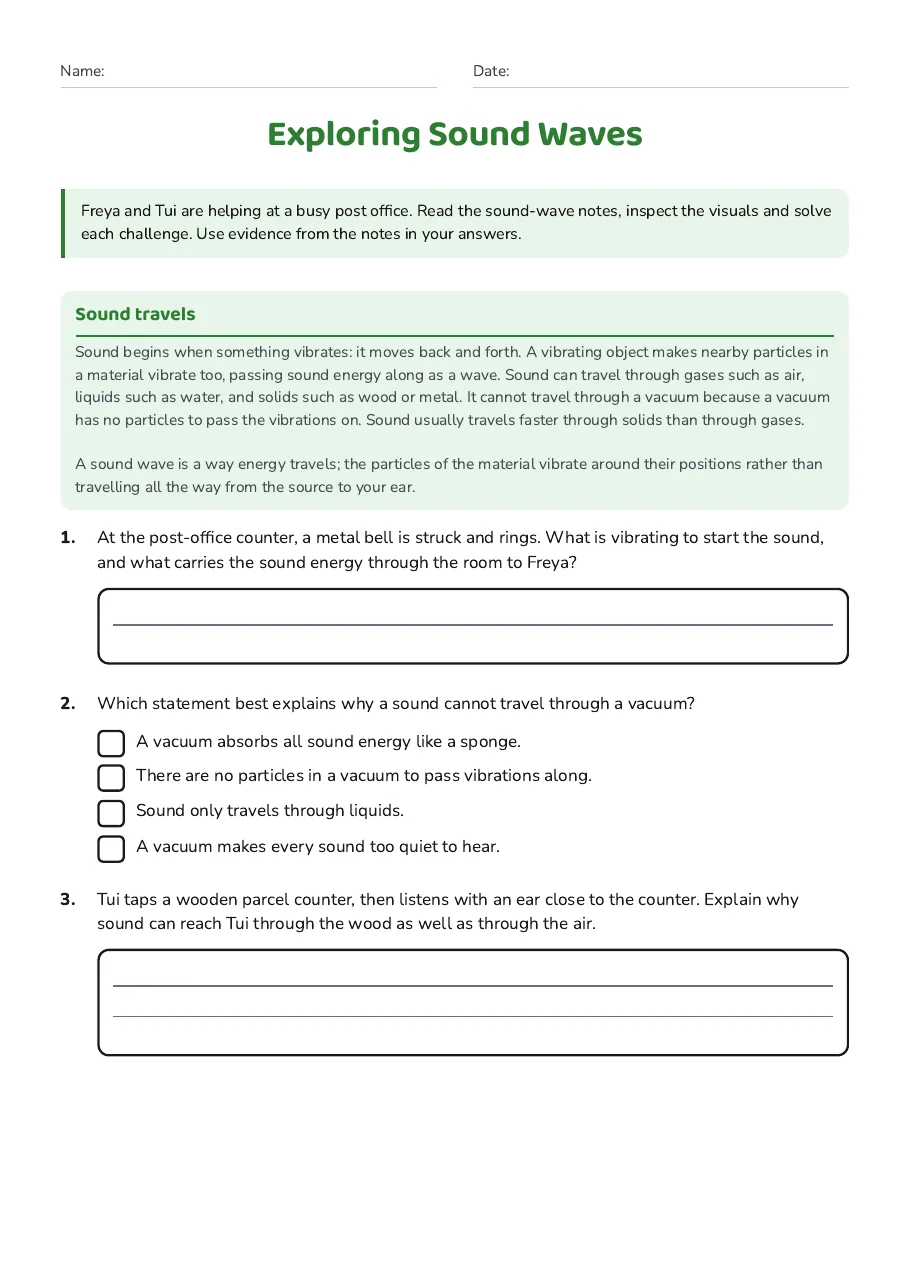
Exploring Sound Waves
Sound travels
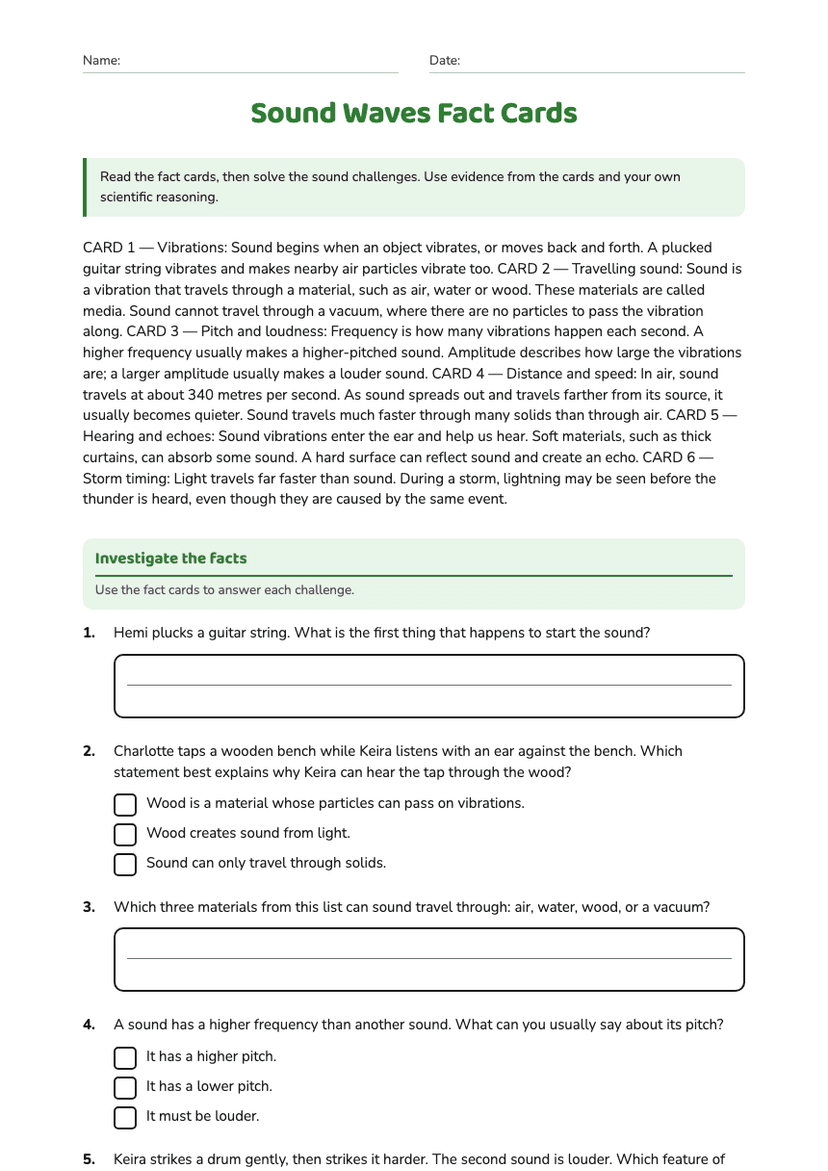
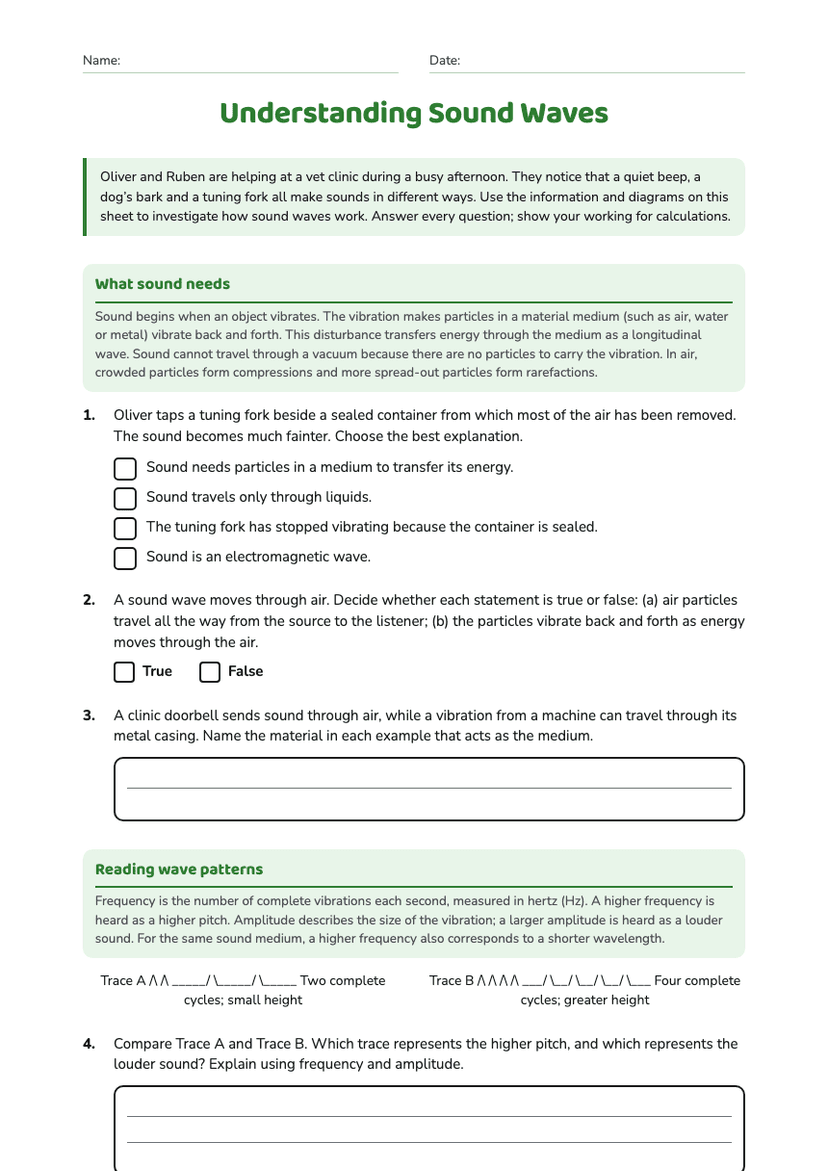
Sound begins when something vibrates: it moves back and forth. A vibrating object makes nearby particles in a material vibrate too, passing sound energy along as a wave. Sound can travel through gases such as air, liquids such as water, and solids such as wood or metal. It cannot travel through a vacuum because a vacuum has no particles to pass the vibrations on. Sound usually travels faster through solids than through gases. A sound wave is a way energy travels; the particles of the material vibrate around their positions rather than travelling all the way from the source to your ear.
- A vacuum absorbs all sound energy like a sponge.
- There are no particles in a vacuum to pass vibrations along.
- Sound only travels through liquids.
- A vacuum makes every sound too quiet to hear.
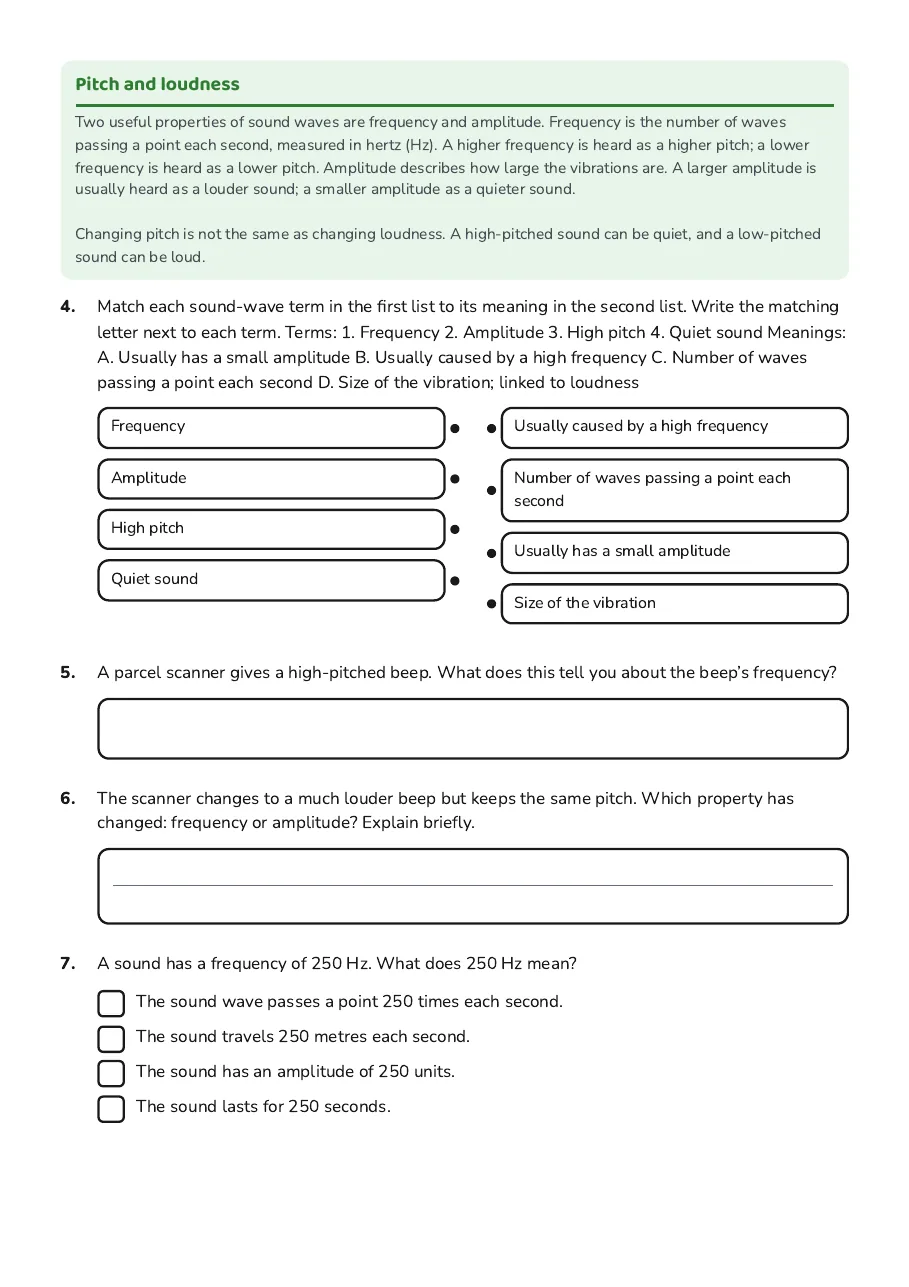
Pitch and loudness
Two useful properties of sound waves are frequency and amplitude. Frequency is the number of waves passing a point each second, measured in hertz (Hz). A higher frequency is heard as a higher pitch; a lower frequency is heard as a lower pitch. Amplitude describes how large the vibrations are. A larger amplitude is usually heard as a louder sound; a smaller amplitude as a quieter sound. Changing pitch is not the same as changing loudness. A high-pitched sound can be quiet, and a low-pitched sound can be loud.
- Frequency
- Amplitude
- High pitch
- Quiet sound
- Usually caused by a high frequency
- Number of waves passing a point each second
- Usually has a small amplitude
- Size of the vibration
- The sound wave passes a point 250 times each second.
- The sound travels 250 metres each second.
- The sound has an amplitude of 250 units.
- The sound lasts for 250 seconds.
3 printable pages
Page 1
Page 2
Page 3
About This Worksheet
Free in Kuraplan
Sign up free, grab the PDF, and customize it for your class.
Print-Ready
Formatted for standard paper. Clean layout, easy to read.
AI-Generated
Created with Kuraplan's AI, designed for real classroom use.
For Teachers & Parents
Use in classrooms, for homework, tutoring, or homeschool.
Need a custom version of this worksheet?
Kuraplan's AI generates custom worksheets in seconds — differentiated for every learner, aligned to your curriculum.
Generate Custom Worksheets — Free