Forces and Motion Fundamentals
A free science worksheet ready for your classroom. Open in Kuraplan to grab the print-ready PDF, customize it for your students, or generate a fresh version in seconds.

Forces and Motion Fundamentals
📖 Reading Passage: Understanding Forces and Motion
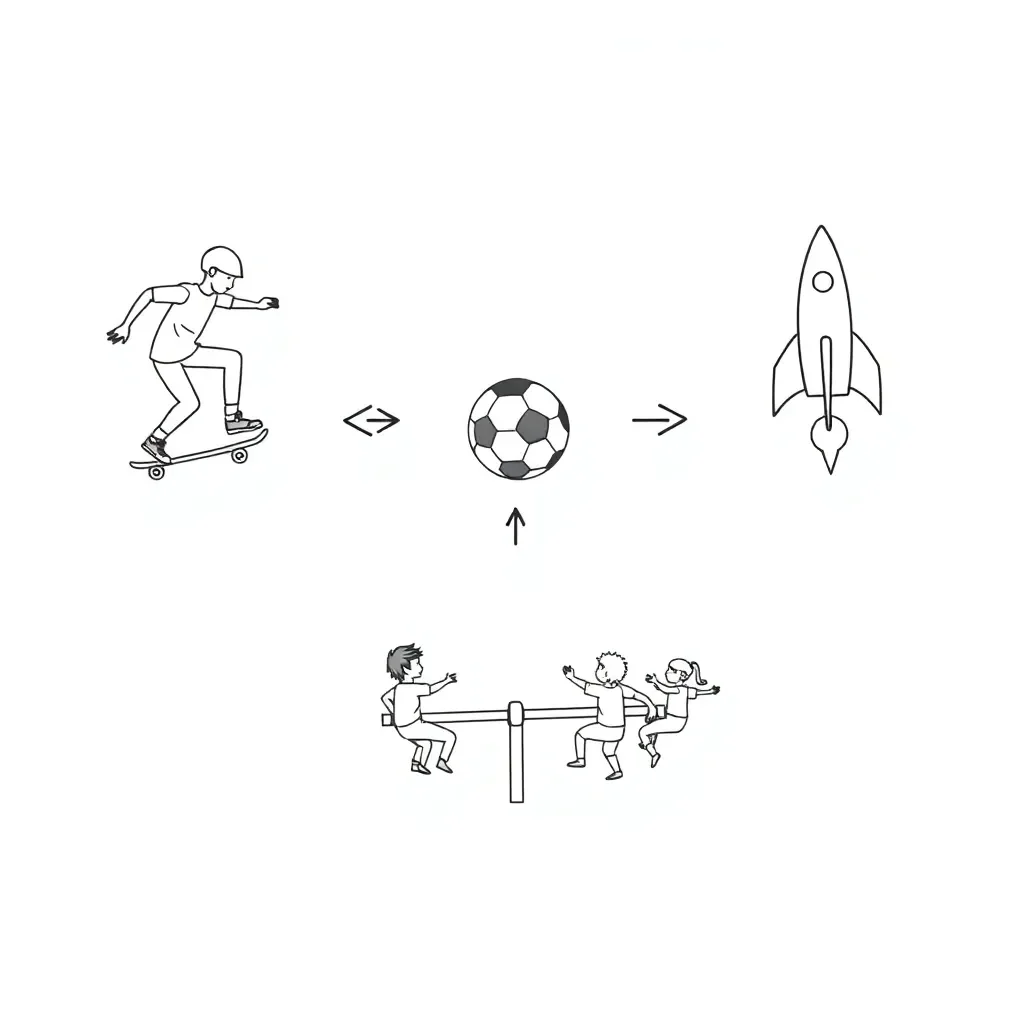
The motion of any object is determined by the sum of all forces acting on it. When you push a shopping cart, kick a soccer ball, or ride a bicycle, forces are at work changing the motion of these objects.
Force and Mass: The effect of a force depends on the mass of the object. A small force can easily move a tennis ball, but the same force would barely budge a bowling ball. The greater the mass, the more force needed to change its motion. Similarly, the greater the force applied to an object, the greater the change in motion.
Newton's Third Law: For every action, there is an equal and opposite reaction. When you walk, your foot pushes backward on the ground, and the ground pushes forward on your foot with equal force. When a rocket fires its engines downward, the exhaust pushes down while the rocket is pushed up.
Reference Frames: Motion is always described relative to something else called a reference frame. A passenger on a moving train appears stationary to other passengers but is moving at 60 mph relative to someone standing on the platform. Understanding reference frames helps us accurately describe forces and motion.
🧠 Comprehension Questions
🔬 Apply Your Knowledge
a) Another passenger in the car: ___________________________
b) A tree outside the car: ___________________________
About This Worksheet
Free in Kuraplan
Sign up free, grab the PDF, and customize it for your class.
Print-Ready
Formatted for standard paper. Clean layout, easy to read.
AI-Generated
Created with Kuraplan's AI, designed for real classroom use.
For Teachers & Parents
Use in classrooms, for homework, tutoring, or homeschool.
Need a custom version of this worksheet?
Kuraplan's AI generates custom worksheets in seconds — differentiated for every learner, aligned to your curriculum.
Generate Custom Worksheets — FreeMore Science Worksheets
Force and Motion Investigations
Free
Pushes and Pulls Investigations
Free
Forces and Friction Investigation
Free
Forces and Motion Exploration
Free
Forces and Motion Experiments
Free
Forces: Cornell Notes Example
Free
Energy and Forces Worksheet
Free