ScienceFreePrintable

Ionic Bonding Properties

A free science worksheet ready for your classroom. Open in Kuraplan to grab the print-ready PDF, customize it for your students, or generate a fresh version in seconds.

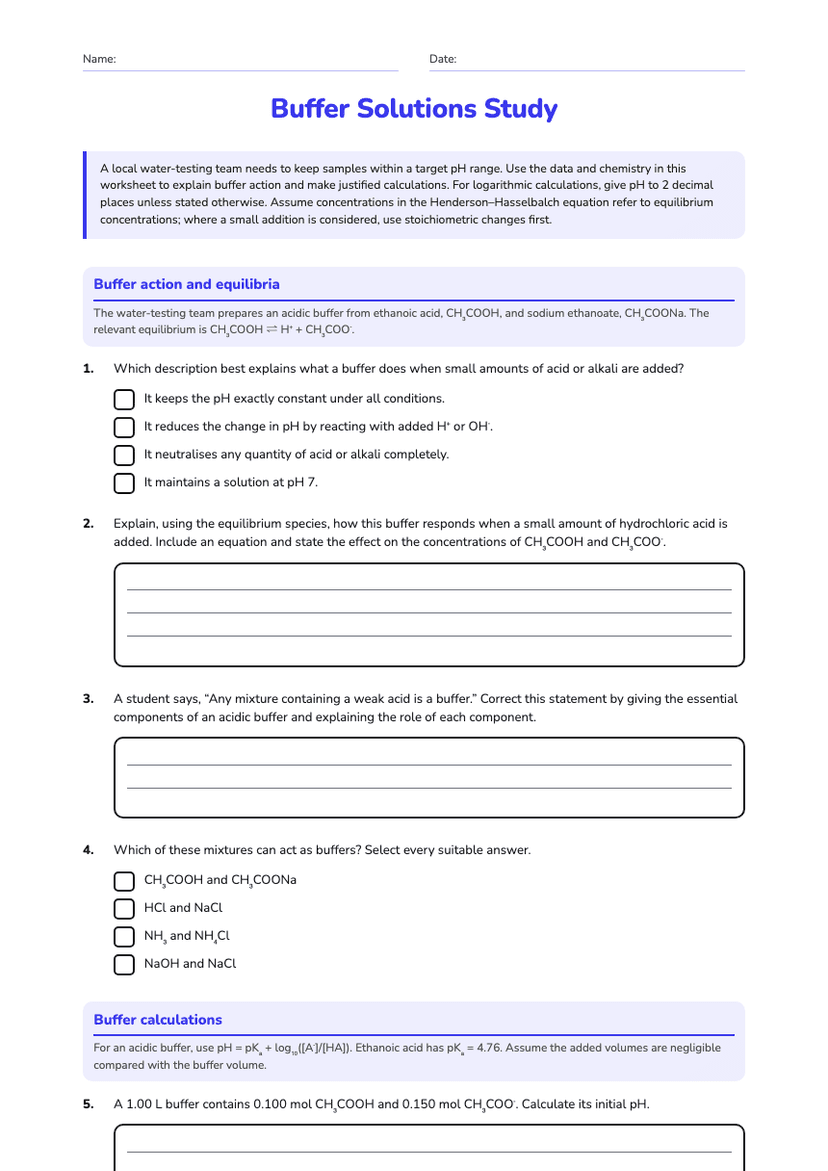
Ionic Bonding Properties worksheet preview
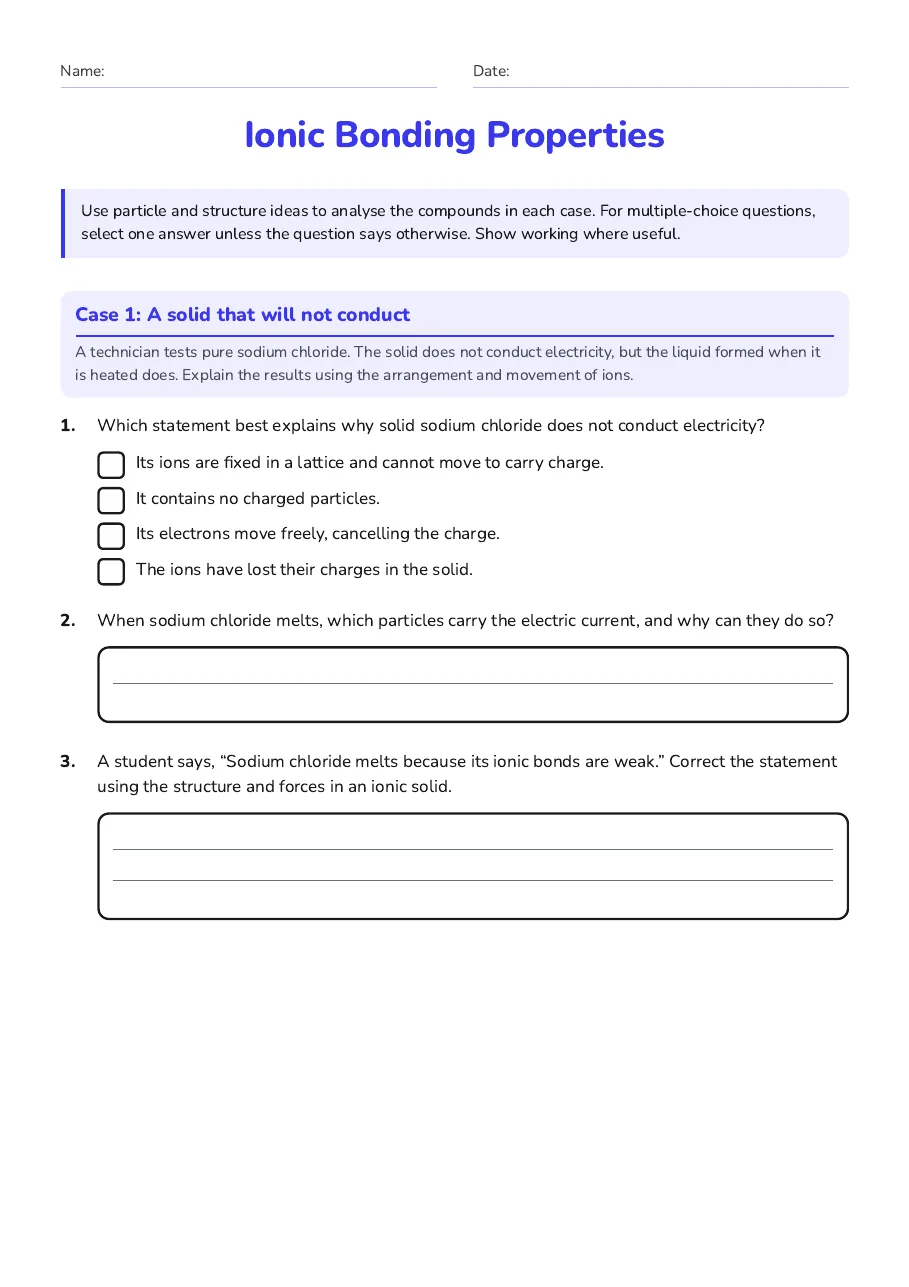
Name:Date:

Ionic Bonding Properties

Use particle and structure ideas to analyse the compounds in each case. For multiple-choice questions, select one answer unless the question says otherwise. Show working where useful.

Case 1: A solid that will not conduct

A technician tests pure sodium chloride. The solid does not conduct electricity, but the liquid formed when it is heated does. Explain the results using the arrangement and movement of ions.

1.Which statement best explains why solid sodium chloride does not conduct electricity?
  • Its ions are fixed in a lattice and cannot move to carry charge.
  • It contains no charged particles.
  • Its electrons move freely, cancelling the charge.
  • The ions have lost their charges in the solid.
2.When sodium chloride melts, which particles carry the electric current, and why can they do so?
3.A student says, “Sodium chloride melts because its ionic bonds are weak.” Correct the statement using the structure and forces in an ionic solid.

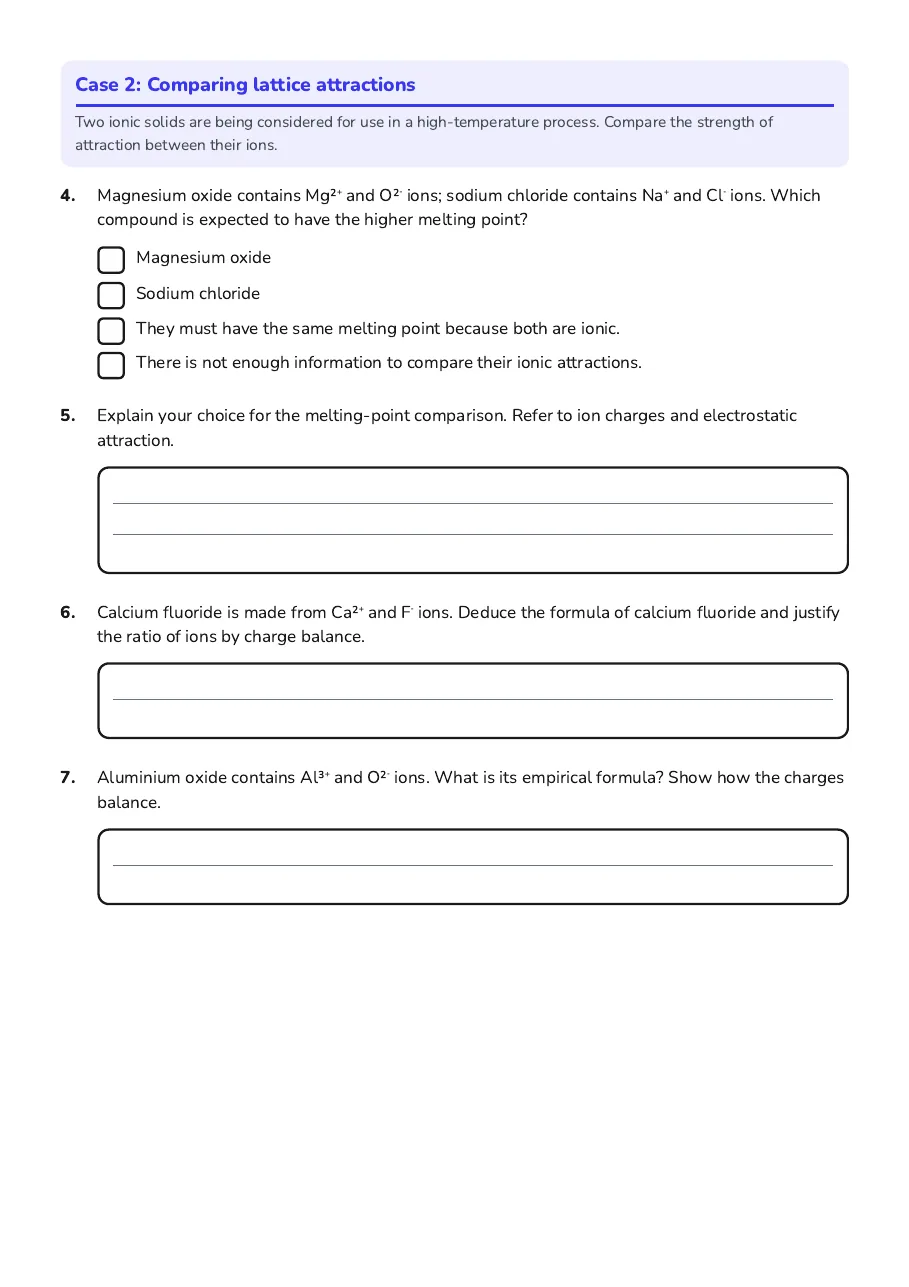
Case 2: Comparing lattice attractions

Two ionic solids are being considered for use in a high-temperature process. Compare the strength of attraction between their ions.

4.Magnesium oxide contains Mg²⁺ and O²⁻ ions; sodium chloride contains Na⁺ and Cl⁻ ions. Which compound is expected to have the higher melting point?
  • Magnesium oxide
  • Sodium chloride
  • They must have the same melting point because both are ionic.
  • There is not enough information to compare their ionic attractions.
5.Explain your choice for the melting-point comparison. Refer to ion charges and electrostatic attraction.
6.Calcium fluoride is made from Ca²⁺ and F⁻ ions. Deduce the formula of calcium fluoride and justify the ratio of ions by charge balance.
7.Aluminium oxide contains Al³⁺ and O²⁻ ions. What is its empirical formula? Show how the charges balance.

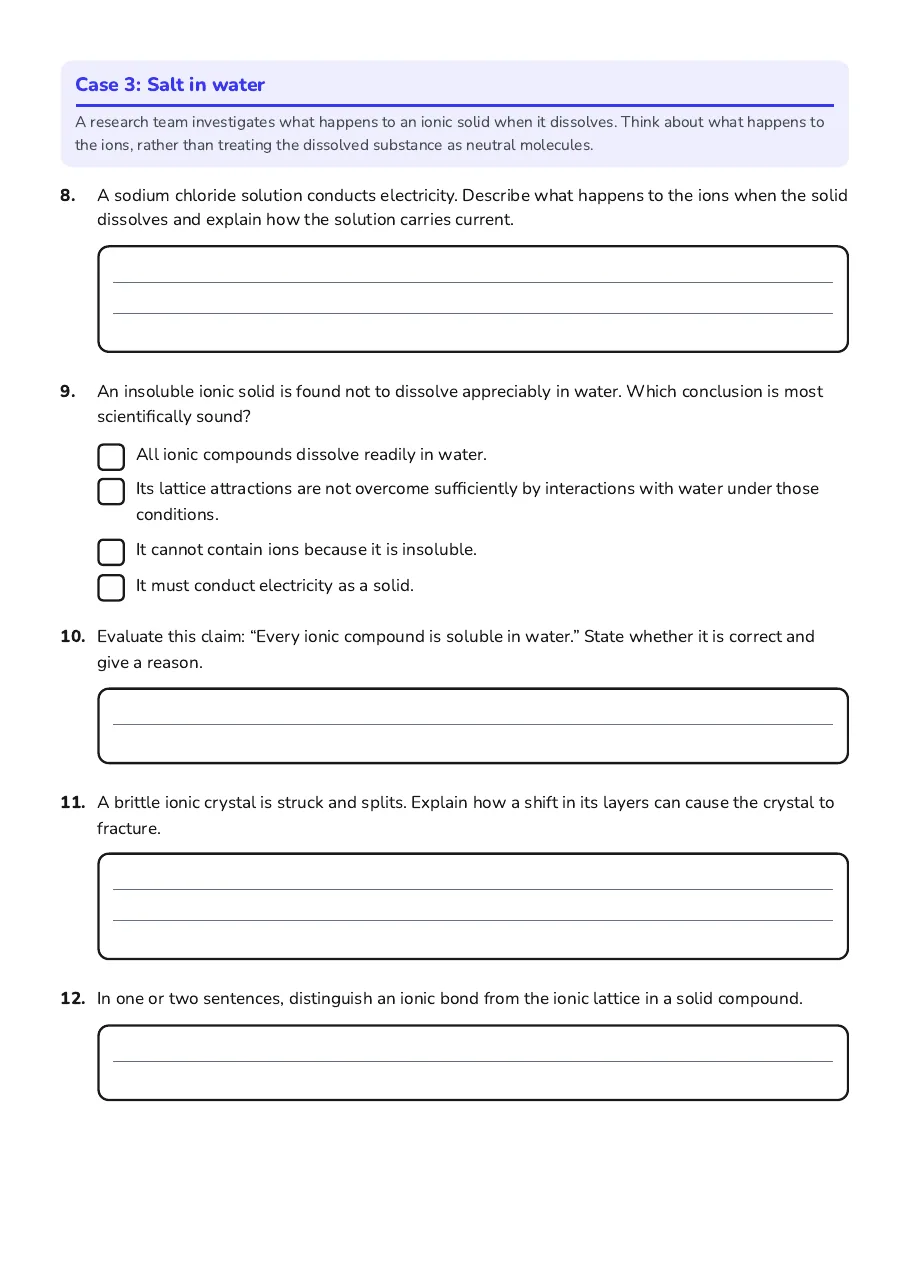
Case 3: Salt in water

A research team investigates what happens to an ionic solid when it dissolves. Think about what happens to the ions, rather than treating the dissolved substance as neutral molecules.

8.A sodium chloride solution conducts electricity. Describe what happens to the ions when the solid dissolves and explain how the solution carries current.
9.An insoluble ionic solid is found not to dissolve appreciably in water. Which conclusion is most scientifically sound?
  • All ionic compounds dissolve readily in water.
  • Its lattice attractions are not overcome sufficiently by interactions with water under those conditions.
  • It cannot contain ions because it is insoluble.
  • It must conduct electricity as a solid.
10.Evaluate this claim: “Every ionic compound is soluble in water.” State whether it is correct and give a reason.
11.A brittle ionic crystal is struck and splits. Explain how a shift in its layers can cause the crystal to fracture.
12.In one or two sentences, distinguish an ionic bond from the ionic lattice in a solid compound.

3 printable pages

  • Ionic Bonding Properties, page 1 of 3: Case 1: A solid that will not conduct

    Page 1

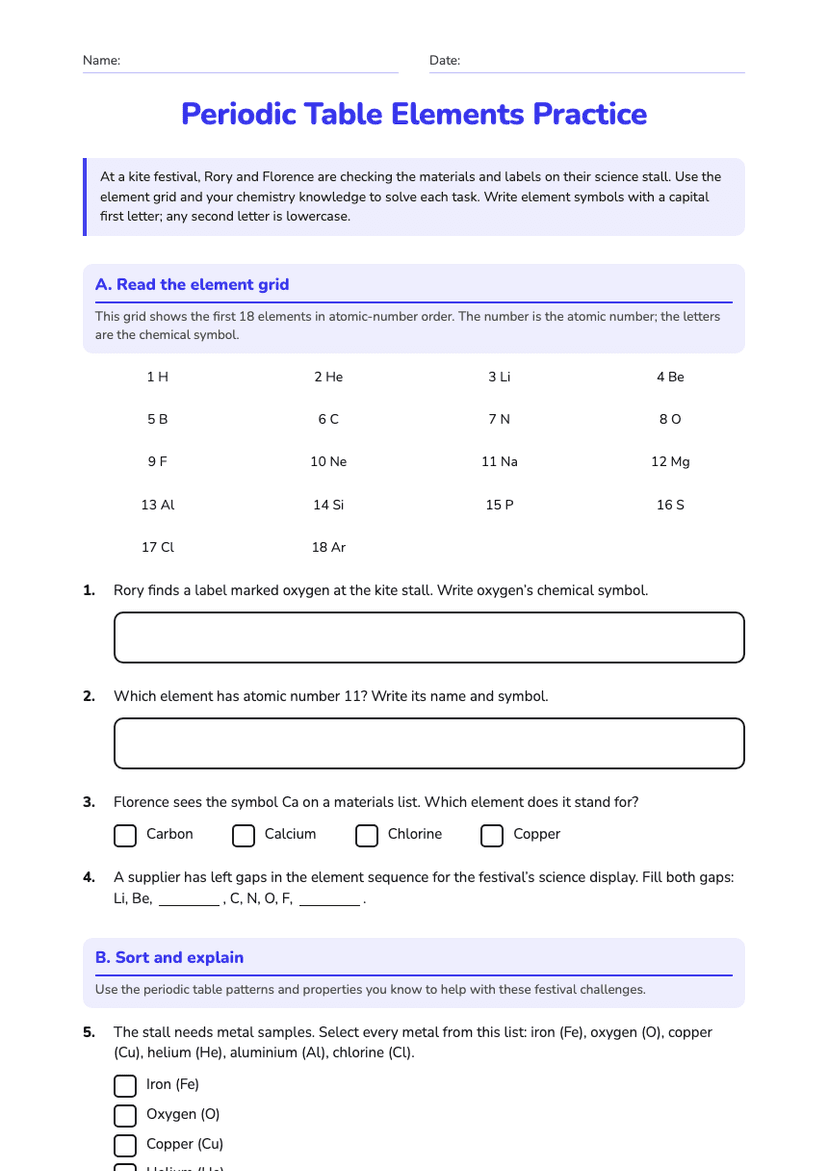
  • Ionic Bonding Properties, page 2 of 3: Case 2: Comparing lattice attractions

    Page 2

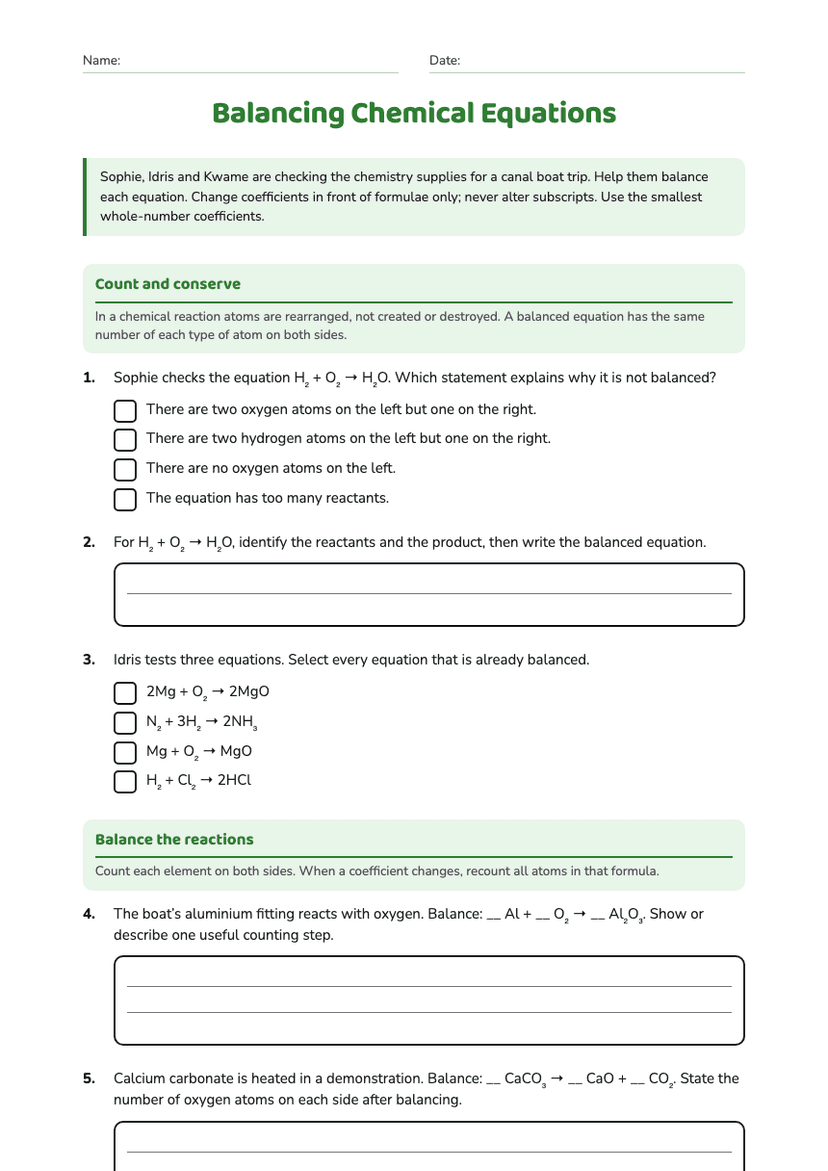
  • Ionic Bonding Properties, page 3 of 3: Case 3: Salt in water

    Page 3

About This Worksheet

Free in Kuraplan

Sign up free, grab the PDF, and customize it for your class.

Print-Ready

Formatted for standard paper. Clean layout, easy to read.

AI-Generated

Created with Kuraplan's AI, designed for real classroom use.

For Teachers & Parents

Use in classrooms, for homework, tutoring, or homeschool.

Need a custom version of this worksheet?

Kuraplan's AI generates custom worksheets in seconds — differentiated for every learner, aligned to your curriculum.

Generate Custom Worksheets — Free
No credit card Curriculum-aligned Under 60 seconds