ScienceFreePrintable

Matter Properties Exploration Worksheet

A free science worksheet ready for your classroom. Open in Kuraplan to grab the print-ready PDF, customize it for your students, or generate a fresh version in seconds.
Matter Properties Exploration Worksheet worksheet preview
Name:Date:

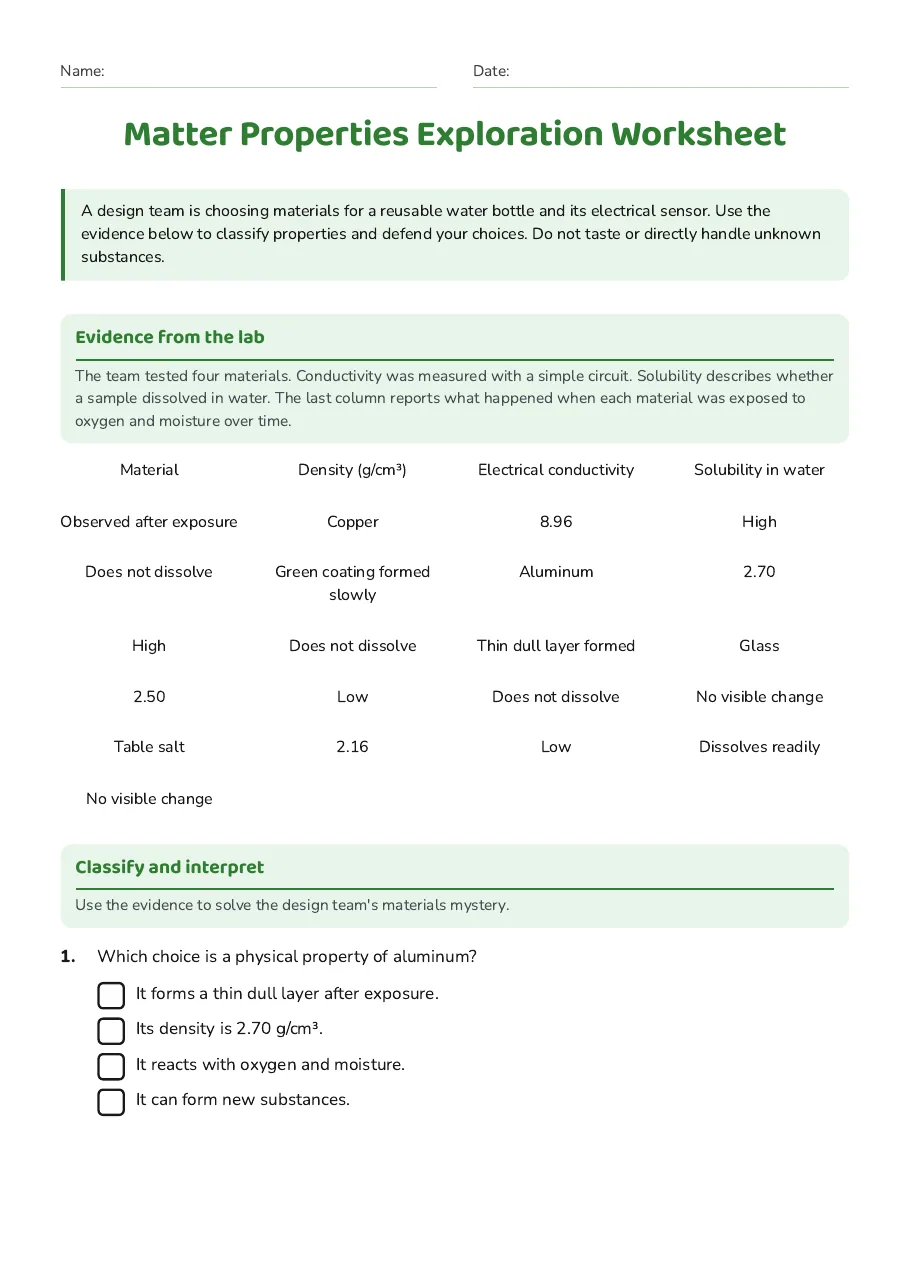
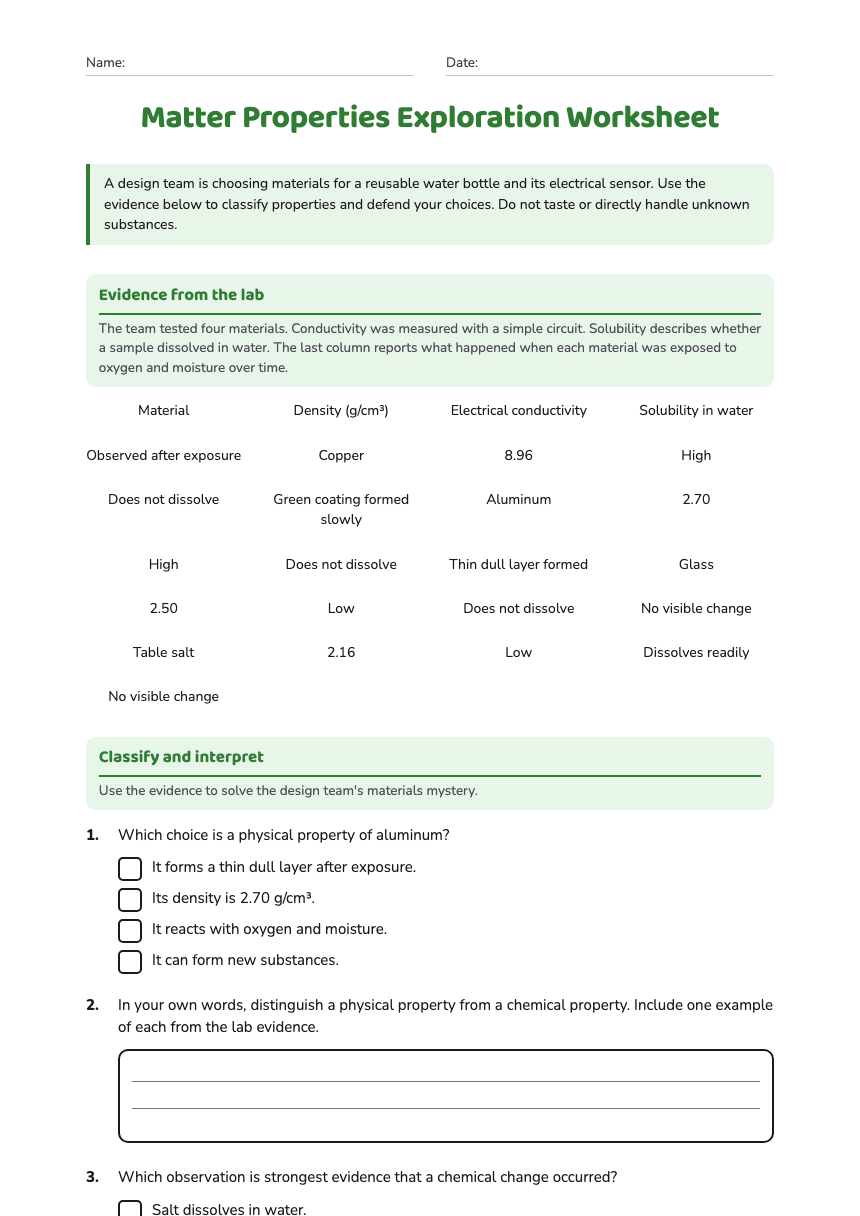
Matter Properties Exploration Worksheet

A design team is choosing materials for a reusable water bottle and its electrical sensor. Use the evidence below to classify properties and defend your choices. Do not taste or directly handle unknown substances.

Evidence from the lab

The team tested four materials. Conductivity was measured with a simple circuit. Solubility describes whether a sample dissolved in water. The last column reports what happened when each material was exposed to oxygen and moisture over time.

Material

Density (g/cm³)

Electrical conductivity

Solubility in water

Observed after exposure

Copper

8.96

High

Does not dissolve

Green coating formed slowly

Aluminum

2.70

High

Does not dissolve

Thin dull layer formed

Glass

2.50

Low

Does not dissolve

No visible change

Table salt

2.16

Low

Dissolves readily

No visible change

Classify and interpret

Use the evidence to solve the design team's materials mystery.

1.Which choice is a physical property of aluminum?
  • It forms a thin dull layer after exposure.
  • Its density is 2.70 g/cm³.
  • It reacts with oxygen and moisture.
  • It can form new substances.
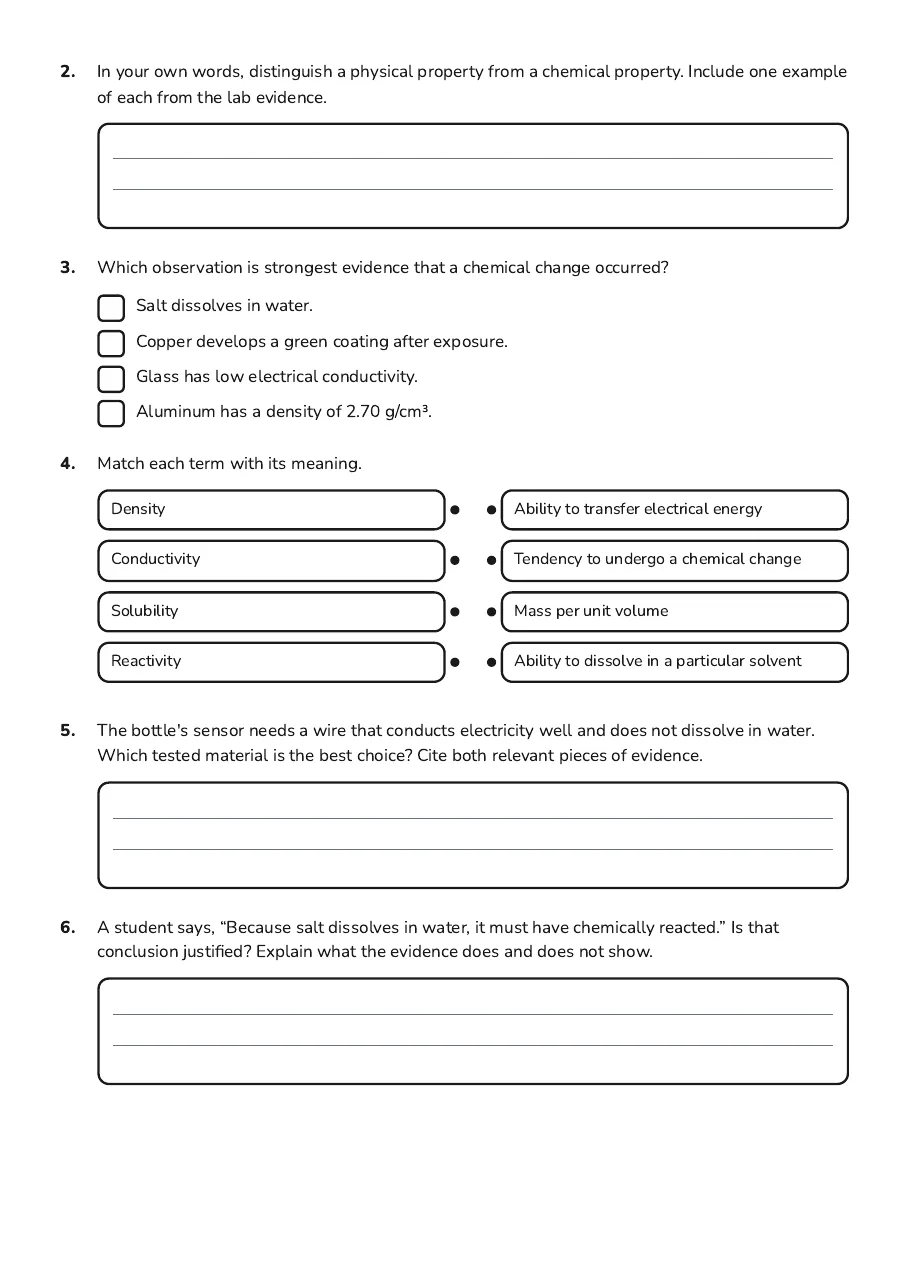
2.In your own words, distinguish a physical property from a chemical property. Include one example of each from the lab evidence.
3.Which observation is strongest evidence that a chemical change occurred?
  • Salt dissolves in water.
  • Copper develops a green coating after exposure.
  • Glass has low electrical conductivity.
  • Aluminum has a density of 2.70 g/cm³.
4.Match each term with its meaning.
  • Density
  • Conductivity
  • Solubility
  • Reactivity
  • Ability to transfer electrical energy
  • Tendency to undergo a chemical change
  • Mass per unit volume
  • Ability to dissolve in a particular solvent
5.The bottle's sensor needs a wire that conducts electricity well and does not dissolve in water. Which tested material is the best choice? Cite both relevant pieces of evidence.
6.A student says, “Because salt dissolves in water, it must have chemically reacted.” Is that conclusion justified? Explain what the evidence does and does not show.
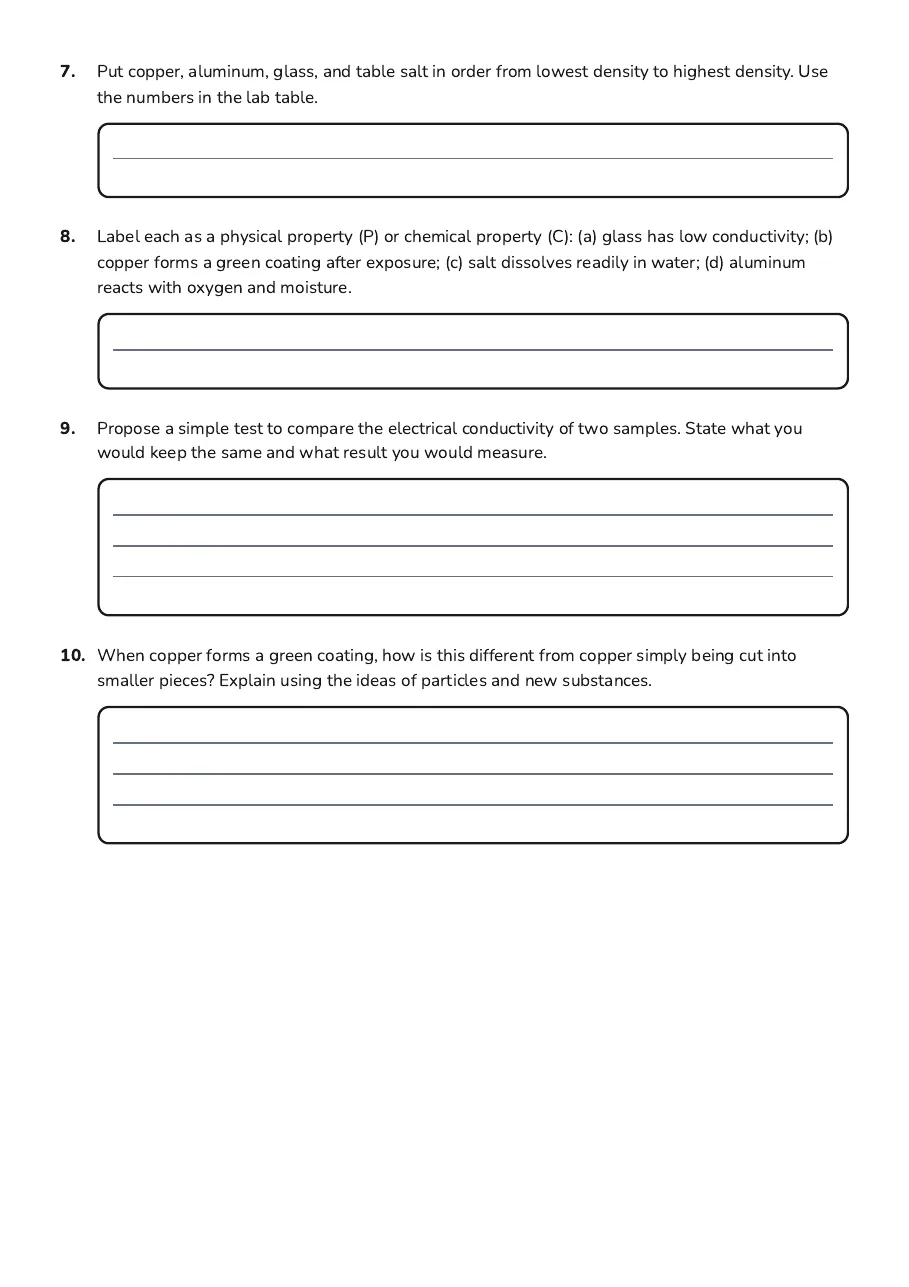
7.Put copper, aluminum, glass, and table salt in order from lowest density to highest density. Use the numbers in the lab table.
8.Label each as a physical property (P) or chemical property (C): (a) glass has low conductivity; (b) copper forms a green coating after exposure; (c) salt dissolves readily in water; (d) aluminum reacts with oxygen and moisture.
9.Propose a simple test to compare the electrical conductivity of two samples. State what you would keep the same and what result you would measure.
10.When copper forms a green coating, how is this different from copper simply being cut into smaller pieces? Explain using the ideas of particles and new substances.

3 printable pages

  • Matter Properties Exploration Worksheet, page 1 of 3: Evidence from the lab, Classify and interpret

    Page 1

  • Matter Properties Exploration Worksheet, page 2 of 3: 2. In your own words, distinguish a physical property from a chemical property. Include…

    Page 2

  • Matter Properties Exploration Worksheet, page 3 of 3: 7. Put copper, aluminum, glass, and table salt in order from lowest density to highest…

    Page 3

About This Worksheet

Free in Kuraplan

Sign up free, grab the PDF, and customize it for your class.

Print-Ready

Formatted for standard paper. Clean layout, easy to read.

AI-Generated

Created with Kuraplan's AI, designed for real classroom use.

For Teachers & Parents

Use in classrooms, for homework, tutoring, or homeschool.

Need a custom version of this worksheet?

Kuraplan's AI generates custom worksheets in seconds — differentiated for every learner, aligned to your curriculum.

Generate Custom Worksheets — Free
No credit card Curriculum-aligned Under 60 seconds