HealthFreePrintable

Media Message Analysis

A free health worksheet ready for your classroom. Open in Kuraplan to grab the print-ready PDF, customize it for your students, or generate a fresh version in seconds.
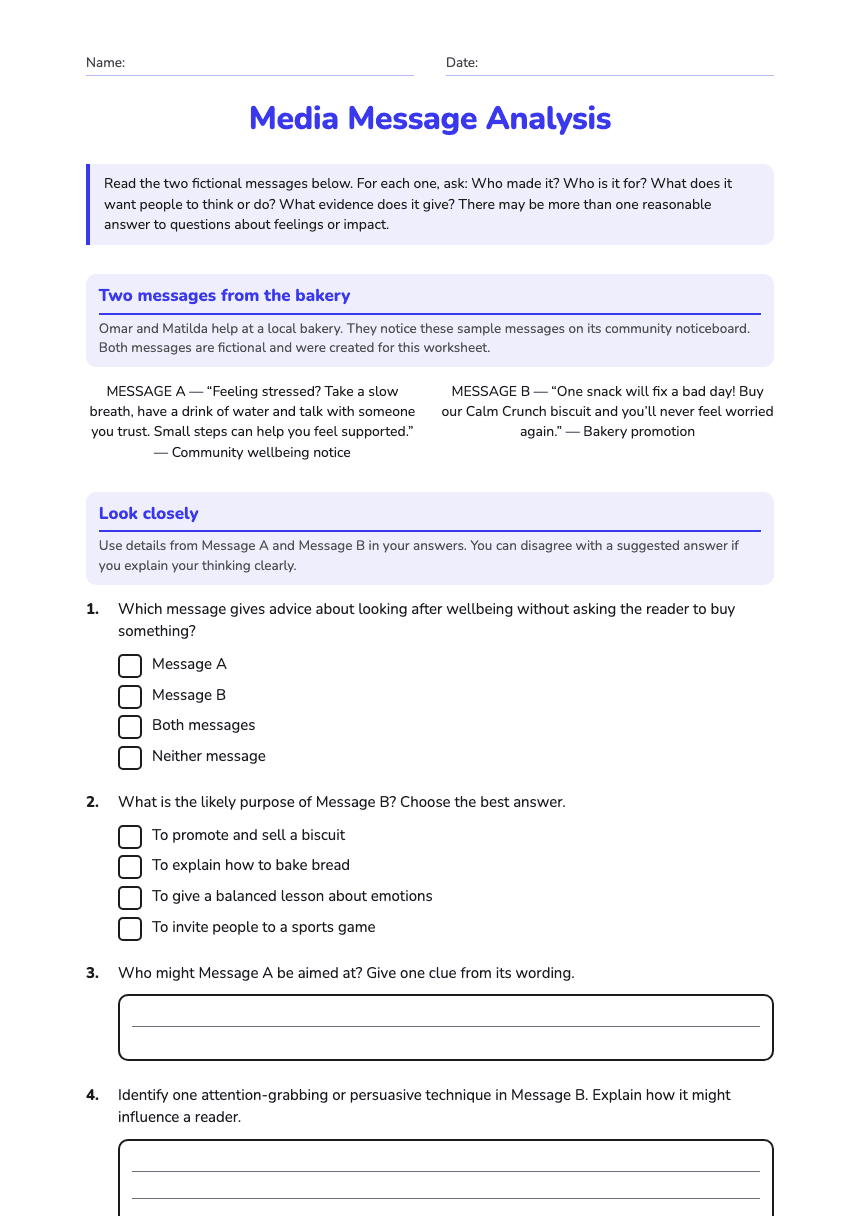
Media Message Analysis worksheet preview
Name:Date:

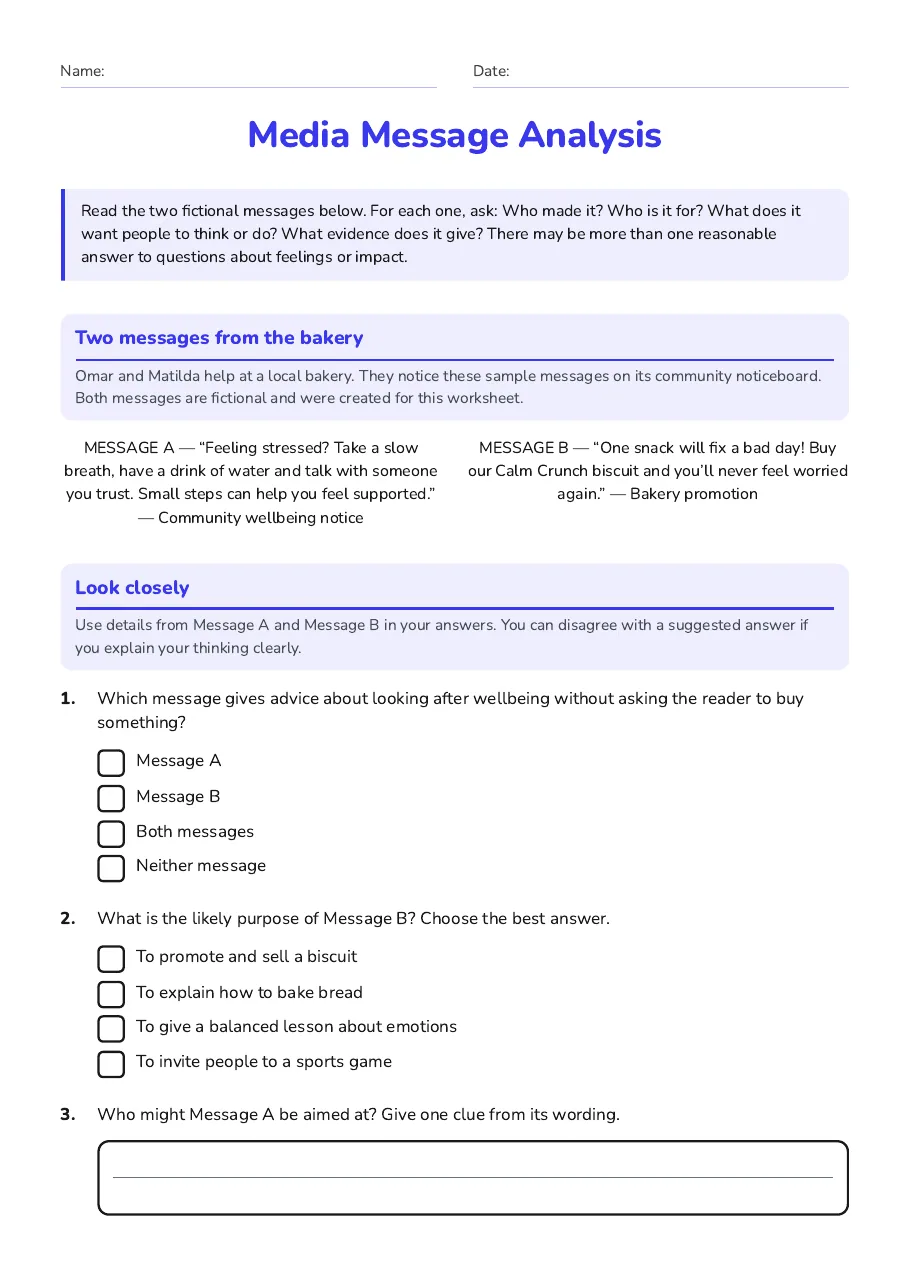
Media Message Analysis

Read the two fictional messages below. For each one, ask: Who made it? Who is it for? What does it want people to think or do? What evidence does it give? There may be more than one reasonable answer to questions about feelings or impact.

Two messages from the bakery

Omar and Matilda help at a local bakery. They notice these sample messages on its community noticeboard. Both messages are fictional and were created for this worksheet.

MESSAGE A — “Feeling stressed? Take a slow breath, have a drink of water and talk with someone you trust. Small steps can help you feel supported.” — Community wellbeing notice

MESSAGE B — “One snack will fix a bad day! Buy our Calm Crunch biscuit and you’ll never feel worried again.” — Bakery promotion

Look closely

Use details from Message A and Message B in your answers. You can disagree with a suggested answer if you explain your thinking clearly.

1.Which message gives advice about looking after wellbeing without asking the reader to buy something?
  • Message A
  • Message B
  • Both messages
  • Neither message
2.What is the likely purpose of Message B? Choose the best answer.
  • To promote and sell a biscuit
  • To explain how to bake bread
  • To give a balanced lesson about emotions
  • To invite people to a sports game
3.Who might Message A be aimed at? Give one clue from its wording.
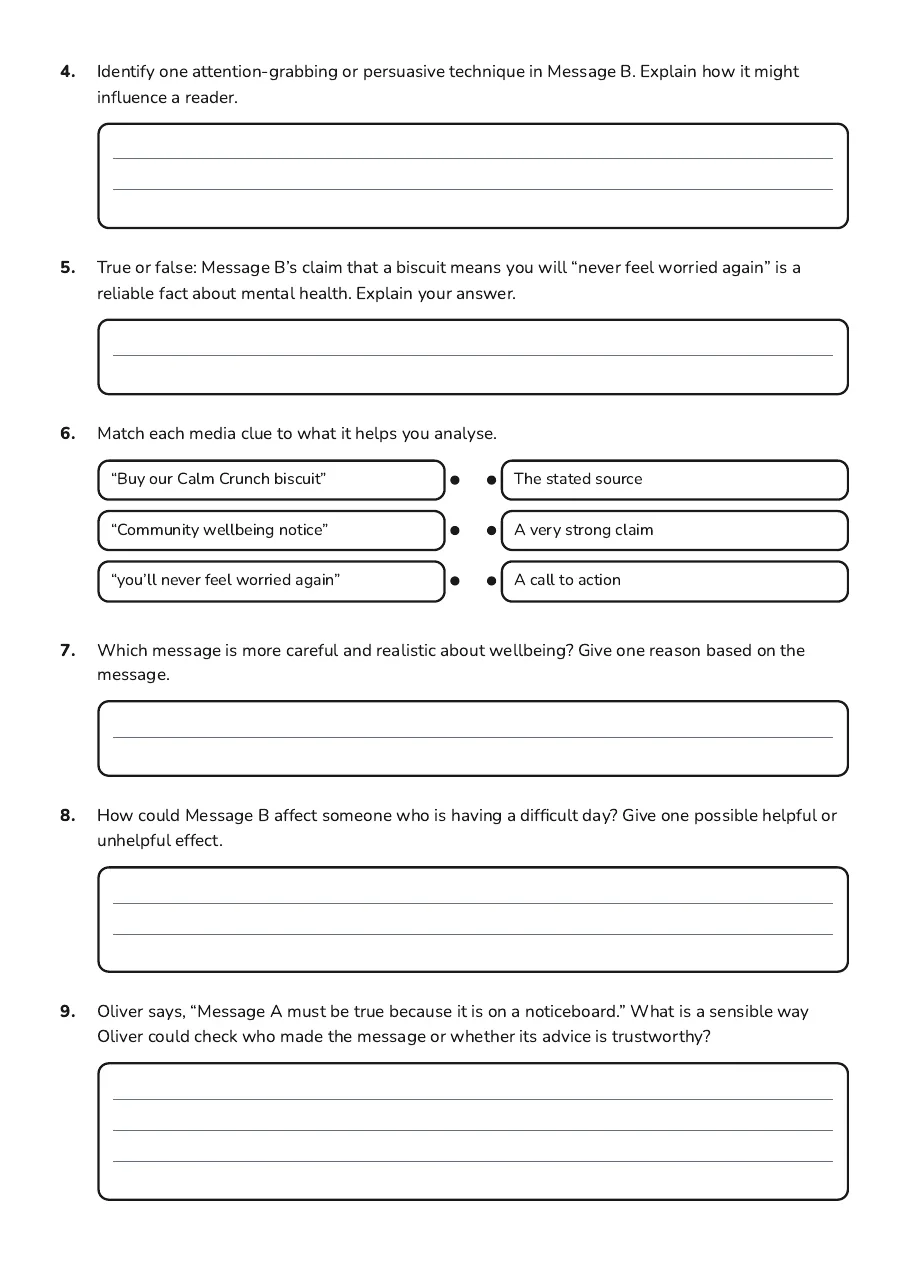
4.Identify one attention-grabbing or persuasive technique in Message B. Explain how it might influence a reader.
5.True or false: Message B’s claim that a biscuit means you will “never feel worried again” is a reliable fact about mental health. Explain your answer.
6.Match each media clue to what it helps you analyse.
  • “Buy our Calm Crunch biscuit”
  • “Community wellbeing notice”
  • “you’ll never feel worried again”
  • The stated source
  • A very strong claim
  • A call to action
7.Which message is more careful and realistic about wellbeing? Give one reason based on the message.
8.How could Message B affect someone who is having a difficult day? Give one possible helpful or unhelpful effect.
9.Oliver says, “Message A must be true because it is on a noticeboard.” What is a sensible way Oliver could check who made the message or whether its advice is trustworthy?
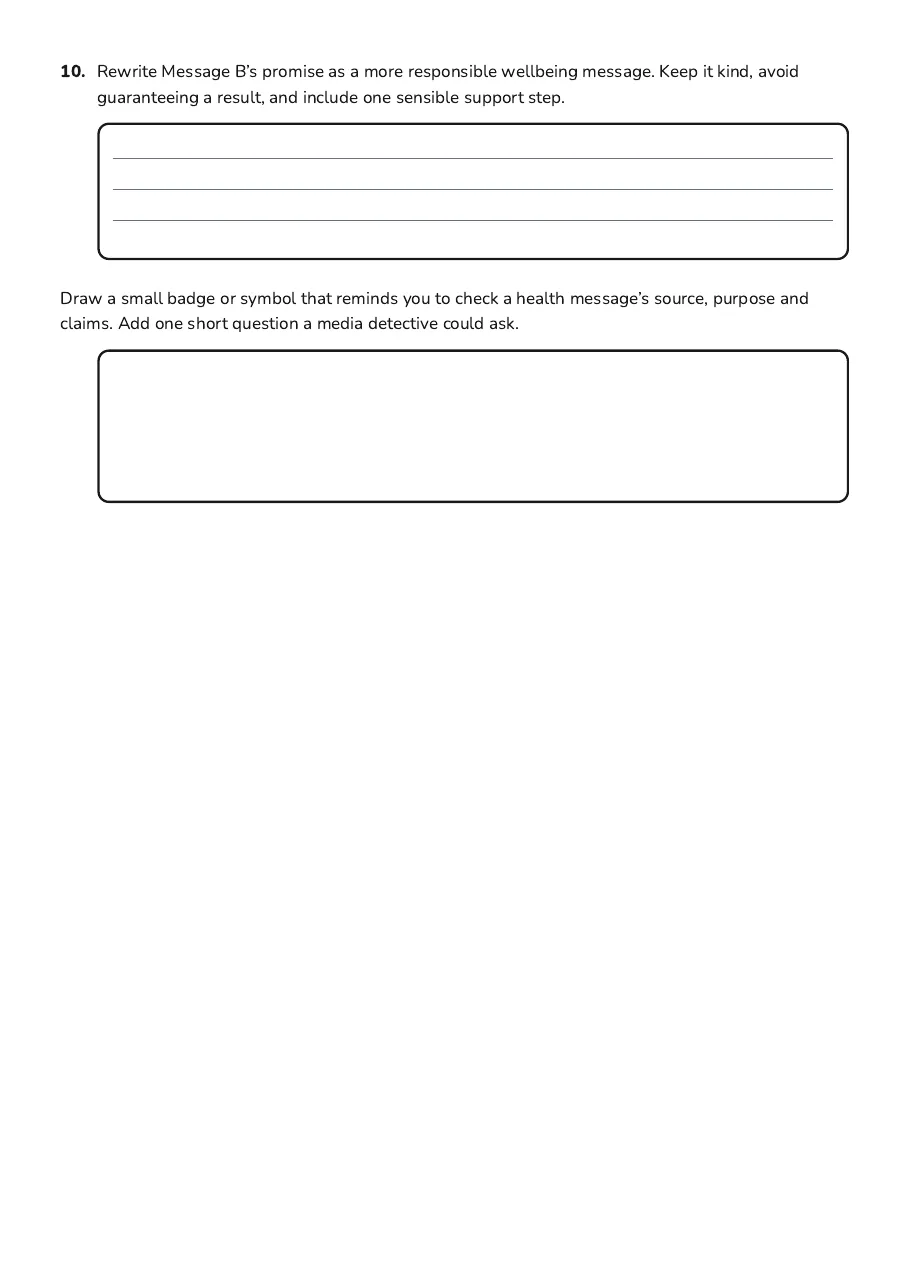
10.Rewrite Message B’s promise as a more responsible wellbeing message. Keep it kind, avoid guaranteeing a result, and include one sensible support step.
Draw a small badge or symbol that reminds you to check a health message’s source, purpose and claims. Add one short question a media detective could ask.

3 printable pages

  • Media Message Analysis, page 1 of 3: Two messages from the bakery, Look closely

    Page 1

  • Media Message Analysis, page 2 of 3: 4. Identify one attention-grabbing or persuasive technique in Message B. Explain how it…

    Page 2

  • Media Message Analysis, page 3 of 3: 10. Rewrite Message B’s promise as a more responsible wellbeing message. Keep it kind,…

    Page 3

About This Worksheet

Free in Kuraplan

Sign up free, grab the PDF, and customize it for your class.

Print-Ready

Formatted for standard paper. Clean layout, easy to read.

AI-Generated

Created with Kuraplan's AI, designed for real classroom use.

For Teachers & Parents

Use in classrooms, for homework, tutoring, or homeschool.

Need a custom version of this worksheet?

Kuraplan's AI generates custom worksheets in seconds — differentiated for every learner, aligned to your curriculum.

Generate Custom Worksheets — Free
No credit card Curriculum-aligned Under 60 seconds