Medieval Jewish Diaspora Life
A free social studies worksheet ready for your classroom. Open in Kuraplan to grab the print-ready PDF, customize it for your students, or generate a fresh version in seconds.
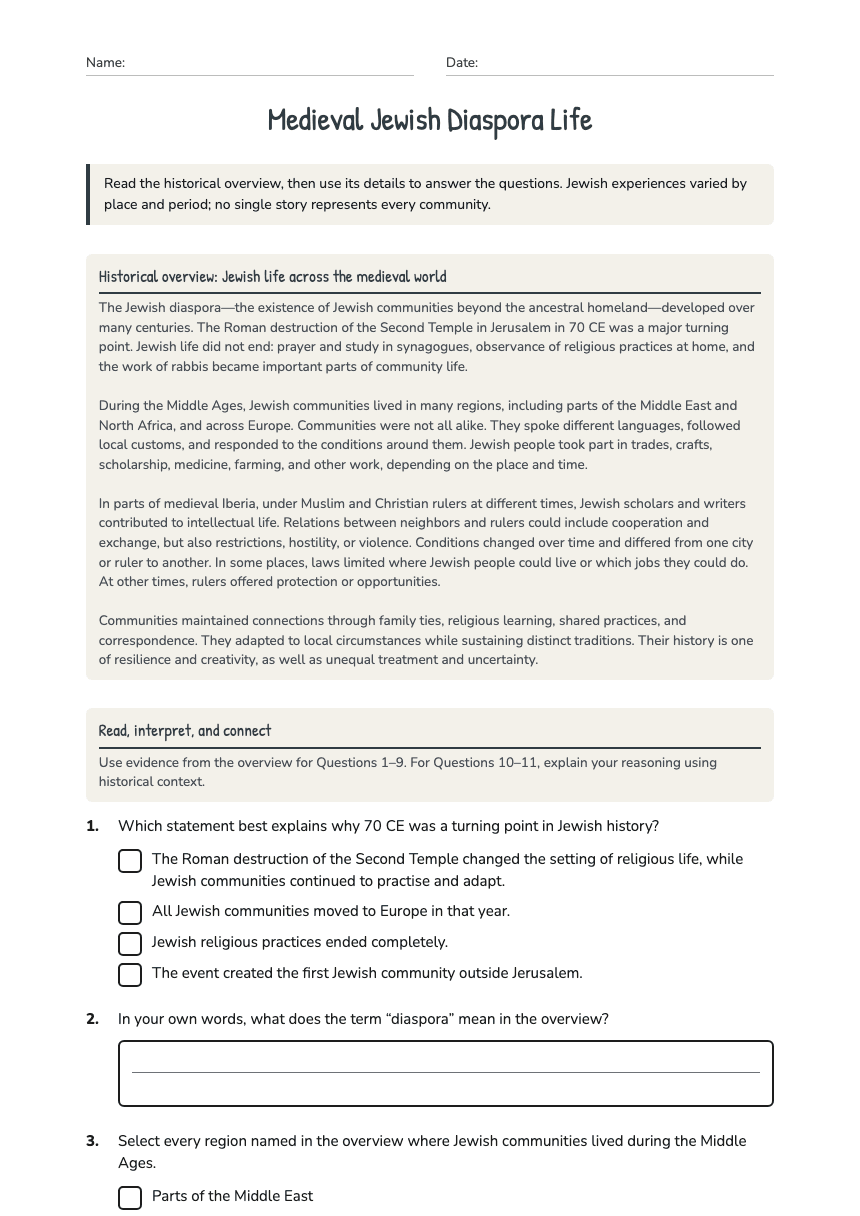
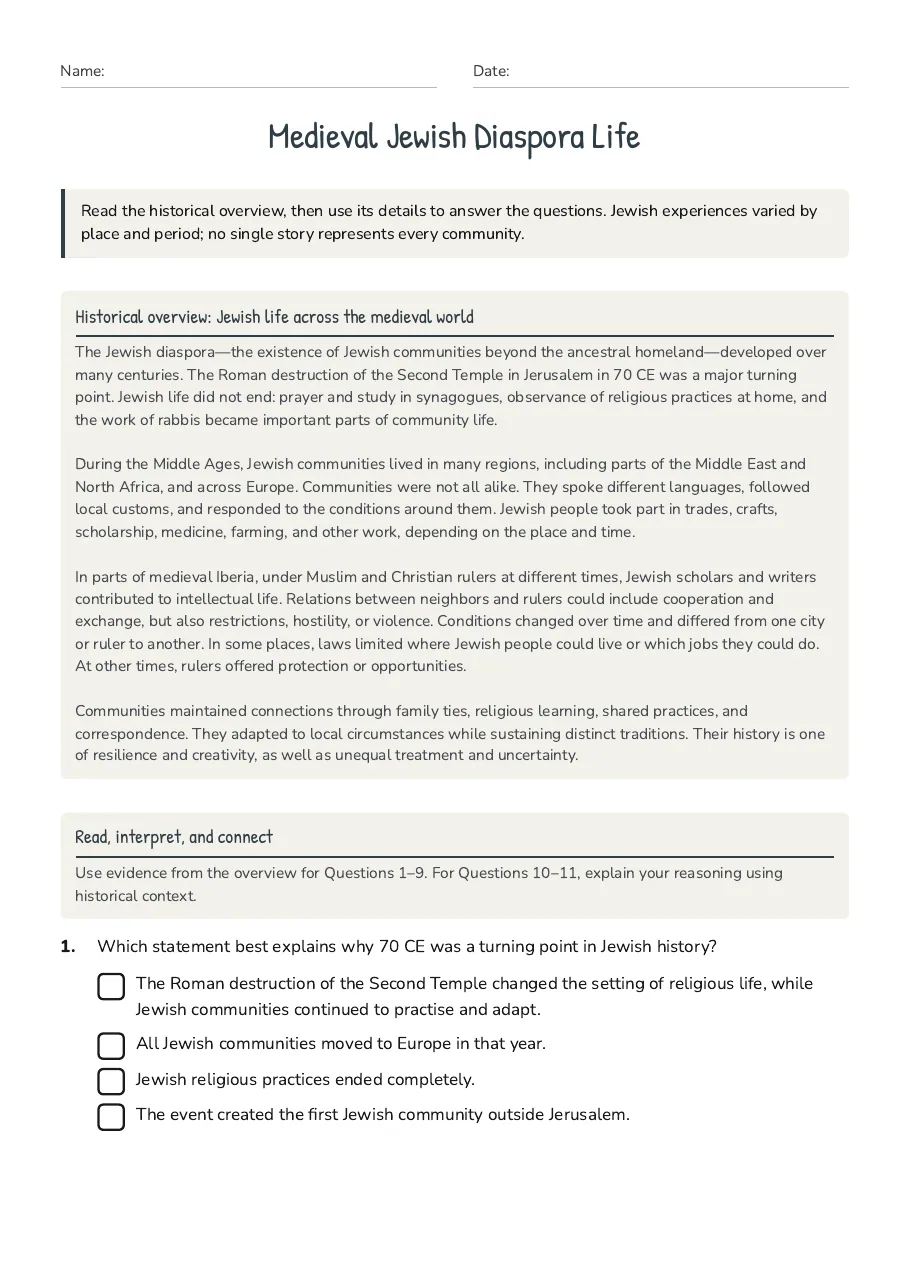
Medieval Jewish Diaspora Life
Historical overview: Jewish life across the medieval world
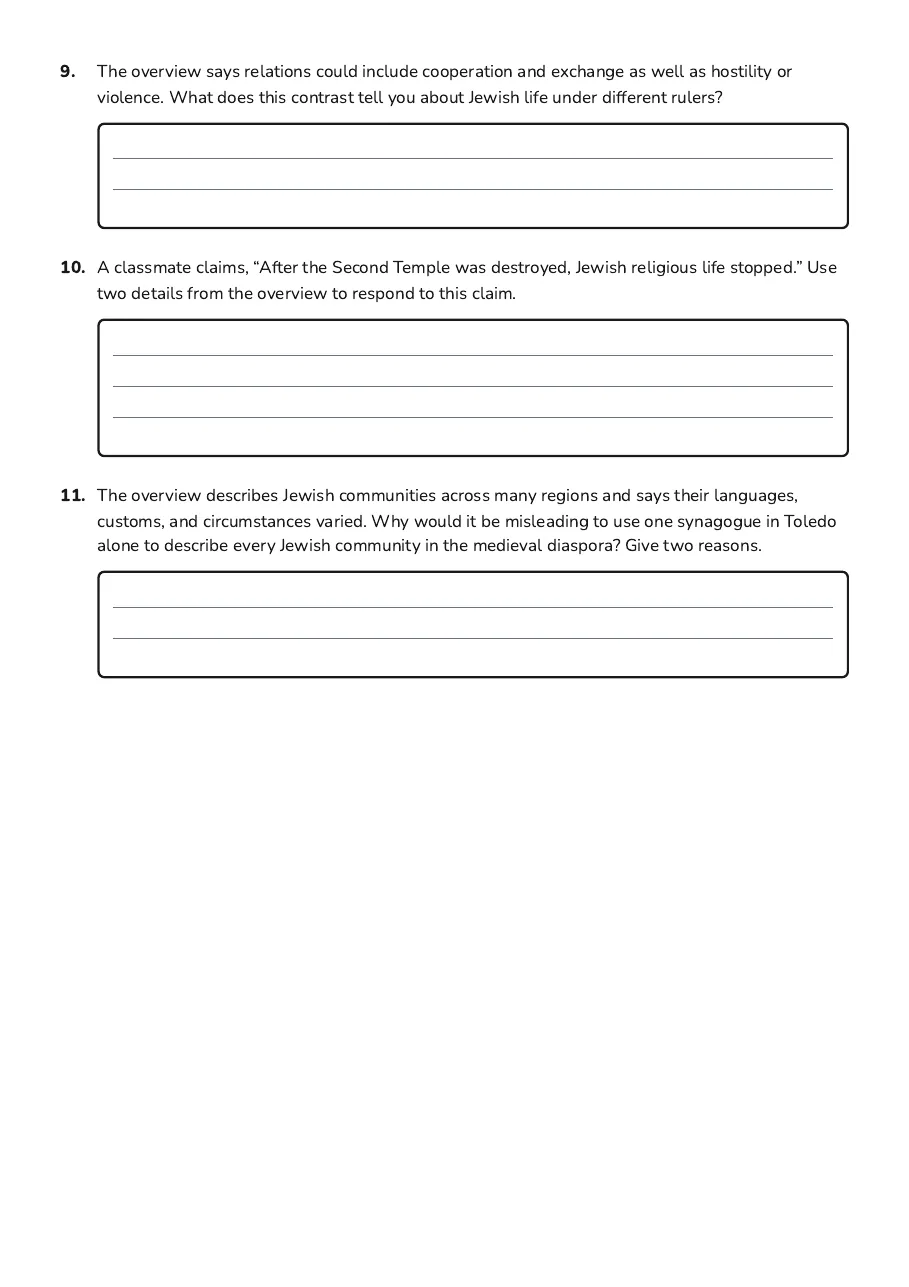
The Jewish diaspora—the existence of Jewish communities beyond the ancestral homeland—developed over many centuries. The Roman destruction of the Second Temple in Jerusalem in 70 CE was a major turning point. Jewish life did not end: prayer and study in synagogues, observance of religious practices at home, and the work of rabbis became important parts of community life. During the Middle Ages, Jewish communities lived in many regions, including parts of the Middle East and North Africa, and across Europe. Communities were not all alike. They spoke different languages, followed local customs, and responded to the conditions around them. Jewish people took part in trades, crafts, scholarship, medicine, farming, and other work, depending on the place and time. In parts of medieval Iberia, under Muslim and Christian rulers at different times, Jewish scholars and writers contributed to intellectual life. Relations between neighbors and rulers could include cooperation and exchange, but also restrictions, hostility, or violence. Conditions changed over time and differed from one city or ruler to another. In some places, laws limited where Jewish people could live or which jobs they could do. At other times, rulers offered protection or opportunities. Communities maintained connections through family ties, religious learning, shared practices, and correspondence. They adapted to local circumstances while sustaining distinct traditions. Their history is one of resilience and creativity, as well as unequal treatment and uncertainty.
Read, interpret, and connect
Use evidence from the overview for Questions 1–9. For Questions 10–11, explain your reasoning using historical context.
- The Roman destruction of the Second Temple changed the setting of religious life, while Jewish communities continued to practise and adapt.
- All Jewish communities moved to Europe in that year.
- Jewish religious practices ended completely.
- The event created the first Jewish community outside Jerusalem.
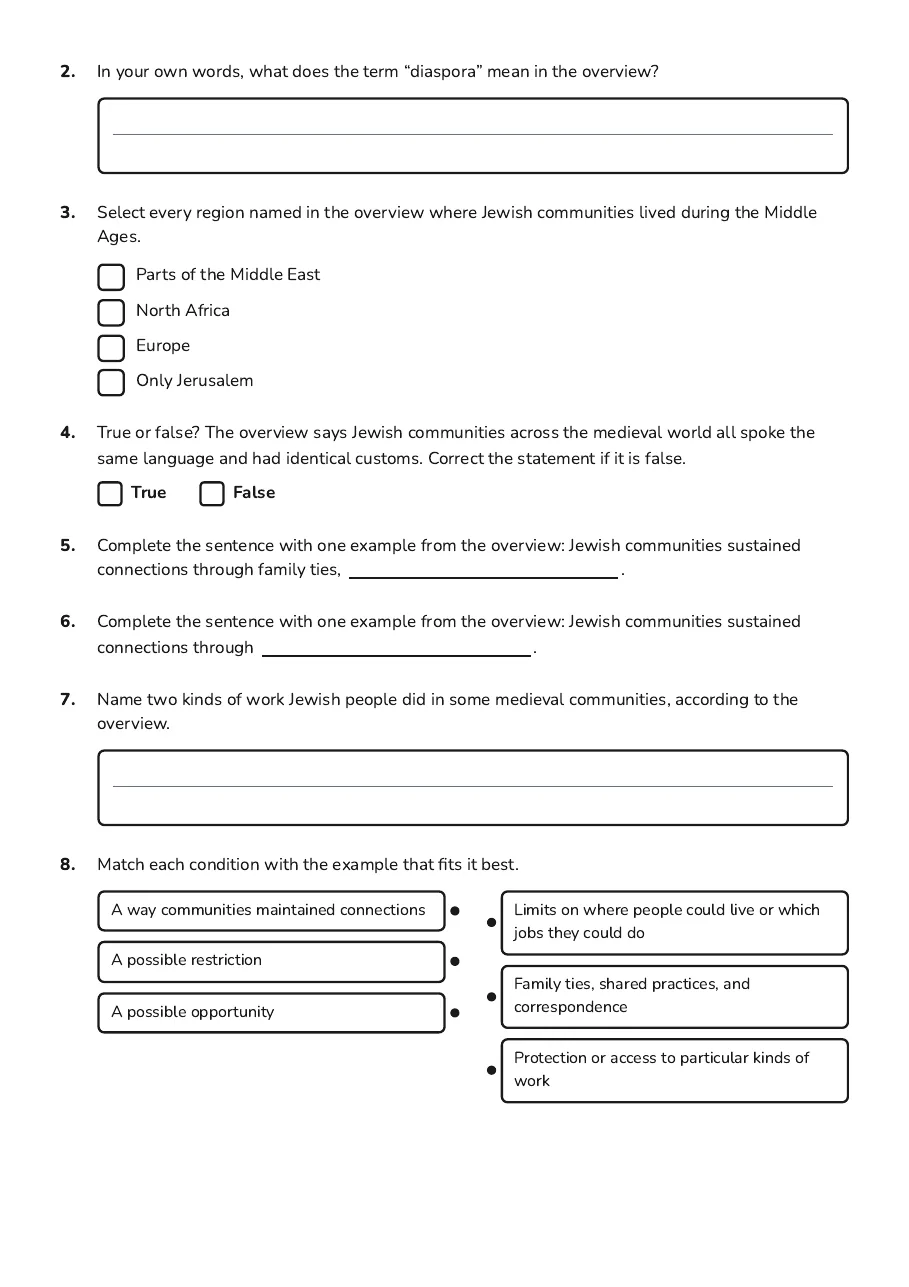
- Parts of the Middle East
- North Africa
- Europe
- Only Jerusalem
- A way communities maintained connections
- A possible restriction
- A possible opportunity
- Limits on where people could live or which jobs they could do
- Family ties, shared practices, and correspondence
- Protection or access to particular kinds of work
3 printable pages
Page 1
Page 2
Page 3
About This Worksheet
Free in Kuraplan
Sign up free, grab the PDF, and customize it for your class.
Print-Ready
Formatted for standard paper. Clean layout, easy to read.
AI-Generated
Created with Kuraplan's AI, designed for real classroom use.
For Teachers & Parents
Use in classrooms, for homework, tutoring, or homeschool.
Need a custom version of this worksheet?
Kuraplan's AI generates custom worksheets in seconds — differentiated for every learner, aligned to your curriculum.
Generate Custom Worksheets — Free