English (ELA)FreePrintable

Narrative Writing Station Rotation

A free english (ela) worksheet ready for your classroom. Open in Kuraplan to grab the print-ready PDF, customize it for your students, or generate a fresh version in seconds.
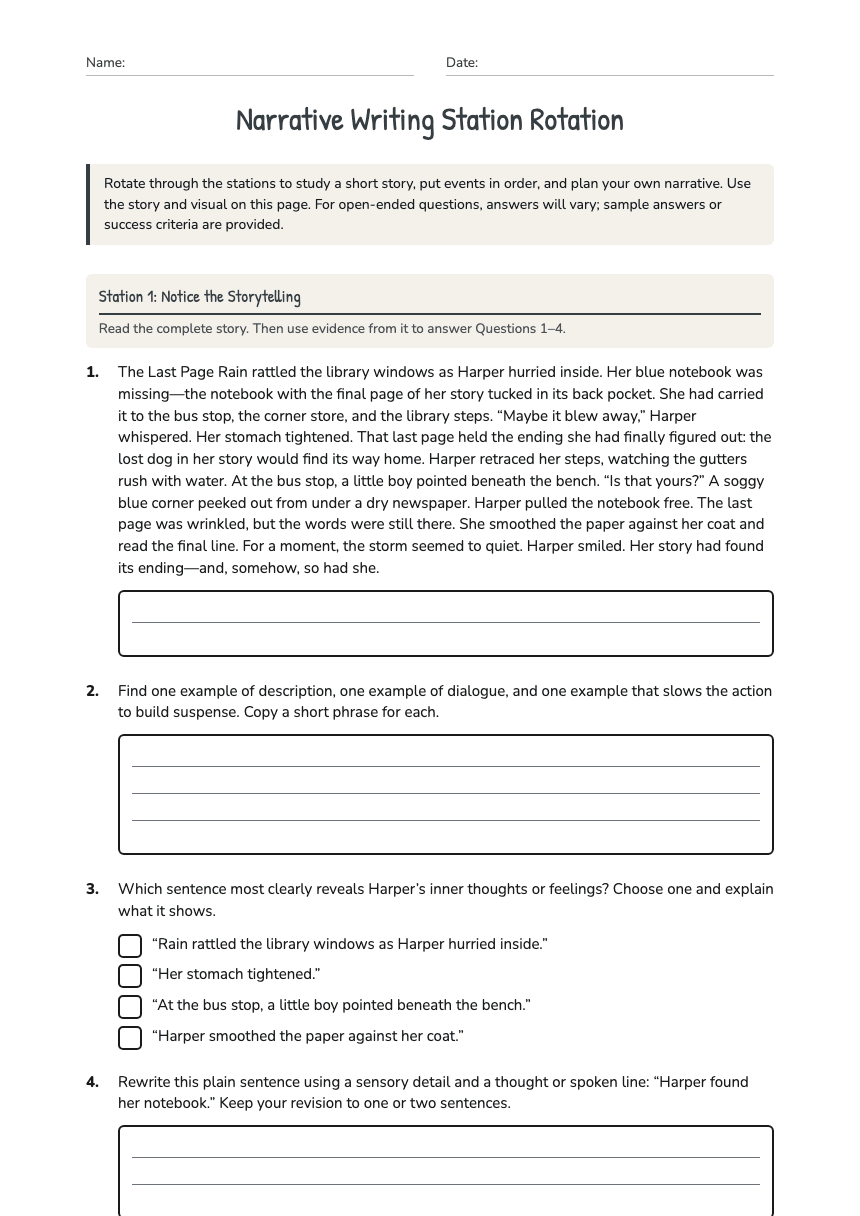
Narrative Writing Station Rotation worksheet preview
Name:Date:

Narrative Writing Station Rotation

Rotate through the stations to study a short story, put events in order, and plan your own narrative. Use the story and visual on this page. For open-ended questions, answers will vary; sample answers or success criteria are provided.

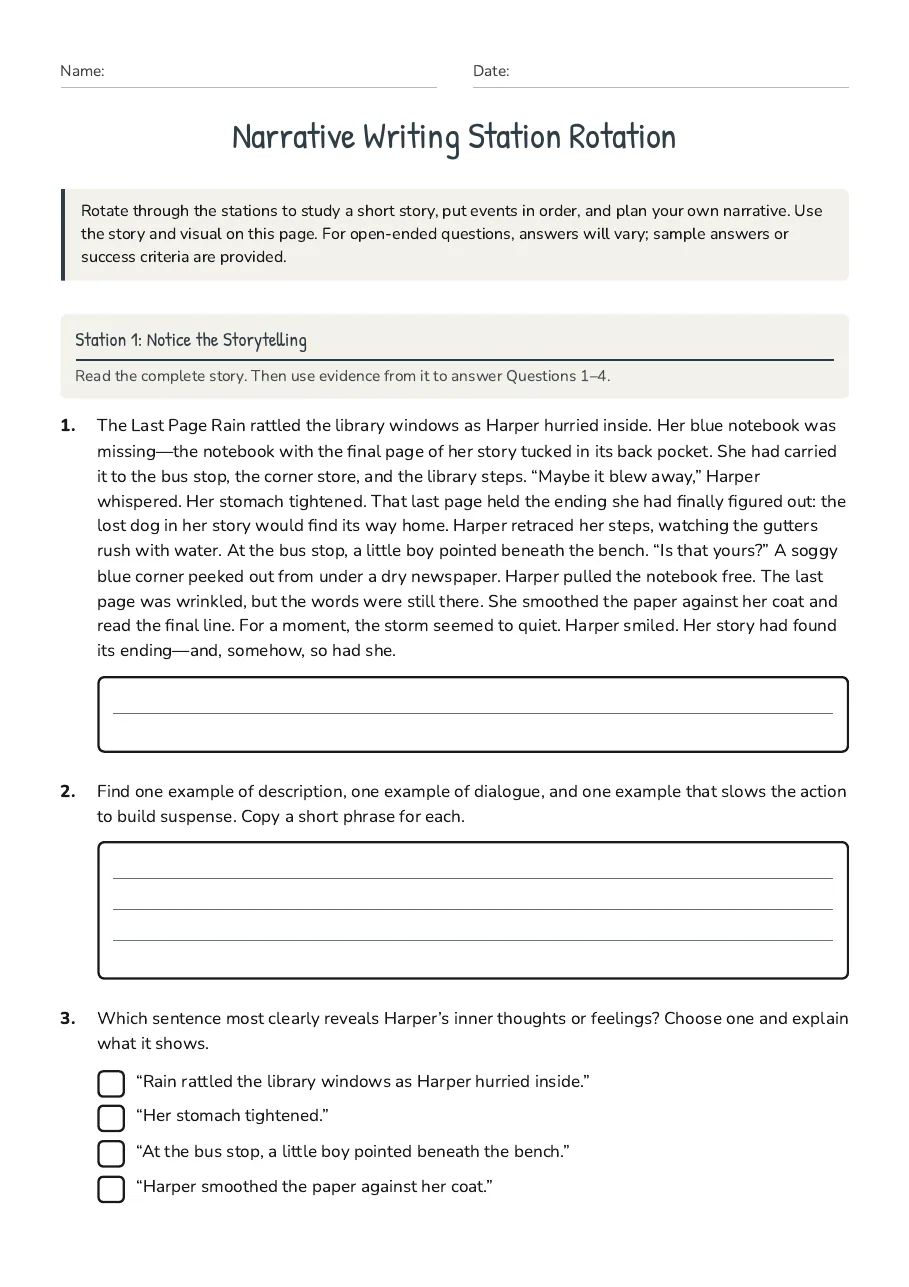
Station 1: Notice the Storytelling

Read the complete story. Then use evidence from it to answer Questions 1–4.

1.The Last Page Rain rattled the library windows as Harper hurried inside. Her blue notebook was missing—the notebook with the final page of her story tucked in its back pocket. She had carried it to the bus stop, the corner store, and the library steps. “Maybe it blew away,” Harper whispered. Her stomach tightened. That last page held the ending she had finally figured out: the lost dog in her story would find its way home. Harper retraced her steps, watching the gutters rush with water. At the bus stop, a little boy pointed beneath the bench. “Is that yours?” A soggy blue corner peeked out from under a dry newspaper. Harper pulled the notebook free. The last page was wrinkled, but the words were still there. She smoothed the paper against her coat and read the final line. For a moment, the storm seemed to quiet. Harper smiled. Her story had found its ending—and, somehow, so had she.
2.Find one example of description, one example of dialogue, and one example that slows the action to build suspense. Copy a short phrase for each.
3.Which sentence most clearly reveals Harper’s inner thoughts or feelings? Choose one and explain what it shows.
  • “Rain rattled the library windows as Harper hurried inside.”
  • “Her stomach tightened.”
  • “At the bus stop, a little boy pointed beneath the bench.”
  • “Harper smoothed the paper against her coat.”
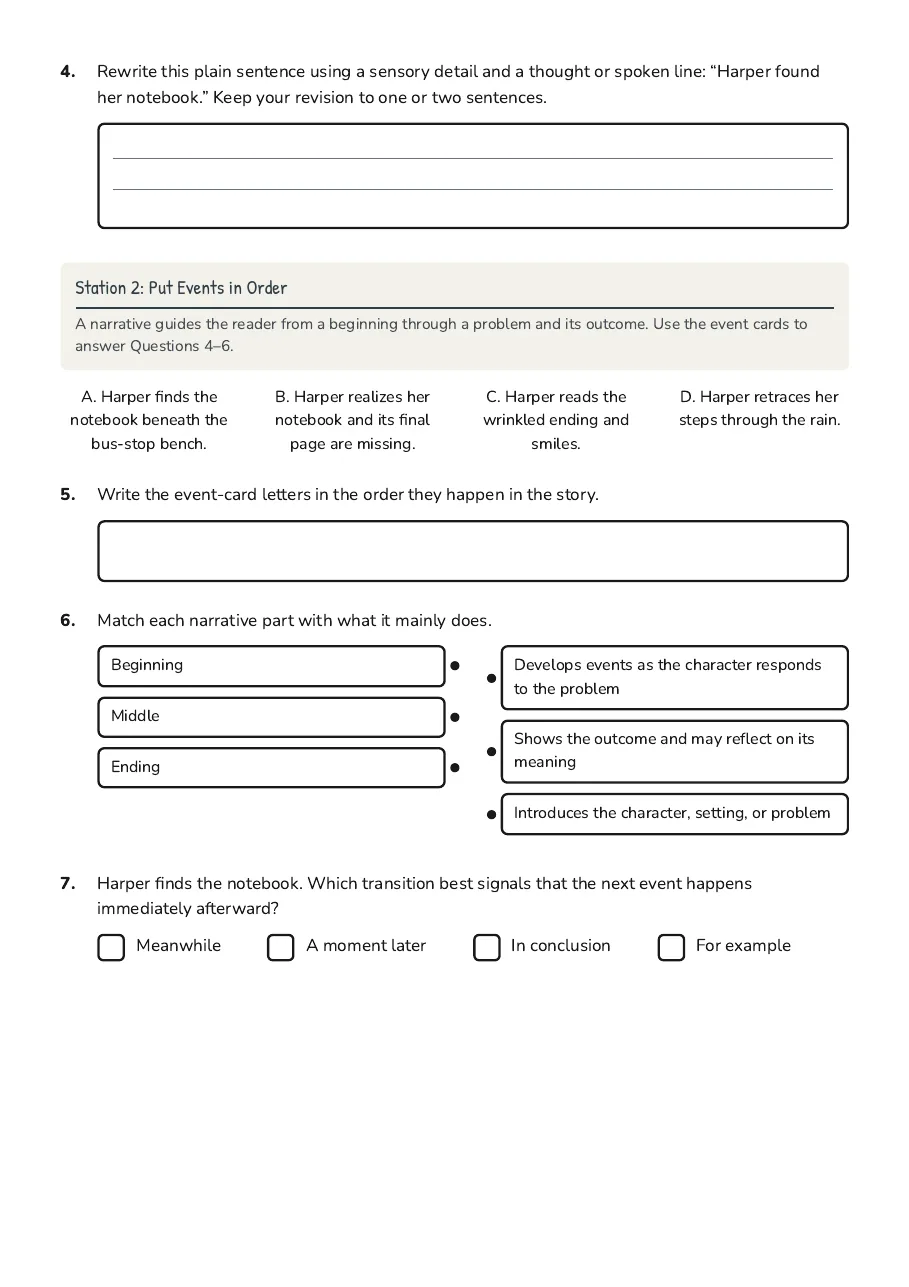
4.Rewrite this plain sentence using a sensory detail and a thought or spoken line: “Harper found her notebook.” Keep your revision to one or two sentences.

Station 2: Put Events in Order

A narrative guides the reader from a beginning through a problem and its outcome. Use the event cards to answer Questions 4–6.

A. Harper finds the notebook beneath the bus-stop bench.

B. Harper realizes her notebook and its final page are missing.

C. Harper reads the wrinkled ending and smiles.

D. Harper retraces her steps through the rain.

5.Write the event-card letters in the order they happen in the story.
6.Match each narrative part with what it mainly does.
  • Beginning
  • Middle
  • Ending
  • Develops events as the character responds to the problem
  • Shows the outcome and may reflect on its meaning
  • Introduces the character, setting, or problem
7.Harper finds the notebook. Which transition best signals that the next event happens immediately afterward?
  • Meanwhile
  • A moment later
  • In conclusion
  • For example

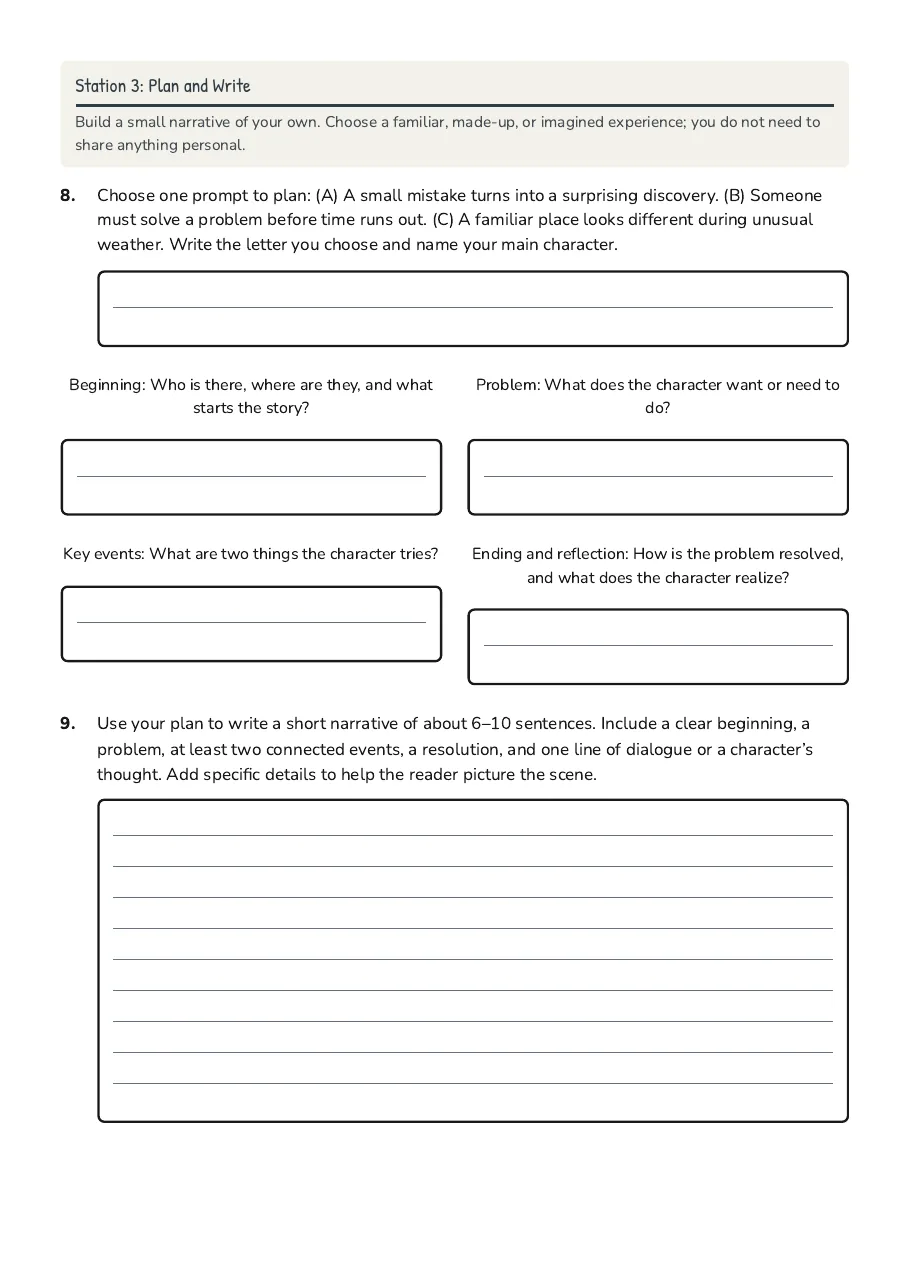
Station 3: Plan and Write

Build a small narrative of your own. Choose a familiar, made-up, or imagined experience; you do not need to share anything personal.

8.Choose one prompt to plan: (A) A small mistake turns into a surprising discovery. (B) Someone must solve a problem before time runs out. (C) A familiar place looks different during unusual weather. Write the letter you choose and name your main character.

Beginning: Who is there, where are they, and what starts the story?

Problem: What does the character want or need to do?

Key events: What are two things the character tries?

Ending and reflection: How is the problem resolved, and what does the character realize?

9.Use your plan to write a short narrative of about 6–10 sentences. Include a clear beginning, a problem, at least two connected events, a resolution, and one line of dialogue or a character’s thought. Add specific details to help the reader picture the scene.
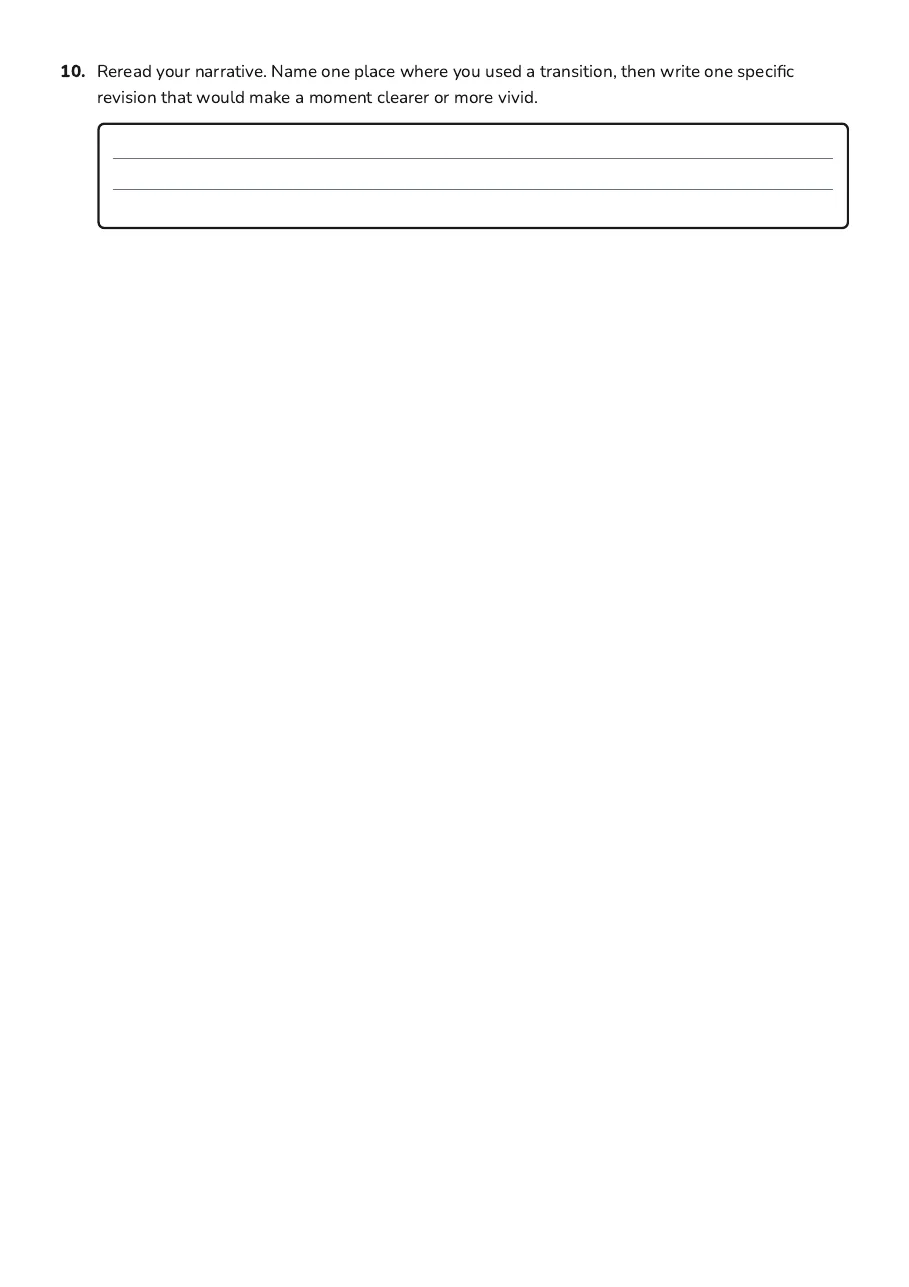
10.Reread your narrative. Name one place where you used a transition, then write one specific revision that would make a moment clearer or more vivid.

4 printable pages

  • Narrative Writing Station Rotation, page 1 of 4: Station 1: Notice the Storytelling

    Page 1

  • Narrative Writing Station Rotation, page 2 of 4: Station 2: Put Events in Order

    Page 2

  • Narrative Writing Station Rotation, page 3 of 4: Station 3: Plan and Write

    Page 3

  • Narrative Writing Station Rotation, page 4 of 4: 10. Reread your narrative. Name one place where you used a transition, then write one…

    Page 4

About This Worksheet

Free in Kuraplan

Sign up free, grab the PDF, and customize it for your class.

Print-Ready

Formatted for standard paper. Clean layout, easy to read.

AI-Generated

Created with Kuraplan's AI, designed for real classroom use.

For Teachers & Parents

Use in classrooms, for homework, tutoring, or homeschool.

Need a custom version of this worksheet?

Kuraplan's AI generates custom worksheets in seconds — differentiated for every learner, aligned to your curriculum.

Generate Custom Worksheets — Free
No credit card Curriculum-aligned Under 60 seconds