ScienceFreePrintable

Particle Theory of Matter

A free science worksheet ready for your classroom. Open in Kuraplan to grab the print-ready PDF, customize it for your students, or generate a fresh version in seconds.
Particle Theory of Matter worksheet preview
Name:Date:

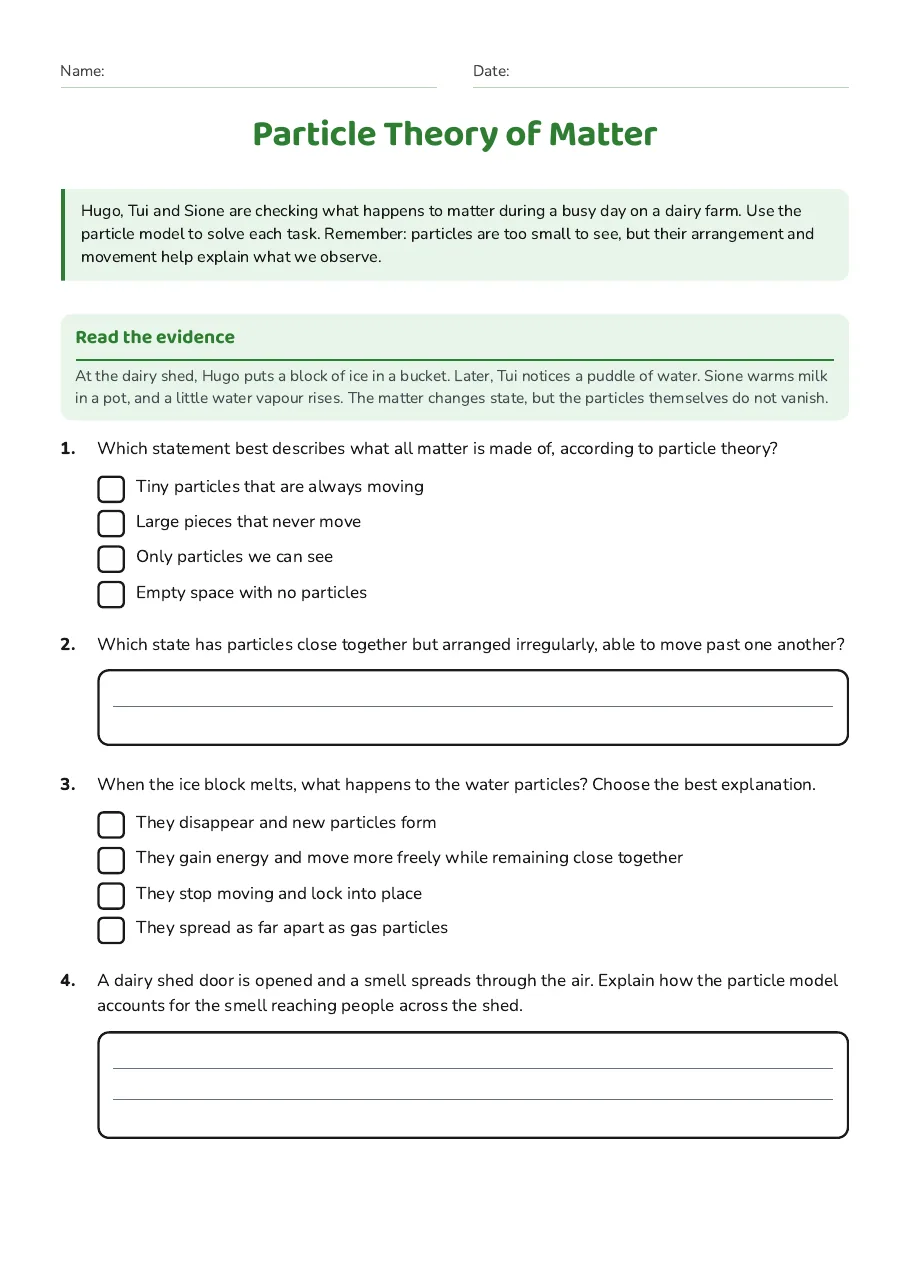
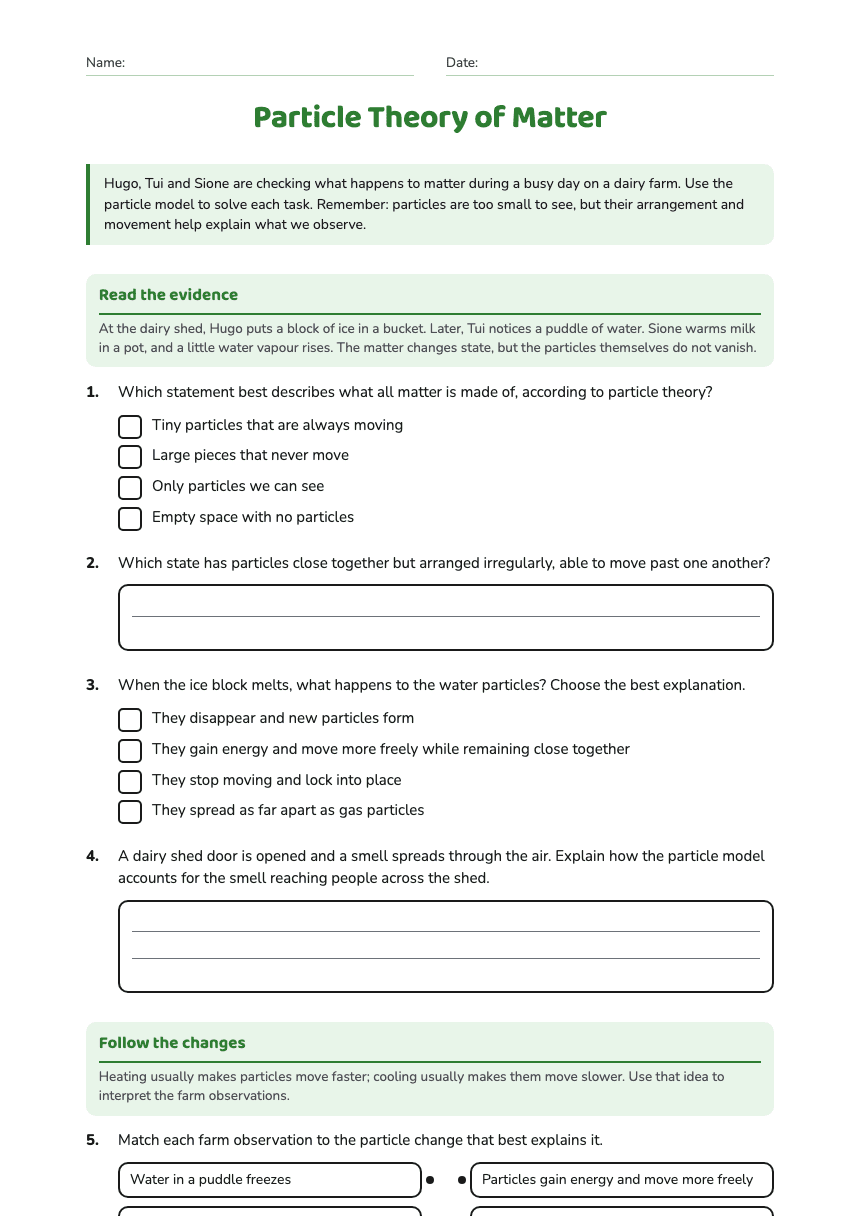
Particle Theory of Matter

Hugo, Tui and Sione are checking what happens to matter during a busy day on a dairy farm. Use the particle model to solve each task. Remember: particles are too small to see, but their arrangement and movement help explain what we observe.

Read the evidence

At the dairy shed, Hugo puts a block of ice in a bucket. Later, Tui notices a puddle of water. Sione warms milk in a pot, and a little water vapour rises. The matter changes state, but the particles themselves do not vanish.

1.Which statement best describes what all matter is made of, according to particle theory?
  • Tiny particles that are always moving
  • Large pieces that never move
  • Only particles we can see
  • Empty space with no particles
2.Which state has particles close together but arranged irregularly, able to move past one another?
3.When the ice block melts, what happens to the water particles? Choose the best explanation.
  • They disappear and new particles form
  • They gain energy and move more freely while remaining close together
  • They stop moving and lock into place
  • They spread as far apart as gas particles
4.A dairy shed door is opened and a smell spreads through the air. Explain how the particle model accounts for the smell reaching people across the shed.

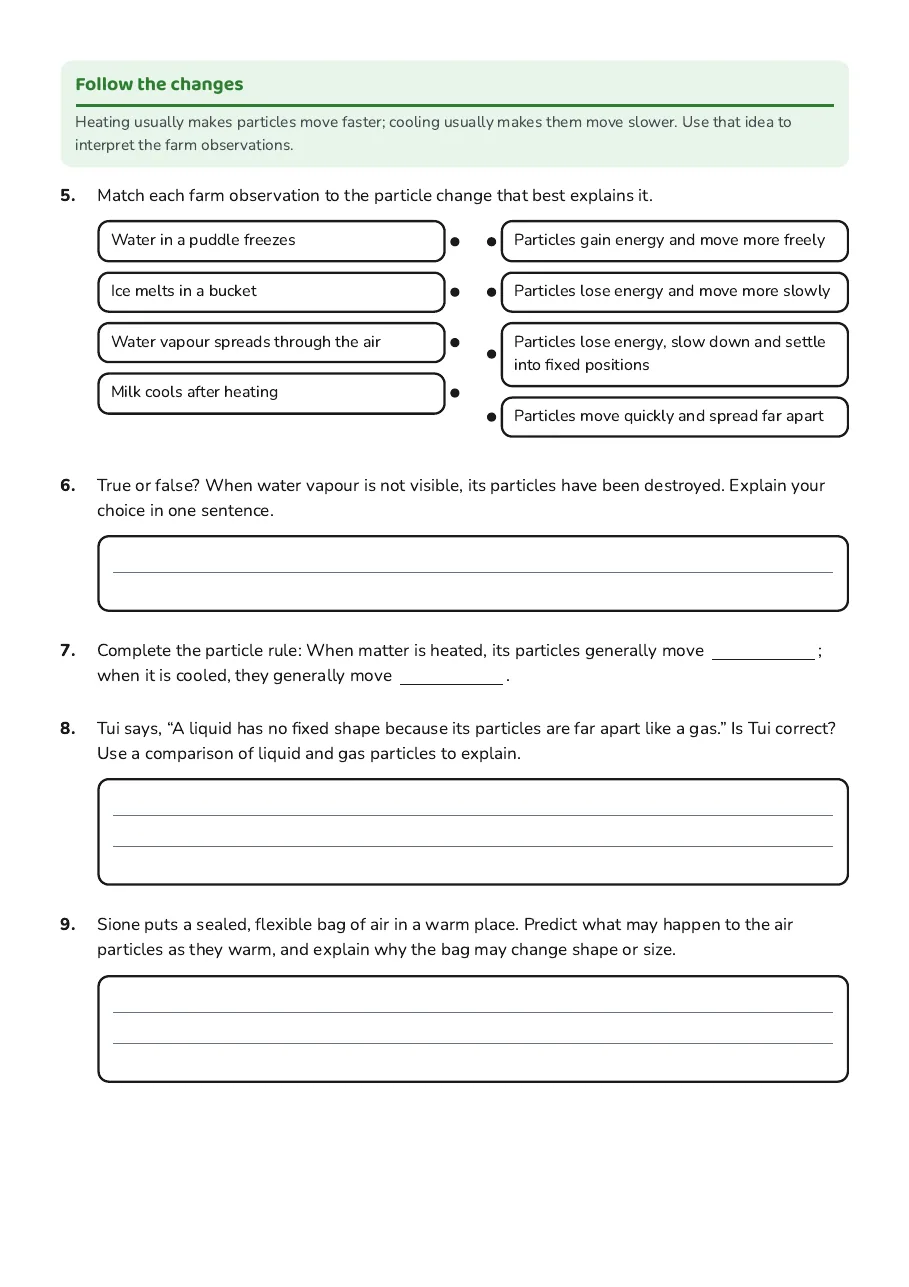
Follow the changes

Heating usually makes particles move faster; cooling usually makes them move slower. Use that idea to interpret the farm observations.

5.Match each farm observation to the particle change that best explains it.
  • Water in a puddle freezes
  • Ice melts in a bucket
  • Water vapour spreads through the air
  • Milk cools after heating
  • Particles gain energy and move more freely
  • Particles lose energy and move more slowly
  • Particles lose energy, slow down and settle into fixed positions
  • Particles move quickly and spread far apart
6.True or false? When water vapour is not visible, its particles have been destroyed. Explain your choice in one sentence.
7.Complete the particle rule: When matter is heated, its particles generally move ; when it is cooled, they generally move .
8.Tui says, “A liquid has no fixed shape because its particles are far apart like a gas.” Is Tui correct? Use a comparison of liquid and gas particles to explain.
9.Sione puts a sealed, flexible bag of air in a warm place. Predict what may happen to the air particles as they warm, and explain why the bag may change shape or size.
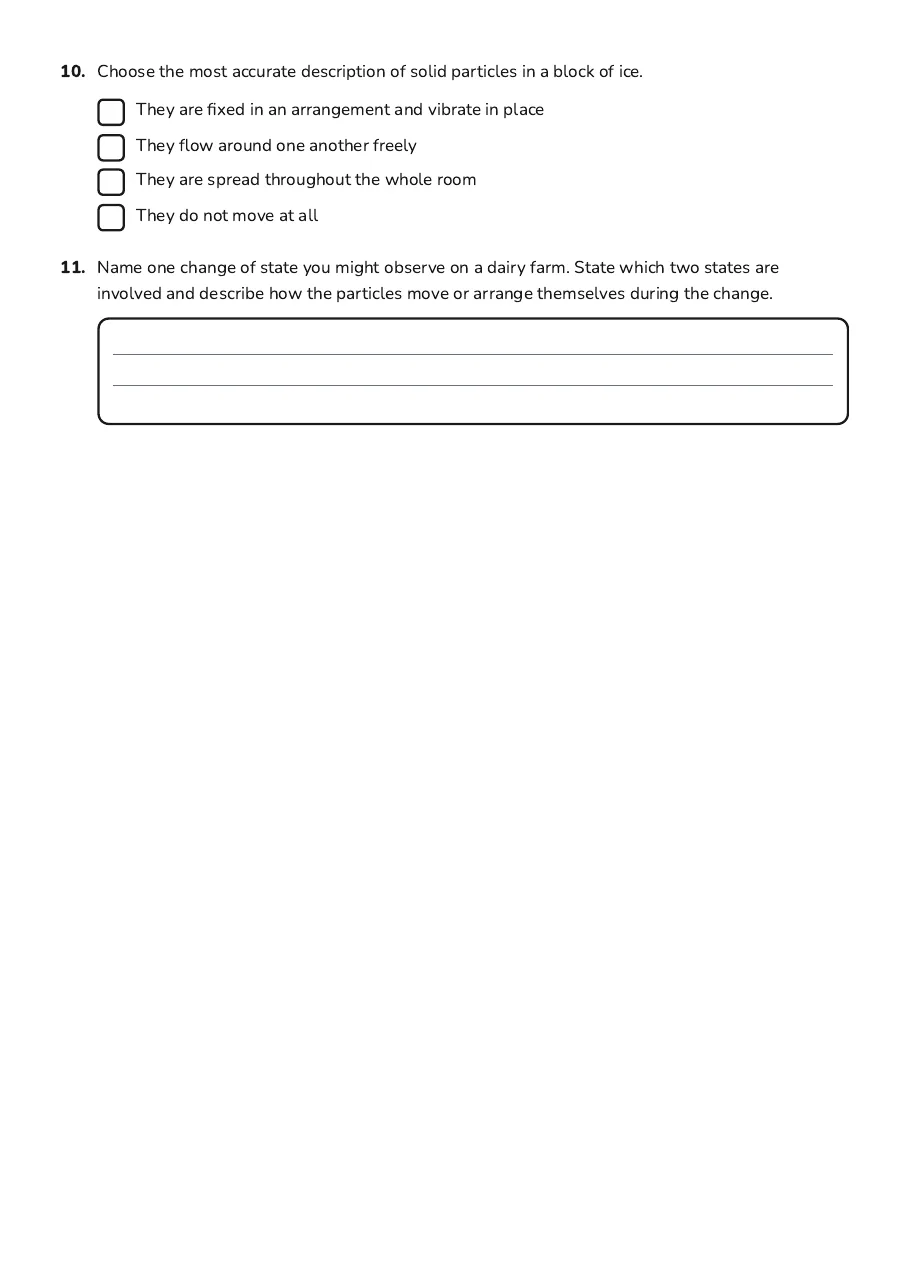
10.Choose the most accurate description of solid particles in a block of ice.
  • They are fixed in an arrangement and vibrate in place
  • They flow around one another freely
  • They are spread throughout the whole room
  • They do not move at all
11.Name one change of state you might observe on a dairy farm. State which two states are involved and describe how the particles move or arrange themselves during the change.

3 printable pages

  • Particle Theory of Matter, page 1 of 3: Read the evidence

    Page 1

  • Particle Theory of Matter, page 2 of 3: Follow the changes

    Page 2

  • Particle Theory of Matter, page 3 of 3: 10. Choose the most accurate description of solid particles in a block of ice.

    Page 3

About This Worksheet

Free in Kuraplan

Sign up free, grab the PDF, and customize it for your class.

Print-Ready

Formatted for standard paper. Clean layout, easy to read.

AI-Generated

Created with Kuraplan's AI, designed for real classroom use.

For Teachers & Parents

Use in classrooms, for homework, tutoring, or homeschool.

Need a custom version of this worksheet?

Kuraplan's AI generates custom worksheets in seconds — differentiated for every learner, aligned to your curriculum.

Generate Custom Worksheets — Free
No credit card Curriculum-aligned Under 60 seconds