Properties of Solids
A free science worksheet ready for your classroom. Open in Kuraplan to grab the print-ready PDF, customize it for your students, or generate a fresh version in seconds.
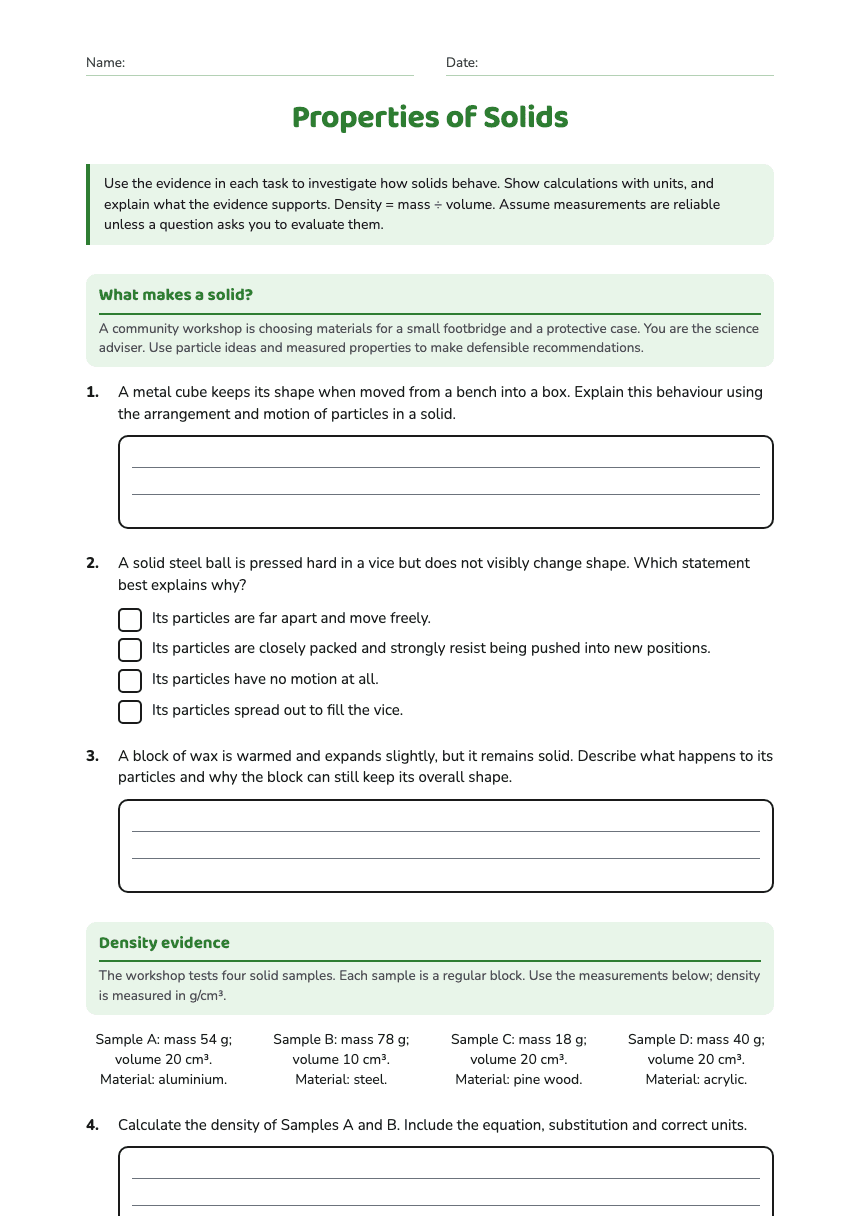
Properties of Solids
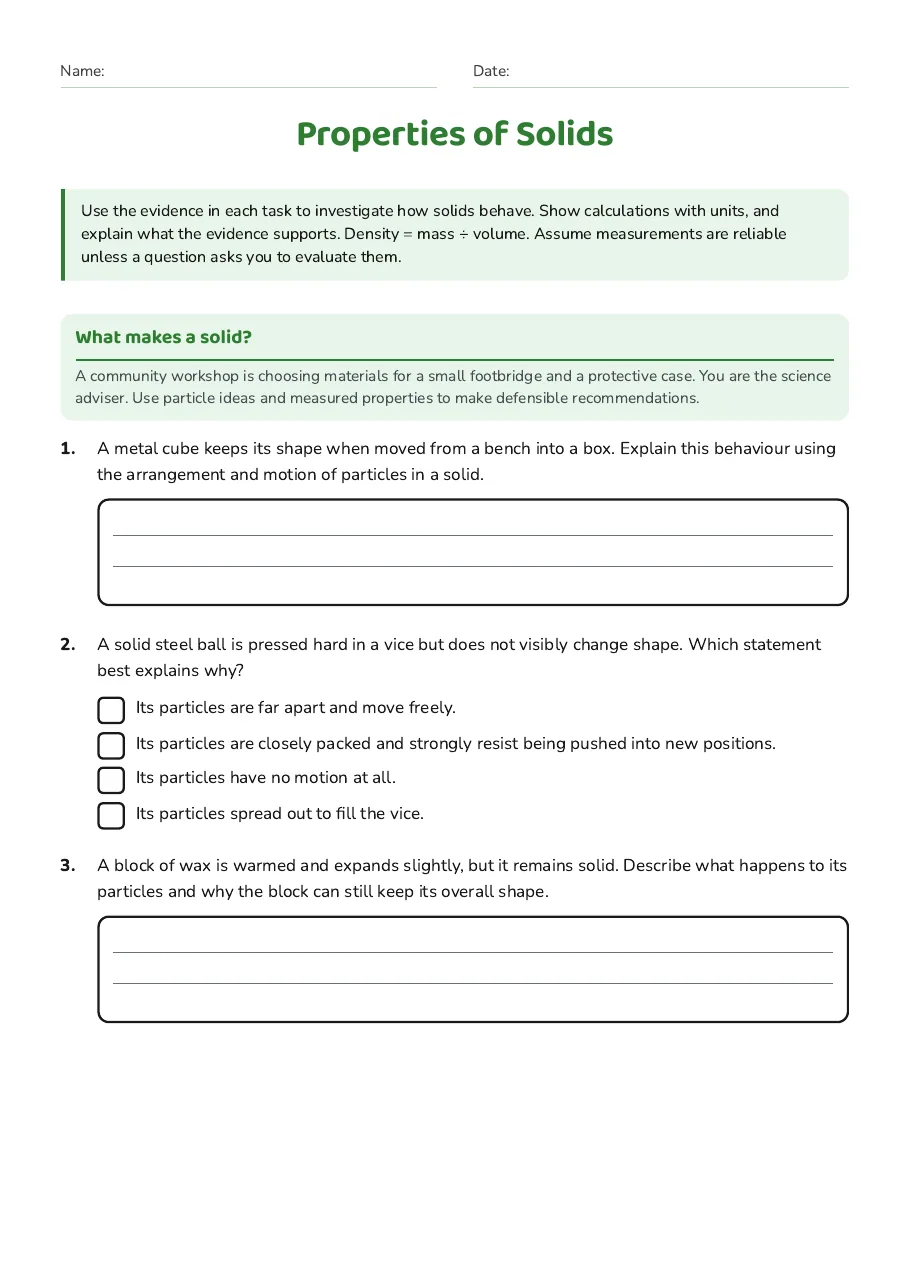
What makes a solid?
A community workshop is choosing materials for a small footbridge and a protective case. You are the science adviser. Use particle ideas and measured properties to make defensible recommendations.
- Its particles are far apart and move freely.
- Its particles are closely packed and strongly resist being pushed into new positions.
- Its particles have no motion at all.
- Its particles spread out to fill the vice.
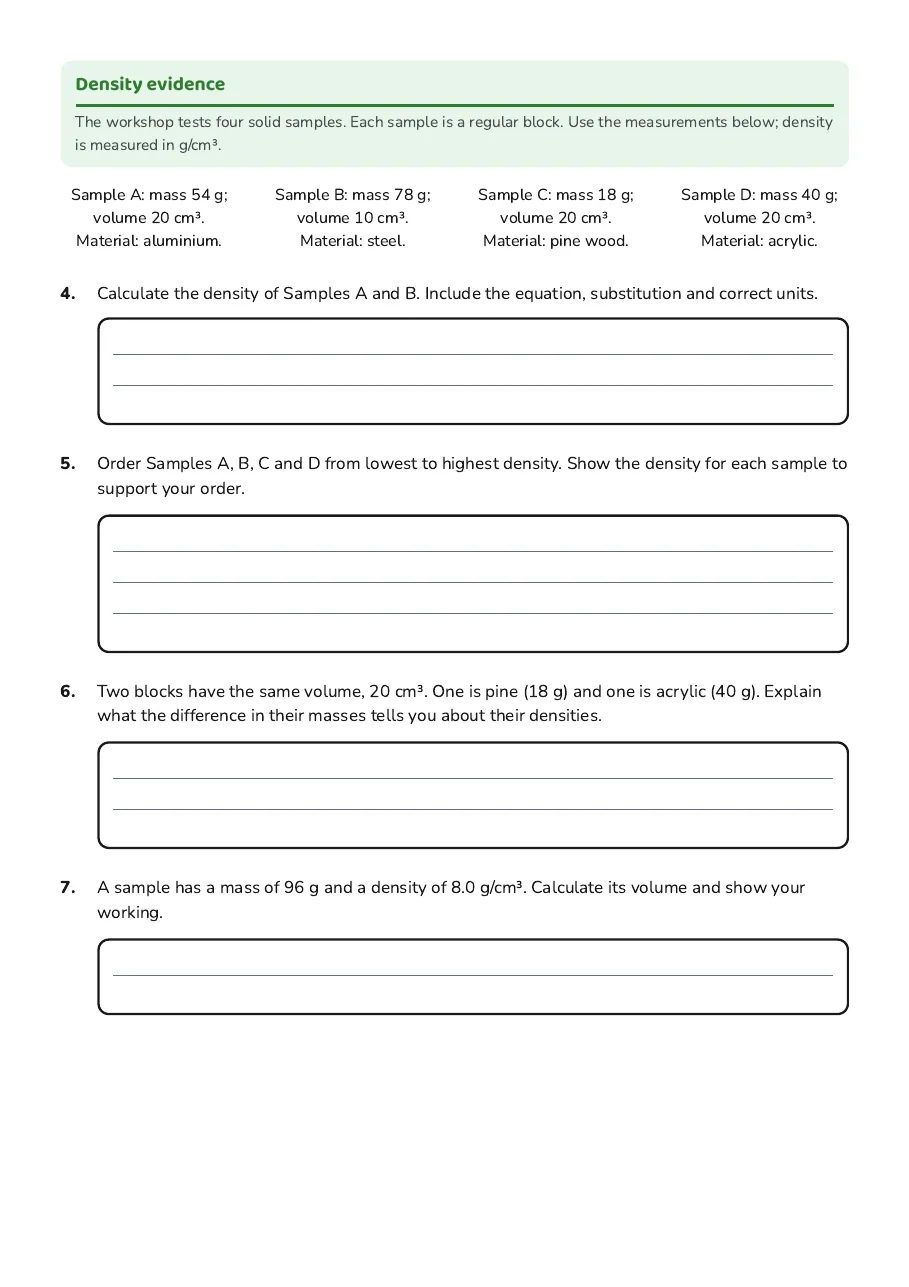
Density evidence
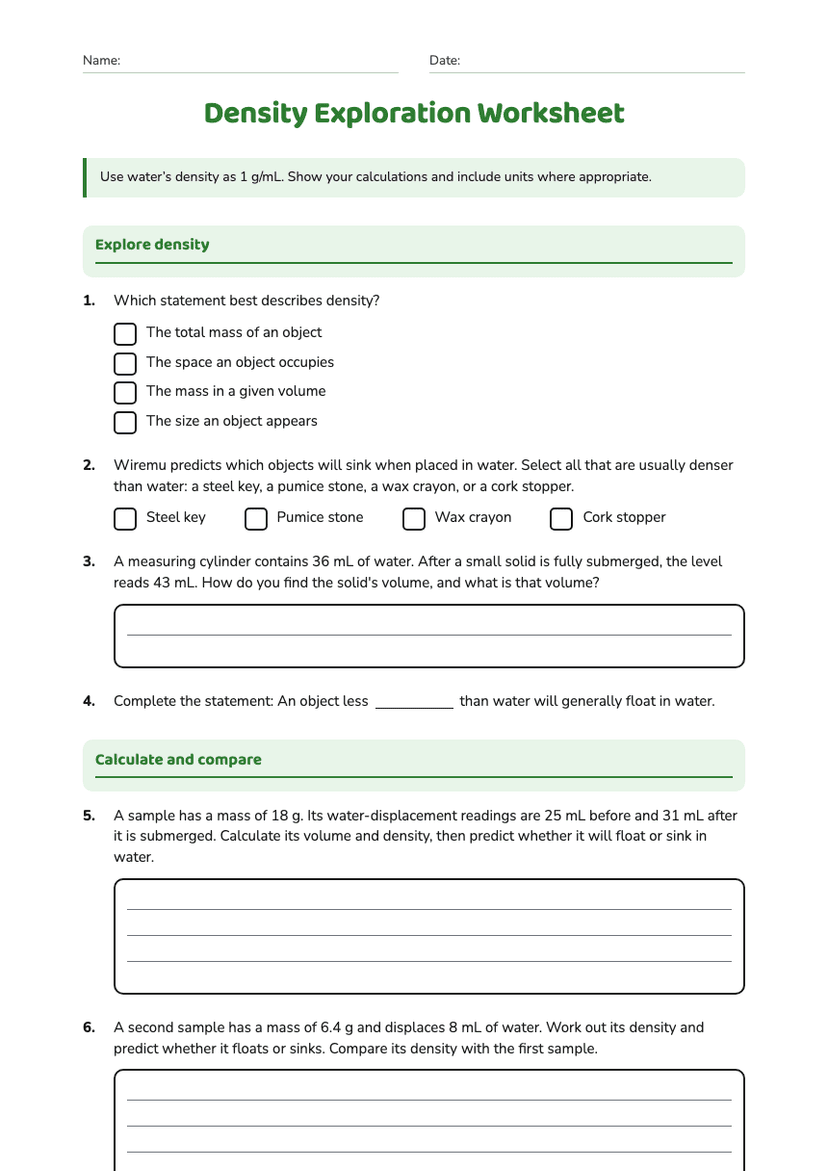
The workshop tests four solid samples. Each sample is a regular block. Use the measurements below; density is measured in g/cm³.
Sample A: mass 54 g; volume 20 cm³. Material: aluminium.
Sample B: mass 78 g; volume 10 cm³. Material: steel.
Sample C: mass 18 g; volume 20 cm³. Material: pine wood.
Sample D: mass 40 g; volume 20 cm³. Material: acrylic.
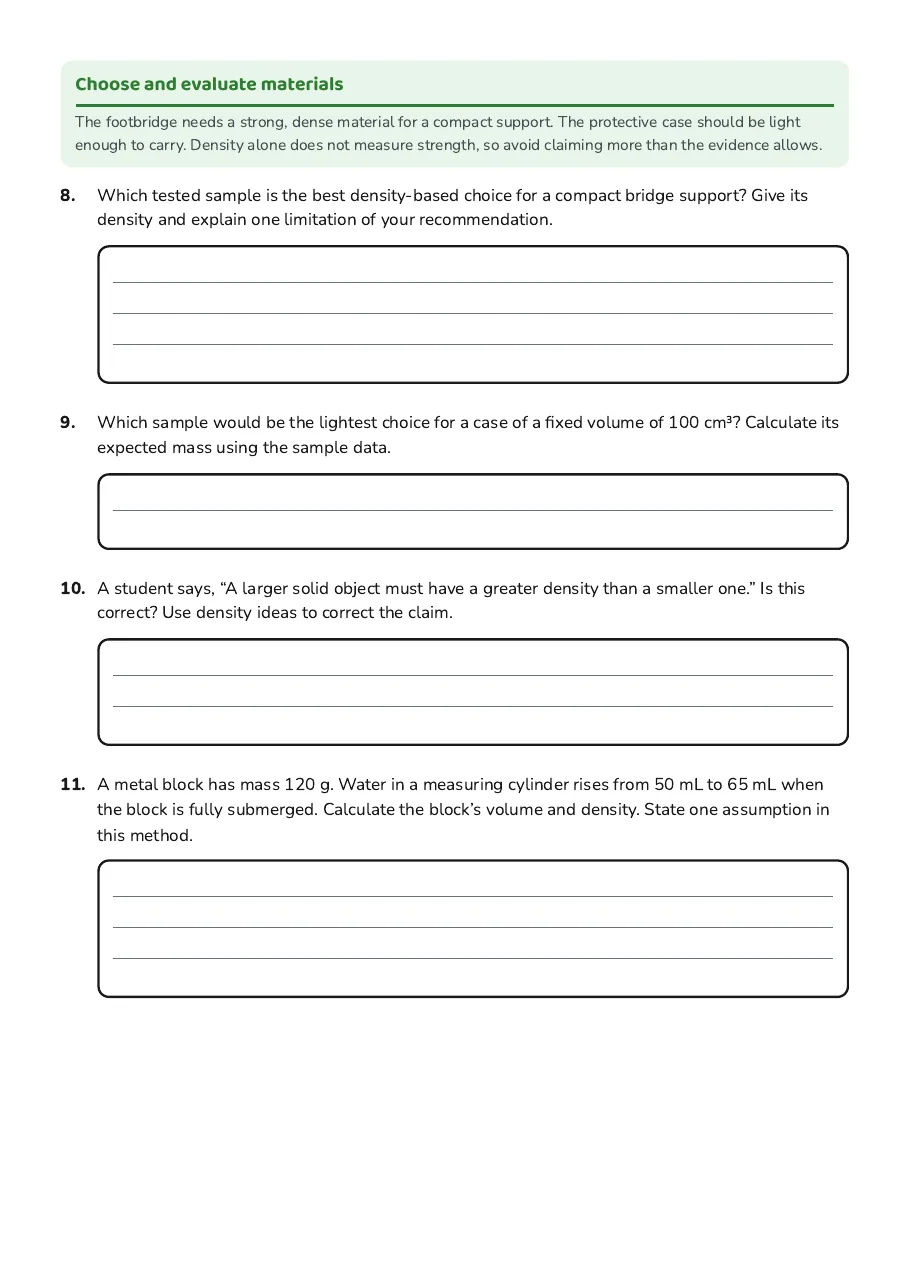
Choose and evaluate materials
The footbridge needs a strong, dense material for a compact support. The protective case should be light enough to carry. Density alone does not measure strength, so avoid claiming more than the evidence allows.
3 printable pages
Page 1
Page 2
Page 3
About This Worksheet
Free in Kuraplan
Sign up free, grab the PDF, and customize it for your class.
Print-Ready
Formatted for standard paper. Clean layout, easy to read.
AI-Generated
Created with Kuraplan's AI, designed for real classroom use.
For Teachers & Parents
Use in classrooms, for homework, tutoring, or homeschool.
Need a custom version of this worksheet?
Kuraplan's AI generates custom worksheets in seconds — differentiated for every learner, aligned to your curriculum.
Generate Custom Worksheets — Free