ScienceFreePrintable

Renewable Energy Solutions

A free science worksheet ready for your classroom. Open in Kuraplan to grab the print-ready PDF, customize it for your students, or generate a fresh version in seconds.

Renewable Energy Solutions worksheet preview
Name:Date:

Renewable Energy Solutions

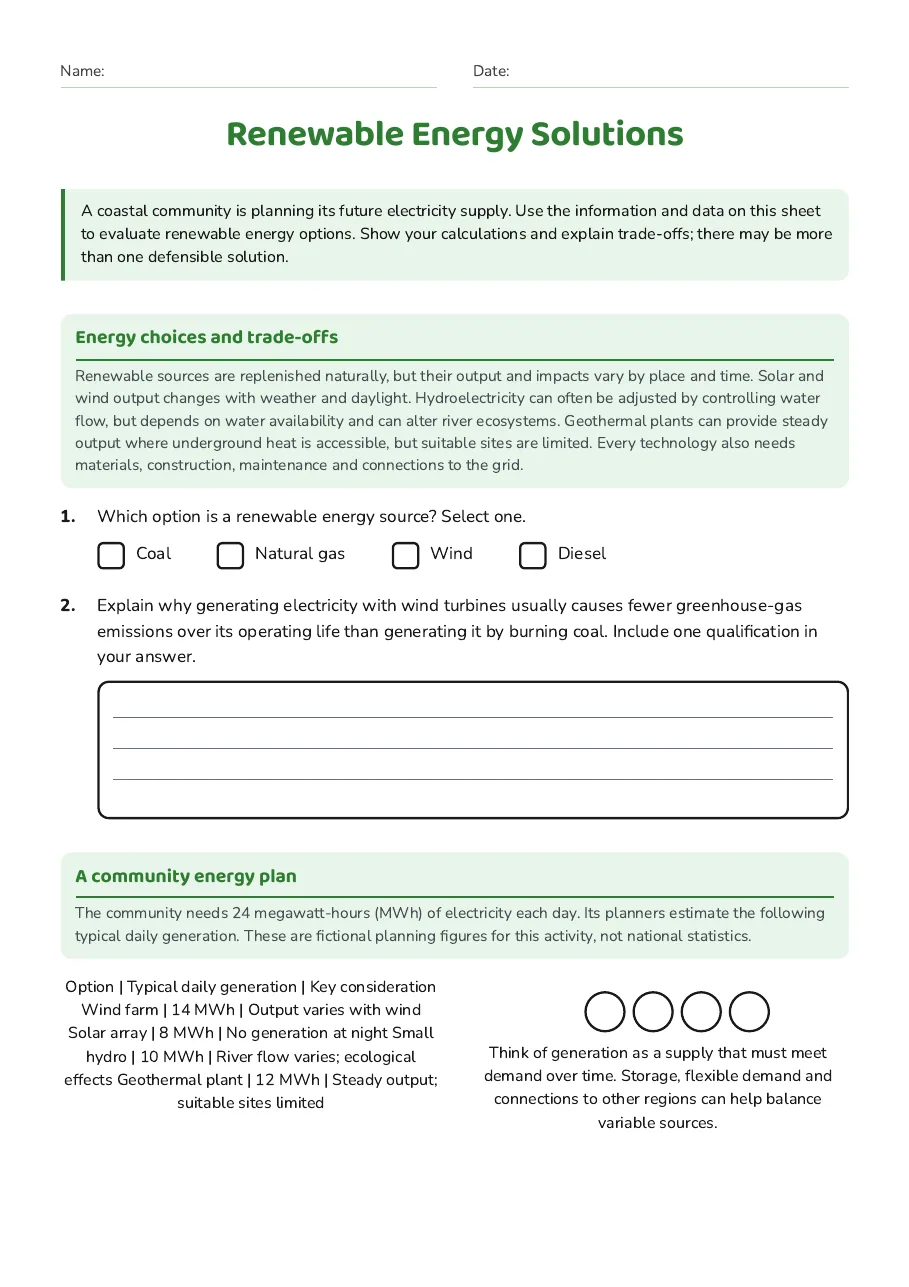
A coastal community is planning its future electricity supply. Use the information and data on this sheet to evaluate renewable energy options. Show your calculations and explain trade-offs; there may be more than one defensible solution.

Energy choices and trade-offs

Renewable sources are replenished naturally, but their output and impacts vary by place and time. Solar and wind output changes with weather and daylight. Hydroelectricity can often be adjusted by controlling water flow, but depends on water availability and can alter river ecosystems. Geothermal plants can provide steady output where underground heat is accessible, but suitable sites are limited. Every technology also needs materials, construction, maintenance and connections to the grid.

1.Which option is a renewable energy source? Select one.
  • Coal
  • Natural gas
  • Wind
  • Diesel
2.Explain why generating electricity with wind turbines usually causes fewer greenhouse-gas emissions over its operating life than generating it by burning coal. Include one qualification in your answer.

A community energy plan

The community needs 24 megawatt-hours (MWh) of electricity each day. Its planners estimate the following typical daily generation. These are fictional planning figures for this activity, not national statistics.

Option | Typical daily generation | Key consideration Wind farm | 14 MWh | Output varies with wind Solar array | 8 MWh | No generation at night Small hydro | 10 MWh | River flow varies; ecological effects Geothermal plant | 12 MWh | Steady output; suitable sites limited

Think of generation as a supply that must meet demand over time. Storage, flexible demand and connections to other regions can help balance variable sources.

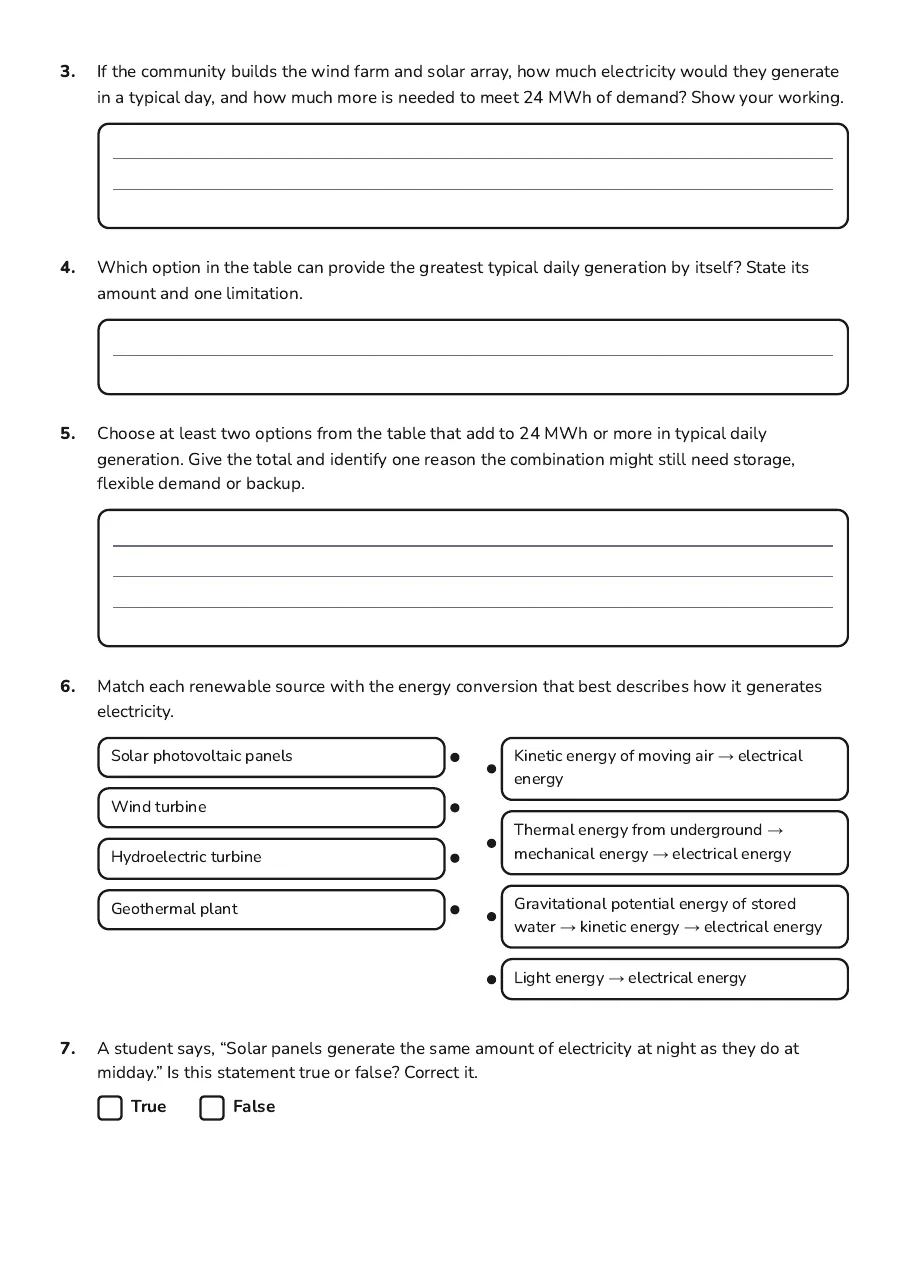
3.If the community builds the wind farm and solar array, how much electricity would they generate in a typical day, and how much more is needed to meet 24 MWh of demand? Show your working.
4.Which option in the table can provide the greatest typical daily generation by itself? State its amount and one limitation.
5.Choose at least two options from the table that add to 24 MWh or more in typical daily generation. Give the total and identify one reason the combination might still need storage, flexible demand or backup.
6.Match each renewable source with the energy conversion that best describes how it generates electricity.
  • Solar photovoltaic panels
  • Wind turbine
  • Hydroelectric turbine
  • Geothermal plant
  • Kinetic energy of moving air → electrical energy
  • Thermal energy from underground → mechanical energy → electrical energy
  • Gravitational potential energy of stored water → kinetic energy → electrical energy
  • Light energy → electrical energy
7.A student says, “Solar panels generate the same amount of electricity at night as they do at midday.” Is this statement true or false? Correct it.
TrueFalse
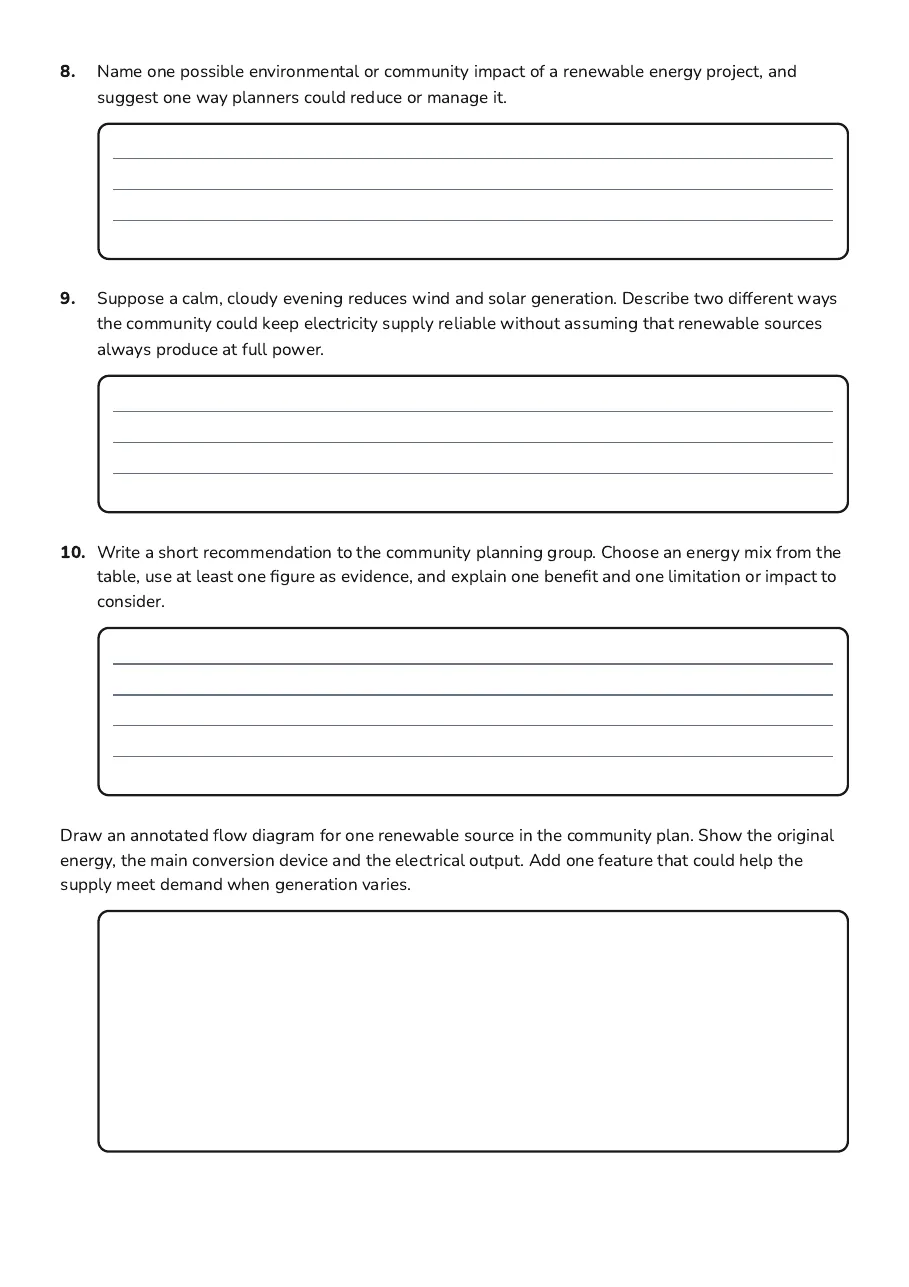
8.Name one possible environmental or community impact of a renewable energy project, and suggest one way planners could reduce or manage it.
9.Suppose a calm, cloudy evening reduces wind and solar generation. Describe two different ways the community could keep electricity supply reliable without assuming that renewable sources always produce at full power.
10.Write a short recommendation to the community planning group. Choose an energy mix from the table, use at least one figure as evidence, and explain one benefit and one limitation or impact to consider.
Draw an annotated flow diagram for one renewable source in the community plan. Show the original energy, the main conversion device and the electrical output. Add one feature that could help the supply meet demand when generation varies.

3 printable pages

  • Renewable Energy Solutions, page 1 of 3: Energy choices and trade-offs, A community energy plan

    Page 1

  • Renewable Energy Solutions, page 2 of 3: 3. If the community builds the wind farm and solar array, how much electricity would they…

    Page 2

  • Renewable Energy Solutions, page 3 of 3: 8. Name one possible environmental or community impact of a renewable energy project, and

    Page 3

About This Worksheet

Free in Kuraplan

Sign up free, grab the PDF, and customize it for your class.

Print-Ready

Formatted for standard paper. Clean layout, easy to read.

AI-Generated

Created with Kuraplan's AI, designed for real classroom use.

For Teachers & Parents

Use in classrooms, for homework, tutoring, or homeschool.

Need a custom version of this worksheet?

Kuraplan's AI generates custom worksheets in seconds — differentiated for every learner, aligned to your curriculum.

Generate Custom Worksheets — Free
No credit card Curriculum-aligned Under 60 seconds