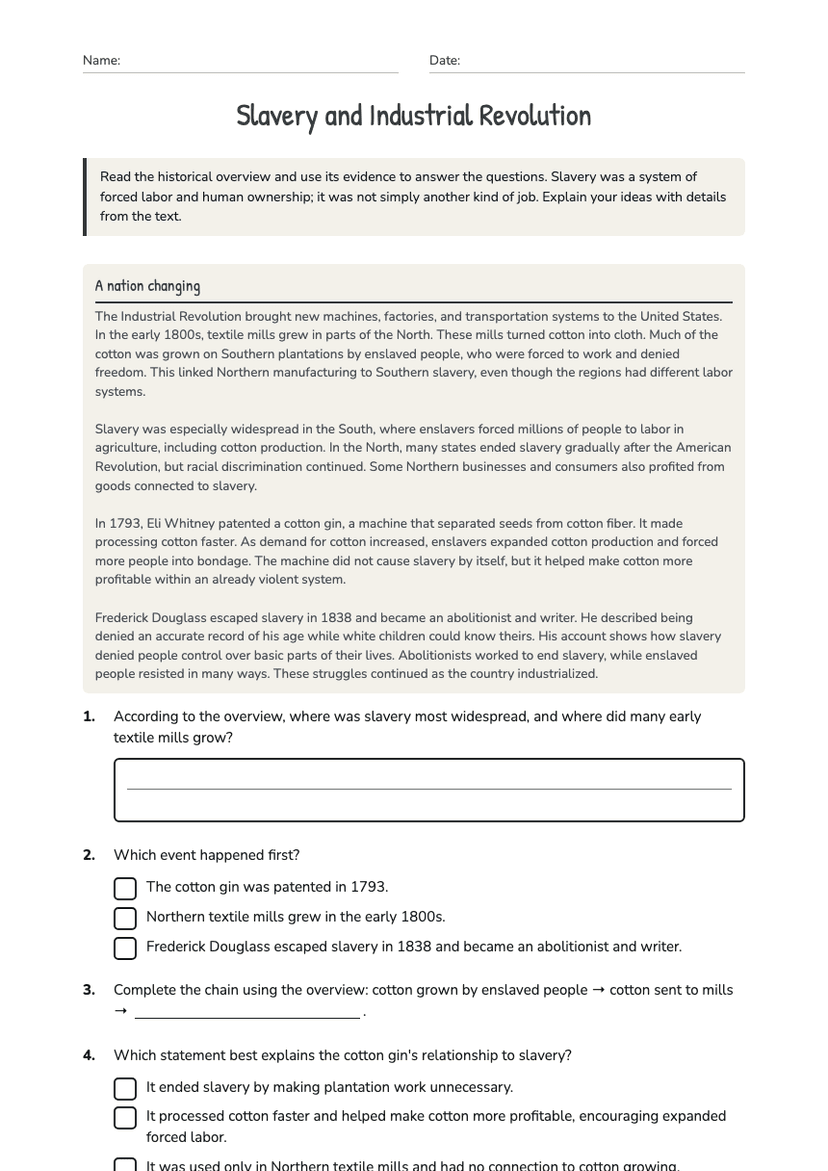
Slavery and Industrial Revolution
A free social studies worksheet ready for your classroom. Open in Kuraplan to grab the print-ready PDF, customize it for your students, or generate a fresh version in seconds.
Slavery and Industrial Revolution
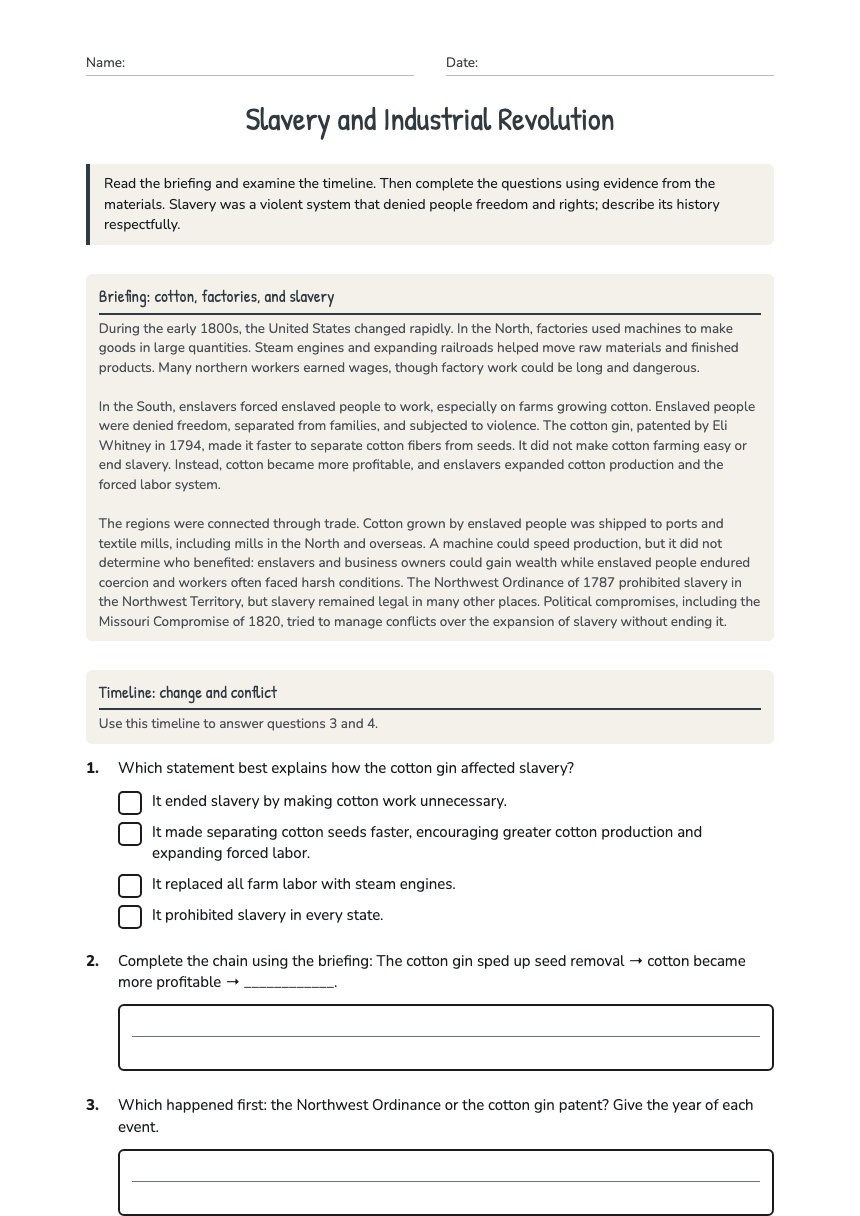
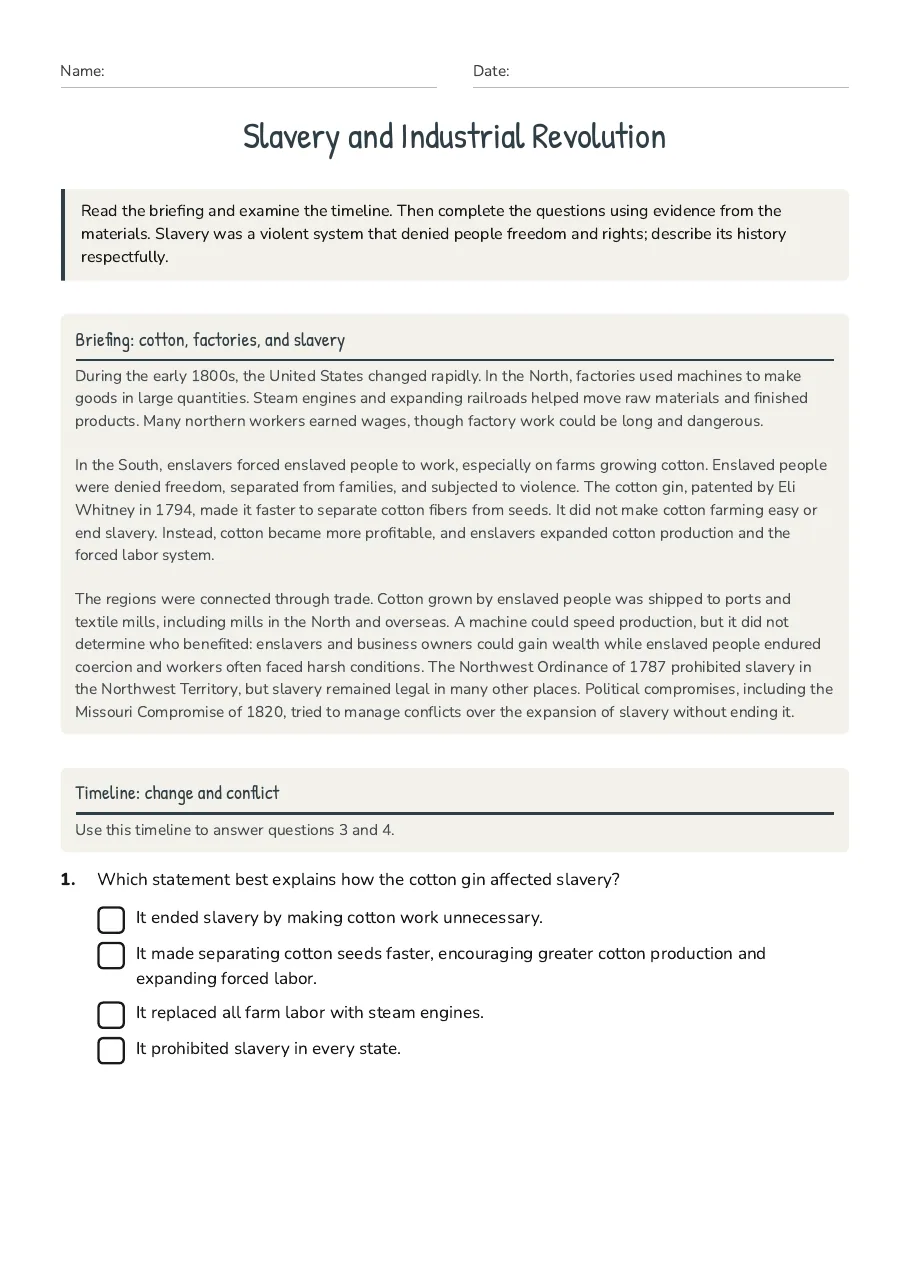
Briefing: cotton, factories, and slavery
During the early 1800s, the United States changed rapidly. In the North, factories used machines to make goods in large quantities. Steam engines and expanding railroads helped move raw materials and finished products. Many northern workers earned wages, though factory work could be long and dangerous. In the South, enslavers forced enslaved people to work, especially on farms growing cotton. Enslaved people were denied freedom, separated from families, and subjected to violence. The cotton gin, patented by Eli Whitney in 1794, made it faster to separate cotton fibers from seeds. It did not make cotton farming easy or end slavery. Instead, cotton became more profitable, and enslavers expanded cotton production and the forced labor system. The regions were connected through trade. Cotton grown by enslaved people was shipped to ports and textile mills, including mills in the North and overseas. A machine could speed production, but it did not determine who benefited: enslavers and business owners could gain wealth while enslaved people endured coercion and workers often faced harsh conditions. The Northwest Ordinance of 1787 prohibited slavery in the Northwest Territory, but slavery remained legal in many other places. Political compromises, including the Missouri Compromise of 1820, tried to manage conflicts over the expansion of slavery without ending it.
Timeline: change and conflict
Use this timeline to answer questions 3 and 4.
- It ended slavery by making cotton work unnecessary.
- It made separating cotton seeds faster, encouraging greater cotton production and expanding forced labor.
- It replaced all farm labor with steam engines.
- It prohibited slavery in every state.
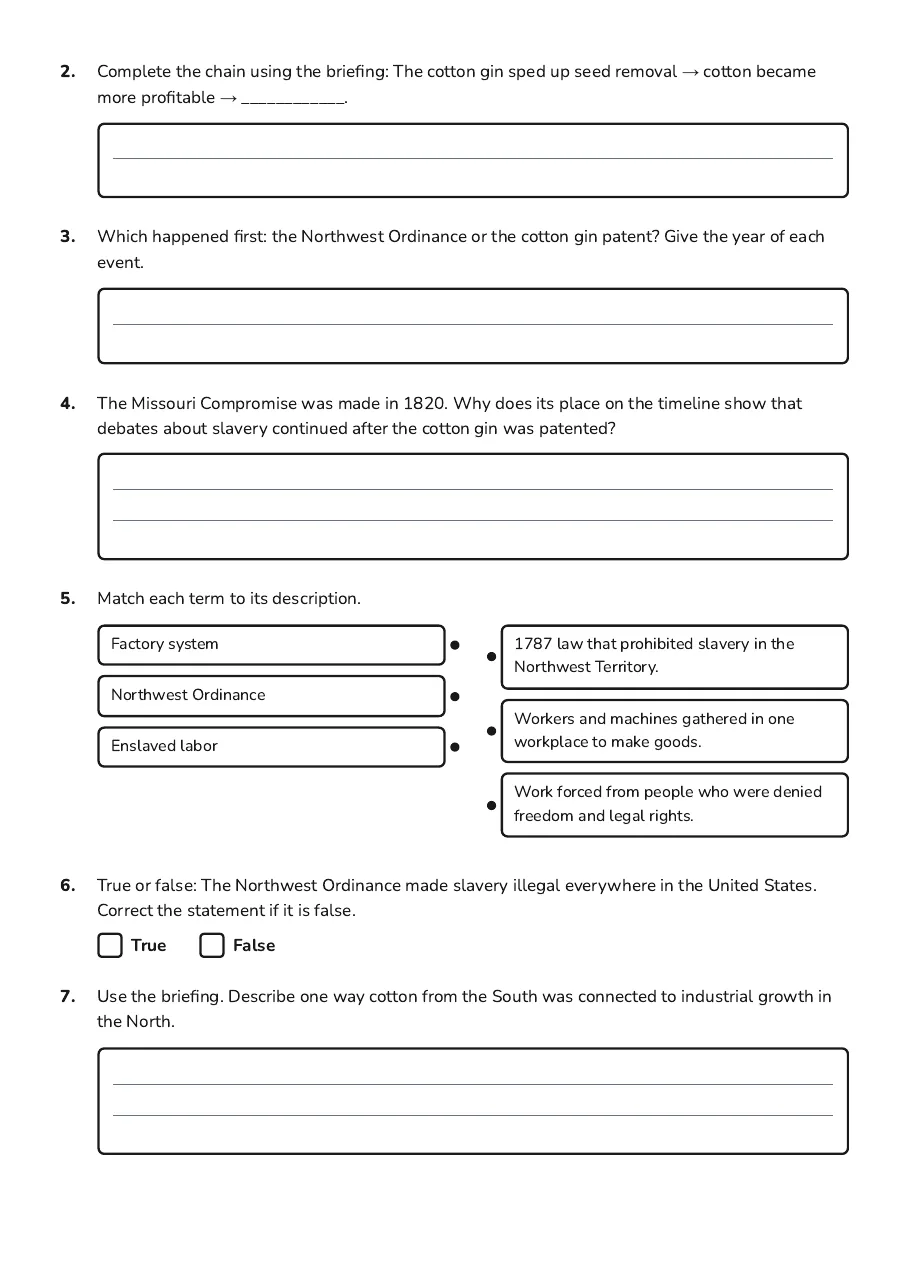
- Factory system
- Northwest Ordinance
- Enslaved labor
- 1787 law that prohibited slavery in the Northwest Territory.
- Workers and machines gathered in one workplace to make goods.
- Work forced from people who were denied freedom and legal rights.
3 printable pages
Page 1
Page 2
Page 3
About This Worksheet
Free in Kuraplan
Sign up free, grab the PDF, and customize it for your class.
Print-Ready
Formatted for standard paper. Clean layout, easy to read.
AI-Generated
Created with Kuraplan's AI, designed for real classroom use.
For Teachers & Parents
Use in classrooms, for homework, tutoring, or homeschool.
Need a custom version of this worksheet?
Kuraplan's AI generates custom worksheets in seconds — differentiated for every learner, aligned to your curriculum.
Generate Custom Worksheets — Free