LanguagesFreePrintable

Spanish Nationality Adjectives Practice

A free languages worksheet ready for your classroom. Open in Kuraplan to grab the print-ready PDF, customize it for your students, or generate a fresh version in seconds.
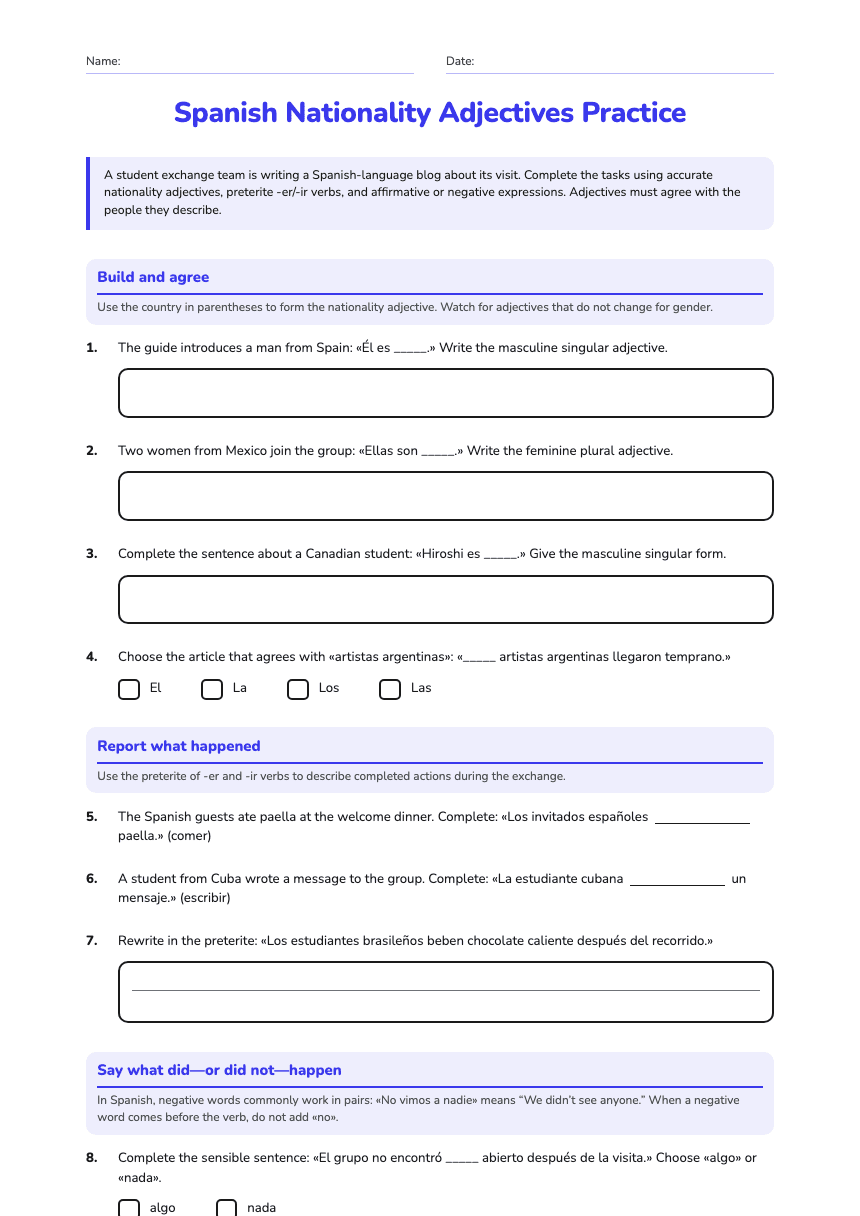
Spanish Nationality Adjectives Practice worksheet preview
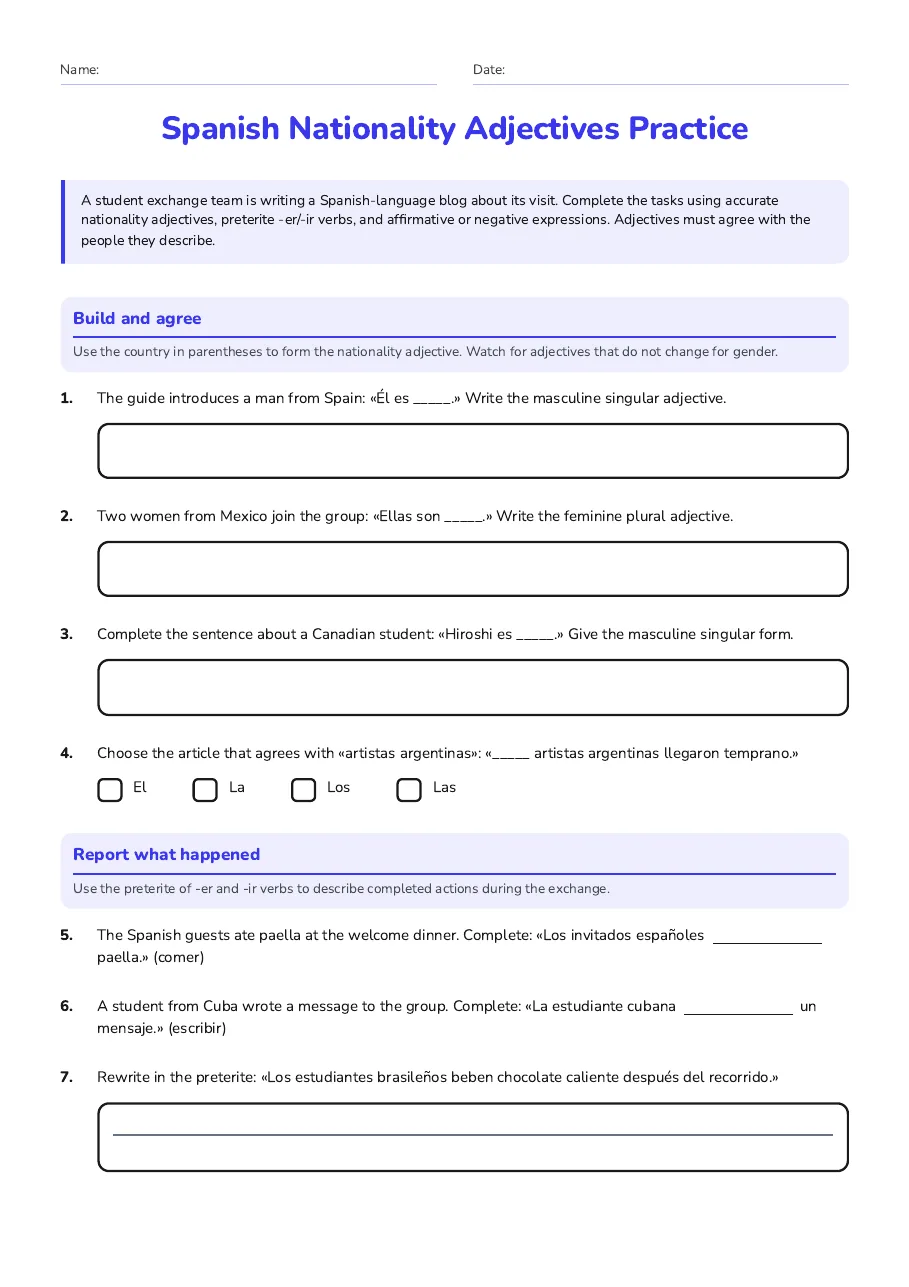
Name:Date:

Spanish Nationality Adjectives Practice

A student exchange team is writing a Spanish-language blog about its visit. Complete the tasks using accurate nationality adjectives, preterite -er/-ir verbs, and affirmative or negative expressions. Adjectives must agree with the people they describe.

Build and agree

Use the country in parentheses to form the nationality adjective. Watch for adjectives that do not change for gender.

1.The guide introduces a man from Spain: «Él es _____.» Write the masculine singular adjective.
2.Two women from Mexico join the group: «Ellas son _____.» Write the feminine plural adjective.
3.Complete the sentence about a Canadian student: «Hiroshi es _____.» Give the masculine singular form.
4.Choose the article that agrees with «artistas argentinas»: «_____ artistas argentinas llegaron temprano.»
  • El
  • La
  • Los
  • Las

Report what happened

Use the preterite of -er and -ir verbs to describe completed actions during the exchange.

5.The Spanish guests ate paella at the welcome dinner. Complete: «Los invitados españoles paella.» (comer)
6.A student from Cuba wrote a message to the group. Complete: «La estudiante cubana un mensaje.» (escribir)
7.Rewrite in the preterite: «Los estudiantes brasileños beben chocolate caliente después del recorrido.»

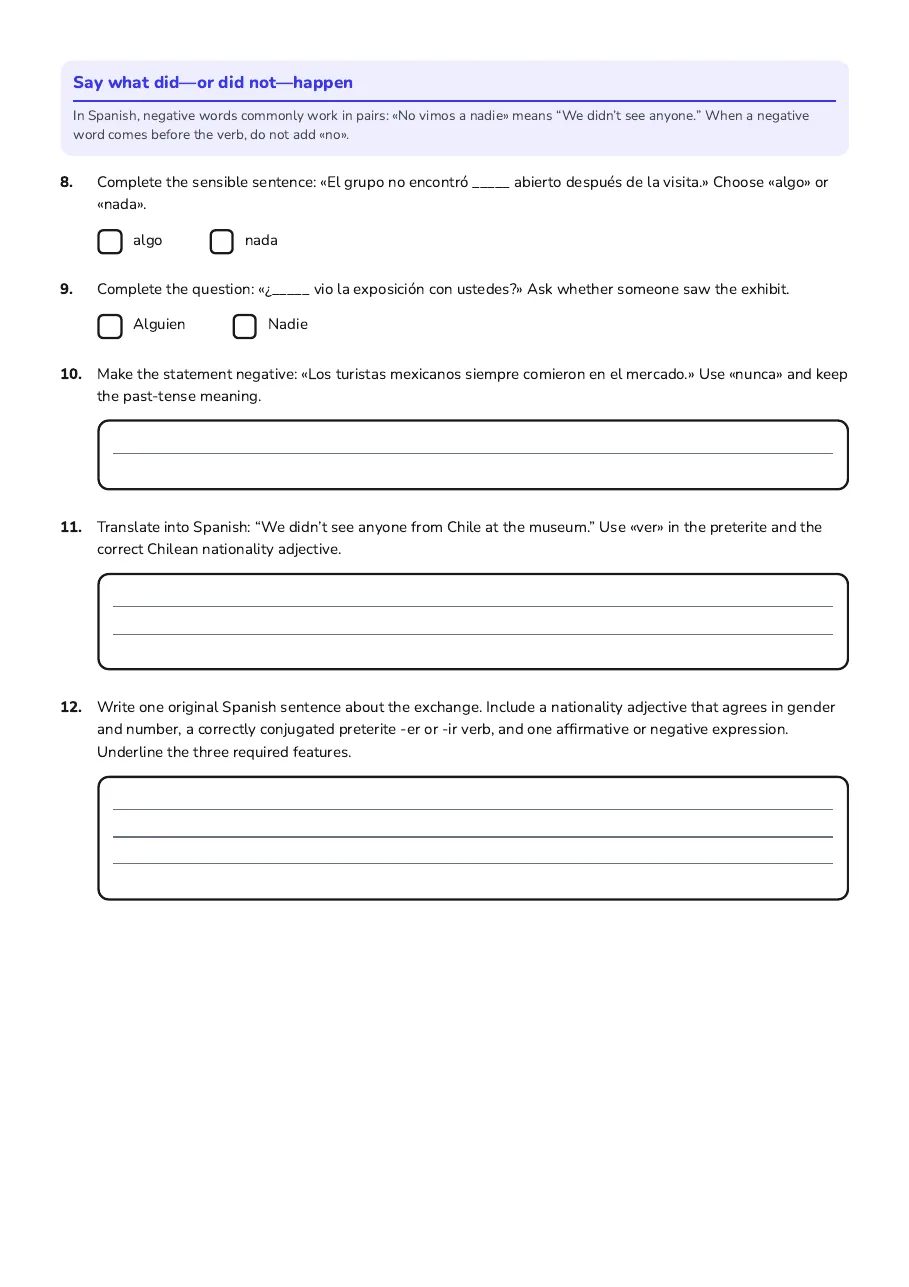
Say what did—or did not—happen

In Spanish, negative words commonly work in pairs: «No vimos a nadie» means “We didn’t see anyone.” When a negative word comes before the verb, do not add «no».

8.Complete the sensible sentence: «El grupo no encontró _____ abierto después de la visita.» Choose «algo» or «nada».
  • algo
  • nada
9.Complete the question: «¿_____ vio la exposición con ustedes?» Ask whether someone saw the exhibit.
  • Alguien
  • Nadie
10.Make the statement negative: «Los turistas mexicanos siempre comieron en el mercado.» Use «nunca» and keep the past-tense meaning.
11.Translate into Spanish: “We didn’t see anyone from Chile at the museum.” Use «ver» in the preterite and the correct Chilean nationality adjective.
12.Write one original Spanish sentence about the exchange. Include a nationality adjective that agrees in gender and number, a correctly conjugated preterite -er or -ir verb, and one affirmative or negative expression. Underline the three required features.

2 printable pages

  • Spanish Nationality Adjectives Practice, page 1 of 2: Build and agree, Report what happened

    Page 1

  • Spanish Nationality Adjectives Practice, page 2 of 2: Say what did—or did not—happen

    Page 2

About This Worksheet

Free in Kuraplan

Sign up free, grab the PDF, and customize it for your class.

Print-Ready

Formatted for standard paper. Clean layout, easy to read.

AI-Generated

Created with Kuraplan's AI, designed for real classroom use.

For Teachers & Parents

Use in classrooms, for homework, tutoring, or homeschool.

Need a custom version of this worksheet?

Kuraplan's AI generates custom worksheets in seconds — differentiated for every learner, aligned to your curriculum.

Generate Custom Worksheets — Free
No credit card Curriculum-aligned Under 60 seconds