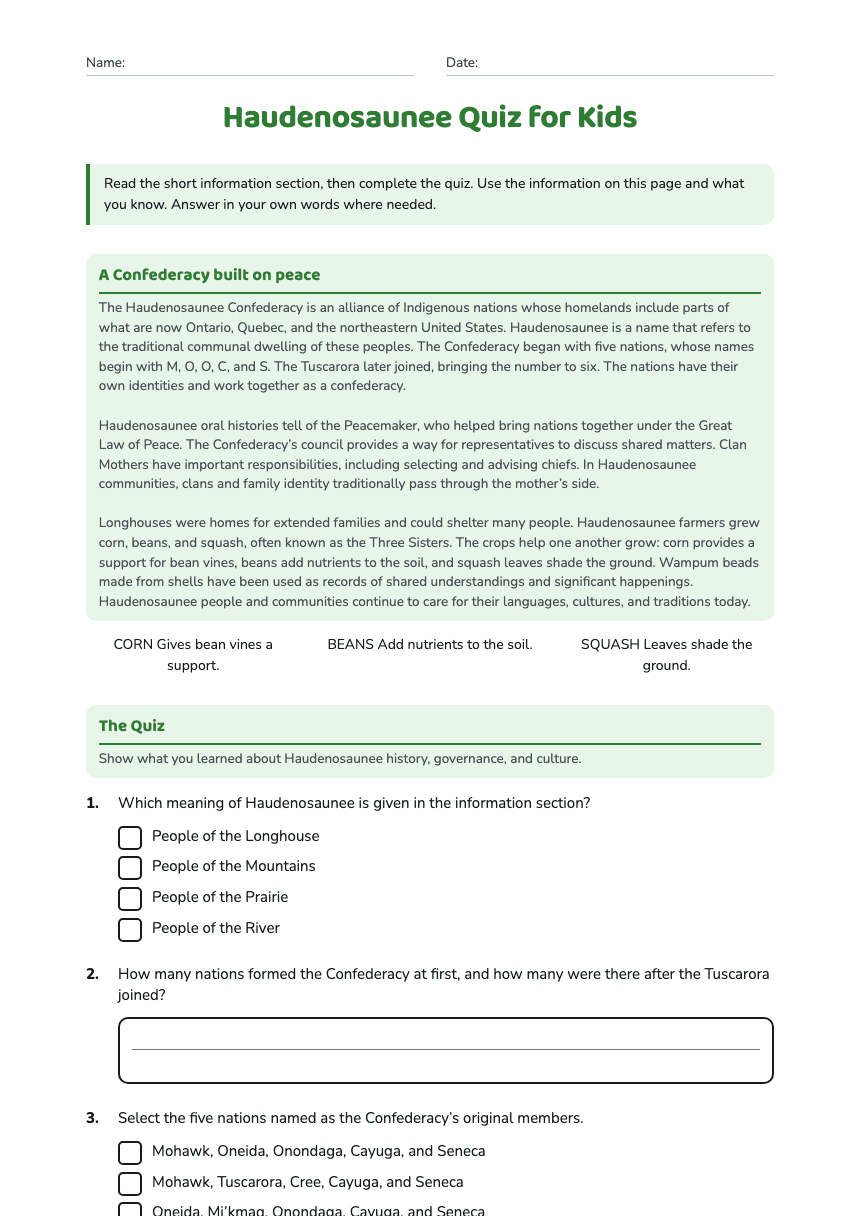
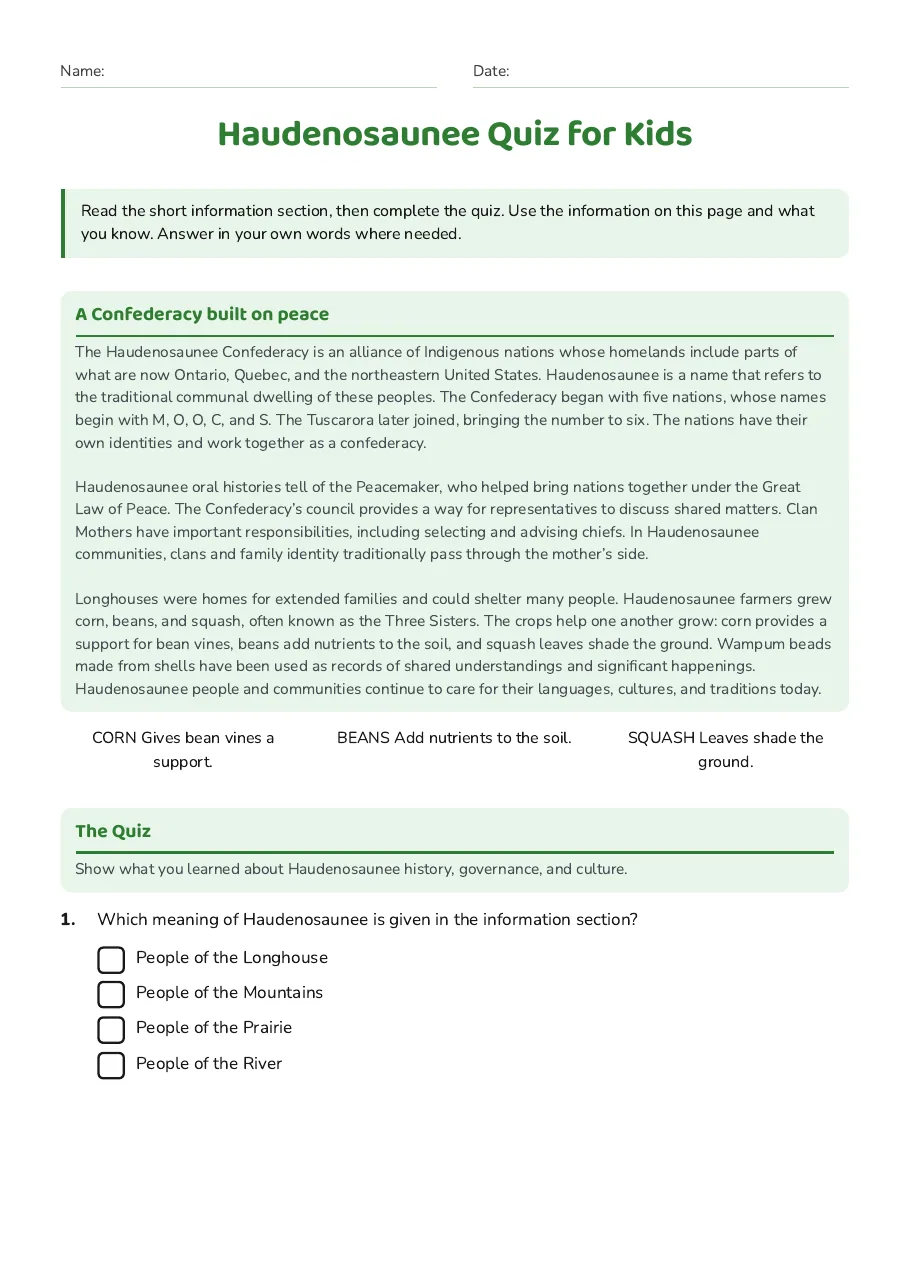
Haudenosaunee Quiz for Kids
A free social studies worksheet ready for your classroom. Open in Kuraplan to grab the print-ready PDF, customize it for your students, or generate a fresh version in seconds.
Haudenosaunee Quiz for Kids
A Confederacy built on peace
The Haudenosaunee Confederacy is an alliance of Indigenous nations whose homelands include parts of what are now Ontario, Quebec, and the northeastern United States. Haudenosaunee is a name that refers to the traditional communal dwelling of these peoples. The Confederacy began with five nations, whose names begin with M, O, O, C, and S. The Tuscarora later joined, bringing the number to six. The nations have their own identities and work together as a confederacy. Haudenosaunee oral histories tell of the Peacemaker, who helped bring nations together under the Great Law of Peace. The Confederacy’s council provides a way for representatives to discuss shared matters. Clan Mothers have important responsibilities, including selecting and advising chiefs. In Haudenosaunee communities, clans and family identity traditionally pass through the mother’s side. Longhouses were homes for extended families and could shelter many people. Haudenosaunee farmers grew corn, beans, and squash, often known as the Three Sisters. The crops help one another grow: corn provides a support for bean vines, beans add nutrients to the soil, and squash leaves shade the ground. Wampum beads made from shells have been used as records of shared understandings and significant happenings. Haudenosaunee people and communities continue to care for their languages, cultures, and traditions today.
CORN Gives bean vines a support.
BEANS Add nutrients to the soil.
SQUASH Leaves shade the ground.
The Quiz
Show what you learned about Haudenosaunee history, governance, and culture.
- People of the Longhouse
- People of the Mountains
- People of the Prairie
- People of the River
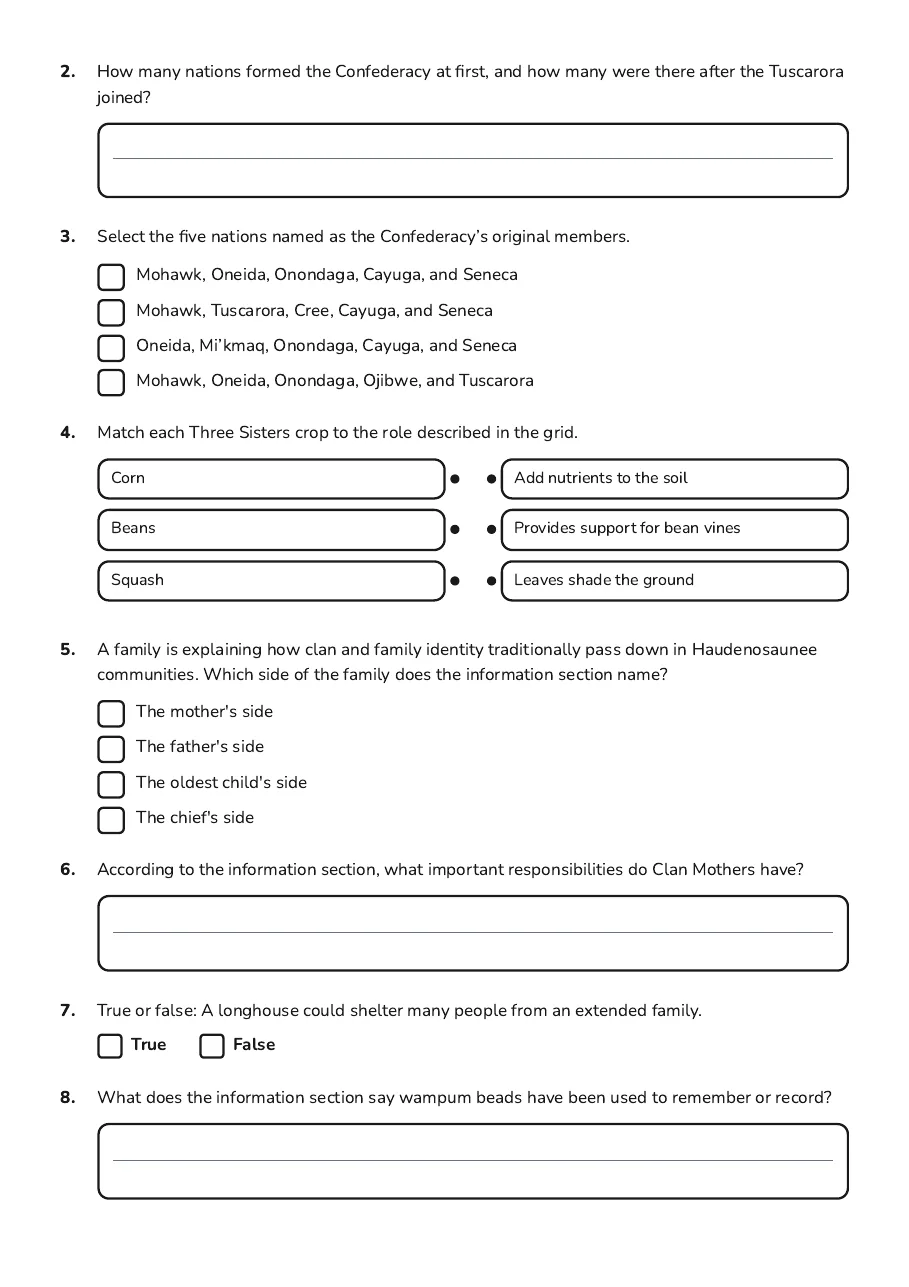
- Mohawk, Oneida, Onondaga, Cayuga, and Seneca
- Mohawk, Tuscarora, Cree, Cayuga, and Seneca
- Oneida, Mi’kmaq, Onondaga, Cayuga, and Seneca
- Mohawk, Oneida, Onondaga, Ojibwe, and Tuscarora
- Corn
- Beans
- Squash
- Add nutrients to the soil
- Provides support for bean vines
- Leaves shade the ground
- The mother's side
- The father's side
- The oldest child's side
- The chief's side
3 printable pages
Page 1
Page 2

Page 3
About This Worksheet
Free in Kuraplan
Sign up free, grab the PDF, and customize it for your class.
Print-Ready
Formatted for standard paper. Clean layout, easy to read.
AI-Generated
Created with Kuraplan's AI, designed for real classroom use.
For Teachers & Parents
Use in classrooms, for homework, tutoring, or homeschool.
Need a custom version of this worksheet?
Kuraplan's AI generates custom worksheets in seconds — differentiated for every learner, aligned to your curriculum.
Generate Custom Worksheets — Free