Energy Nuclear Power Station — free printable diagram
Free geography resource for teachers · CC BY-NC 4.0
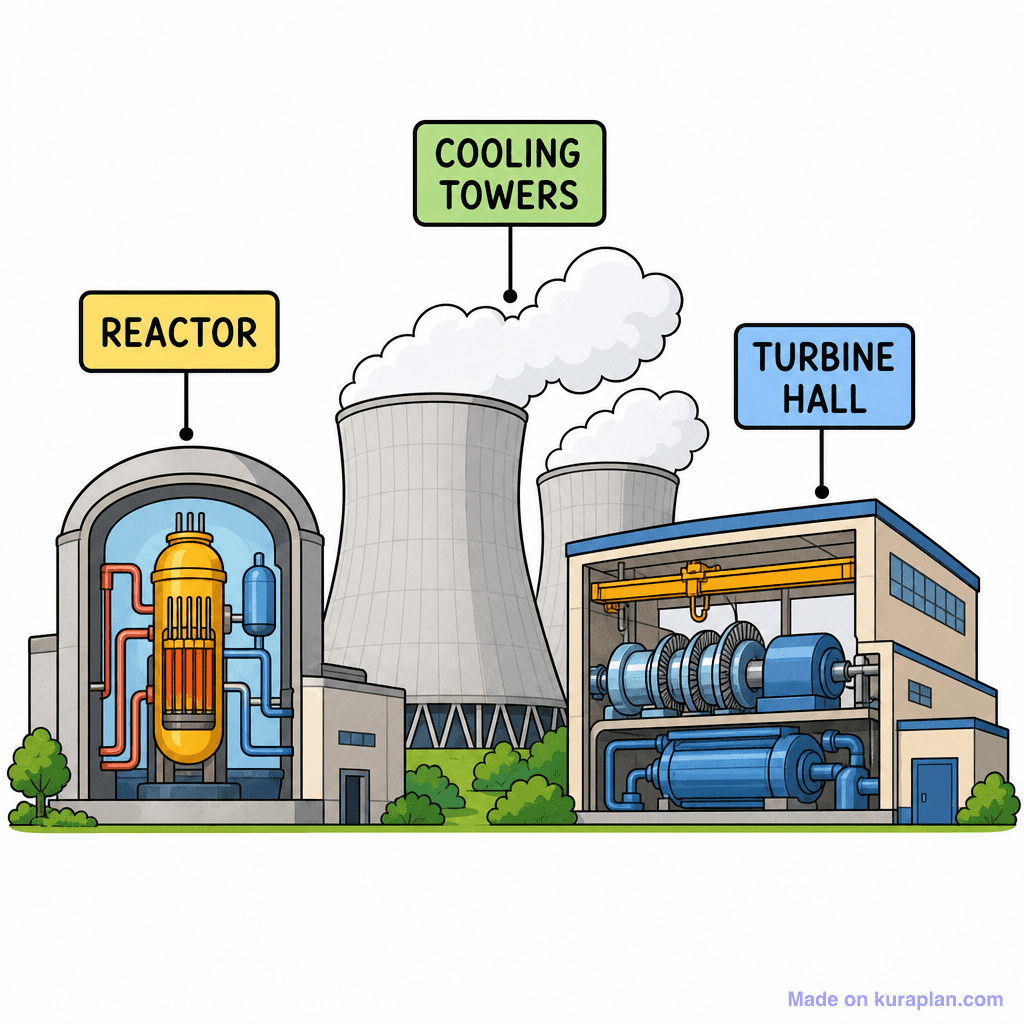
About this illustration
This image is a cartoon-style flat illustration depicting the main components of a nuclear power plant. It visually explains the process of electricity generation by showing a reactor building, two large cooling towers emitting steam, and a turbine hall with internal machinery. Each major component is clearly labelled with text boxes: 'REACTOR', 'COOLING TOWERS', and 'TURBINE HALL'. This diagram is ideal for teaching students about nuclear energy and power plant structure in science or technology lessons, suitable for worksheets, slides, or labelling activities.
How a nuclear power station works
A nuclear power station makes electricity the same way a coal or gas station does — by boiling water into steam and using that steam to spin a turbine connected to a generator. The only difference is where the heat comes from: instead of burning a fuel, the heat is released by nuclear fission, the splitting of large atomic nuclei inside a reactor.
- Fuel
- Uranium, sometimes plutonium
- Reaction
- Nuclear fission — a large nucleus splits in two
- What fission releases
- Heat energy
- Reactor
- Where the fission reaction is contained and controlled
- Control rods
- Absorb neutrons — lowered in to slow the reaction, raised out to speed it up
- Heat exchanger / boiler
- Uses the heat to turn water into steam
- Turbine and generator
- Steam spins the turbine, which turns the generator
- Waste
- Radioactive, and needs long-term storage
- Follow the diagram as an energy pathway: fission releases heat, the heat makes steam, the steam turns a turbine, the turbine turns a generator, the generator makes electricity. Every stage after the first is identical to a fossil-fuel station.
- Fission is a chain reaction. Splitting one nucleus releases neutrons that go on to split others, so without control it would accelerate — which is exactly what the control rods are there to prevent.
- Generating electricity this way releases no carbon dioxide, which is the main argument made for it. The counter-arguments are the radioactive waste, the cost of building and decommissioning the station, and the consequences of an accident.
- The large towers release water vapour, not smoke. They are cooling towers, part of getting rid of waste heat, and the plume is condensed steam — a very common misreading of the picture.
- Fission is not fusion. Fission splits a large nucleus and is what power stations use today; fusion joins small nuclei together and is what powers the sun.
- Most station diagrams show two separate water loops, joined only at the heat exchanger: a coolant loop that carries heat out of the reactor, and a second loop whose water is turned into the steam that drives the turbine. Tracing which loop is which is a good way to check a student is reading the diagram rather than the labels.
How to use
- 1Right-click the image and choose “Save image as”, or use the download button.
- 2Use it in your classroom worksheets, slides or printables — free under CC BY-NC 4.0.
- 3Attribute as “Image by Kuraplan” or link back to kuraplan.com. Not for commercial resale.
Turn this image into a worksheet
This illustration is already in Kuraplan's editor — describe the worksheet you need and the AI builds it around the image in seconds.
Related illustrations
More from Energy & Sustainability
Free worksheets on Energy Nuclear Power Station
All free worksheetsBrowse by subject
21 subjects · 5,118 free illustrations
Maths
1,894 free illustrations
Cross-Curricular
835 free illustrations
Science
814 free illustrations
English
612 free illustrations
Health
200 free illustrations
Social Studies
177 free illustrations
Religious Education
139 free illustrations
Music
128 free illustrations
Art
66 free illustrations
Drama
56 free illustrations
Social Sciences
48 free illustrations
History
47 free illustrations
Arts
26 free illustrations
PE
25 free illustrations
Te Reo Māori
24 free illustrations
Technology
16 free illustrations
Culture
7 free illustrations
Business
1 free illustrations
English
1 free illustrations
English (ELA)
1 free illustrations
Languages
1 free illustrations