PEFreePrintable
Cross Country Skills Assessment
A free pe worksheet ready for your classroom. Open in Kuraplan to grab the print-ready PDF, customize it for your students, or generate a fresh version in seconds.
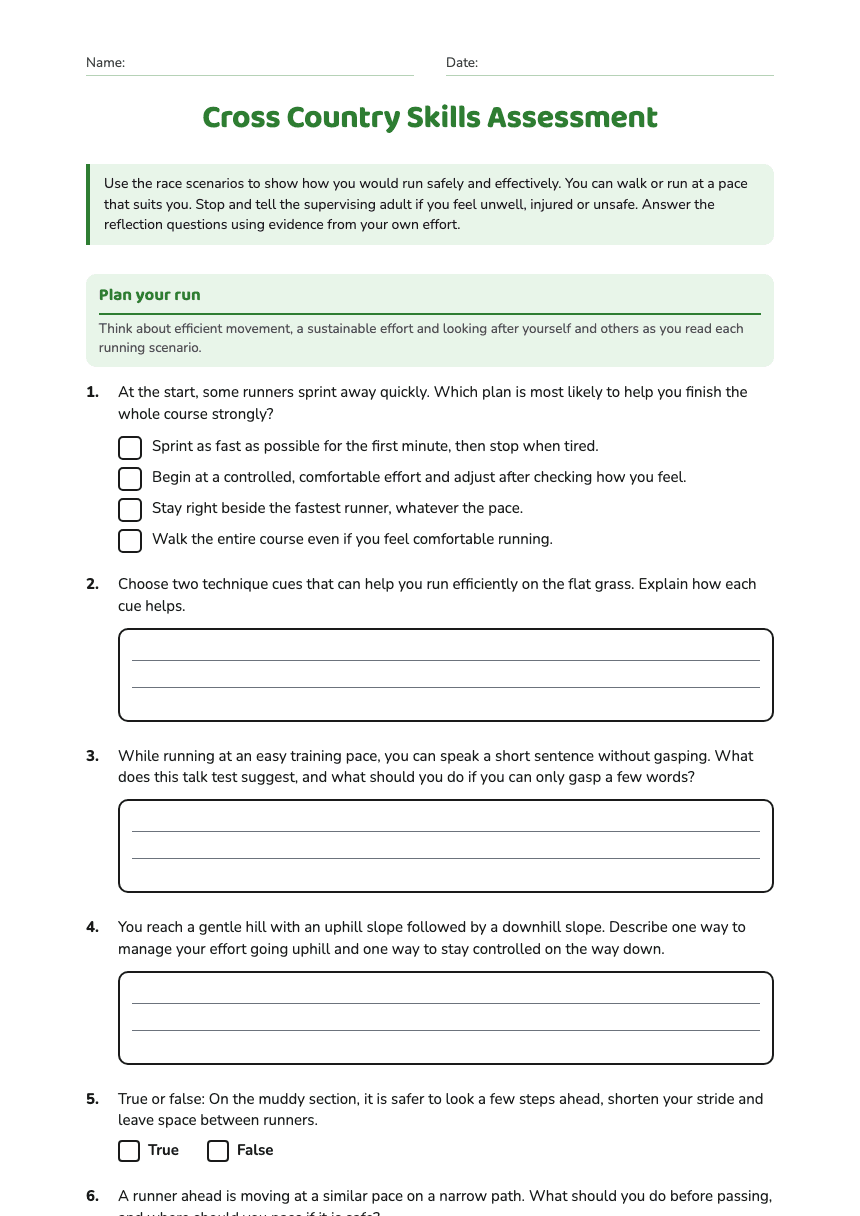
Name:Date:
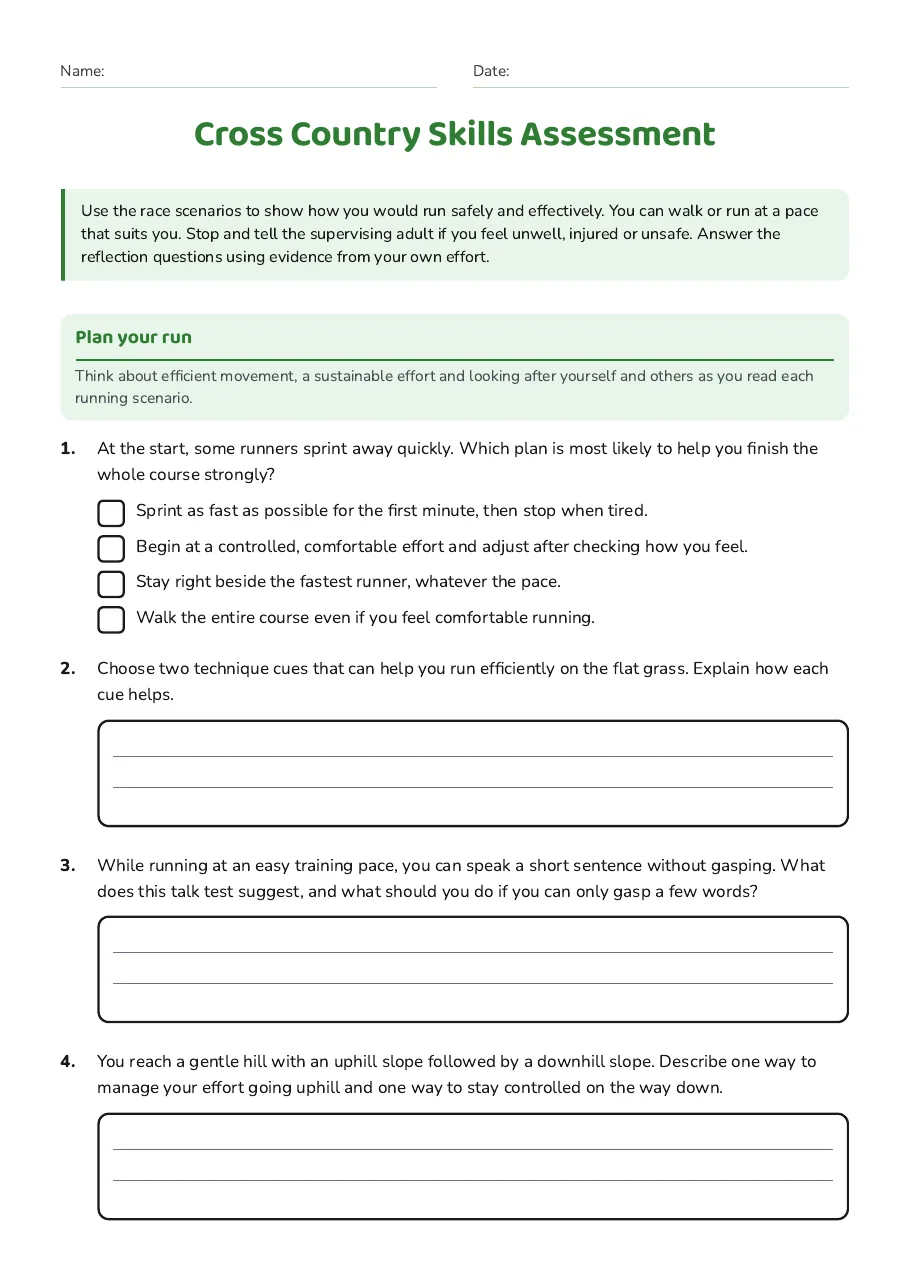
Cross Country Skills Assessment
Use the race scenarios to show how you would run safely and effectively. You can walk or run at a pace that suits you. Stop and tell the supervising adult if you feel unwell, injured or unsafe. Answer the reflection questions using evidence from your own effort.
Plan your run
Think about efficient movement, a sustainable effort and looking after yourself and others as you read each running scenario.
1.At the start, some runners sprint away quickly. Which plan is most likely to help you finish the whole course strongly?
- Sprint as fast as possible for the first minute, then stop when tired.
- Begin at a controlled, comfortable effort and adjust after checking how you feel.
- Stay right beside the fastest runner, whatever the pace.
- Walk the entire course even if you feel comfortable running.
2.Choose two technique cues that can help you run efficiently on the flat grass. Explain how each cue helps.
3.While running at an easy training pace, you can speak a short sentence without gasping. What does this talk test suggest, and what should you do if you can only gasp a few words?
4.You reach a gentle hill with an uphill slope followed by a downhill slope. Describe one way to manage your effort going uphill and one way to stay controlled on the way down.
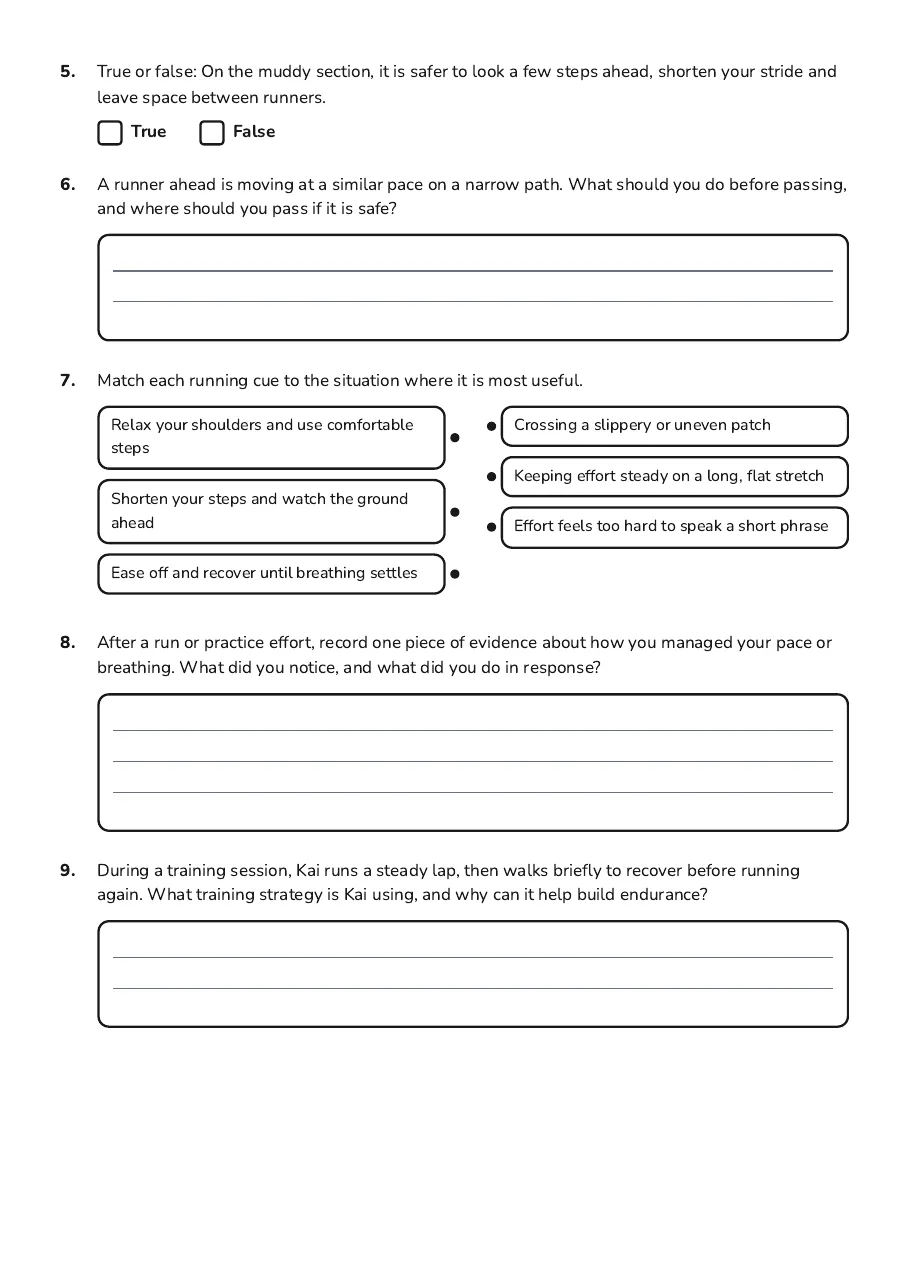
5.True or false: On the muddy section, it is safer to look a few steps ahead, shorten your stride and leave space between runners.
TrueFalse
6.A runner ahead is moving at a similar pace on a narrow path. What should you do before passing, and where should you pass if it is safe?
7.Match each running cue to the situation where it is most useful.
- Relax your shoulders and use comfortable steps
- Shorten your steps and watch the ground ahead
- Ease off and recover until breathing settles
- Crossing a slippery or uneven patch
- Keeping effort steady on a long, flat stretch
- Effort feels too hard to speak a short phrase
8.After a run or practice effort, record one piece of evidence about how you managed your pace or breathing. What did you notice, and what did you do in response?
9.During a training session, Kai runs a steady lap, then walks briefly to recover before running again. What training strategy is Kai using, and why can it help build endurance?
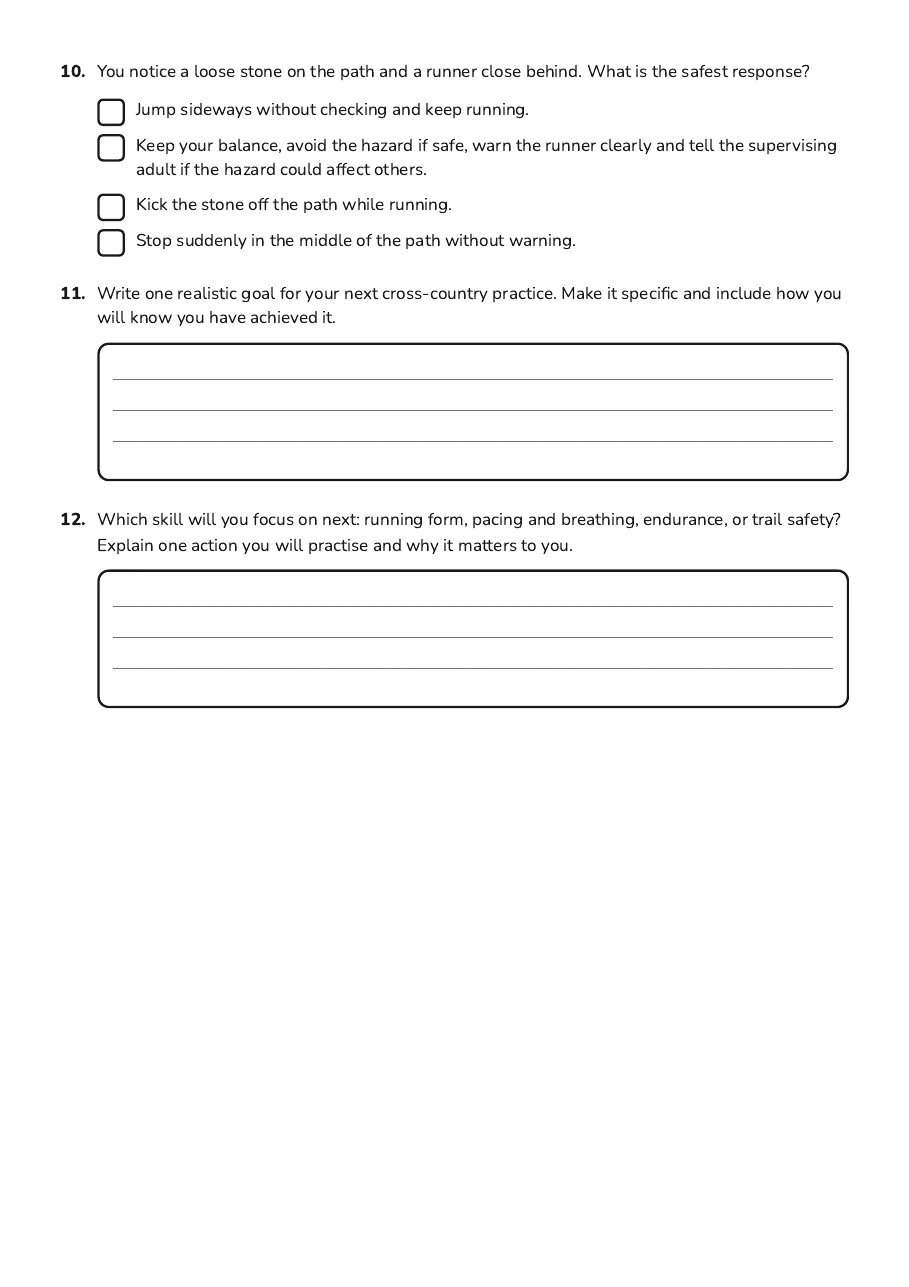
10.You notice a loose stone on the path and a runner close behind. What is the safest response?
- Jump sideways without checking and keep running.
- Keep your balance, avoid the hazard if safe, warn the runner clearly and tell the supervising adult if the hazard could affect others.
- Kick the stone off the path while running.
- Stop suddenly in the middle of the path without warning.
11.Write one realistic goal for your next cross-country practice. Make it specific and include how you will know you have achieved it.
12.Which skill will you focus on next: running form, pacing and breathing, endurance, or trail safety? Explain one action you will practise and why it matters to you.
3 printable pages
Page 1
Page 2
Page 3
About This Worksheet
Free in Kuraplan
Sign up free, grab the PDF, and customize it for your class.
Print-Ready
Formatted for standard paper. Clean layout, easy to read.
AI-Generated
Created with Kuraplan's AI, designed for real classroom use.
For Teachers & Parents
Use in classrooms, for homework, tutoring, or homeschool.
Need a custom version of this worksheet?
Kuraplan's AI generates custom worksheets in seconds — differentiated for every learner, aligned to your curriculum.
Generate Custom Worksheets — Free No credit card Curriculum-aligned Under 60 seconds
More PE Worksheets
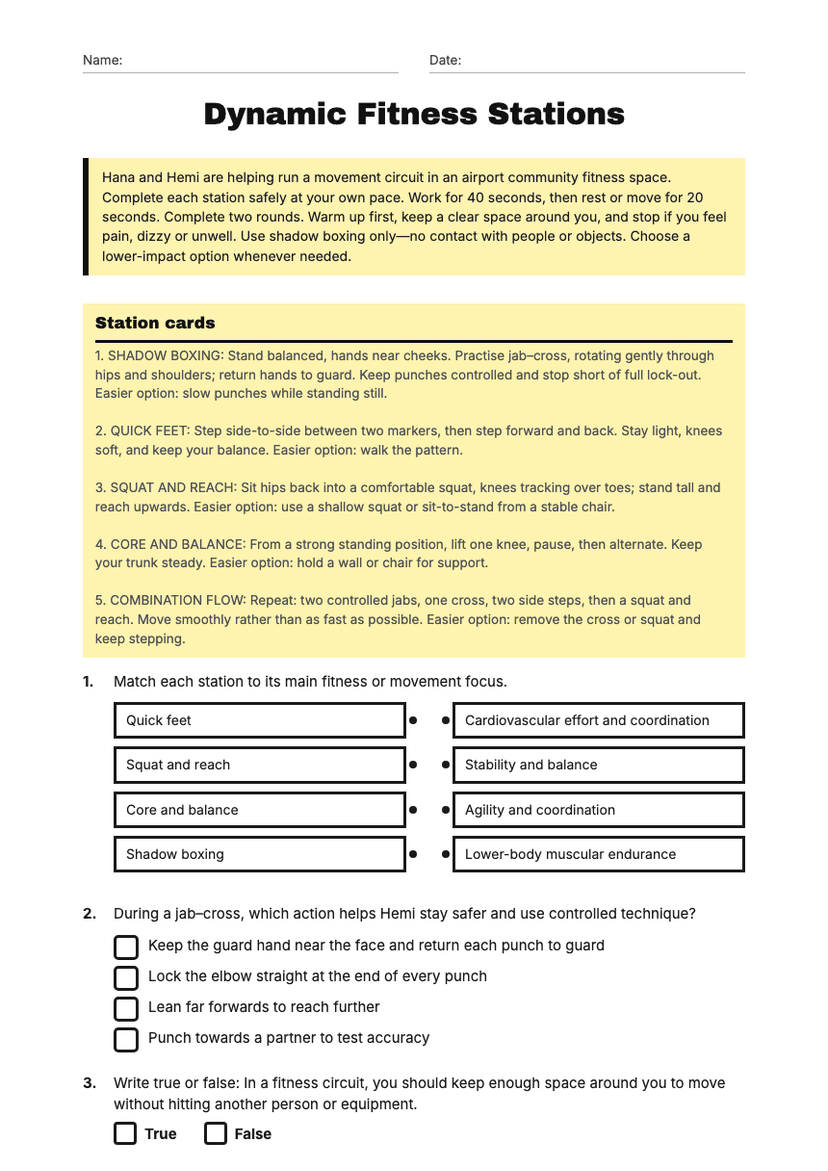
Year 10
Dynamic Fitness Stations
Free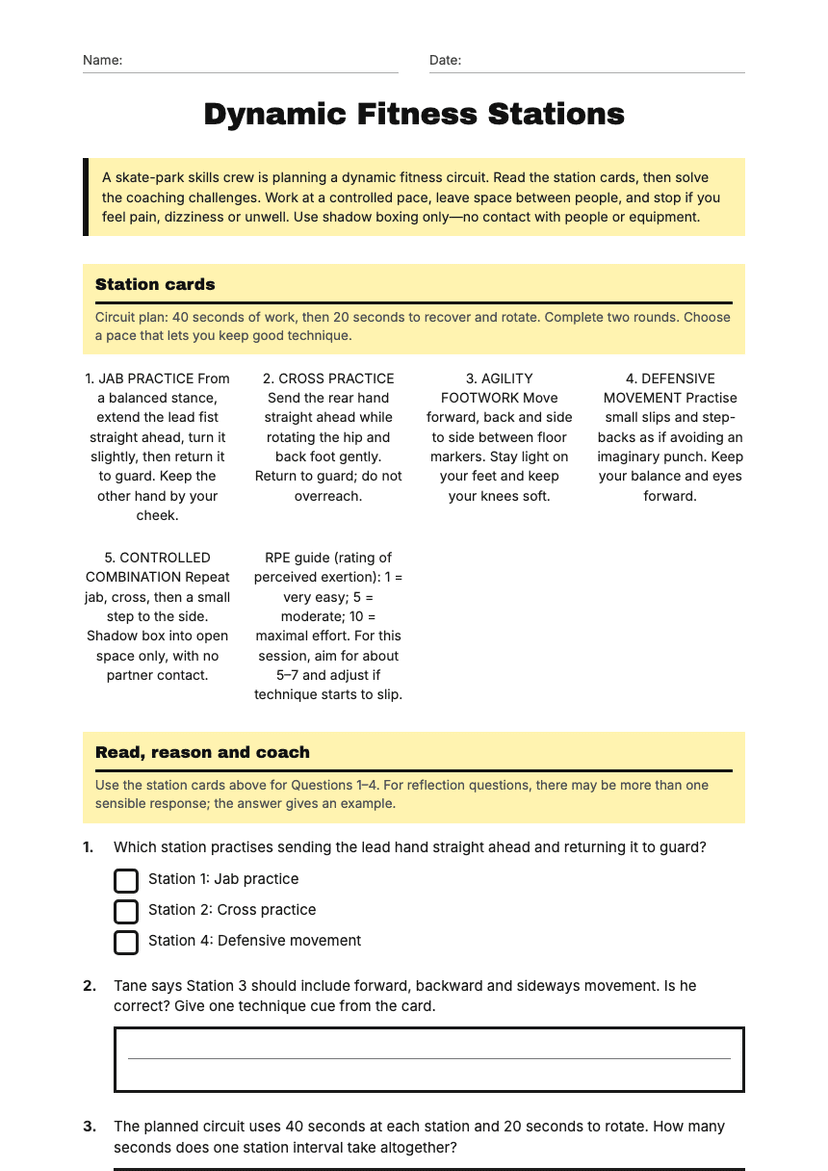
Year 10
Dynamic Fitness Stations
Free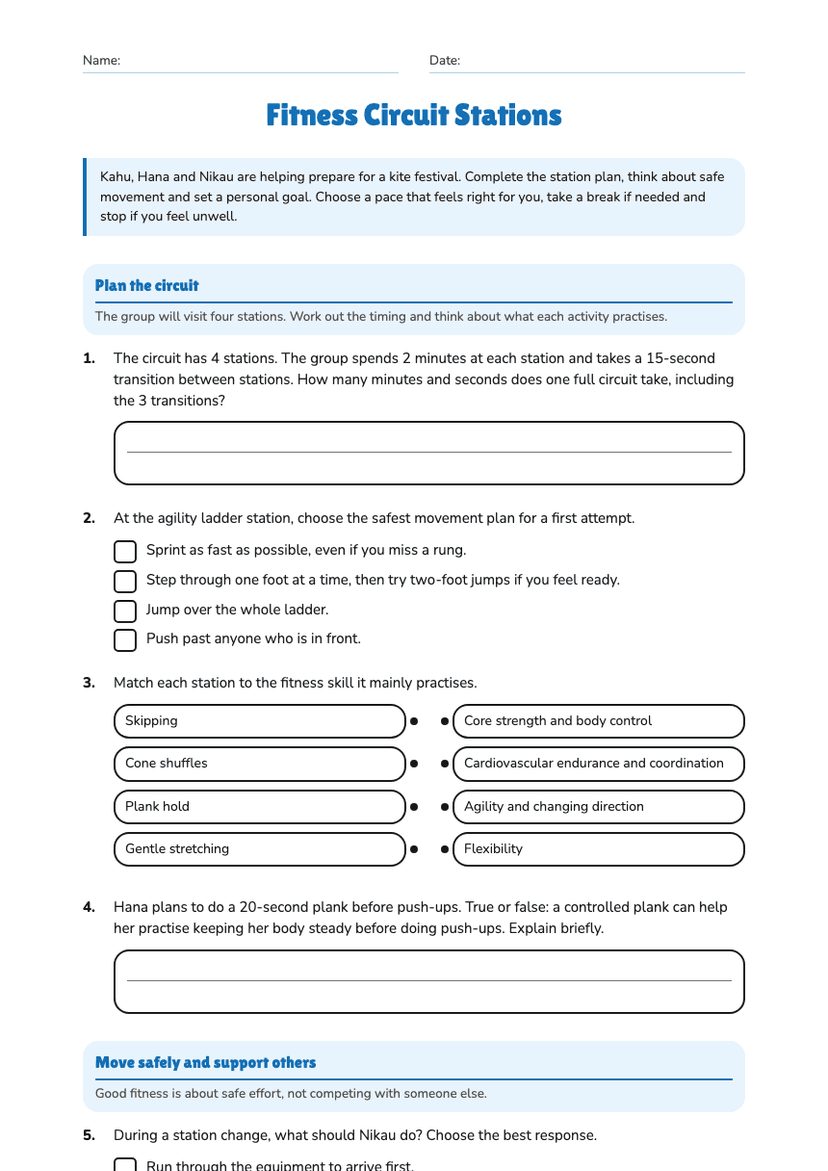
Year 5–6
Fitness Circuit Stations
Free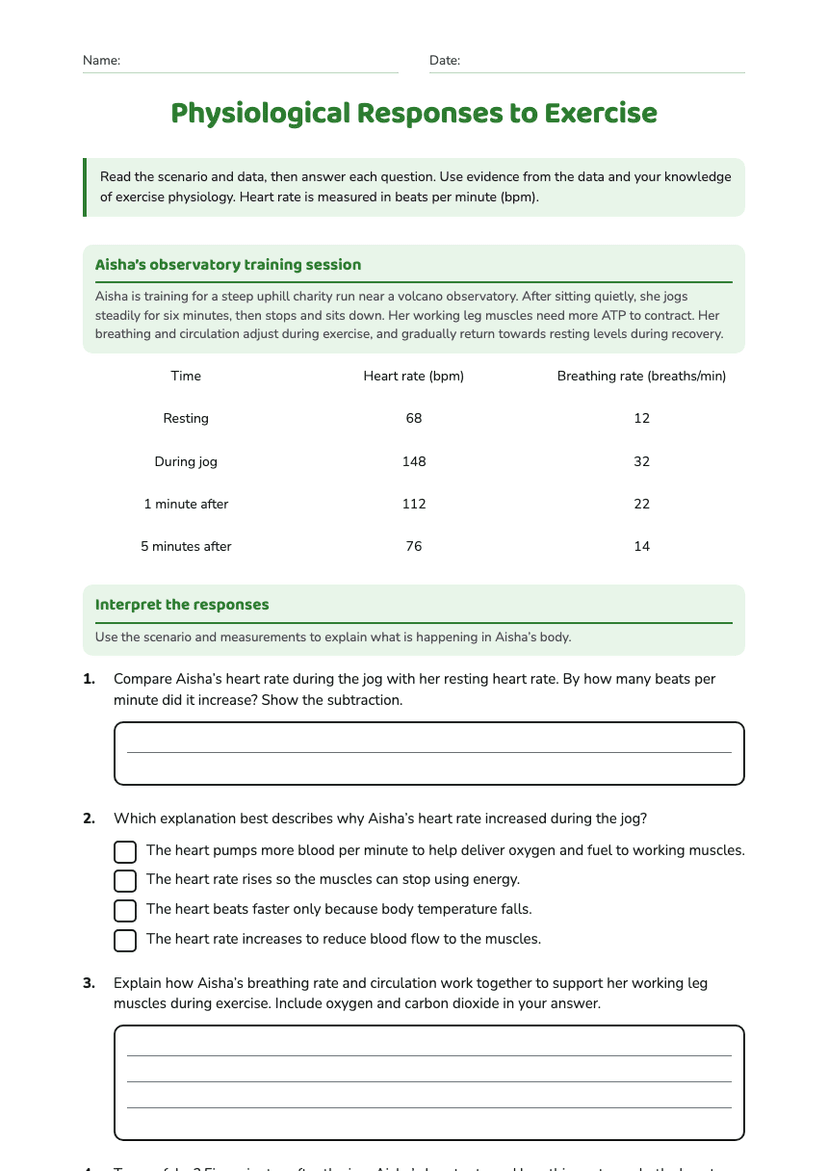
Year 11
Physiological Responses to Exercise
Free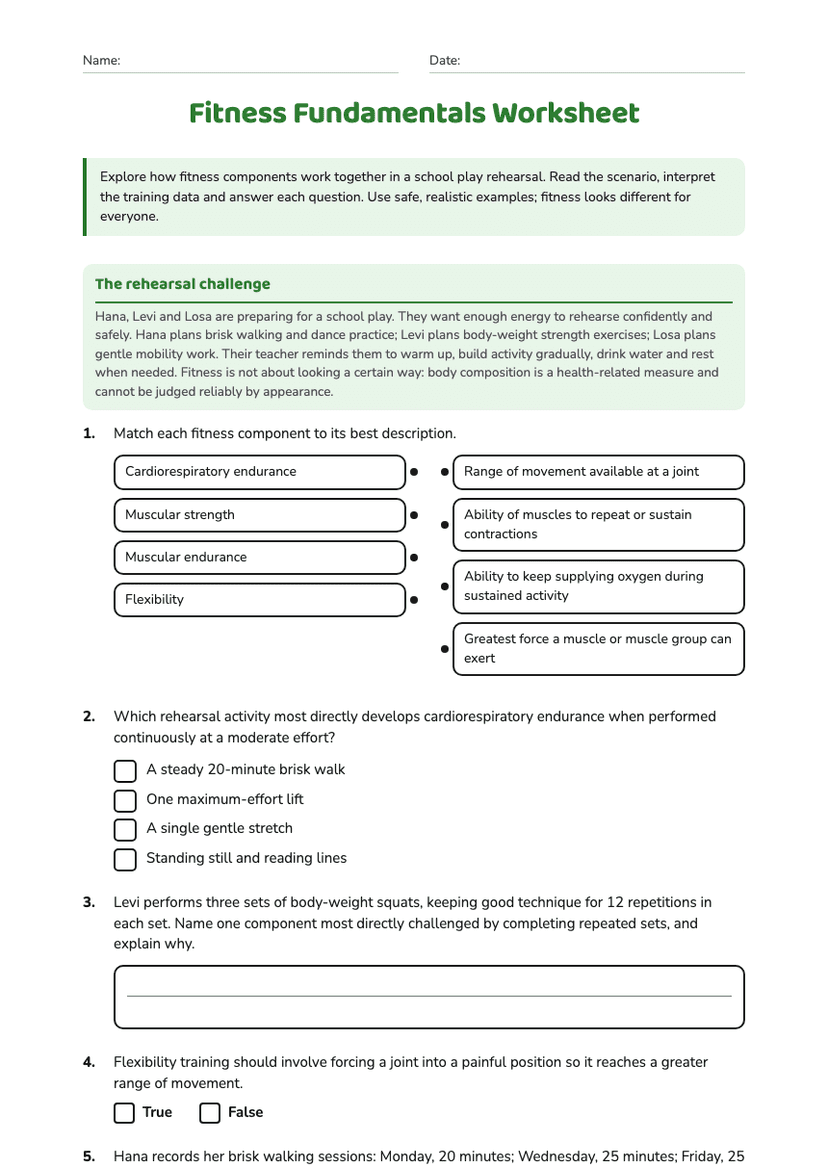
Year 10
Fitness Fundamentals Worksheet
Free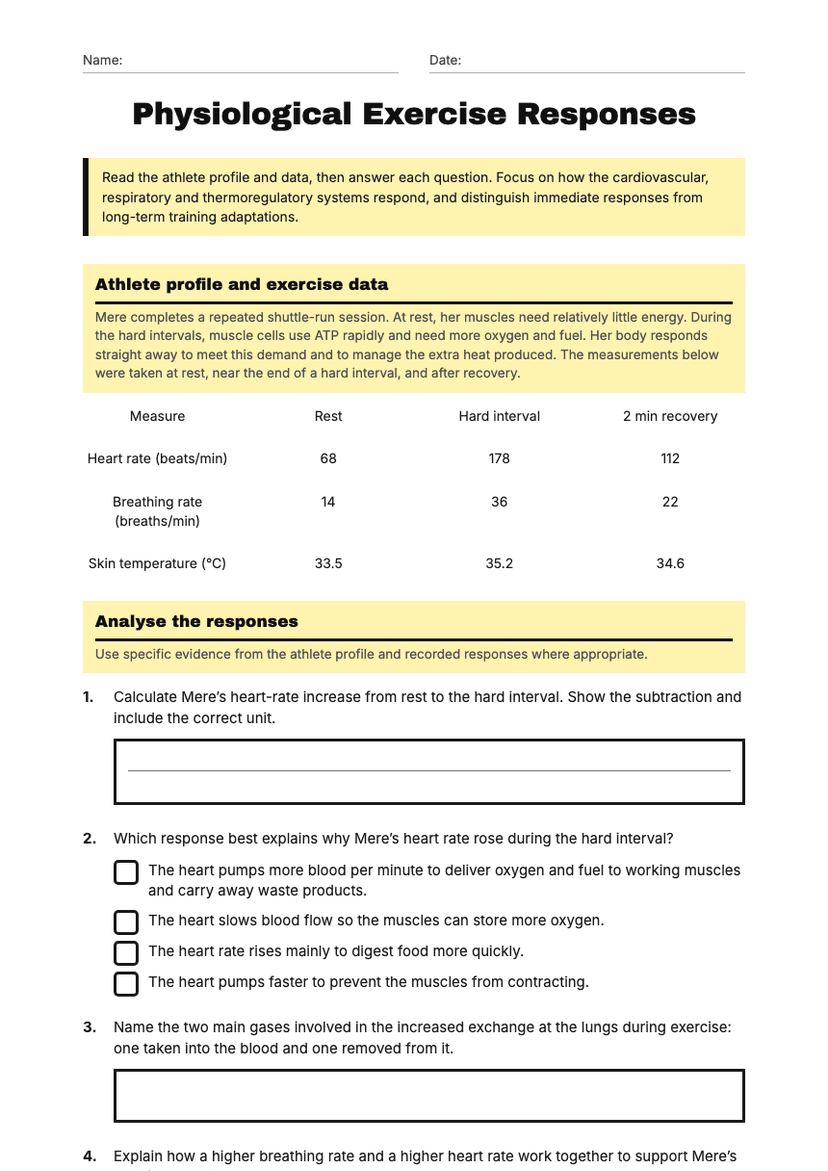
Year 12
Physiological Exercise Responses
Free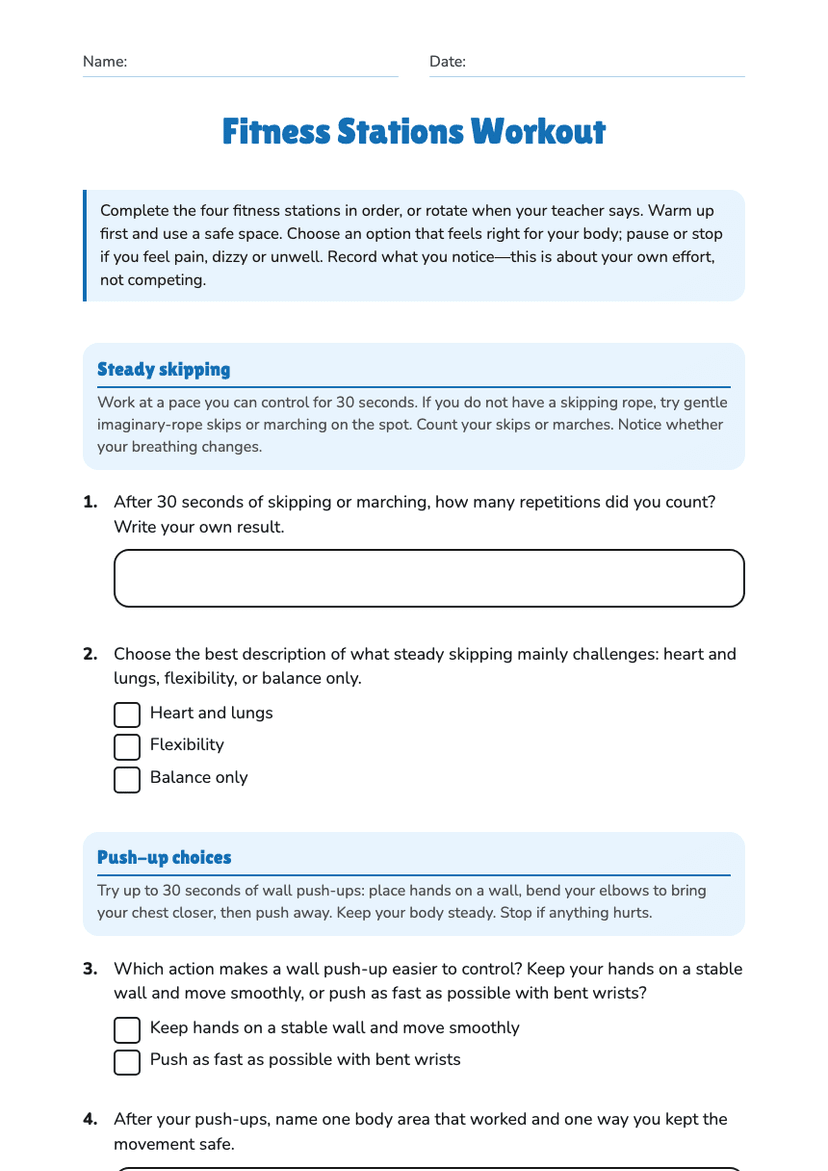
Fitness Stations Workout
Free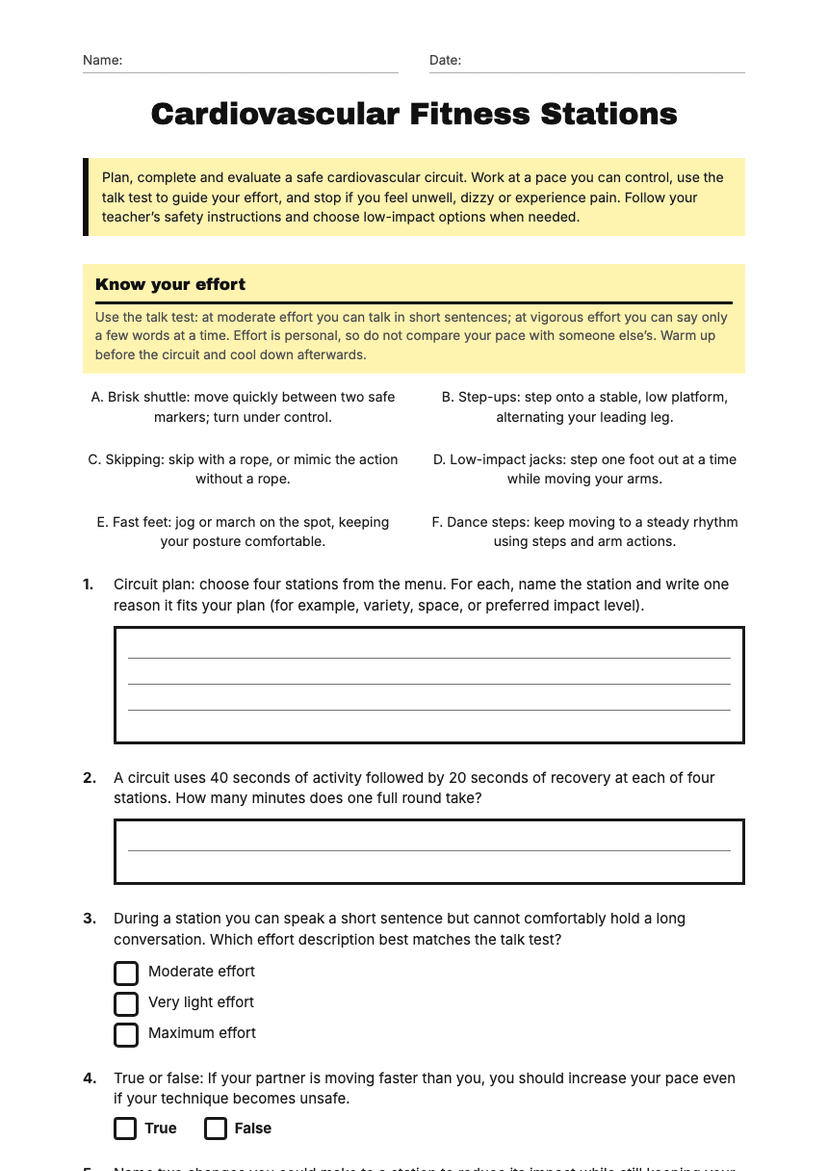
Year 10