ScienceFreePrintable

Energy Calculations Worksheet

A free science worksheet ready for your classroom. Open in Kuraplan to grab the print-ready PDF, customize it for your students, or generate a fresh version in seconds.
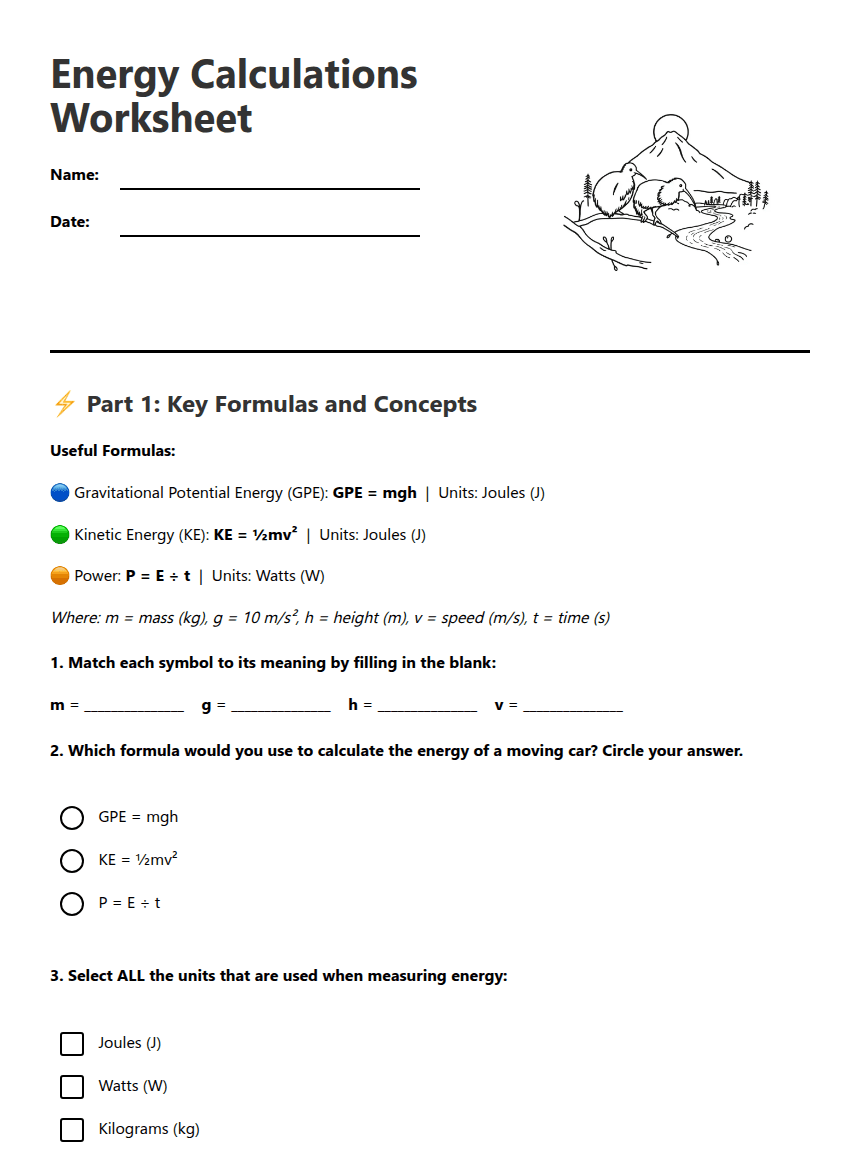
Energy Calculations Worksheet worksheet preview
Energy Calculations Worksheet

Energy calculations illustration

⚡ Part 1: Key Formulas and Concepts

Useful Formulas:

🔵 Gravitational Potential Energy (GPE): GPE = mgh  |  Units: Joules (J)

🟢 Kinetic Energy (KE): KE = ½mv²  |  Units: Joules (J)

🟠 Power: P = E ÷ t  |  Units: Watts (W)

Where: m = mass (kg), g = 10 m/s², h = height (m), v = speed (m/s), t = time (s)

1. Match each symbol to its meaning by filling in the blank:

m = _______________    g = _______________    h = _______________    v = _______________

2. Which formula would you use to calculate the energy of a moving car? Circle your answer.

GPE = mgh

KE = ½mv²

P = E ÷ t

3. Select ALL the units that are used when measuring energy:

Joules (J)

Watts (W)

Kilograms (kg)

Newtons (N)

🔢 Part 2: Calculation Problems

Show all working in the boxes provided. Include units in your answers.

4. A 5 kg book is placed on a shelf 2 metres above the ground. Calculate its gravitational potential energy.
5. A 60 kg student runs at a speed of 4 m/s. Calculate their kinetic energy.
6. A rugby player does 1 200 J of work in 6 seconds. Calculate their power output.
7. A 2 kg ball is dropped from a height of 5 metres. Calculate its GPE at the top. If all the GPE converts to KE at the bottom, what is the ball's speed just before it hits the ground? (Hint: set GPE = KE and solve for v)
8. A Māori warrior uses a traditional spear (taiaha) to throw at a target. If the spear has a mass of 1 kg and is thrown at a speed of 20 m/s, calculate its kinetic energy.
9. A Māori fishing net is raised from a depth of 3 metres. If the net weighs 10 kg, calculate the gravitational potential energy gained when it is lifted to the surface.

🌏 Part 3: Real-World Applications

10. A rollercoaster car has more kinetic energy at the bottom of a hill than at the top. Explain why this happens using what you know about GPE and KE.
11. Two students carry identical boxes up a flight of stairs. Student A takes 10 seconds and Student B takes 20 seconds. They both do 500 J of work. Who has greater power, and why?
12. A hydroelectric dam in New Zealand stores water 80 metres above the turbines. The water has a mass of 500 kg. Calculate the GPE stored in the water, then explain how this energy is converted into electrical energy.
13. Discuss how traditional Māori practices, such as the use of water for irrigation, relate to the concepts of energy and power. How does understanding these concepts help in sustainable practices?

About This Worksheet

Free in Kuraplan

Sign up free, grab the PDF, and customize it for your class.

Print-Ready

Formatted for standard paper. Clean layout, easy to read.

AI-Generated

Created with Kuraplan's AI, designed for real classroom use.

For Teachers & Parents

Use in classrooms, for homework, tutoring, or homeschool.

Need a custom version of this worksheet?

Kuraplan's AI generates custom worksheets in seconds — differentiated for every learner, aligned to your curriculum.

Generate Custom Worksheets — Free
No credit card Curriculum-aligned Under 60 seconds