Sound Through Different Mediums
A free science worksheet ready for your classroom. Open in Kuraplan to grab the print-ready PDF, customize it for your students, or generate a fresh version in seconds.
Sound Through Different Mediums
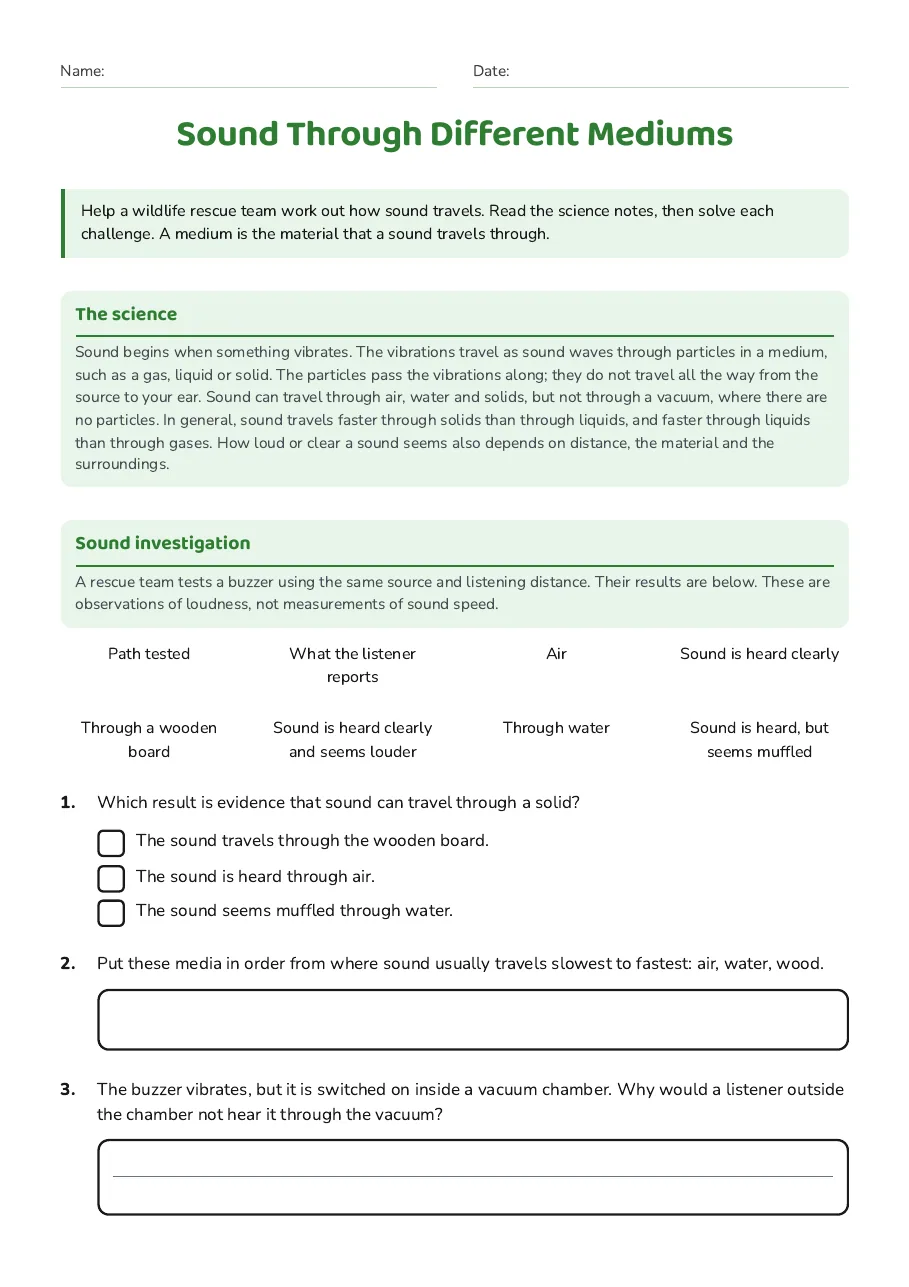
The science
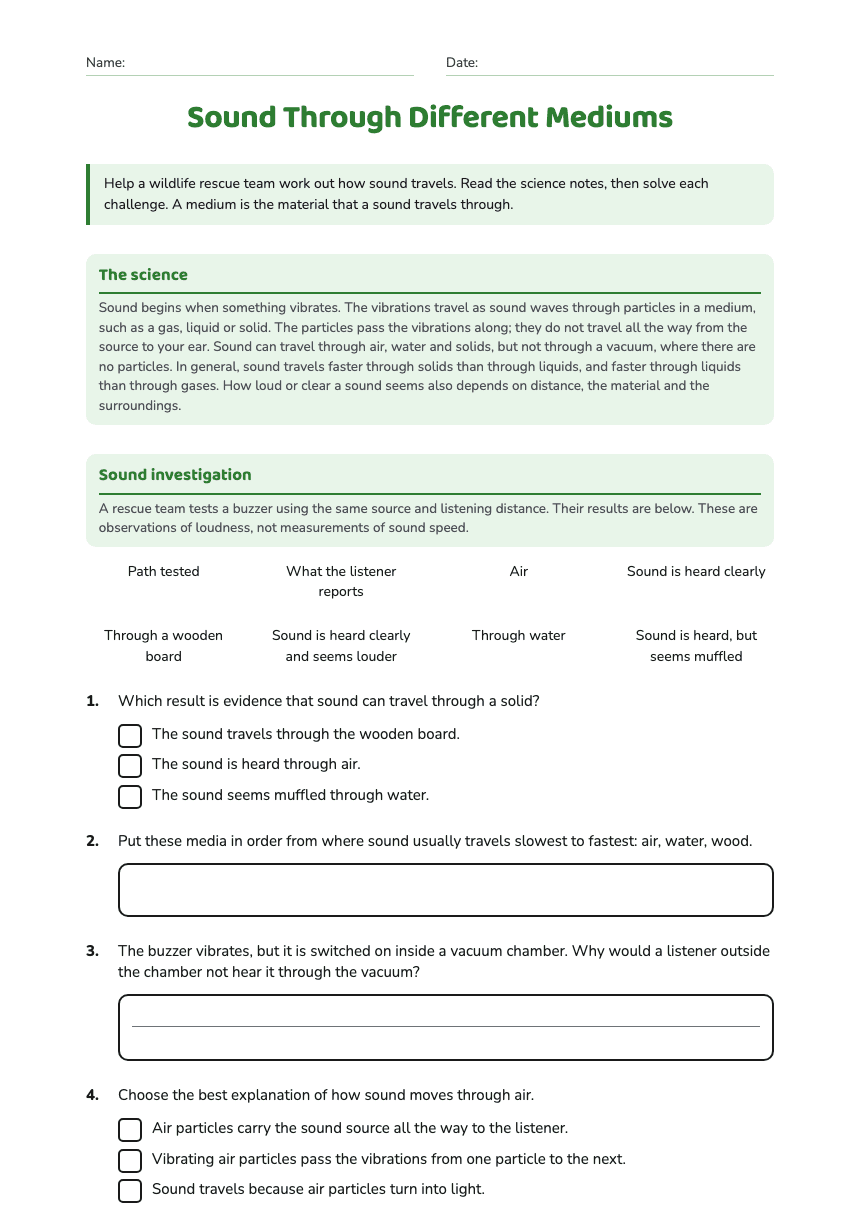
Sound begins when something vibrates. The vibrations travel as sound waves through particles in a medium, such as a gas, liquid or solid. The particles pass the vibrations along; they do not travel all the way from the source to your ear. Sound can travel through air, water and solids, but not through a vacuum, where there are no particles. In general, sound travels faster through solids than through liquids, and faster through liquids than through gases. How loud or clear a sound seems also depends on distance, the material and the surroundings.
Sound investigation
A rescue team tests a buzzer using the same source and listening distance. Their results are below. These are observations of loudness, not measurements of sound speed.
Path tested
What the listener reports
Air
Sound is heard clearly
Through a wooden board
Sound is heard clearly and seems louder
Through water
Sound is heard, but seems muffled
- The sound travels through the wooden board.
- The sound is heard through air.
- The sound seems muffled through water.
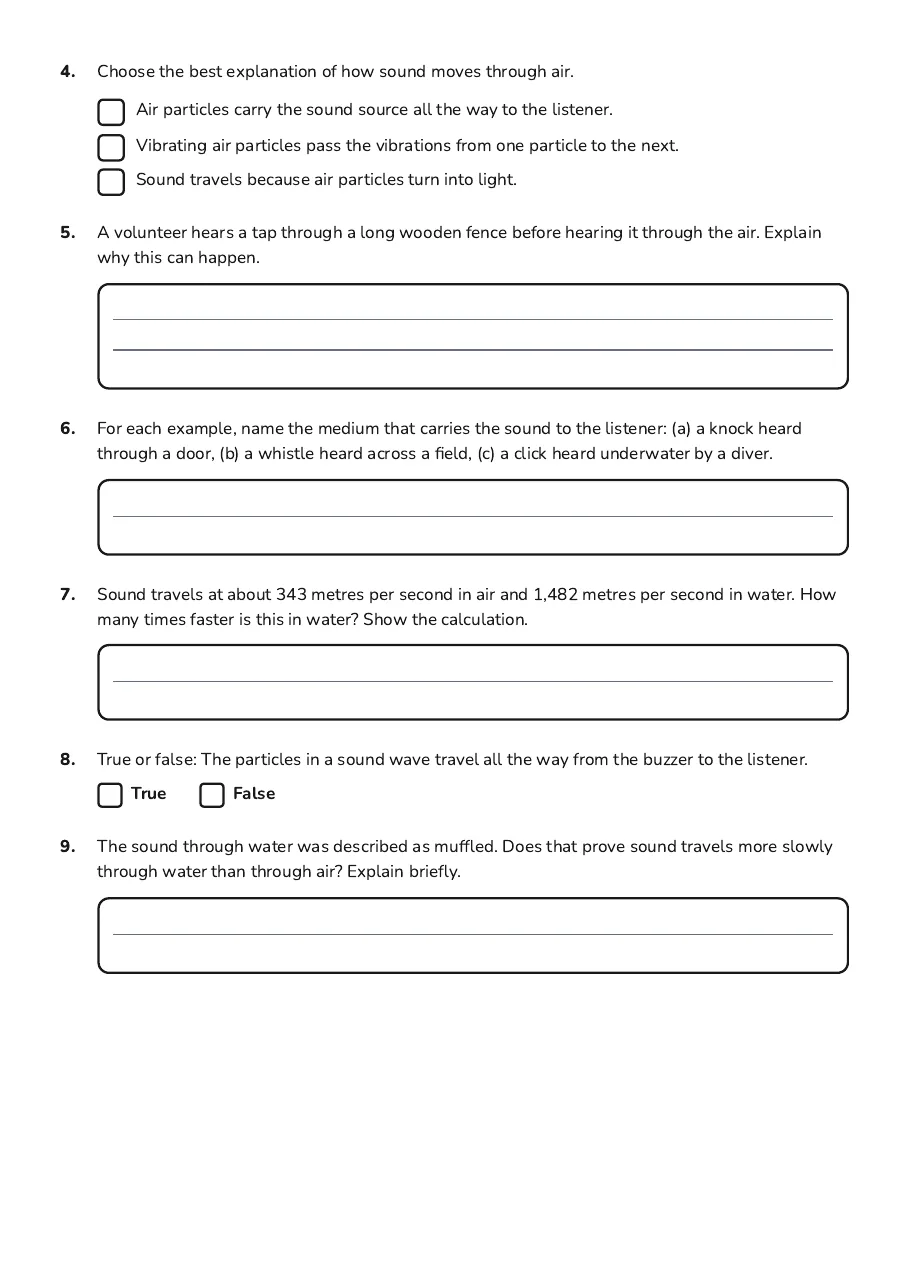
- Air particles carry the sound source all the way to the listener.
- Vibrating air particles pass the vibrations from one particle to the next.
- Sound travels because air particles turn into light.
3 printable pages
Page 1
Page 2

Page 3
About This Worksheet
Free in Kuraplan
Sign up free, grab the PDF, and customize it for your class.
Print-Ready
Formatted for standard paper. Clean layout, easy to read.
AI-Generated
Created with Kuraplan's AI, designed for real classroom use.
For Teachers & Parents
Use in classrooms, for homework, tutoring, or homeschool.
Need a custom version of this worksheet?
Kuraplan's AI generates custom worksheets in seconds — differentiated for every learner, aligned to your curriculum.
Generate Custom Worksheets — Free