Comparing Garment Industry Texts
A free english (ela) worksheet ready for your classroom. Open in Kuraplan to grab the print-ready PDF, customize it for your students, or generate a fresh version in seconds.
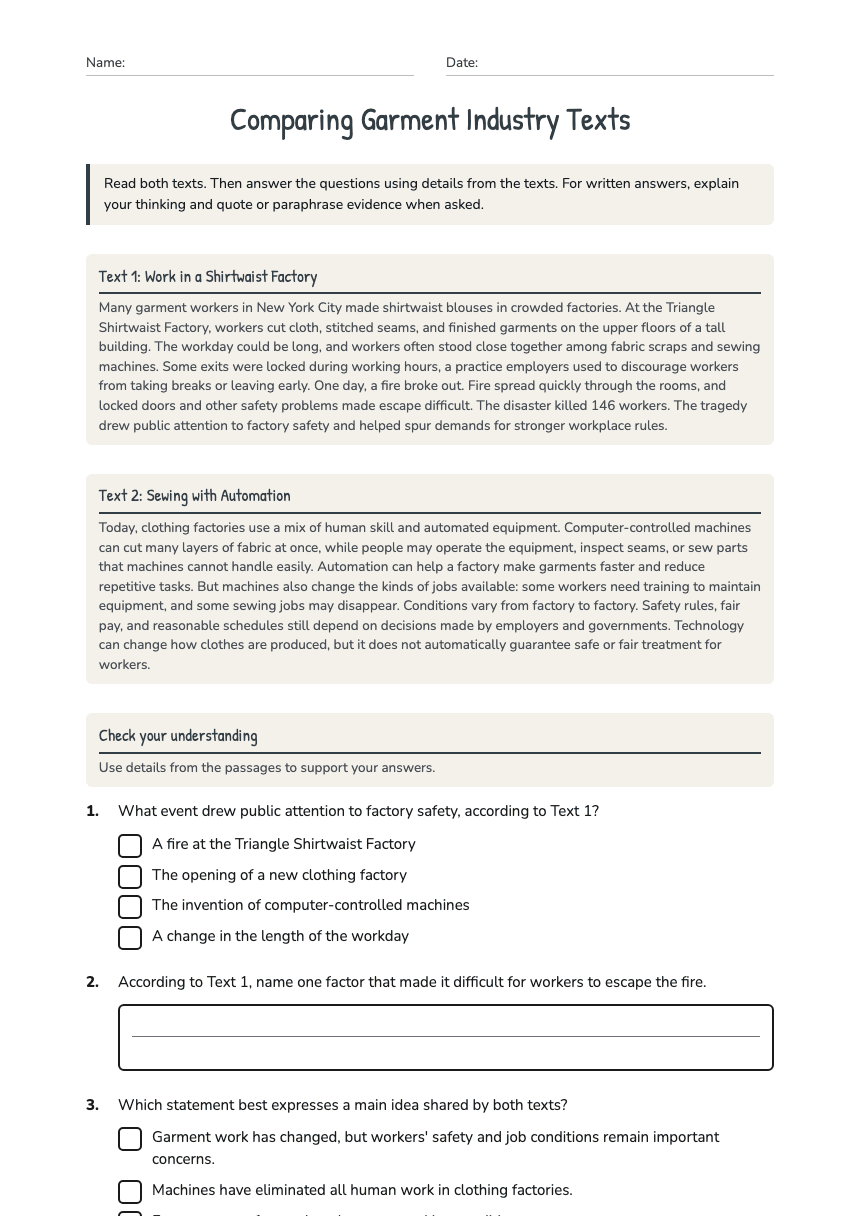
Comparing Garment Industry Texts
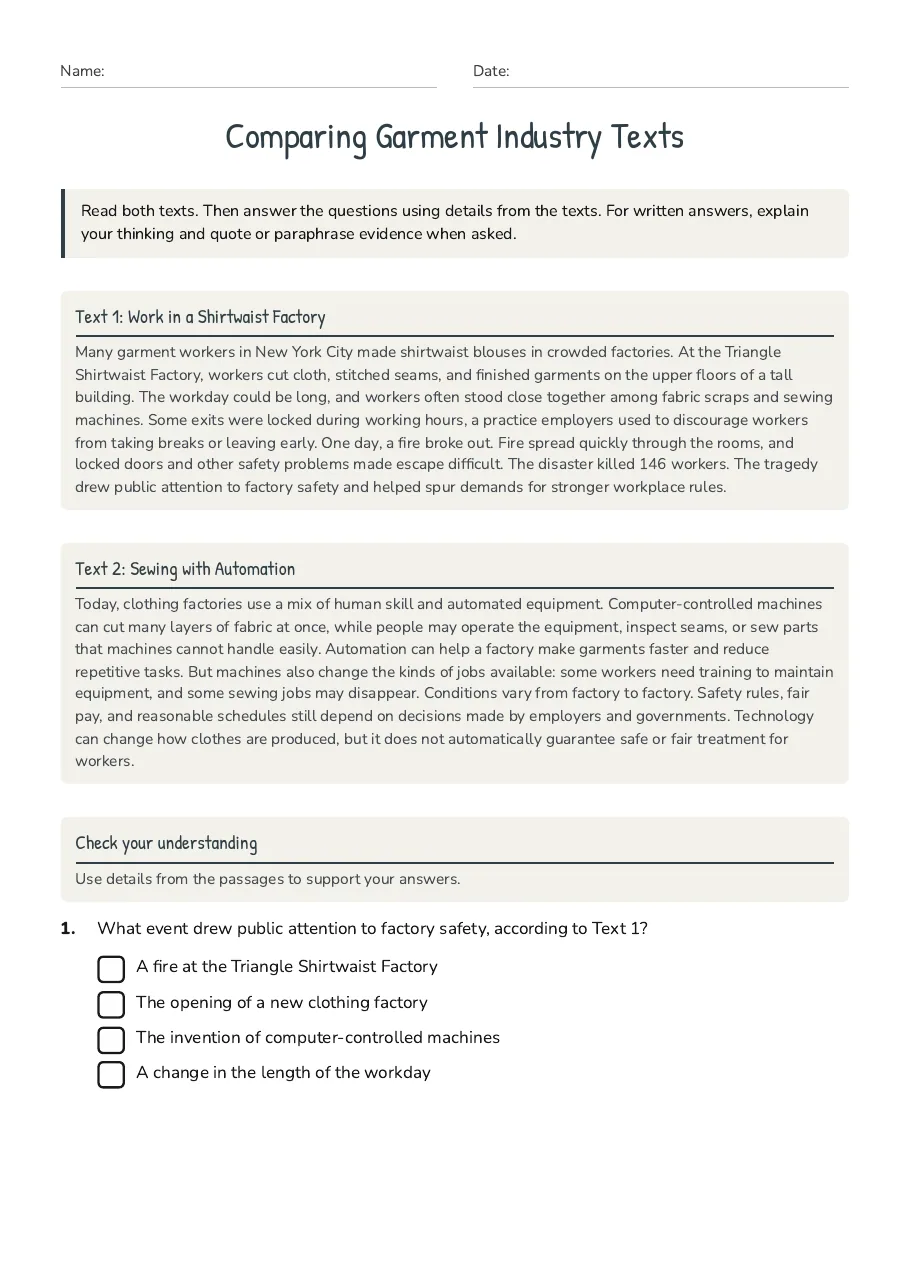
Text 1: Work in a Shirtwaist Factory
Many garment workers in New York City made shirtwaist blouses in crowded factories. At the Triangle Shirtwaist Factory, workers cut cloth, stitched seams, and finished garments on the upper floors of a tall building. The workday could be long, and workers often stood close together among fabric scraps and sewing machines. Some exits were locked during working hours, a practice employers used to discourage workers from taking breaks or leaving early. One day, a fire broke out. Fire spread quickly through the rooms, and locked doors and other safety problems made escape difficult. The disaster killed 146 workers. The tragedy drew public attention to factory safety and helped spur demands for stronger workplace rules.
Text 2: Sewing with Automation
Today, clothing factories use a mix of human skill and automated equipment. Computer-controlled machines can cut many layers of fabric at once, while people may operate the equipment, inspect seams, or sew parts that machines cannot handle easily. Automation can help a factory make garments faster and reduce repetitive tasks. But machines also change the kinds of jobs available: some workers need training to maintain equipment, and some sewing jobs may disappear. Conditions vary from factory to factory. Safety rules, fair pay, and reasonable schedules still depend on decisions made by employers and governments. Technology can change how clothes are produced, but it does not automatically guarantee safe or fair treatment for workers.
Check your understanding
Use details from the passages to support your answers.
- A fire at the Triangle Shirtwaist Factory
- The opening of a new clothing factory
- The invention of computer-controlled machines
- A change in the length of the workday
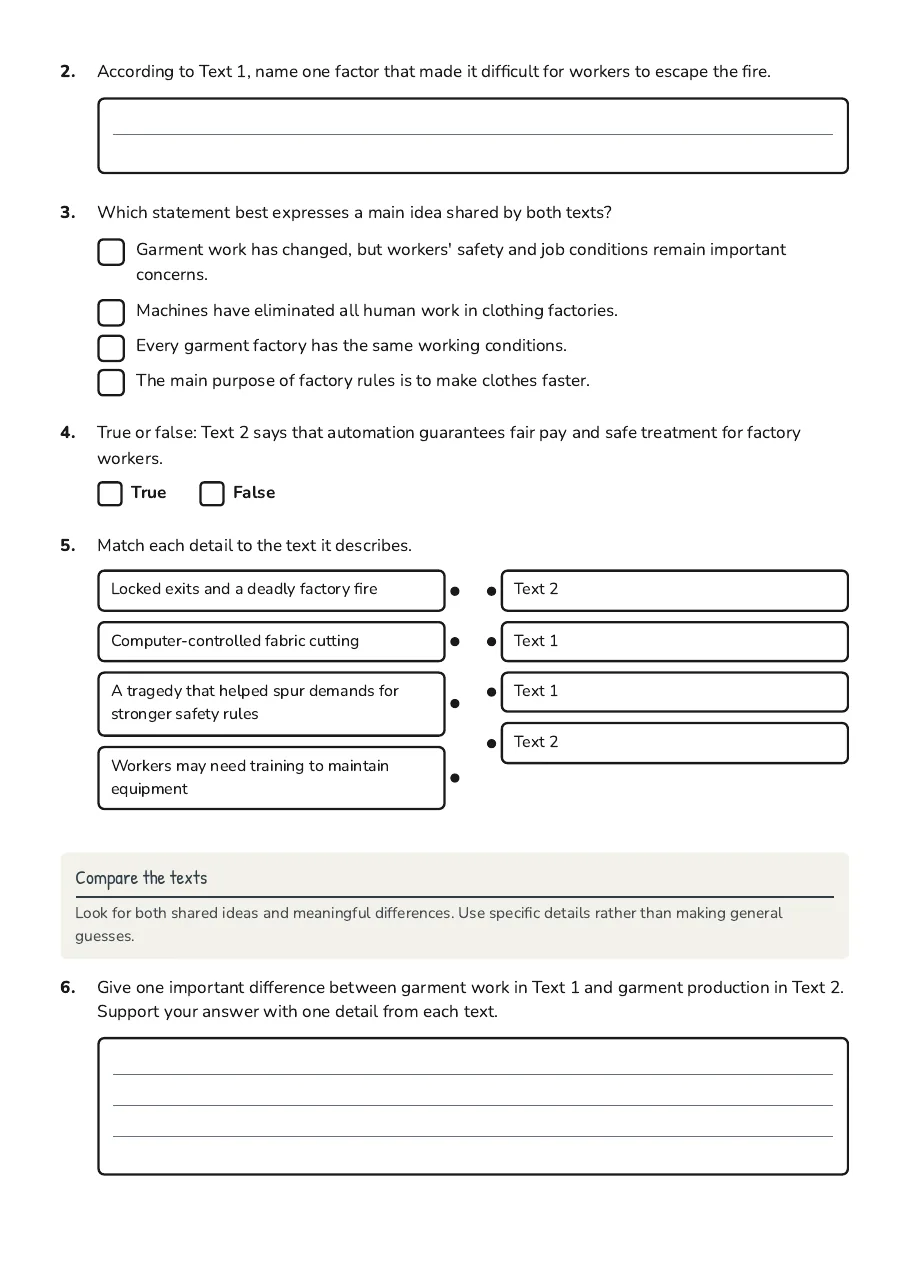
- Garment work has changed, but workers' safety and job conditions remain important concerns.
- Machines have eliminated all human work in clothing factories.
- Every garment factory has the same working conditions.
- The main purpose of factory rules is to make clothes faster.
- Locked exits and a deadly factory fire
- Computer-controlled fabric cutting
- A tragedy that helped spur demands for stronger safety rules
- Workers may need training to maintain equipment
- Text 2
- Text 1
- Text 1
- Text 2
Compare the texts
Look for both shared ideas and meaningful differences. Use specific details rather than making general guesses.
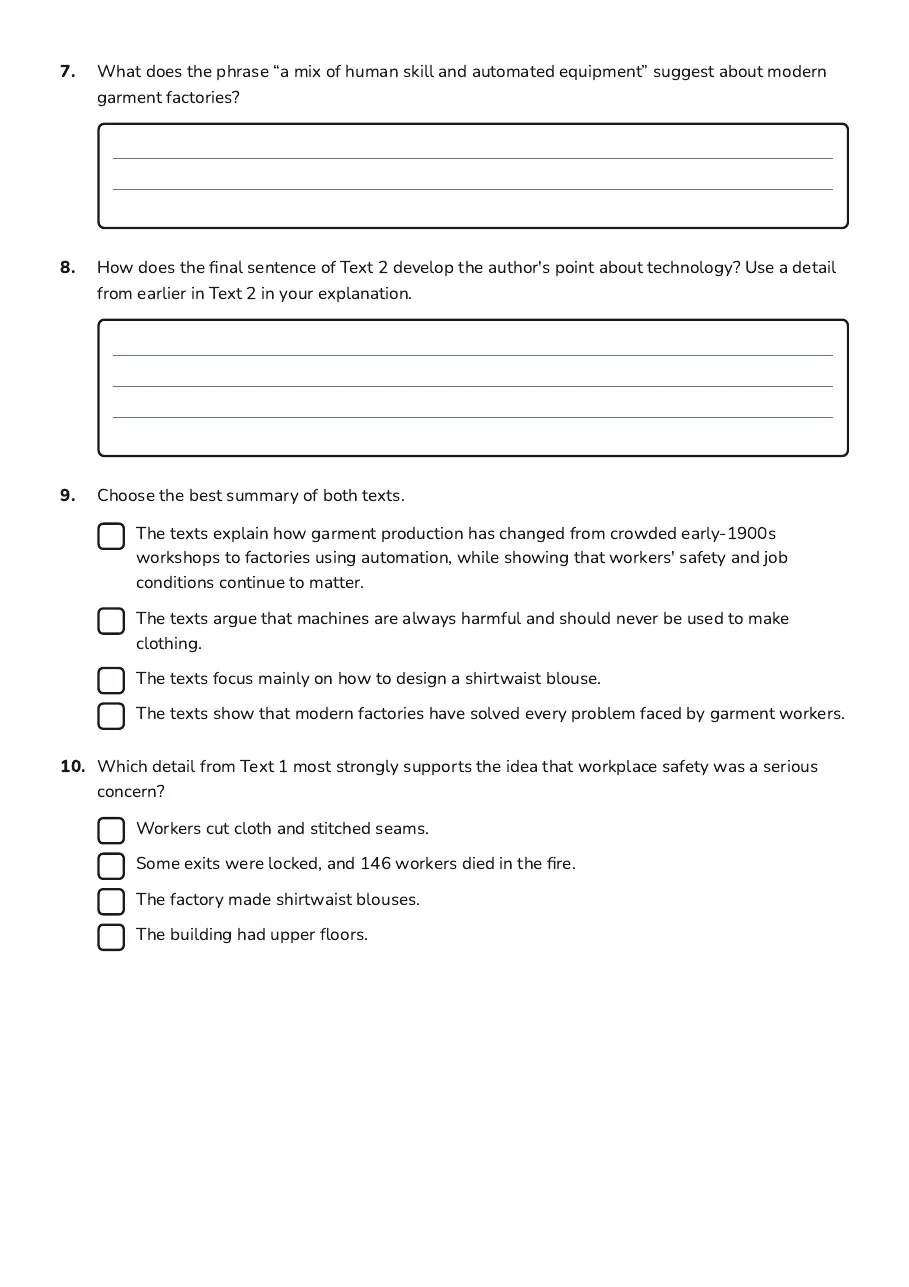
- The texts explain how garment production has changed from crowded early-1900s workshops to factories using automation, while showing that workers' safety and job conditions continue to matter.
- The texts argue that machines are always harmful and should never be used to make clothing.
- The texts focus mainly on how to design a shirtwaist blouse.
- The texts show that modern factories have solved every problem faced by garment workers.
- Workers cut cloth and stitched seams.
- Some exits were locked, and 146 workers died in the fire.
- The factory made shirtwaist blouses.
- The building had upper floors.
3 printable pages
Page 1
Page 2
Page 3
About This Worksheet
Free in Kuraplan
Sign up free, grab the PDF, and customize it for your class.
Print-Ready
Formatted for standard paper. Clean layout, easy to read.
AI-Generated
Created with Kuraplan's AI, designed for real classroom use.
For Teachers & Parents
Use in classrooms, for homework, tutoring, or homeschool.
Need a custom version of this worksheet?
Kuraplan's AI generates custom worksheets in seconds — differentiated for every learner, aligned to your curriculum.
Generate Custom Worksheets — Free