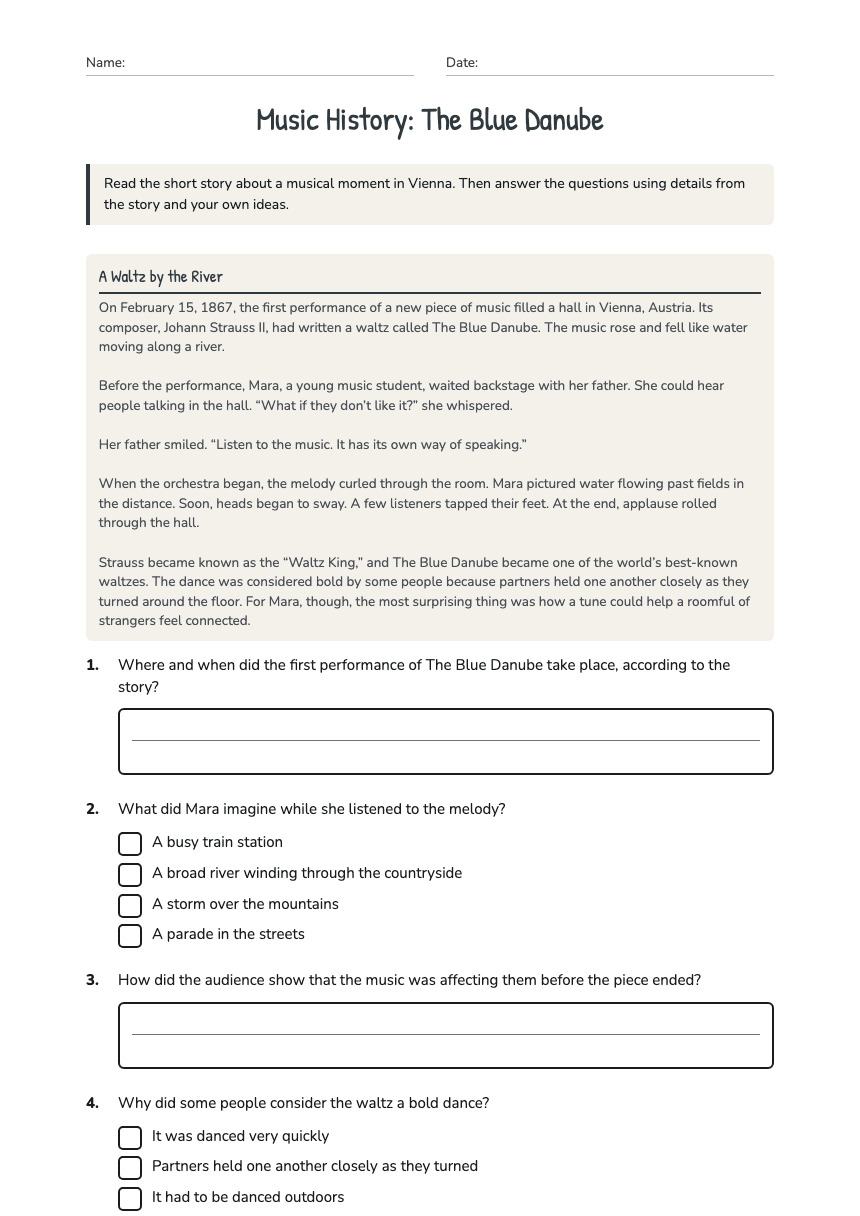
Music History: The Blue Danube
A free english (ela) worksheet ready for your classroom. Open in Kuraplan to grab the print-ready PDF, customize it for your students, or generate a fresh version in seconds.
Music History: The Blue Danube
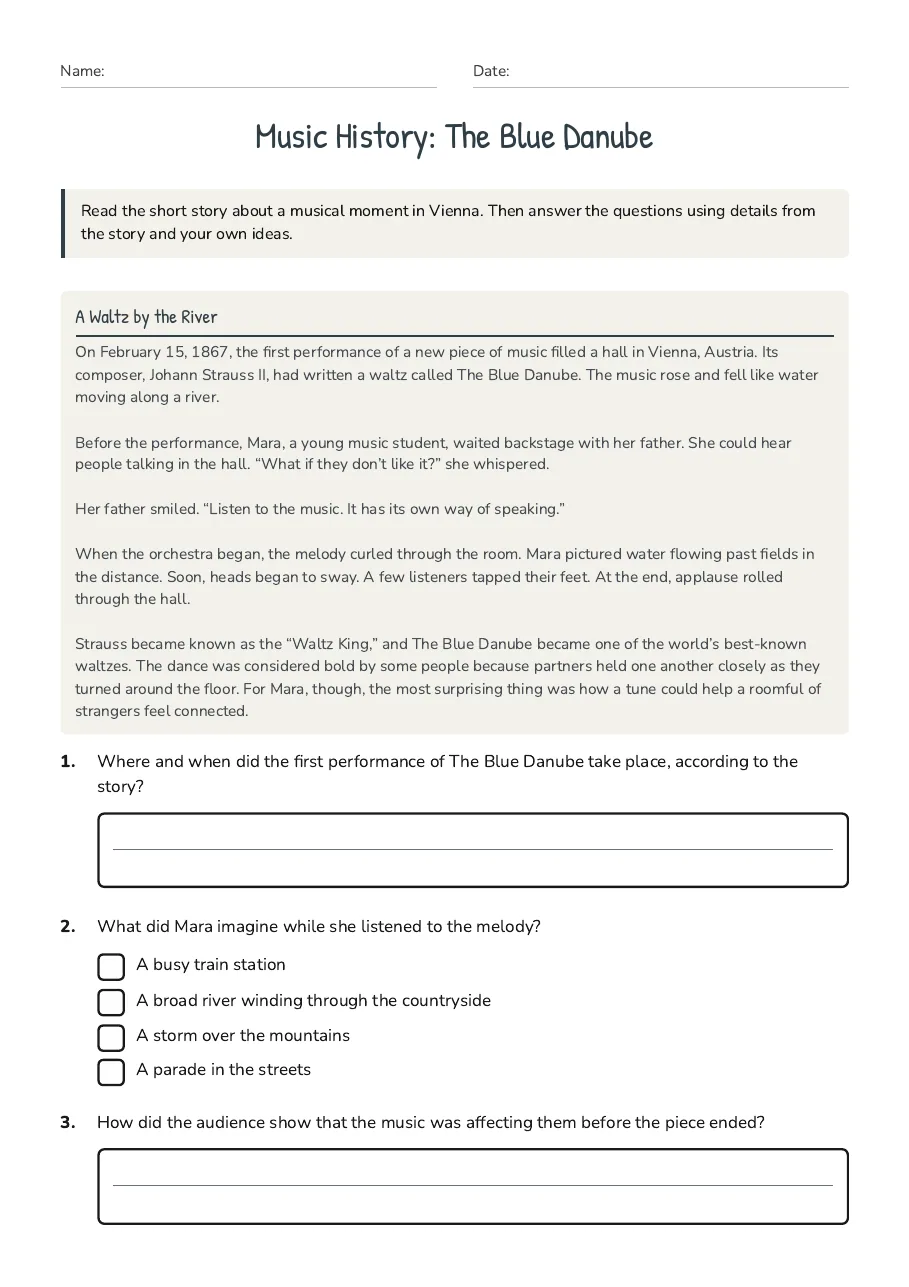
A Waltz by the River
On February 15, 1867, the first performance of a new piece of music filled a hall in Vienna, Austria. Its composer, Johann Strauss II, had written a waltz called The Blue Danube. The music rose and fell like water moving along a river. Before the performance, Mara, a young music student, waited backstage with her father. She could hear people talking in the hall. “What if they don’t like it?” she whispered. Her father smiled. “Listen to the music. It has its own way of speaking.” When the orchestra began, the melody curled through the room. Mara pictured water flowing past fields in the distance. Soon, heads began to sway. A few listeners tapped their feet. At the end, applause rolled through the hall. Strauss became known as the “Waltz King,” and The Blue Danube became one of the world’s best-known waltzes. The dance was considered bold by some people because partners held one another closely as they turned around the floor. For Mara, though, the most surprising thing was how a tune could help a roomful of strangers feel connected.
- A busy train station
- A broad river winding through the countryside
- A storm over the mountains
- A parade in the streets
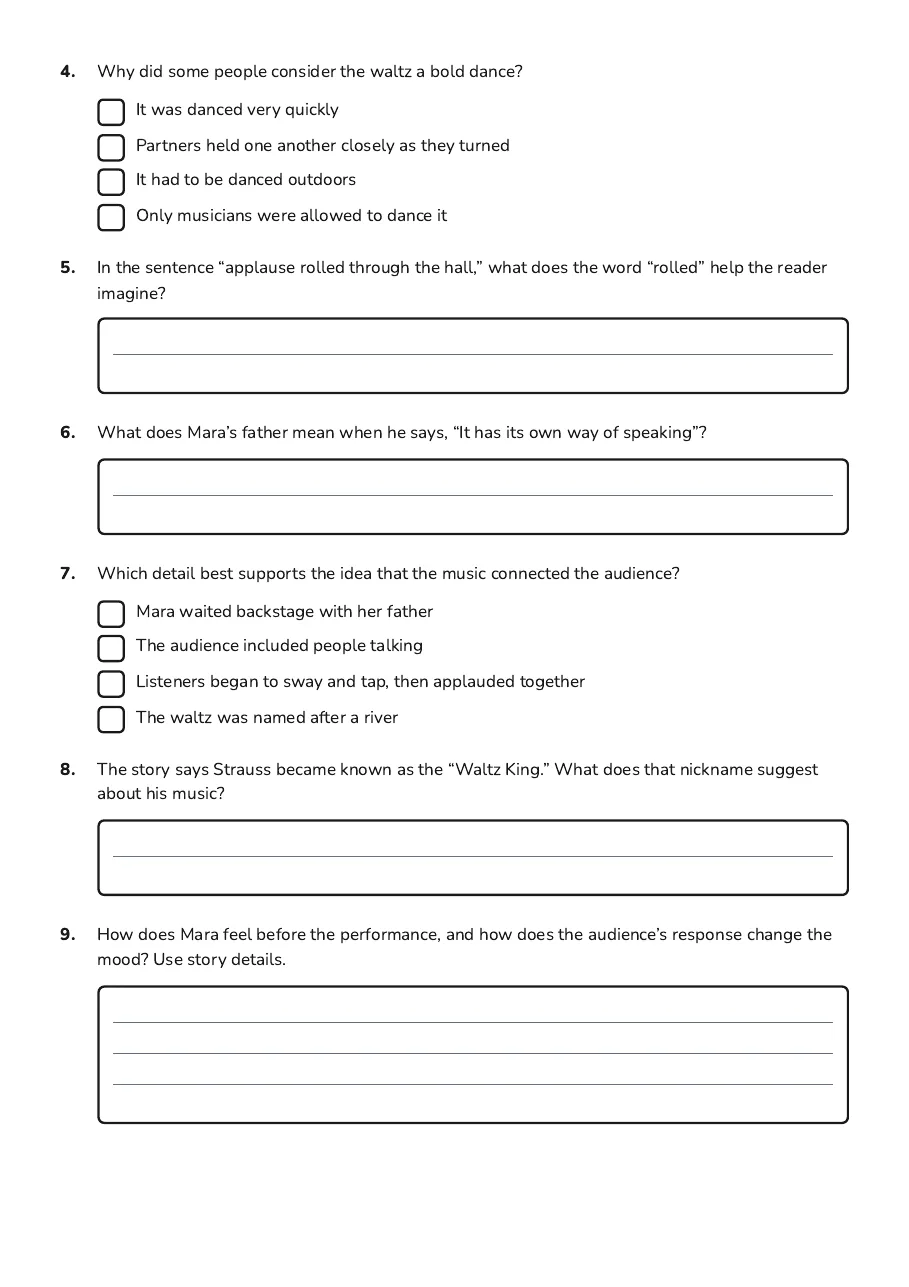
- It was danced very quickly
- Partners held one another closely as they turned
- It had to be danced outdoors
- Only musicians were allowed to dance it
- Mara waited backstage with her father
- The audience included people talking
- Listeners began to sway and tap, then applauded together
- The waltz was named after a river
3 printable pages
Page 1
Page 2

Page 3
About This Worksheet
Free in Kuraplan
Sign up free, grab the PDF, and customize it for your class.
Print-Ready
Formatted for standard paper. Clean layout, easy to read.
AI-Generated
Created with Kuraplan's AI, designed for real classroom use.
For Teachers & Parents
Use in classrooms, for homework, tutoring, or homeschool.
Need a custom version of this worksheet?
Kuraplan's AI generates custom worksheets in seconds — differentiated for every learner, aligned to your curriculum.
Generate Custom Worksheets — Free