Manifest Destiny Perspectives
A free us history worksheet ready for your classroom. Open in Kuraplan to grab the print-ready PDF, customize it for your students, or generate a fresh version in seconds.
Manifest Destiny Perspectives
📚 Part 1: Document Analysis
Document A: The Ideology
Source: John O'Sullivan, "Annexation," The United States Magazine and Democratic Review, July 1845.
Context: O'Sullivan is a New York journalist justifying why the United States should annex Texas and Oregon.
"Texas is now ours... Her star and her stripe may already be said to have taken their place in the glorious band of our nationality. Why were we delayed so long? It was because other nations tried to interfere with us, attempting to check the fulfillment of our manifest destiny [clear, obvious future] to overspread the continent allotted by Providence [God's care or will] for the free development of our yearly multiplying millions.
This expansion is a right such as a tree has to the space of air and the earth suitable for the full growth of its nature. We are entering on our untrodden space, with the truths of God in our minds. We are the nation of human progress, and who will, what can, set limits to our onward march? It is our destiny to establish on earth the noblest temple of liberty and rights."
Document B: The Local Reality
Source: Luzena Stanley Wilson, '49er: Memories of Gold Rush Days, written later in life recounting her arrival in Sacramento, California, in 1849.
"The gold was entirely a secondary consideration with us. We wanted to see the great West, and find a home where we could prosper. When we arrived, the influx [flooding in] of population was wonderful. Within a few months, a canvas city of tents grew into a bustling town of wood houses.
Hotels, stores, and markets sprang up overnight to feed the thousands of men seeking their fortunes. Energy and enterprise [business ambition] were in the air. Men worked with a feverish strength, building roads, digging canals, and creating laws out of nothing. It felt as though a new civilization, built on hard work and democratic equality, was born in a single day. Every man, no matter how poor he started, had a chance to become a millionaire by his own labor. It was a sight that made me proud to be an American."
📖 Part 2: Contrasting Perspectives
Document C: The Displaced Sovereign
Source: Chief William Shaw, a leader of the Miwok people of California's Central Valley, from an interview/account recorded by early California settlers and historians regarding the 1840s/1850s.
"The white men came like a fierce flood that could not be stopped. They did not ask for permission; they simply took. They dug up the earth, muddied the clear mountain rivers where the salmon swam, and cut down the ancient oak trees that gave our families our sustenance [food and survival] of acorns.
Where our villages stood for generations, they built their wooden towns and fenced off the land. They brought diseases that made our children die, and if our young men tried to hunt the cattle they brought onto our lands, they called us thieves and shot us. To the white man, the gold was a blessing. To us, the gold was a malignant [evil, destructive] curse that completely destroyed our world, our laws, and our way of living."
Document D: The Legal Conquest
Source: Excerpts from An Act for the Government and Protection of Indians, passed by the first California State Legislature on April 22, 1850.
"Section 3: Any white person may go before a Justice of the Peace and obtain the care, custody, and control of any Indian child, next of kin consenting... and the person having such child shall properly feed, clothe, and humanely treat him or her.
Section 6: In no case shall a white man be convicted of any offense upon the testimony of an Indian.
Section 20: Any Indian found loitering or strolling about, without any visible means of support, or living an immoral life, may be arrested; and it shall be the duty of the judge to hire out such Indian to the highest bidder, for public or private work, for any term not exceeding four months, for the purpose of making them work."
✏️ Part 3: Critical Analysis
About This Worksheet
Free in Kuraplan
Sign up free, grab the PDF, and customize it for your class.
Print-Ready
Formatted for standard paper. Clean layout, easy to read.
AI-Generated
Created with Kuraplan's AI, designed for real classroom use.
For Teachers & Parents
Use in classrooms, for homework, tutoring, or homeschool.
Need a custom version of this worksheet?
Kuraplan's AI generates custom worksheets in seconds — differentiated for every learner, aligned to your curriculum.
Generate Custom Worksheets — FreeMore US History Worksheets
Washington Jefferson Political Legacy
Free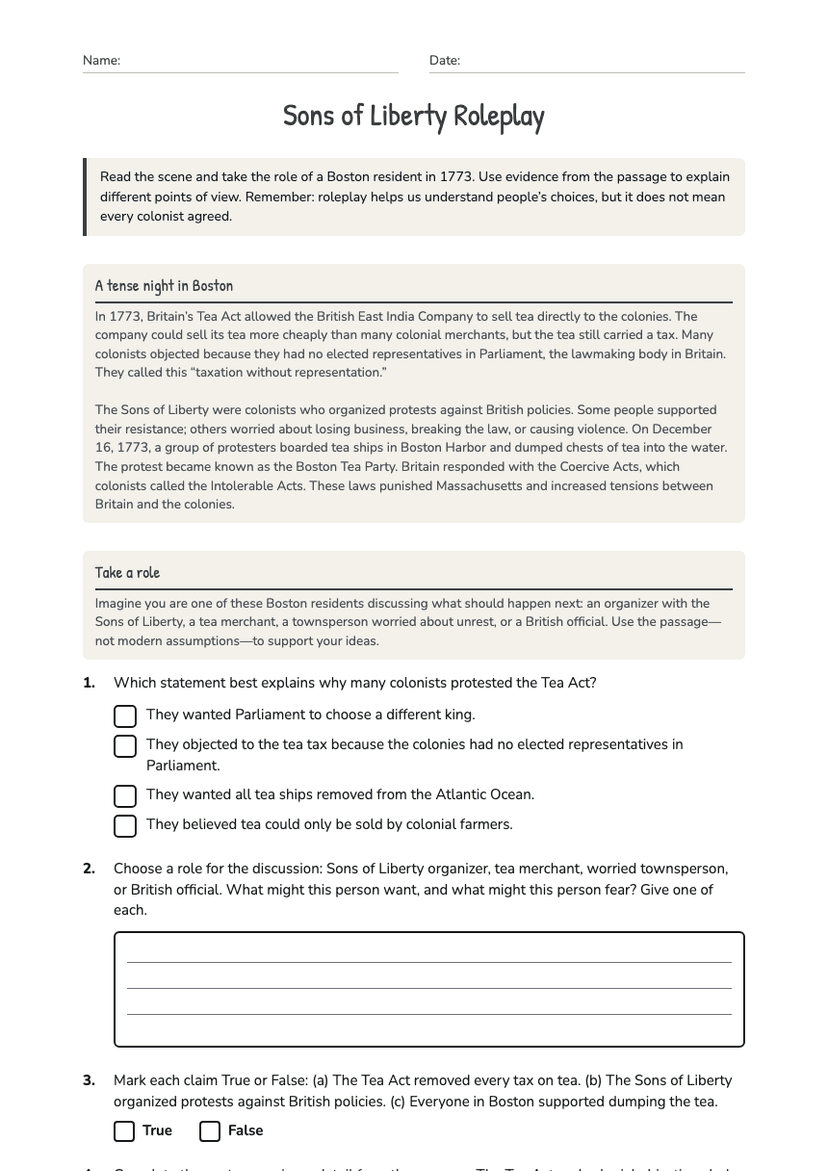
Sons of Liberty Roleplay
Free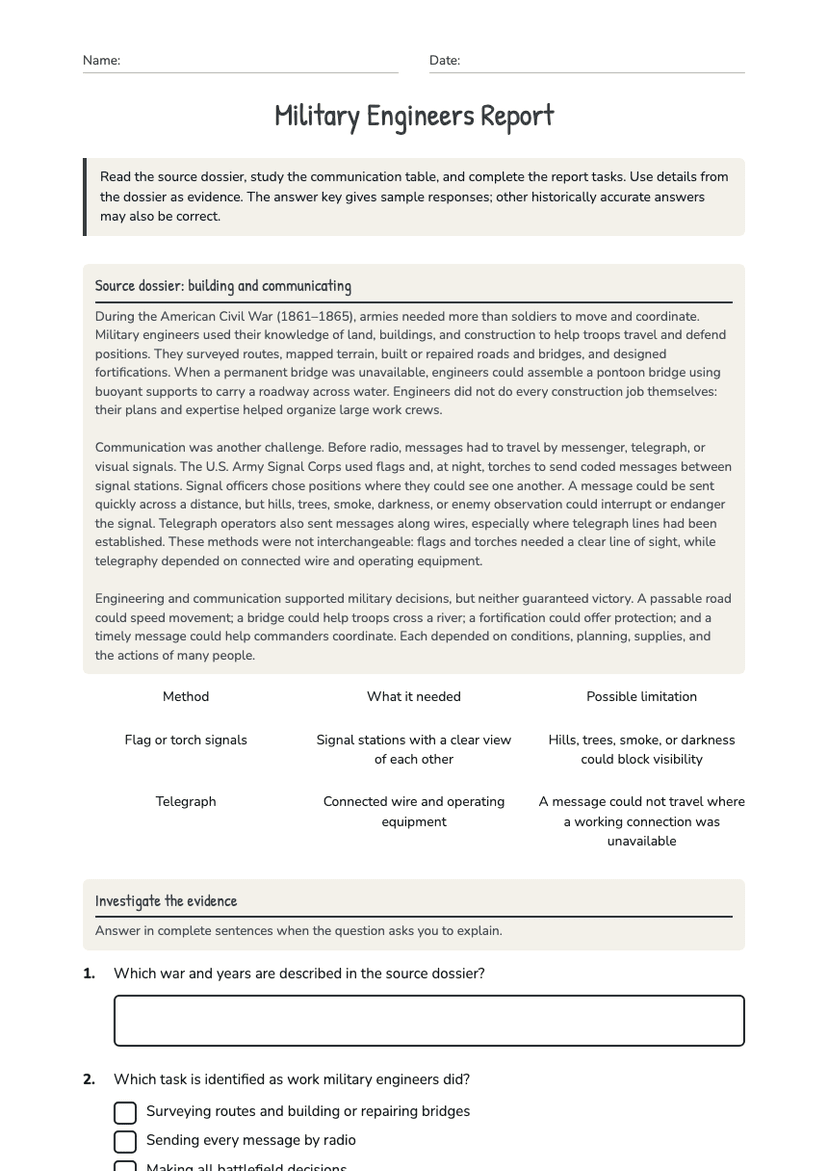
Military Engineers Report
Free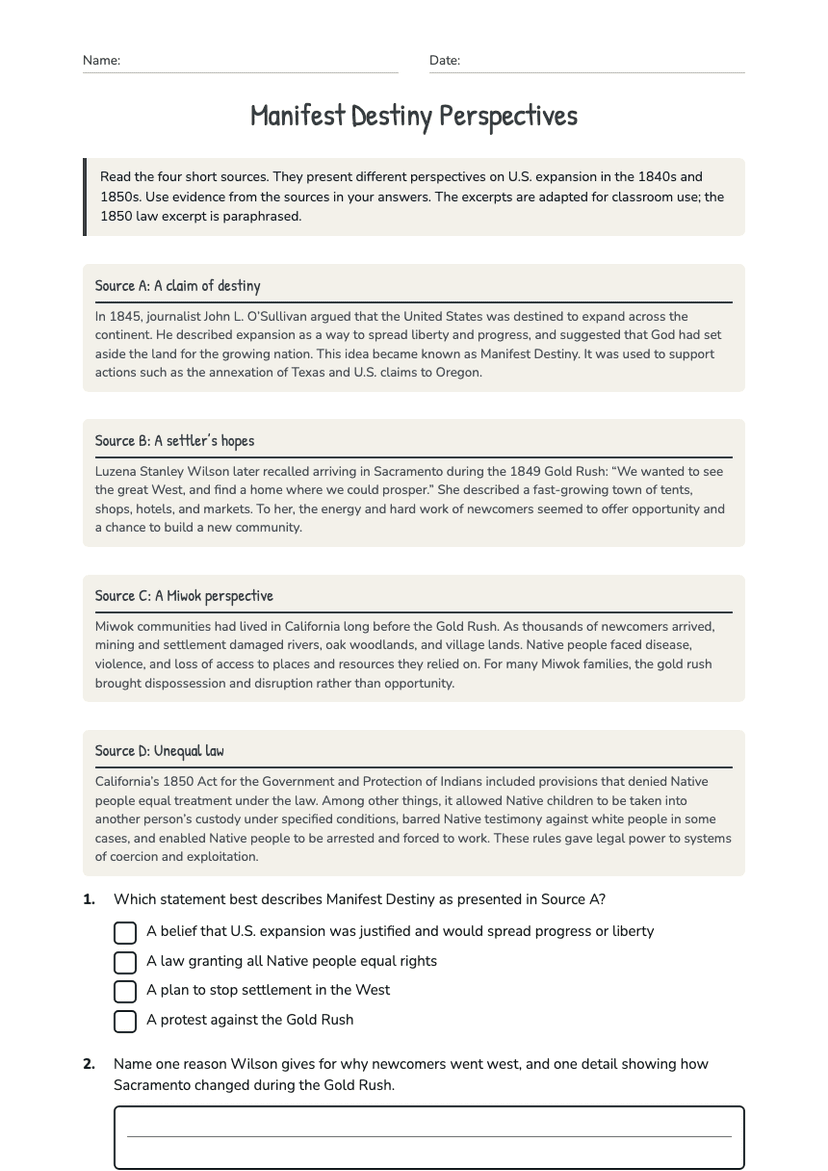
Manifest Destiny Perspectives
Free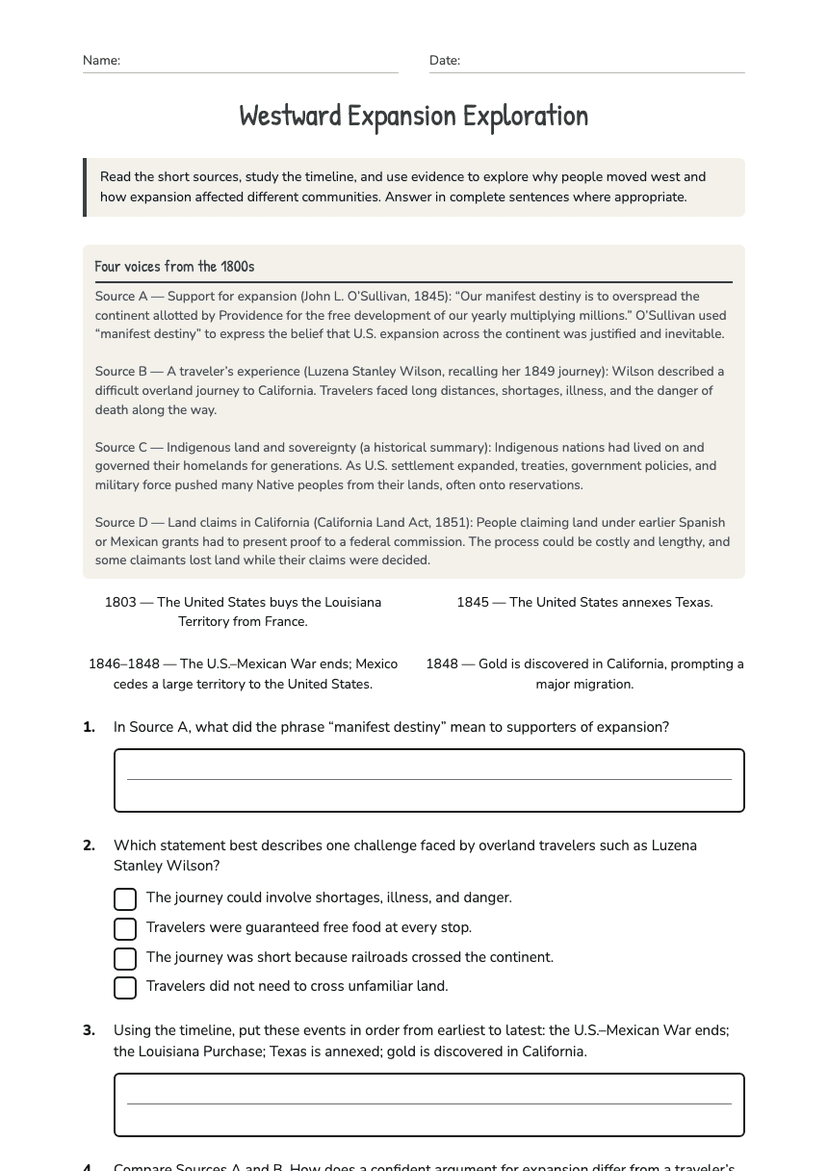
Westward Expansion Exploration
Free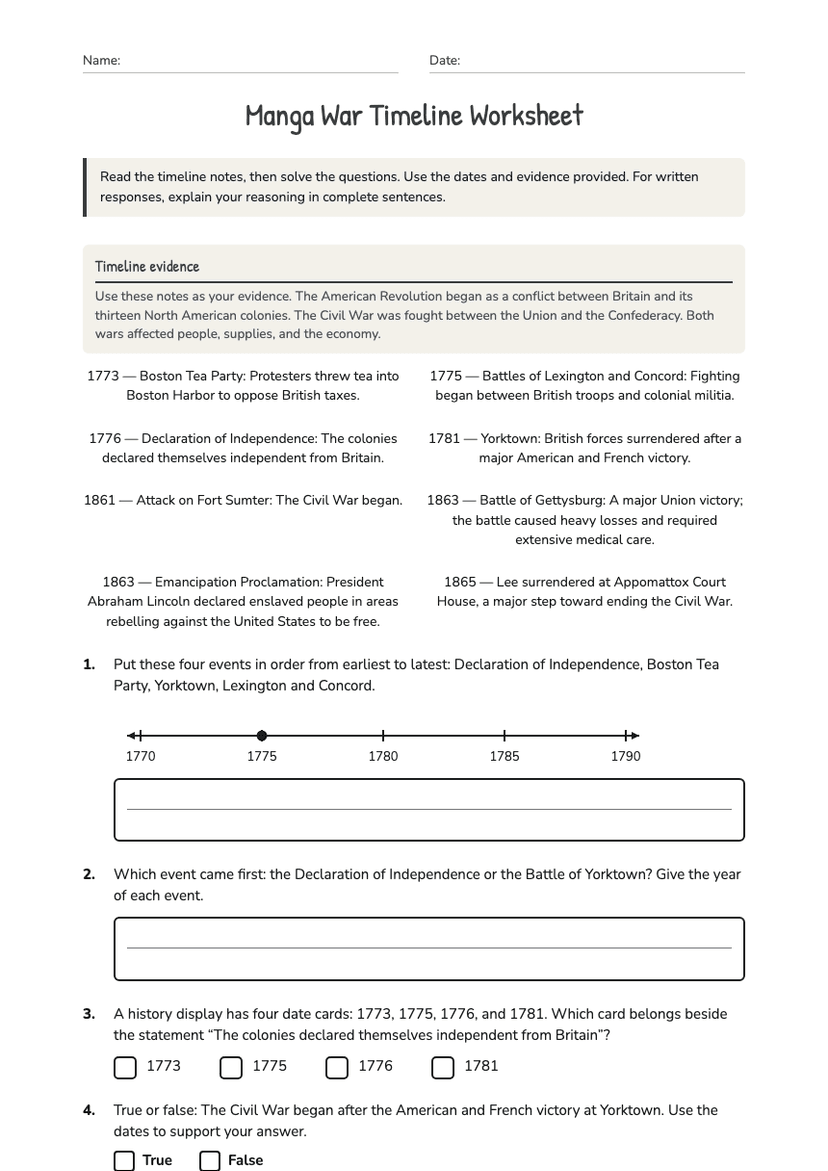
Manga War Timeline Worksheet
Free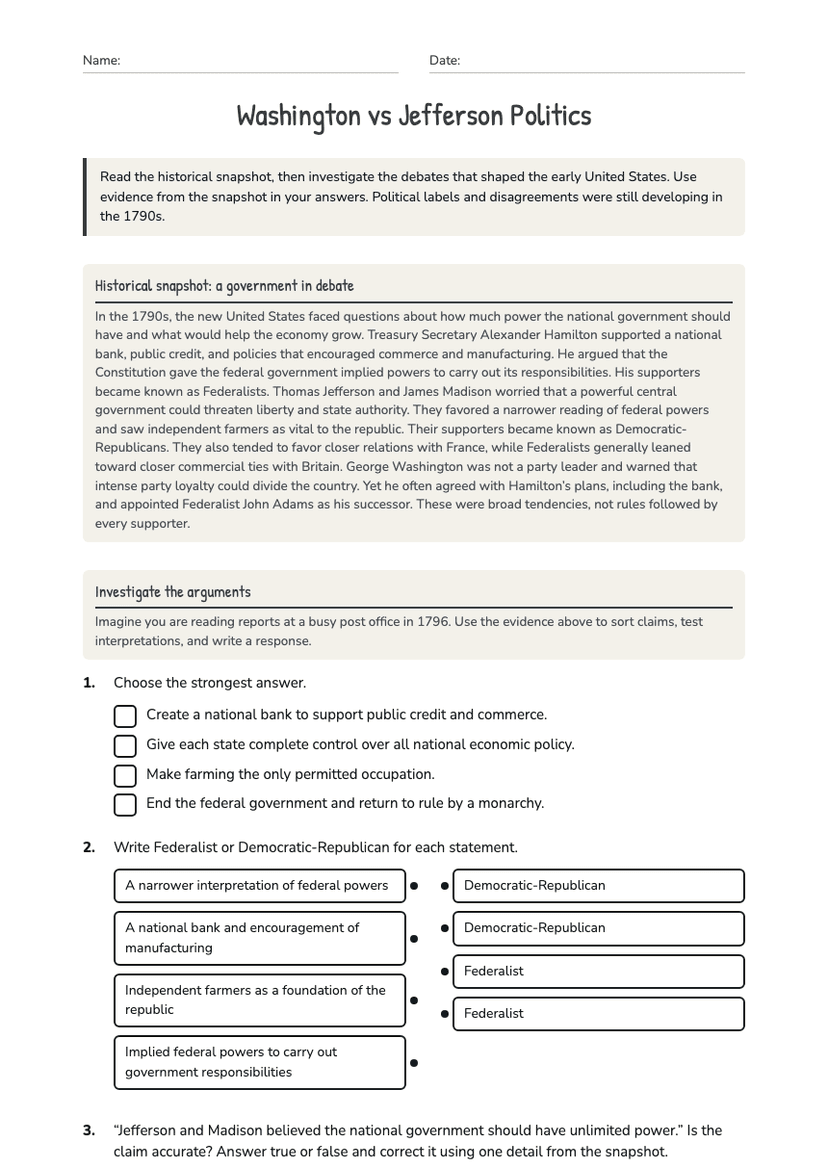
Washington vs Jefferson Politics
Free