Tattooist of Auschwitz Analysis
A free english (ela) worksheet ready for your classroom. Open in Kuraplan to grab the print-ready PDF, customize it for your students, or generate a fresh version in seconds.
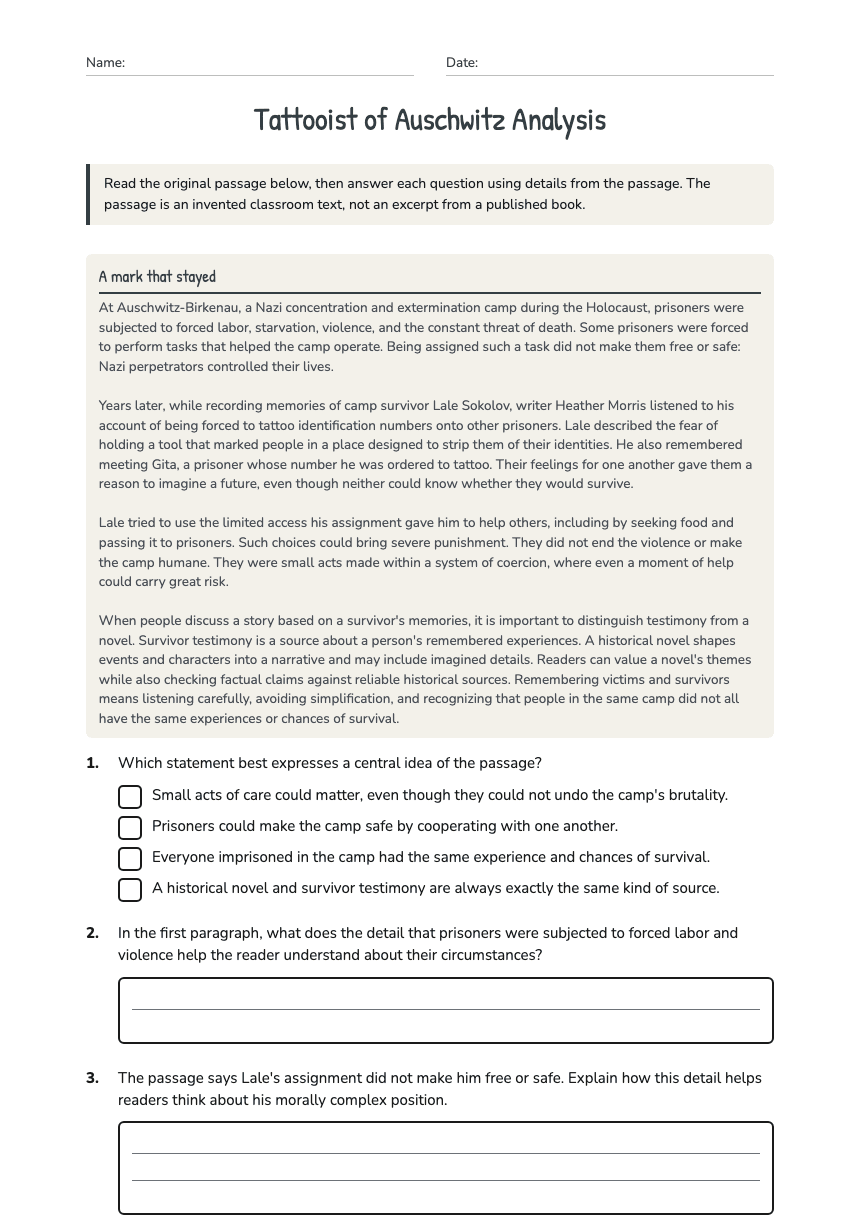
Tattooist of Auschwitz Analysis
A mark that stayed
At Auschwitz-Birkenau, a Nazi concentration and extermination camp during the Holocaust, prisoners were subjected to forced labor, starvation, violence, and the constant threat of death. Some prisoners were forced to perform tasks that helped the camp operate. Being assigned such a task did not make them free or safe: Nazi perpetrators controlled their lives. Years later, while recording memories of camp survivor Lale Sokolov, writer Heather Morris listened to his account of being forced to tattoo identification numbers onto other prisoners. Lale described the fear of holding a tool that marked people in a place designed to strip them of their identities. He also remembered meeting Gita, a prisoner whose number he was ordered to tattoo. Their feelings for one another gave them a reason to imagine a future, even though neither could know whether they would survive. Lale tried to use the limited access his assignment gave him to help others, including by seeking food and passing it to prisoners. Such choices could bring severe punishment. They did not end the violence or make the camp humane. They were small acts made within a system of coercion, where even a moment of help could carry great risk. When people discuss a story based on a survivor's memories, it is important to distinguish testimony from a novel. Survivor testimony is a source about a person's remembered experiences. A historical novel shapes events and characters into a narrative and may include imagined details. Readers can value a novel's themes while also checking factual claims against reliable historical sources. Remembering victims and survivors means listening carefully, avoiding simplification, and recognizing that people in the same camp did not all have the same experiences or chances of survival.
- Small acts of care could matter, even though they could not undo the camp's brutality.
- Prisoners could make the camp safe by cooperating with one another.
- Everyone imprisoned in the camp had the same experience and chances of survival.
- A historical novel and survivor testimony are always exactly the same kind of source.
- Their feelings gave them a reason to imagine a future despite uncertainty.
- Their relationship guaranteed that they would both survive.
- Their relationship allowed them to stop the camp's violence.
- Their feelings meant they no longer feared what might happen.
3 printable pages
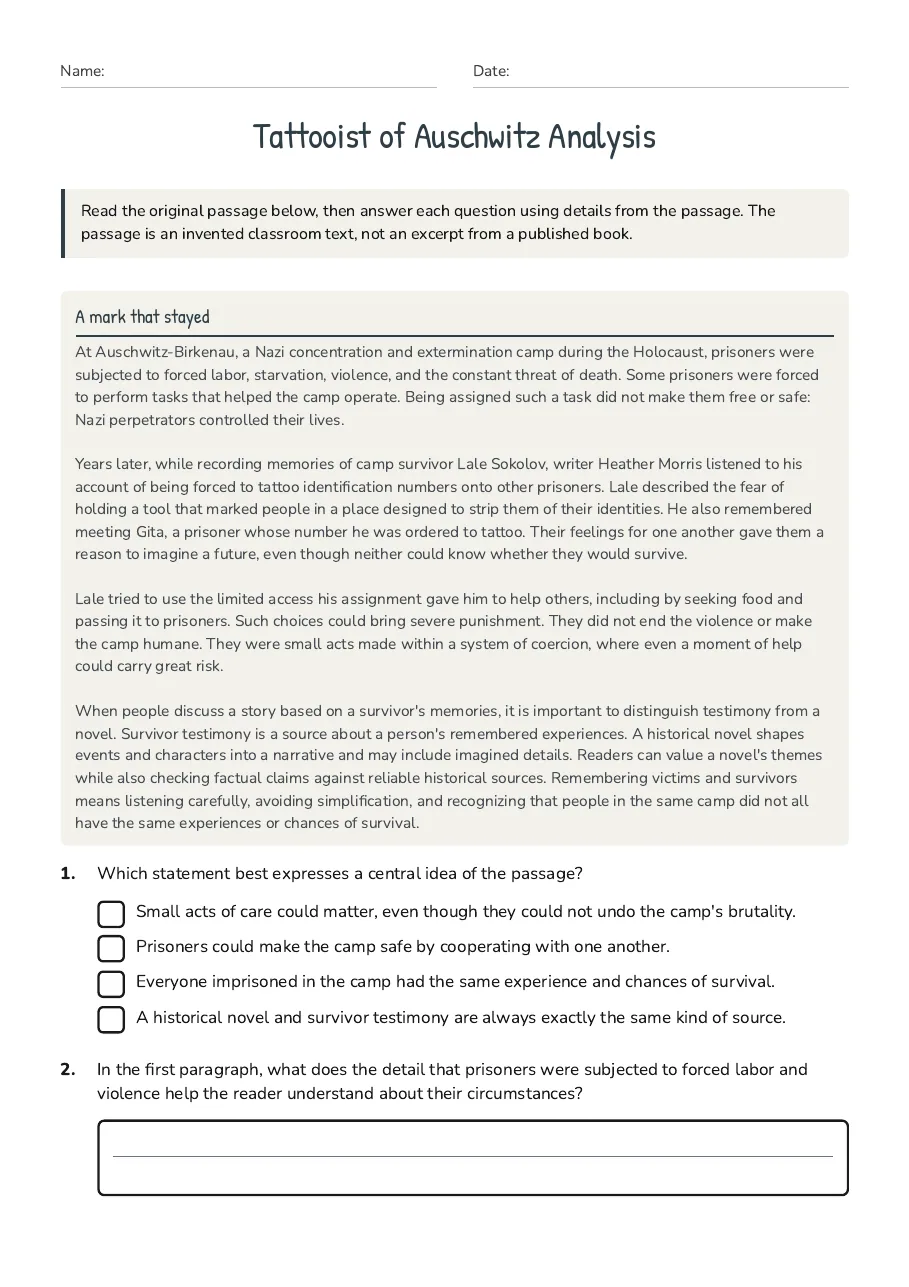
Page 1
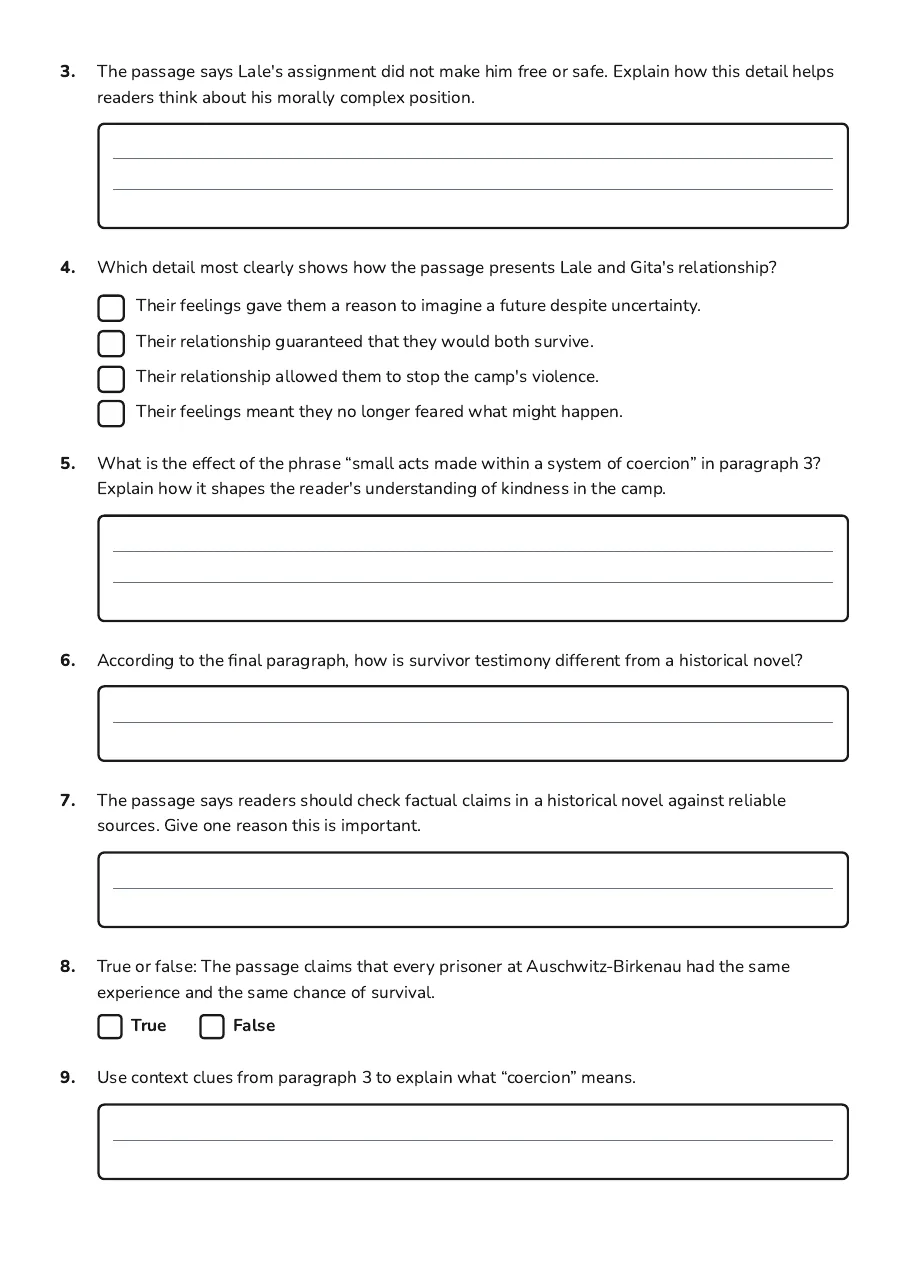
Page 2

Page 3
About This Worksheet
Free in Kuraplan
Sign up free, grab the PDF, and customize it for your class.
Print-Ready
Formatted for standard paper. Clean layout, easy to read.
AI-Generated
Created with Kuraplan's AI, designed for real classroom use.
For Teachers & Parents
Use in classrooms, for homework, tutoring, or homeschool.
Need a custom version of this worksheet?
Kuraplan's AI generates custom worksheets in seconds — differentiated for every learner, aligned to your curriculum.
Generate Custom Worksheets — Free