ScienceFreePrintable

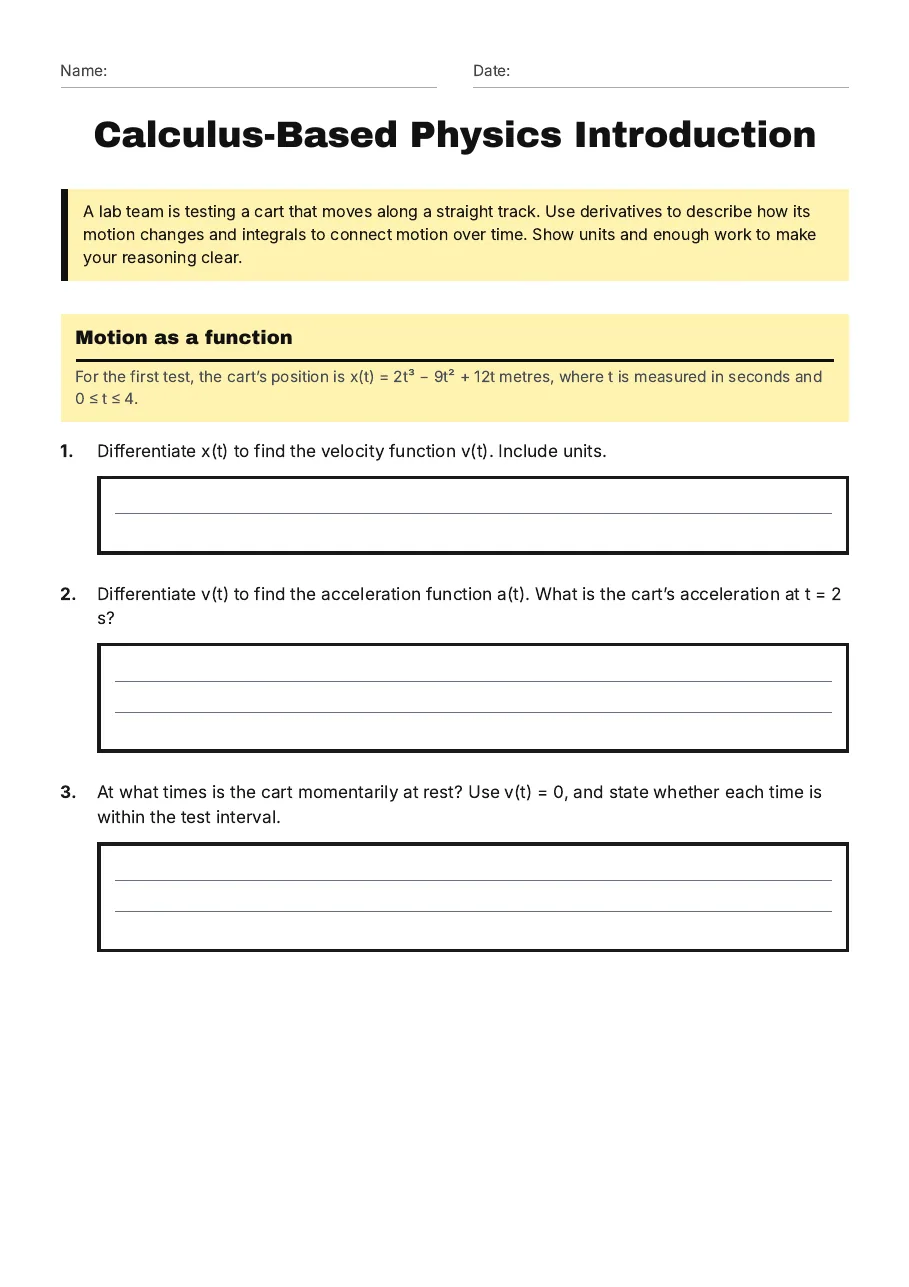
Calculus-Based Physics Introduction

A free science worksheet ready for your classroom. Open in Kuraplan to grab the print-ready PDF, customize it for your students, or generate a fresh version in seconds.
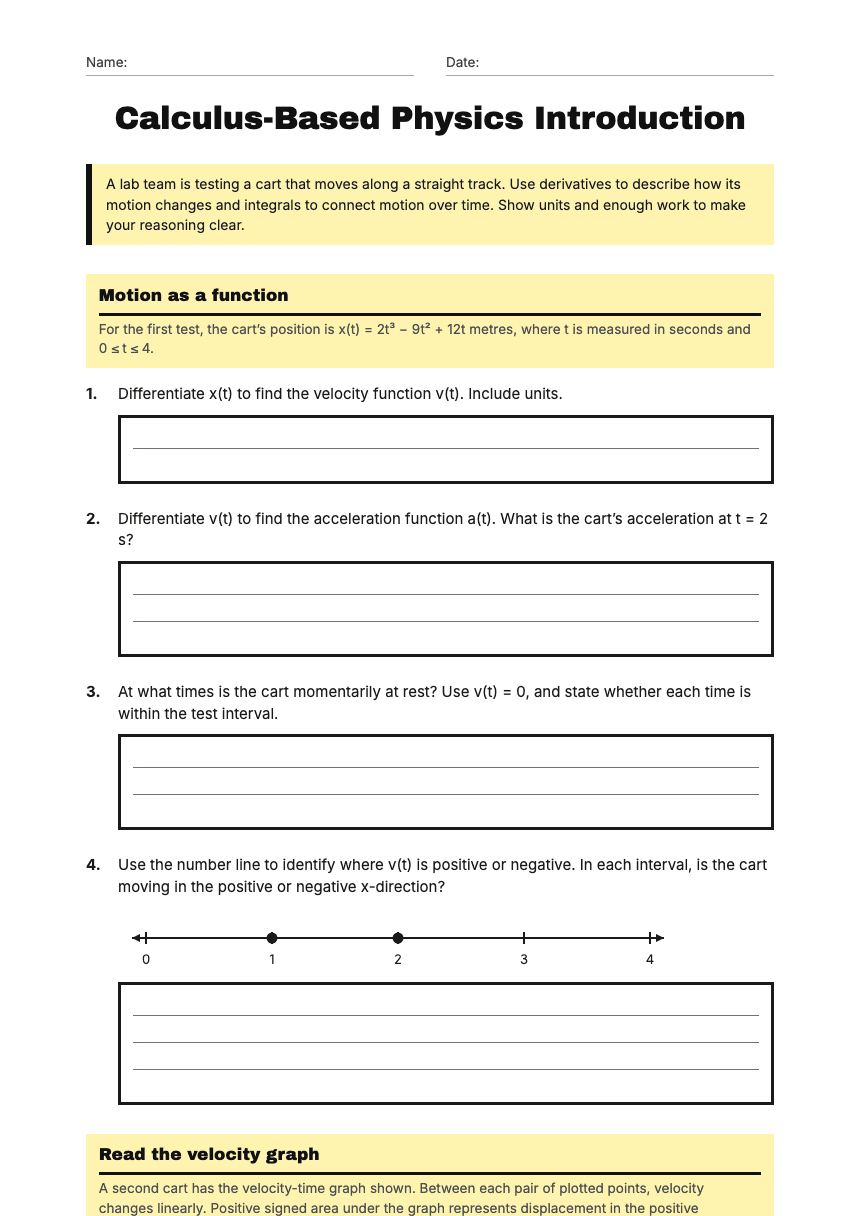
Calculus-Based Physics Introduction worksheet preview
Name:Date:

Calculus-Based Physics Introduction

A lab team is testing a cart that moves along a straight track. Use derivatives to describe how its motion changes and integrals to connect motion over time. Show units and enough work to make your reasoning clear.

Motion as a function

For the first test, the cart’s position is x(t) = 2t³ − 9t² + 12t metres, where t is measured in seconds and 0 ≤ t ≤ 4.

1.Differentiate x(t) to find the velocity function v(t). Include units.
2.Differentiate v(t) to find the acceleration function a(t). What is the cart’s acceleration at t = 2 s?
3.At what times is the cart momentarily at rest? Use v(t) = 0, and state whether each time is within the test interval.
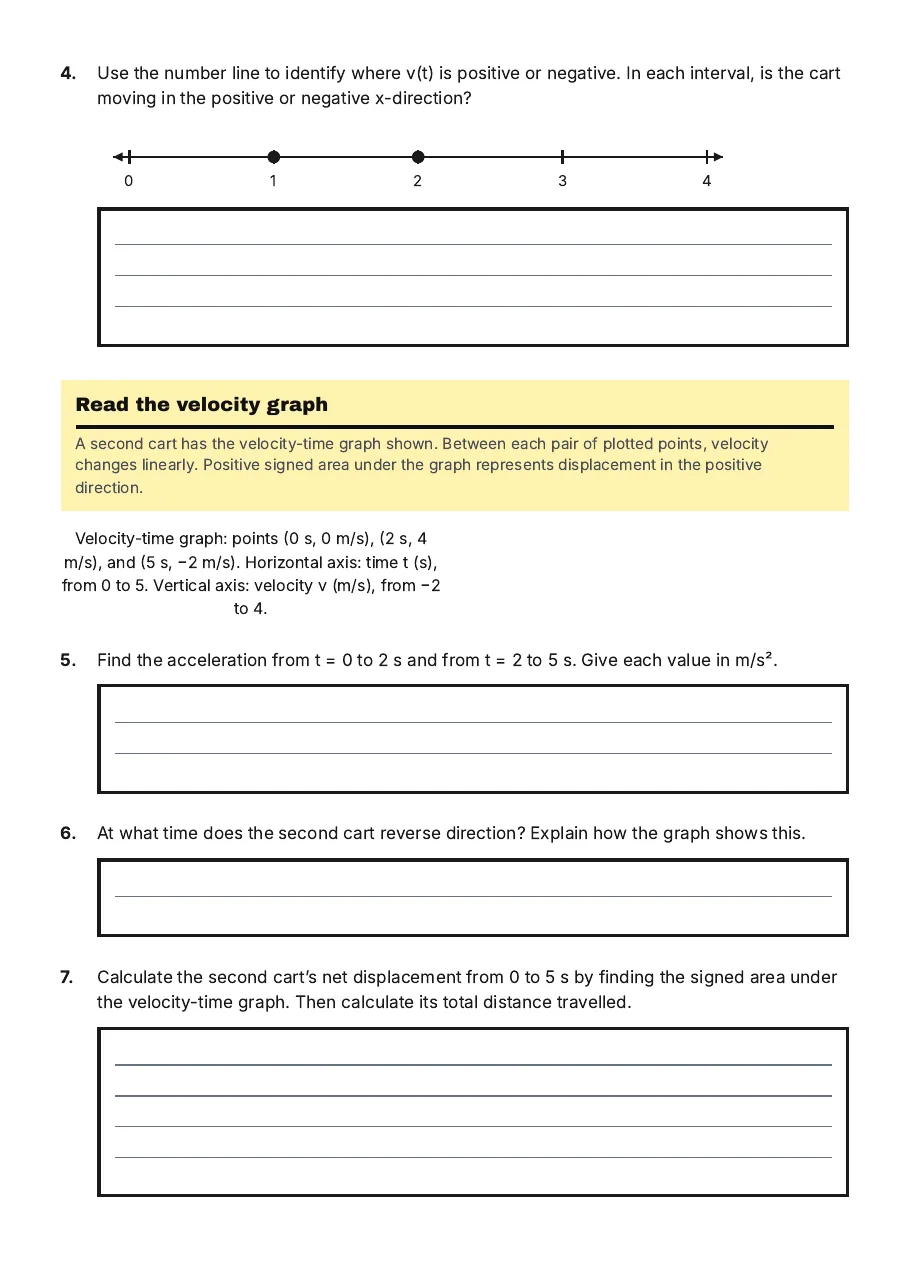
4.Use the number line to identify where v(t) is positive or negative. In each interval, is the cart moving in the positive or negative x-direction?
01234

Read the velocity graph

A second cart has the velocity-time graph shown. Between each pair of plotted points, velocity changes linearly. Positive signed area under the graph represents displacement in the positive direction.

Velocity-time graph: points (0 s, 0 m/s), (2 s, 4 m/s), and (5 s, −2 m/s). Horizontal axis: time t (s), from 0 to 5. Vertical axis: velocity v (m/s), from −2 to 4.

5.Find the acceleration from t = 0 to 2 s and from t = 2 to 5 s. Give each value in m/s².
6.At what time does the second cart reverse direction? Explain how the graph shows this.
7.Calculate the second cart’s net displacement from 0 to 5 s by finding the signed area under the velocity-time graph. Then calculate its total distance travelled.

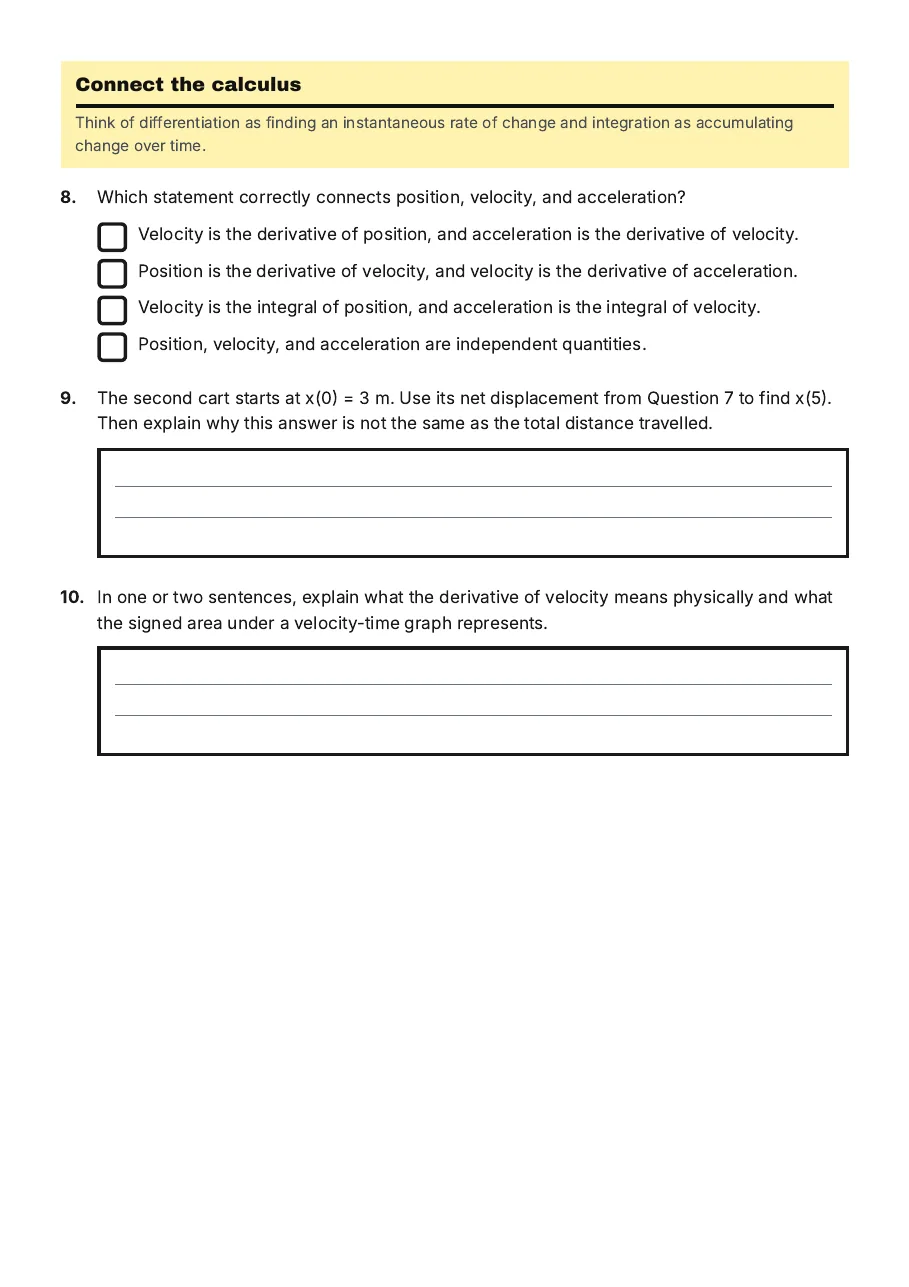
Connect the calculus

Think of differentiation as finding an instantaneous rate of change and integration as accumulating change over time.

8.Which statement correctly connects position, velocity, and acceleration?
  • Velocity is the derivative of position, and acceleration is the derivative of velocity.
  • Position is the derivative of velocity, and velocity is the derivative of acceleration.
  • Velocity is the integral of position, and acceleration is the integral of velocity.
  • Position, velocity, and acceleration are independent quantities.
9.The second cart starts at x(0) = 3 m. Use its net displacement from Question 7 to find x(5). Then explain why this answer is not the same as the total distance travelled.
10.In one or two sentences, explain what the derivative of velocity means physically and what the signed area under a velocity-time graph represents.

3 printable pages

  • Calculus-Based Physics Introduction, page 1 of 3: Motion as a function

    Page 1

  • Calculus-Based Physics Introduction, page 2 of 3: Read the velocity graph

    Page 2

  • Calculus-Based Physics Introduction, page 3 of 3: Connect the calculus

    Page 3

About This Worksheet

Free in Kuraplan

Sign up free, grab the PDF, and customize it for your class.

Print-Ready

Formatted for standard paper. Clean layout, easy to read.

AI-Generated

Created with Kuraplan's AI, designed for real classroom use.

For Teachers & Parents

Use in classrooms, for homework, tutoring, or homeschool.

Need a custom version of this worksheet?

Kuraplan's AI generates custom worksheets in seconds — differentiated for every learner, aligned to your curriculum.

Generate Custom Worksheets — Free
No credit card Curriculum-aligned Under 60 seconds