ScienceFreePrintable

Light Path Measurement Analysis

A free science worksheet ready for your classroom. Open in Kuraplan to grab the print-ready PDF, customize it for your students, or generate a fresh version in seconds.
Light Path Measurement Analysis worksheet preview
Name:Date:

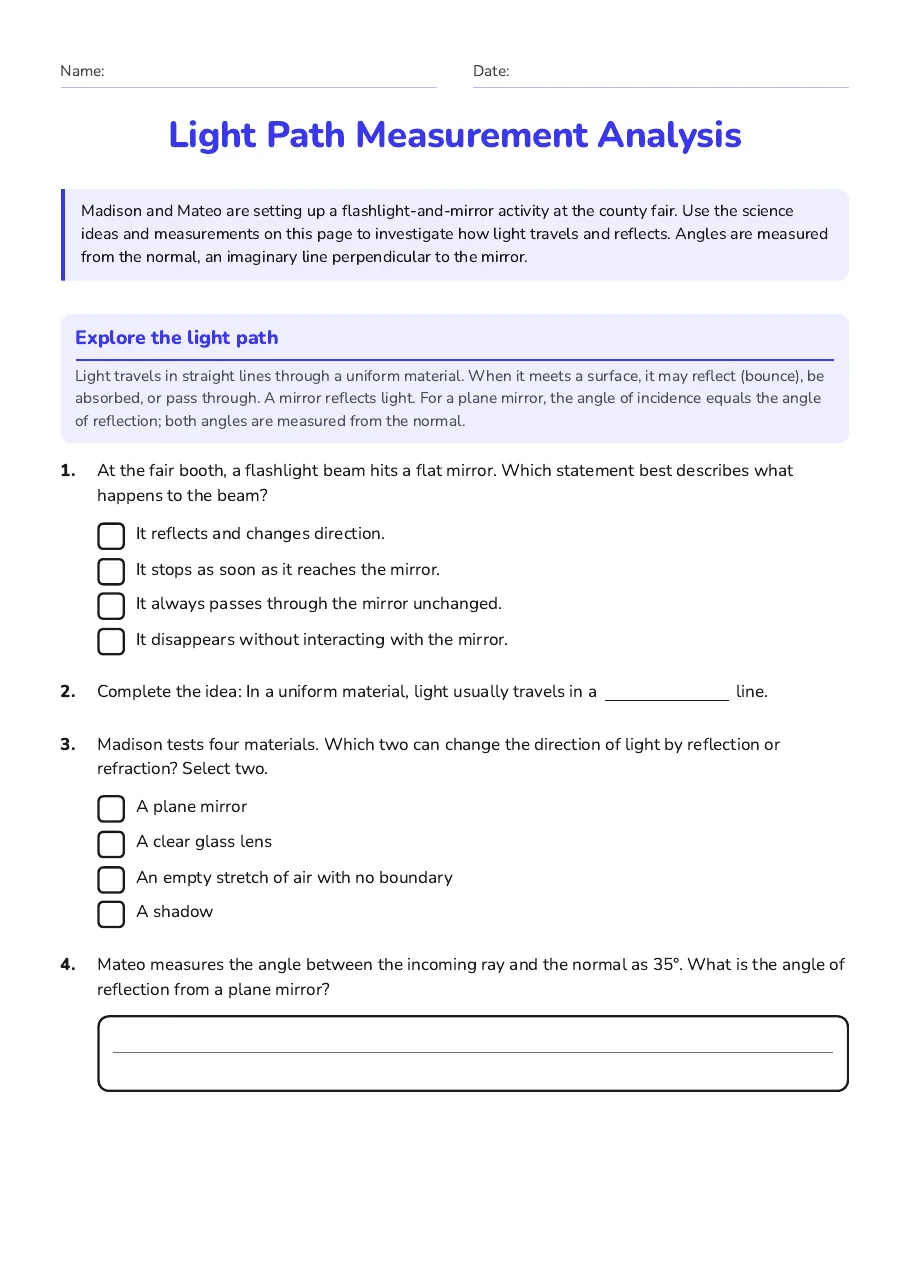
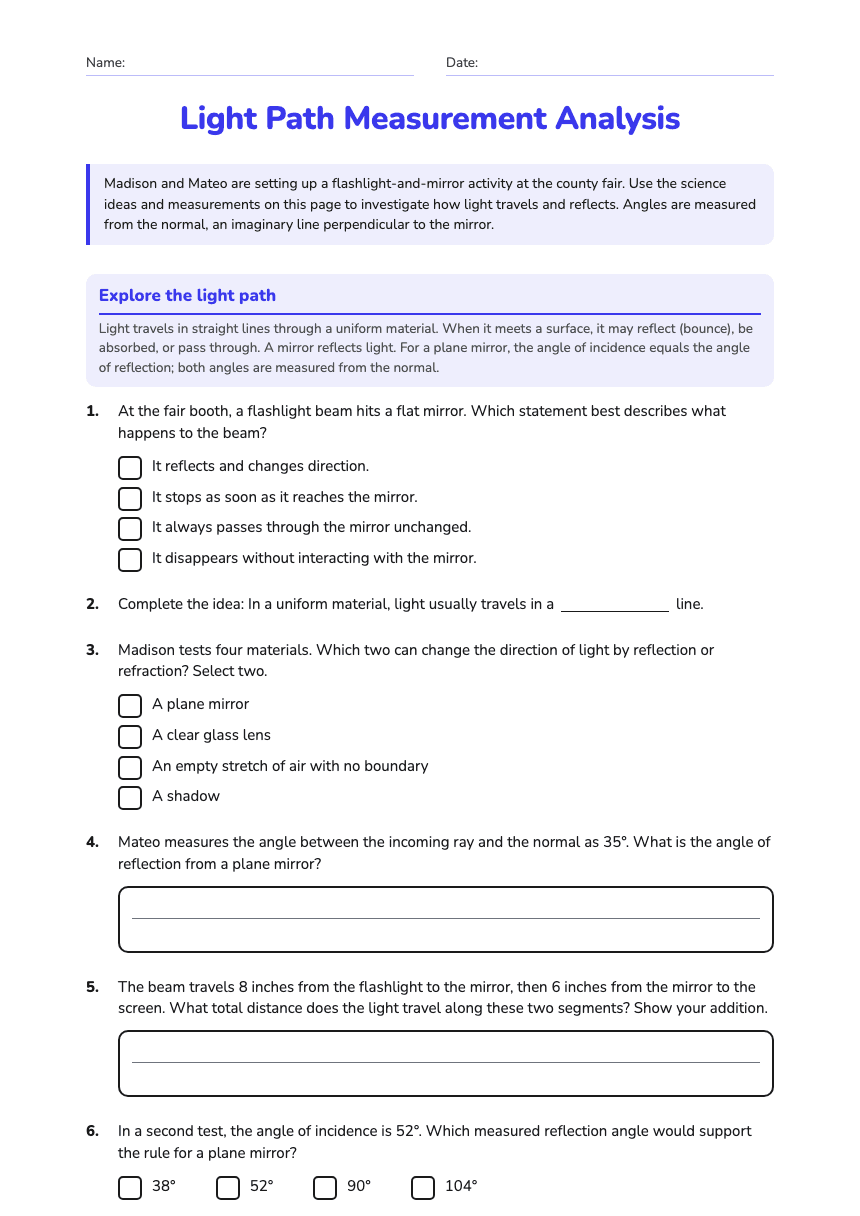
Light Path Measurement Analysis

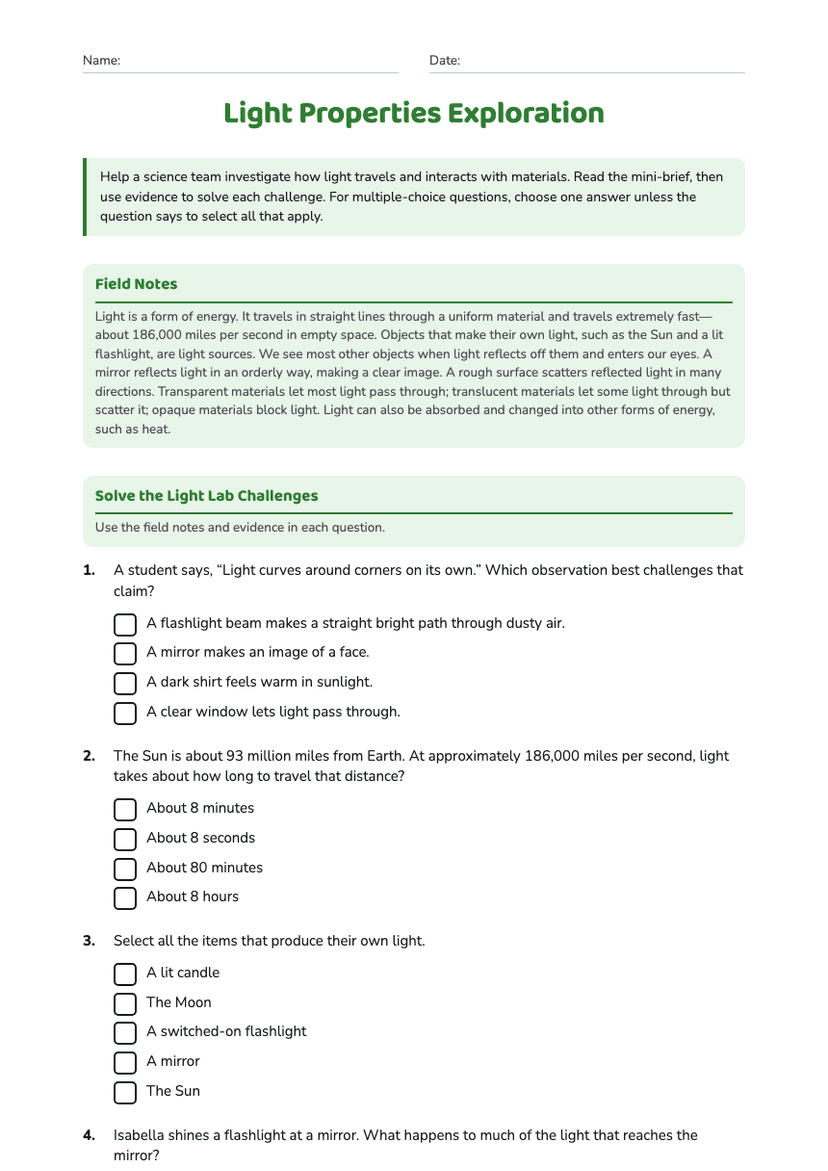
Madison and Mateo are setting up a flashlight-and-mirror activity at the county fair. Use the science ideas and measurements on this page to investigate how light travels and reflects. Angles are measured from the normal, an imaginary line perpendicular to the mirror.

Explore the light path

Light travels in straight lines through a uniform material. When it meets a surface, it may reflect (bounce), be absorbed, or pass through. A mirror reflects light. For a plane mirror, the angle of incidence equals the angle of reflection; both angles are measured from the normal.

1.At the fair booth, a flashlight beam hits a flat mirror. Which statement best describes what happens to the beam?
  • It reflects and changes direction.
  • It stops as soon as it reaches the mirror.
  • It always passes through the mirror unchanged.
  • It disappears without interacting with the mirror.
2.Complete the idea: In a uniform material, light usually travels in a line.
3.Madison tests four materials. Which two can change the direction of light by reflection or refraction? Select two.
  • A plane mirror
  • A clear glass lens
  • An empty stretch of air with no boundary
  • A shadow
4.Mateo measures the angle between the incoming ray and the normal as 35°. What is the angle of reflection from a plane mirror?
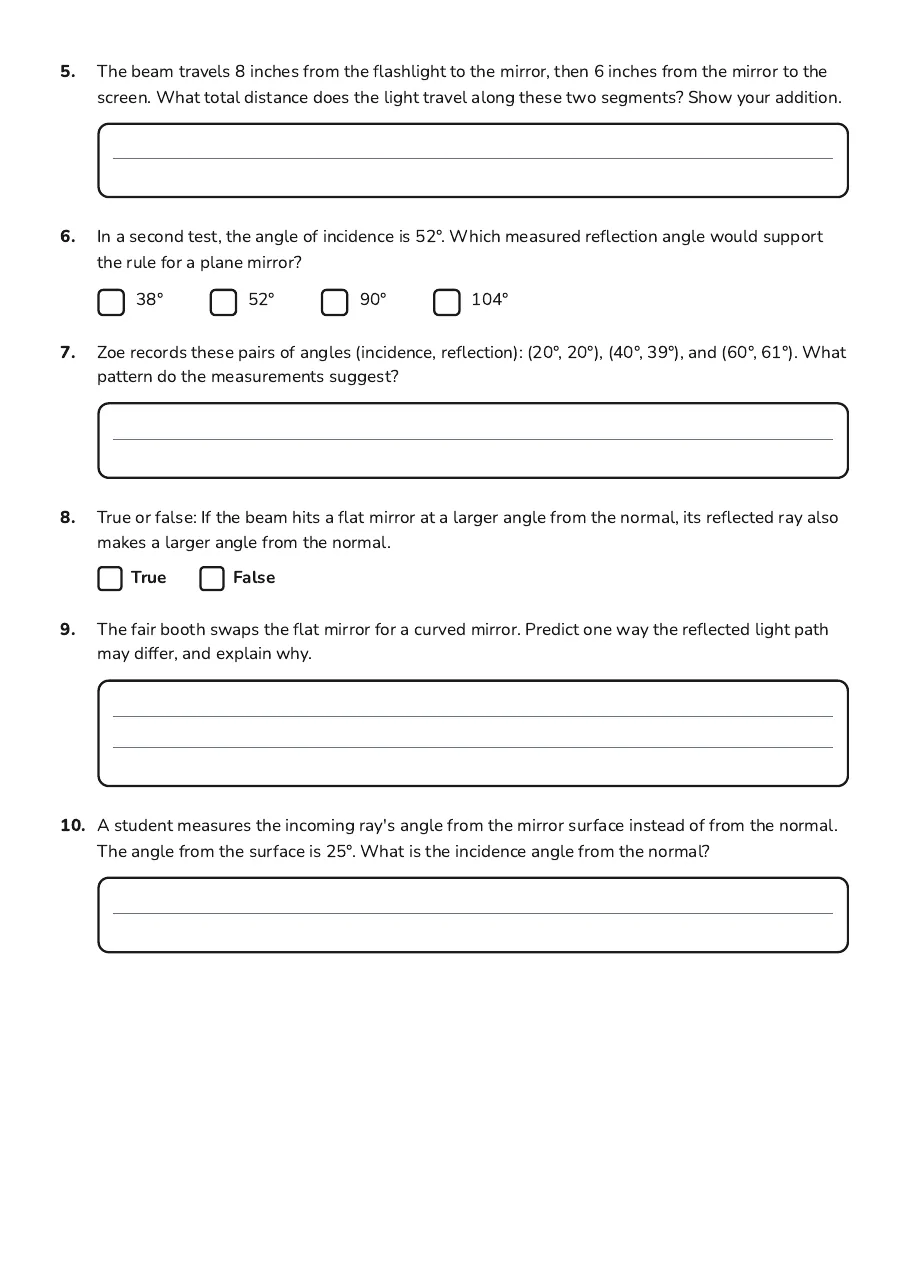
5.The beam travels 8 inches from the flashlight to the mirror, then 6 inches from the mirror to the screen. What total distance does the light travel along these two segments? Show your addition.
6.In a second test, the angle of incidence is 52°. Which measured reflection angle would support the rule for a plane mirror?
  • 38°
  • 52°
  • 90°
  • 104°
7.Zoe records these pairs of angles (incidence, reflection): (20°, 20°), (40°, 39°), and (60°, 61°). What pattern do the measurements suggest?
8.True or false: If the beam hits a flat mirror at a larger angle from the normal, its reflected ray also makes a larger angle from the normal.
TrueFalse
9.The fair booth swaps the flat mirror for a curved mirror. Predict one way the reflected light path may differ, and explain why.
10.A student measures the incoming ray's angle from the mirror surface instead of from the normal. The angle from the surface is 25°. What is the incidence angle from the normal?

2 printable pages

  • Light Path Measurement Analysis, page 1 of 2: Explore the light path

    Page 1

  • Light Path Measurement Analysis, page 2 of 2: 5. The beam travels 8 inches from the flashlight to the mirror, then 6 inches from the…

    Page 2

About This Worksheet

Free in Kuraplan

Sign up free, grab the PDF, and customize it for your class.

Print-Ready

Formatted for standard paper. Clean layout, easy to read.

AI-Generated

Created with Kuraplan's AI, designed for real classroom use.

For Teachers & Parents

Use in classrooms, for homework, tutoring, or homeschool.

Need a custom version of this worksheet?

Kuraplan's AI generates custom worksheets in seconds — differentiated for every learner, aligned to your curriculum.

Generate Custom Worksheets — Free
No credit card Curriculum-aligned Under 60 seconds