Mad-House Chapters 12-13
A free english (ela) worksheet ready for your classroom. Open in Kuraplan to grab the print-ready PDF, customize it for your students, or generate a fresh version in seconds.
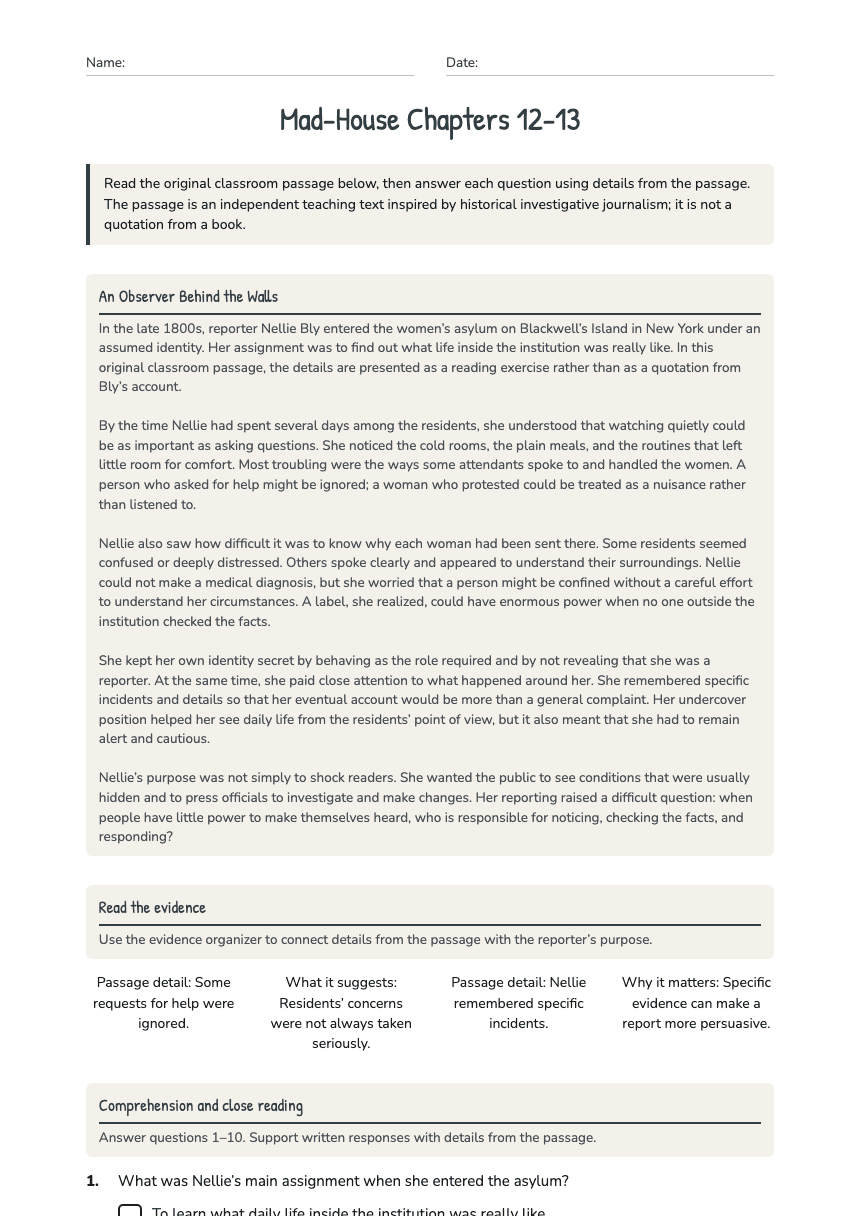
Mad-House Chapters 12-13
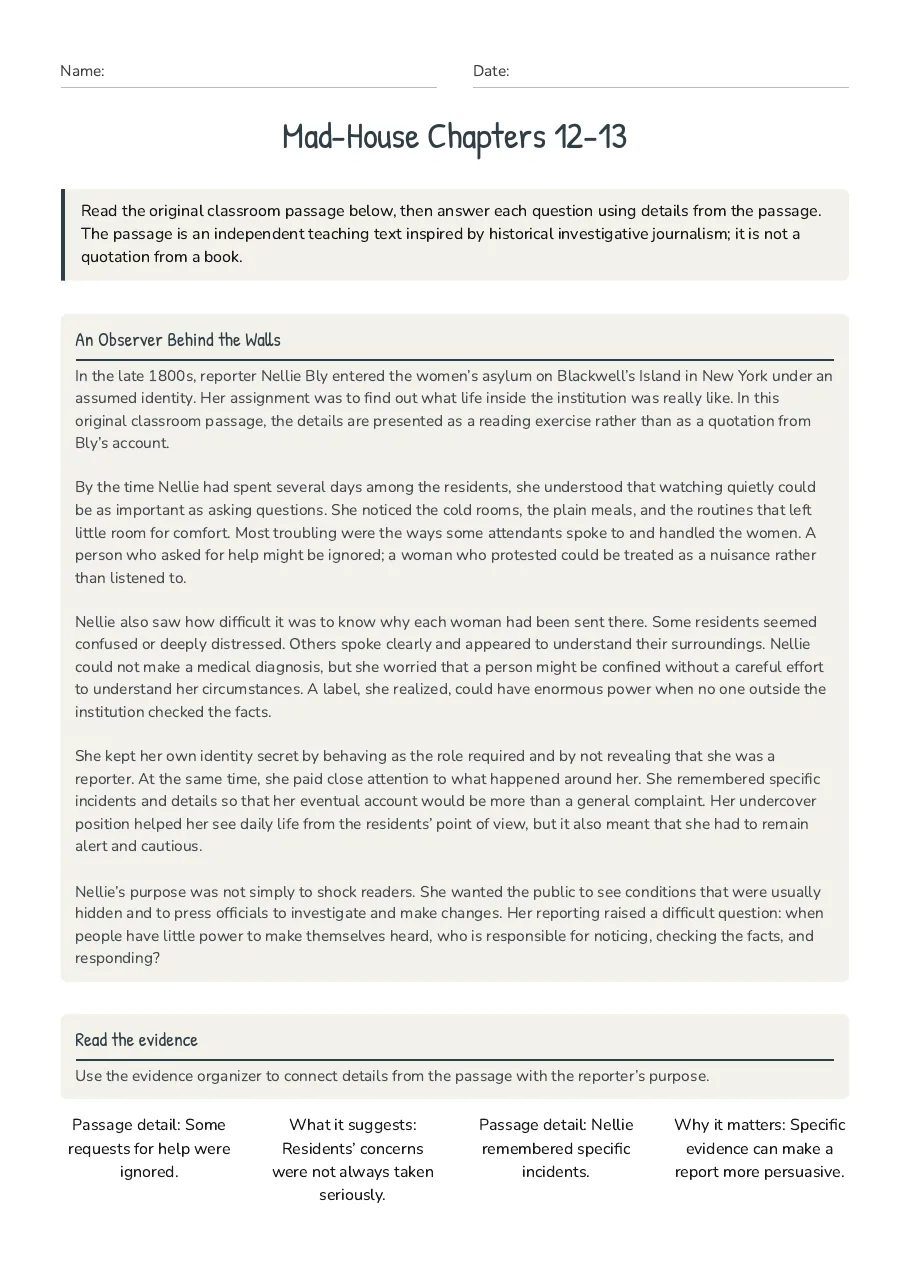
An Observer Behind the Walls
In the late 1800s, reporter Nellie Bly entered the women’s asylum on Blackwell’s Island in New York under an assumed identity. Her assignment was to find out what life inside the institution was really like. In this original classroom passage, the details are presented as a reading exercise rather than as a quotation from Bly’s account. By the time Nellie had spent several days among the residents, she understood that watching quietly could be as important as asking questions. She noticed the cold rooms, the plain meals, and the routines that left little room for comfort. Most troubling were the ways some attendants spoke to and handled the women. A person who asked for help might be ignored; a woman who protested could be treated as a nuisance rather than listened to. Nellie also saw how difficult it was to know why each woman had been sent there. Some residents seemed confused or deeply distressed. Others spoke clearly and appeared to understand their surroundings. Nellie could not make a medical diagnosis, but she worried that a person might be confined without a careful effort to understand her circumstances. A label, she realized, could have enormous power when no one outside the institution checked the facts. She kept her own identity secret by behaving as the role required and by not revealing that she was a reporter. At the same time, she paid close attention to what happened around her. She remembered specific incidents and details so that her eventual account would be more than a general complaint. Her undercover position helped her see daily life from the residents’ point of view, but it also meant that she had to remain alert and cautious. Nellie’s purpose was not simply to shock readers. She wanted the public to see conditions that were usually hidden and to press officials to investigate and make changes. Her reporting raised a difficult question: when people have little power to make themselves heard, who is responsible for noticing, checking the facts, and responding?
Read the evidence
Use the evidence organizer to connect details from the passage with the reporter’s purpose.
Passage detail: Some requests for help were ignored.
What it suggests: Residents’ concerns were not always taken seriously.
Passage detail: Nellie remembered specific incidents.
Why it matters: Specific evidence can make a report more persuasive.
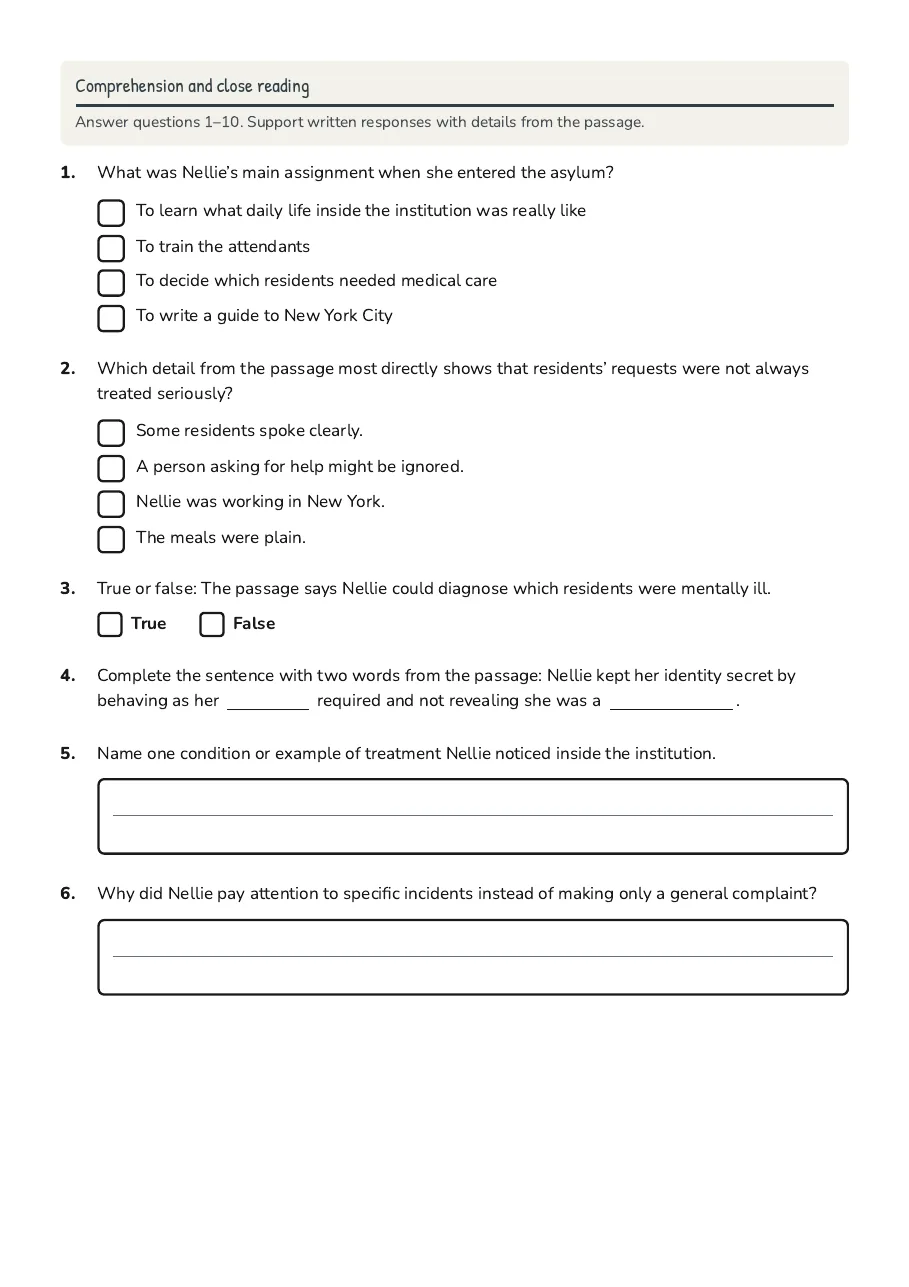
Comprehension and close reading
Answer questions 1–10. Support written responses with details from the passage.
- To learn what daily life inside the institution was really like
- To train the attendants
- To decide which residents needed medical care
- To write a guide to New York City
- Some residents spoke clearly.
- A person asking for help might be ignored.
- Nellie was working in New York.
- The meals were plain.
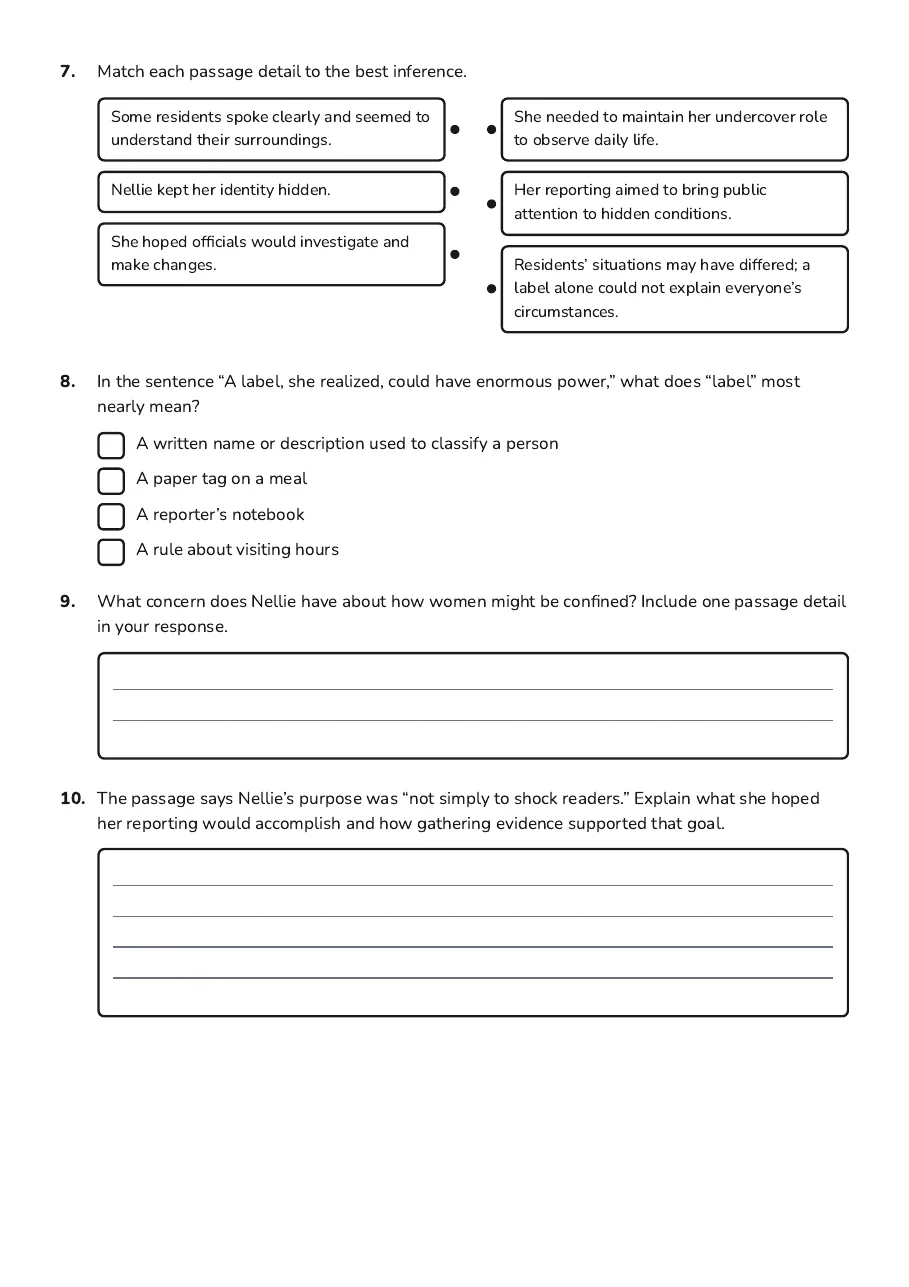
- Some residents spoke clearly and seemed to understand their surroundings.
- Nellie kept her identity hidden.
- She hoped officials would investigate and make changes.
- She needed to maintain her undercover role to observe daily life.
- Her reporting aimed to bring public attention to hidden conditions.
- Residents’ situations may have differed; a label alone could not explain everyone’s circumstances.
- A written name or description used to classify a person
- A paper tag on a meal
- A reporter’s notebook
- A rule about visiting hours
3 printable pages
Page 1
Page 2
Page 3
About This Worksheet
Free in Kuraplan
Sign up free, grab the PDF, and customize it for your class.
Print-Ready
Formatted for standard paper. Clean layout, easy to read.
AI-Generated
Created with Kuraplan's AI, designed for real classroom use.
For Teachers & Parents
Use in classrooms, for homework, tutoring, or homeschool.
Need a custom version of this worksheet?
Kuraplan's AI generates custom worksheets in seconds — differentiated for every learner, aligned to your curriculum.
Generate Custom Worksheets — Free