Musket Technology and Tactics
A free us history worksheet ready for your classroom. Open in Kuraplan to grab the print-ready PDF, customize it for your students, or generate a fresh version in seconds.
Musket Technology and Tactics
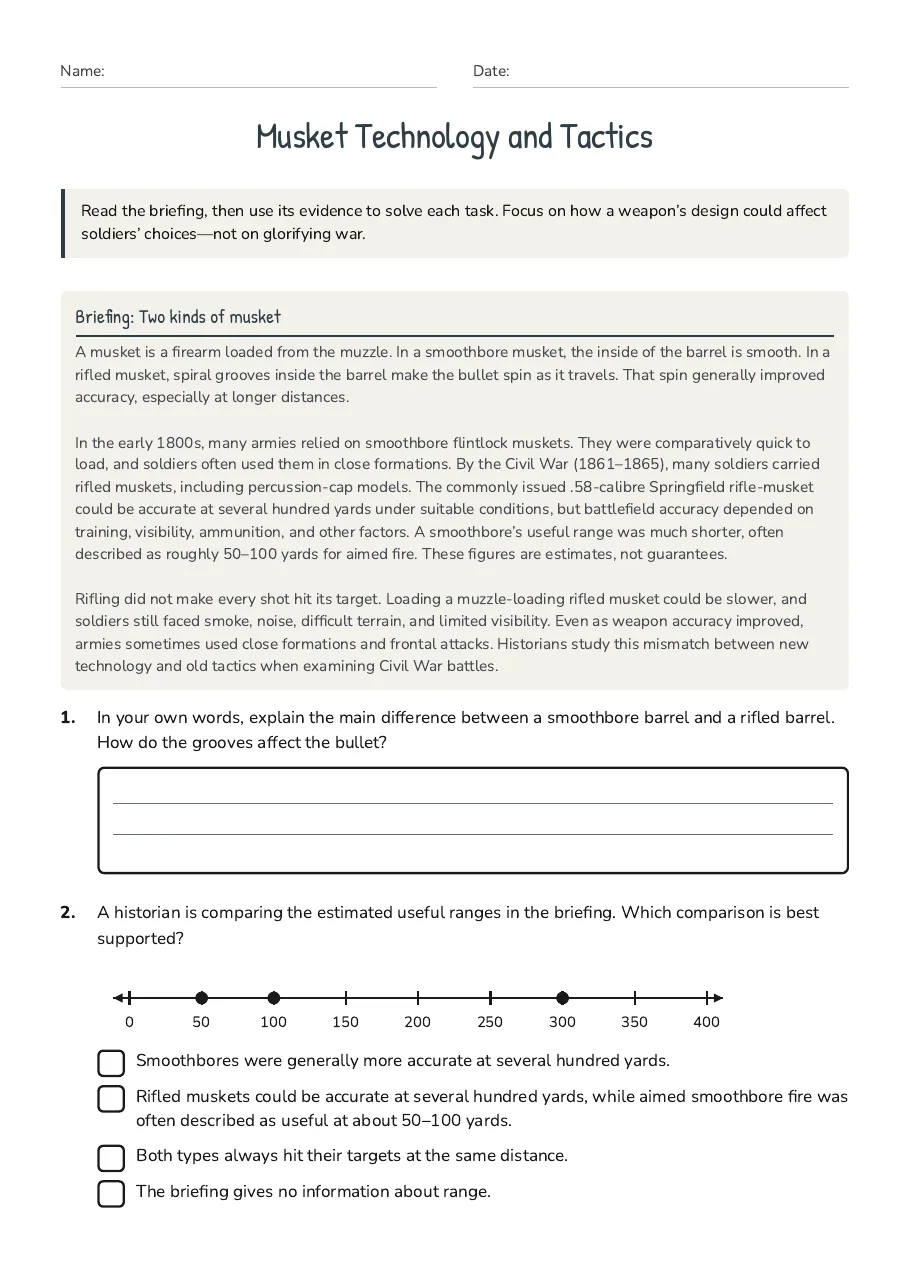
Briefing: Two kinds of musket
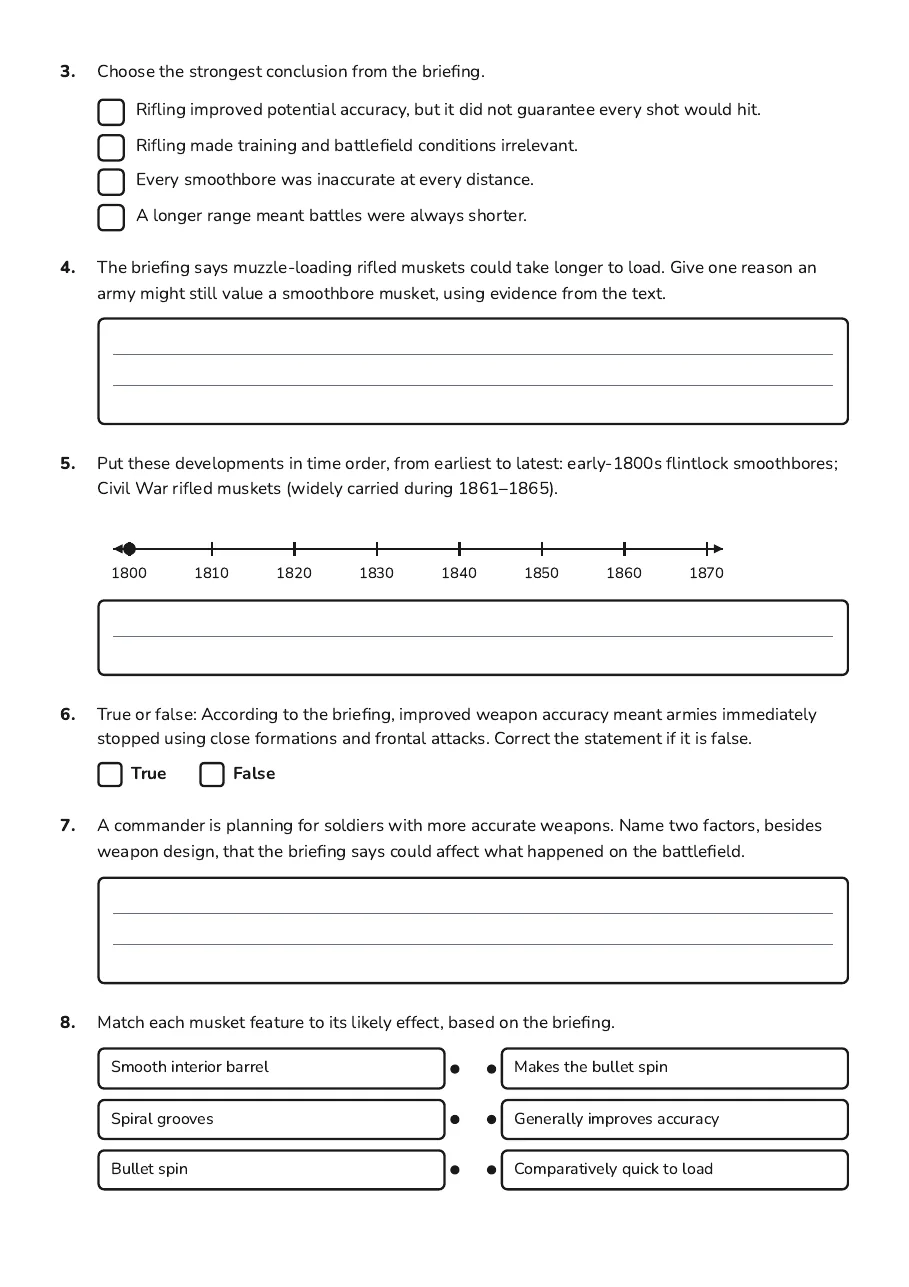
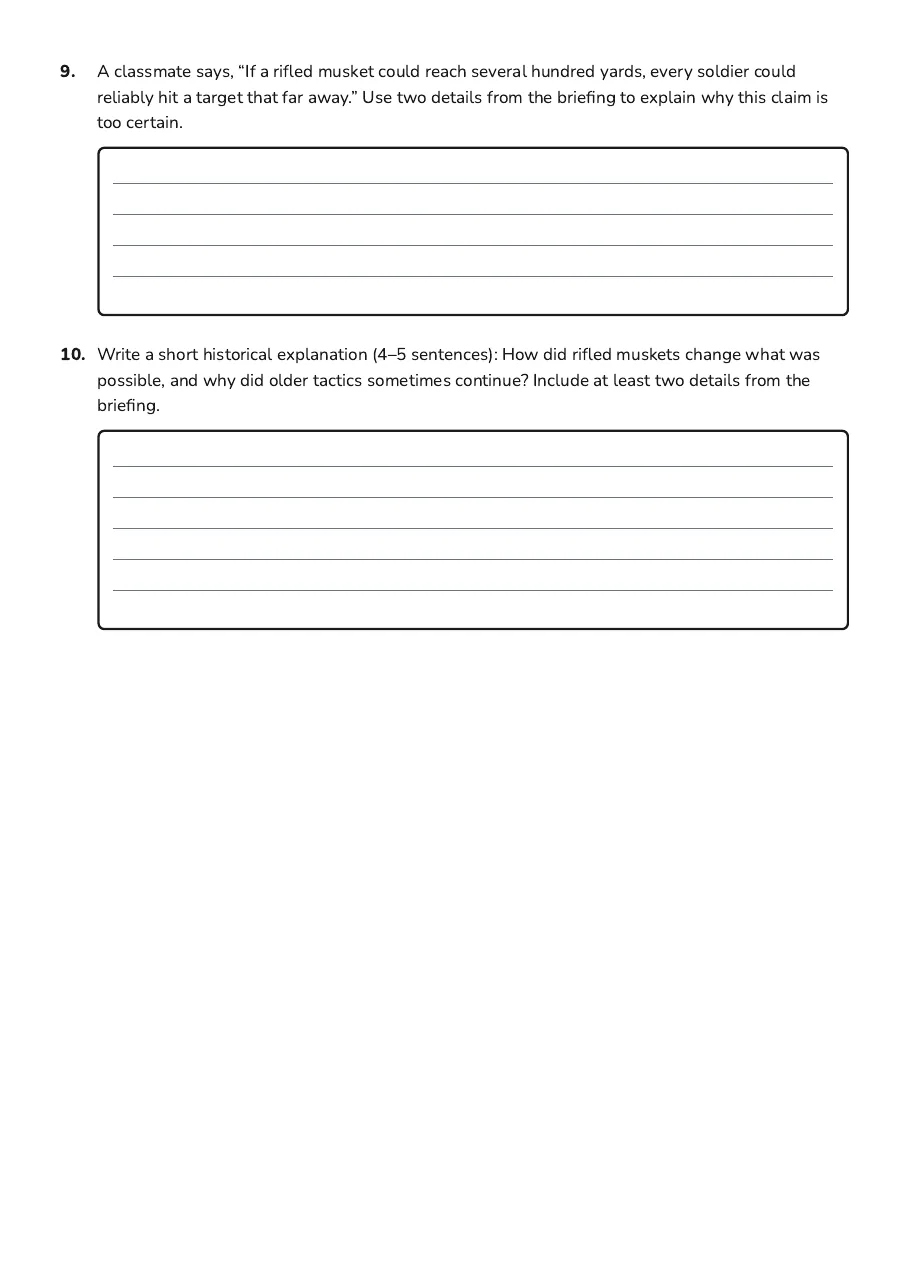
A musket is a firearm loaded from the muzzle. In a smoothbore musket, the inside of the barrel is smooth. In a rifled musket, spiral grooves inside the barrel make the bullet spin as it travels. That spin generally improved accuracy, especially at longer distances. In the early 1800s, many armies relied on smoothbore flintlock muskets. They were comparatively quick to load, and soldiers often used them in close formations. By the Civil War (1861–1865), many soldiers carried rifled muskets, including percussion-cap models. The commonly issued .58-calibre Springfield rifle-musket could be accurate at several hundred yards under suitable conditions, but battlefield accuracy depended on training, visibility, ammunition, and other factors. A smoothbore’s useful range was much shorter, often described as roughly 50–100 yards for aimed fire. These figures are estimates, not guarantees. Rifling did not make every shot hit its target. Loading a muzzle-loading rifled musket could be slower, and soldiers still faced smoke, noise, difficult terrain, and limited visibility. Even as weapon accuracy improved, armies sometimes used close formations and frontal attacks. Historians study this mismatch between new technology and old tactics when examining Civil War battles.
- Smoothbores were generally more accurate at several hundred yards.
- Rifled muskets could be accurate at several hundred yards, while aimed smoothbore fire was often described as useful at about 50–100 yards.
- Both types always hit their targets at the same distance.
- The briefing gives no information about range.
- Rifling improved potential accuracy, but it did not guarantee every shot would hit.
- Rifling made training and battlefield conditions irrelevant.
- Every smoothbore was inaccurate at every distance.
- A longer range meant battles were always shorter.
- Smooth interior barrel
- Spiral grooves
- Bullet spin
- Makes the bullet spin
- Generally improves accuracy
- Comparatively quick to load
3 printable pages
Page 1
Page 2
Page 3
About This Worksheet
Free in Kuraplan
Sign up free, grab the PDF, and customize it for your class.
Print-Ready
Formatted for standard paper. Clean layout, easy to read.
AI-Generated
Created with Kuraplan's AI, designed for real classroom use.
For Teachers & Parents
Use in classrooms, for homework, tutoring, or homeschool.
Need a custom version of this worksheet?
Kuraplan's AI generates custom worksheets in seconds — differentiated for every learner, aligned to your curriculum.
Generate Custom Worksheets — FreeMore US History Worksheets
Washington Jefferson Political Legacy
Free
Sons of Liberty Roleplay
Free
Military Engineers Report
Free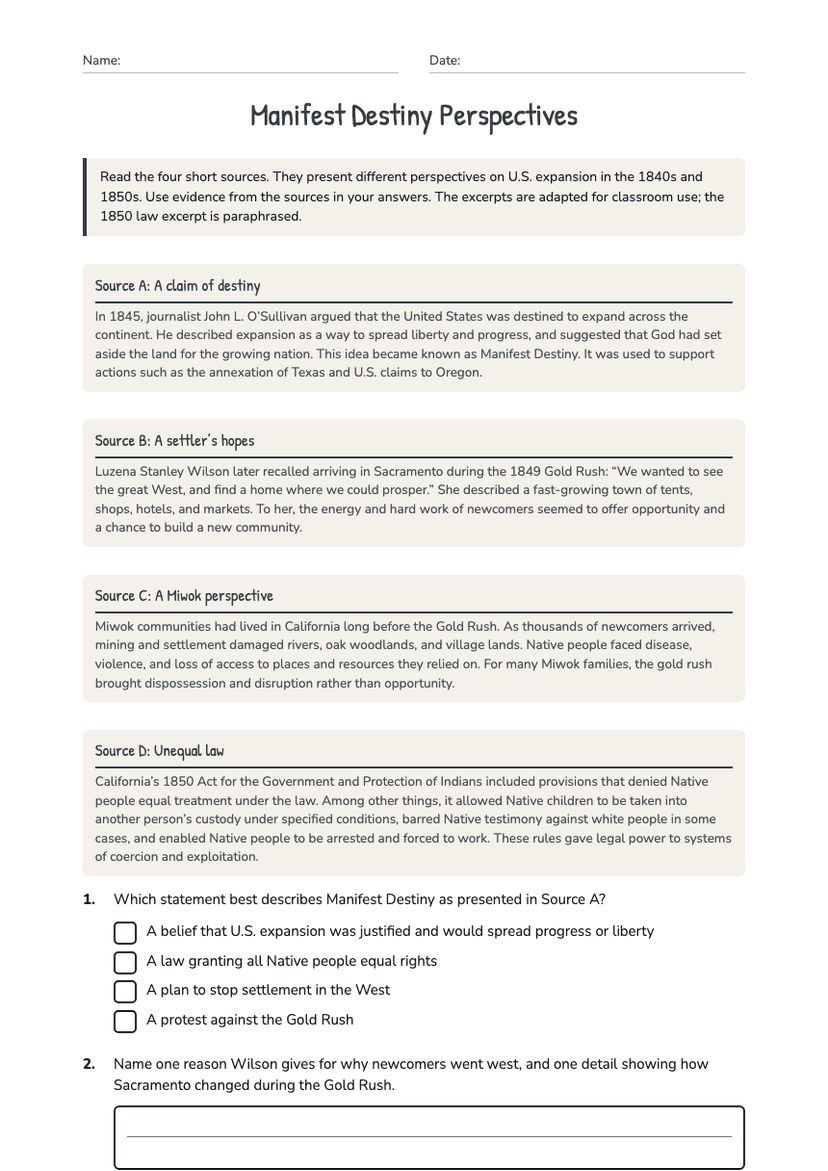
Manifest Destiny Perspectives
Free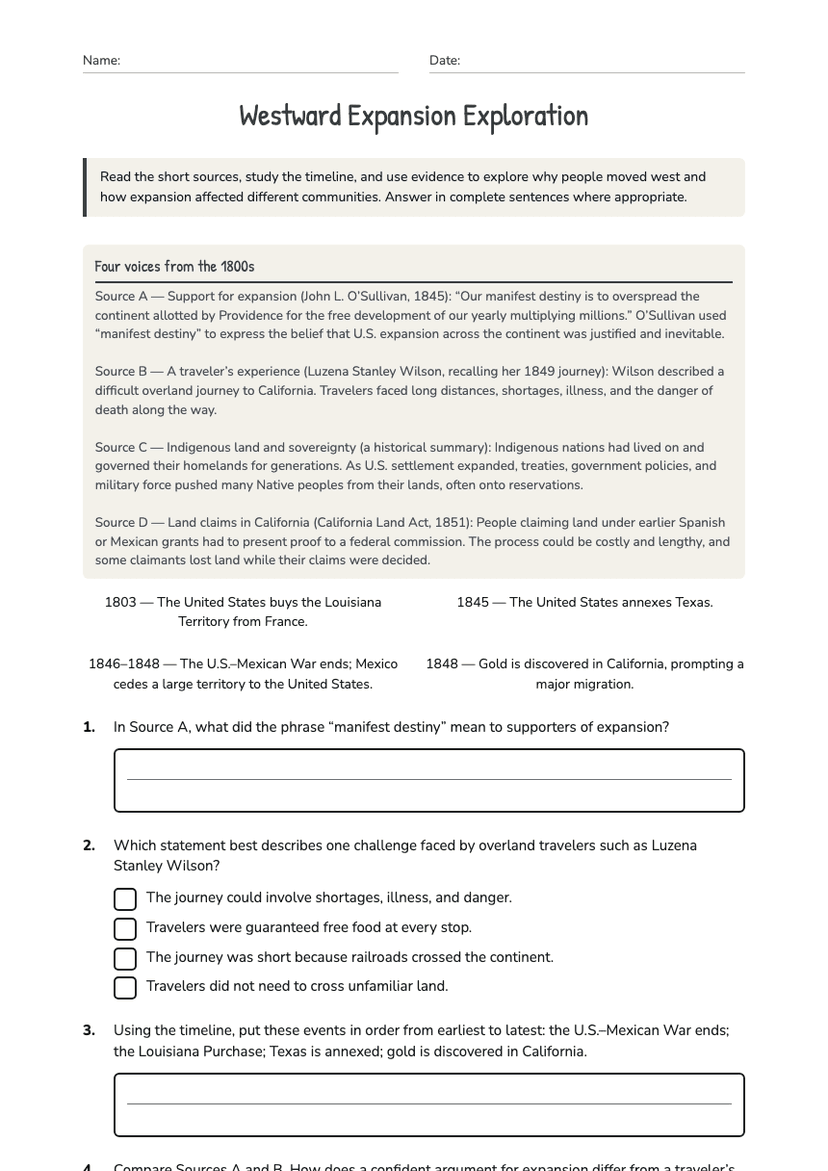
Westward Expansion Exploration
Free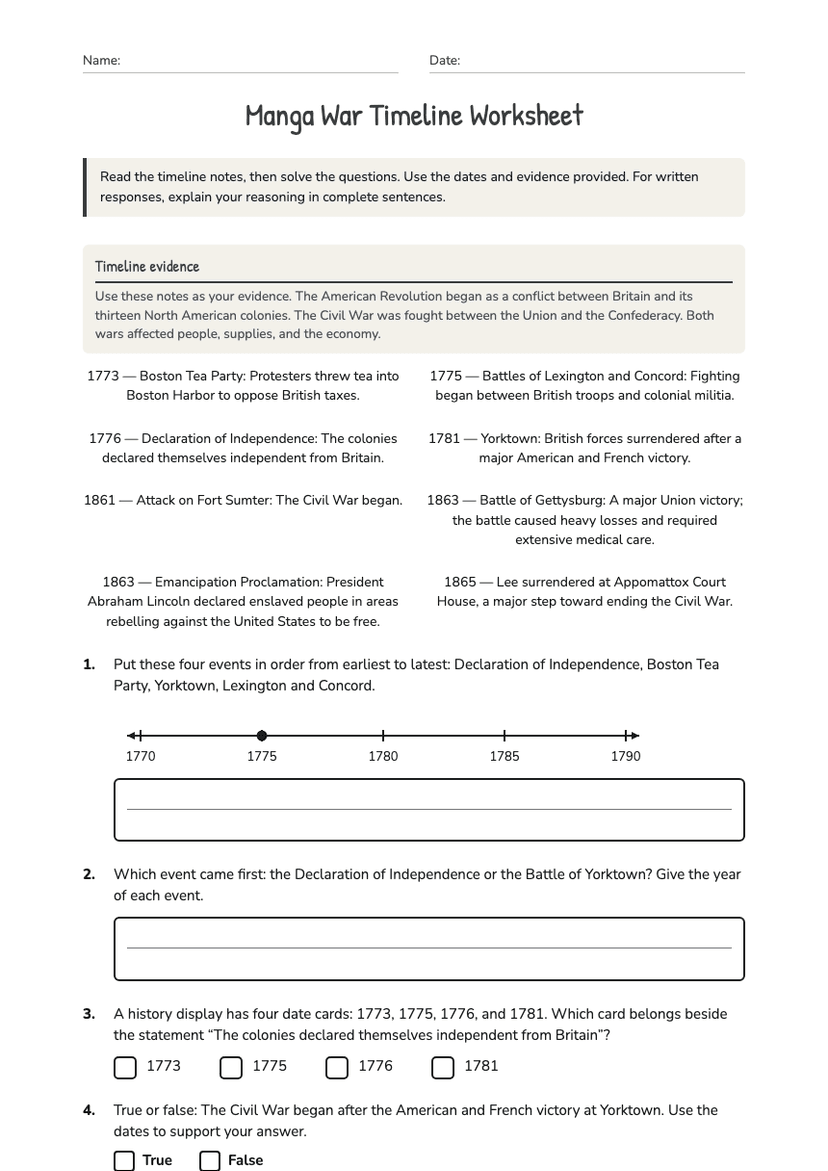
Manga War Timeline Worksheet
Free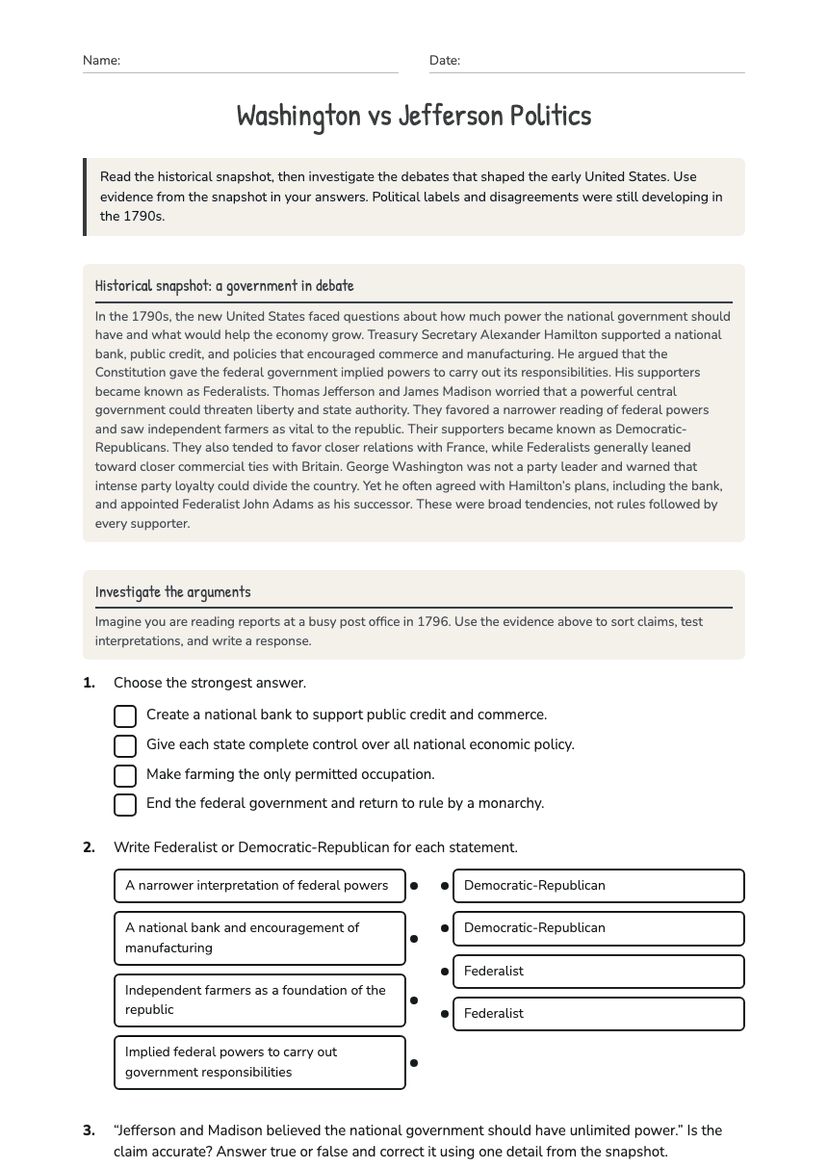
Washington vs Jefferson Politics
Free