FreePrintable

Organism Classification Unit

A free, printable general worksheet ready for your classroom. Download instantly, print, and hand out to your students — no account needed.

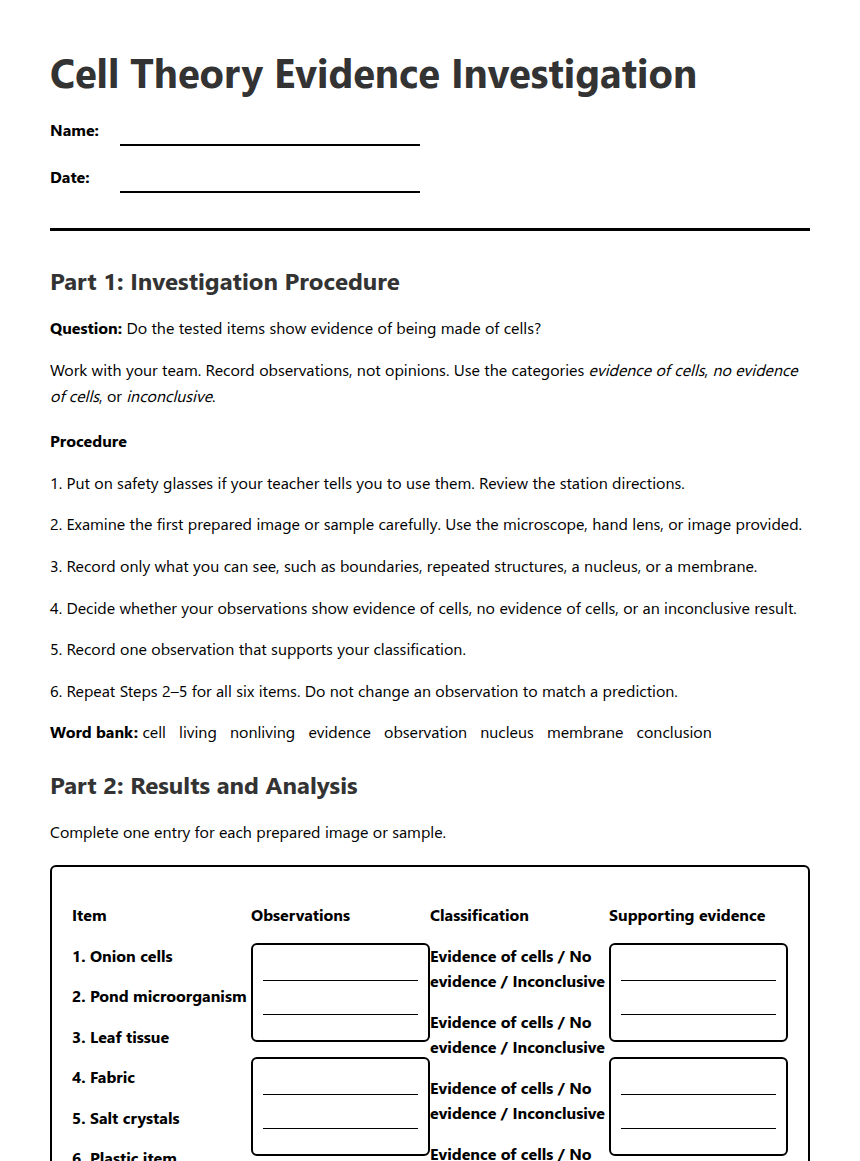
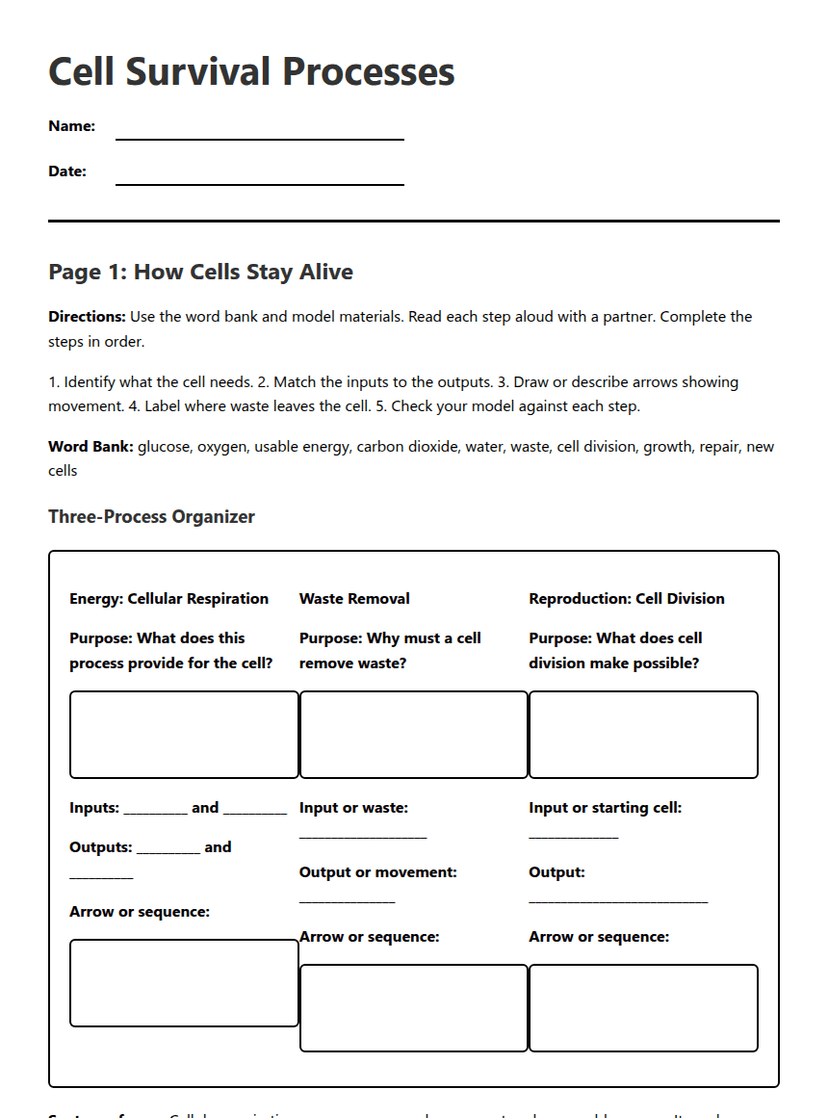
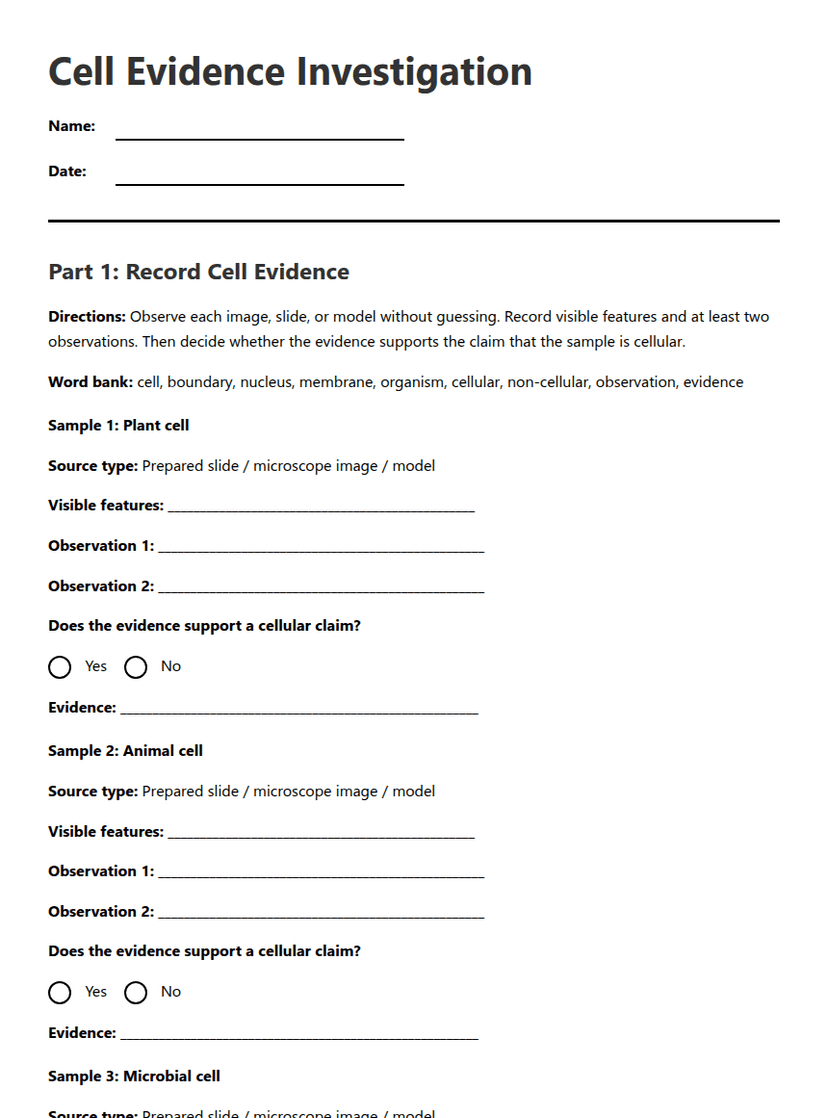
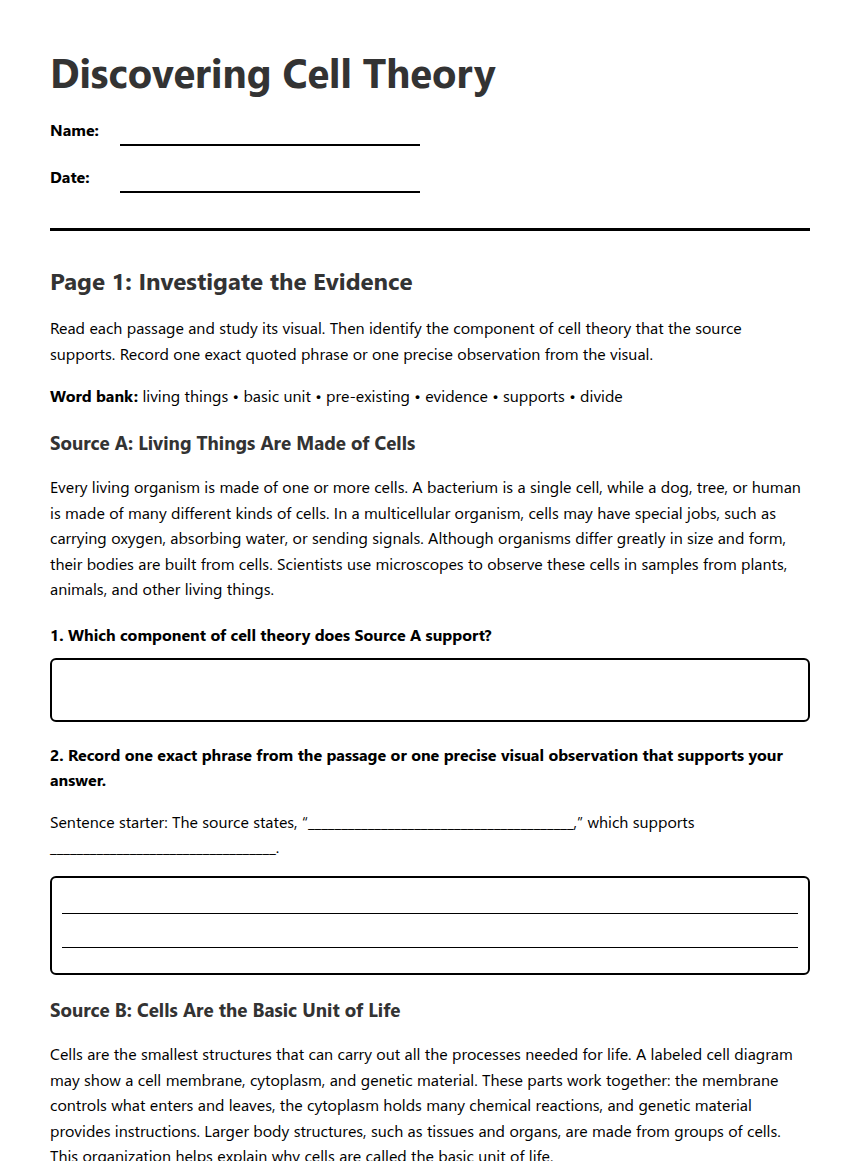
Organism Classification Unit worksheet preview

Organism Classification Unit

Various organisms including plants, animals, and microorganisms

🔬 Part 1: Classification Fundamentals

1. What is biodiversity?

The study of only animal species

The variety of all living organisms on Earth

The process of naming organisms

The extinction of species

2. Which characteristics do scientists commonly use to classify organisms? (Check all that apply)

Cell type (prokaryote or eukaryote)

Method of reproduction

How they obtain nutrition

Their favorite color

Ability to move

3. A scientist discovers an organism that has cells with nuclei, makes its own food using sunlight, and cannot move from place to place. This organism is most likely a:

Animal

Plant

Bacterium

Fungus

4. Why do scientists classify organisms into groups?

To make studying life easier and more organized

To decide which organisms are most important

To determine which organisms are extinct

To count how many organisms exist

📝 Part 2: Classification Models

5. You have been given these four organisms to classify: Oak tree, Eagle, Mushroom, E. coli bacteria. Create a classification model by filling in the chart below with the organism names based on their characteristics.

Has a nucleus in cells: _________________, _________________, _________________

No nucleus in cells: _________________

Makes own food: _________________

Cannot make own food: _________________, _________________, _________________

Can move from place to place: _________________

6. Explain why you placed the eagle and mushroom in the same group for "Cannot make own food" but they are very different organisms.
7. A student creates a classification model that groups all green organisms together and all non-green organisms together. Explain one problem with this classification method.

🌍 Part 3: Scientific Communication

8. Compare and contrast a rose bush and a pine tree. List two similarities and two differences that scientists would use for classification.

Similarities:

1. _________________________________________________

2. _________________________________________________

Differences:

1. _________________________________________________

2. _________________________________________________

9. You discover a new organism that has the following characteristics: single-celled, has a nucleus, lives in pond water, and can move using tiny hair-like structures. Write a short scientific description explaining how you would classify this organism and defend your reasoning.
10. How can learning about organism classification help scientists and people in everyday life? Give one specific example.

About This Worksheet

Free Download

No sign-up, no email, no paywall. Just download and print.

Print-Ready

Formatted for standard paper. Clean layout, easy to read.

AI-Generated

Created with Kuraplan's AI, designed for real classroom use.

For Teachers & Parents

Use in classrooms, for homework, tutoring, or homeschool.

Need a custom version of this worksheet?

Kuraplan's AI generates custom worksheets in seconds — differentiated for every learner, aligned to your curriculum.

Generate Custom Worksheets — Free
No credit card Curriculum-aligned Under 60 seconds