ScienceFreePrintable

Renewable Energy Models

A free science worksheet ready for your classroom. Open in Kuraplan to grab the print-ready PDF, customize it for your students, or generate a fresh version in seconds.

Renewable Energy Models worksheet preview
Name:Date:

Renewable Energy Models

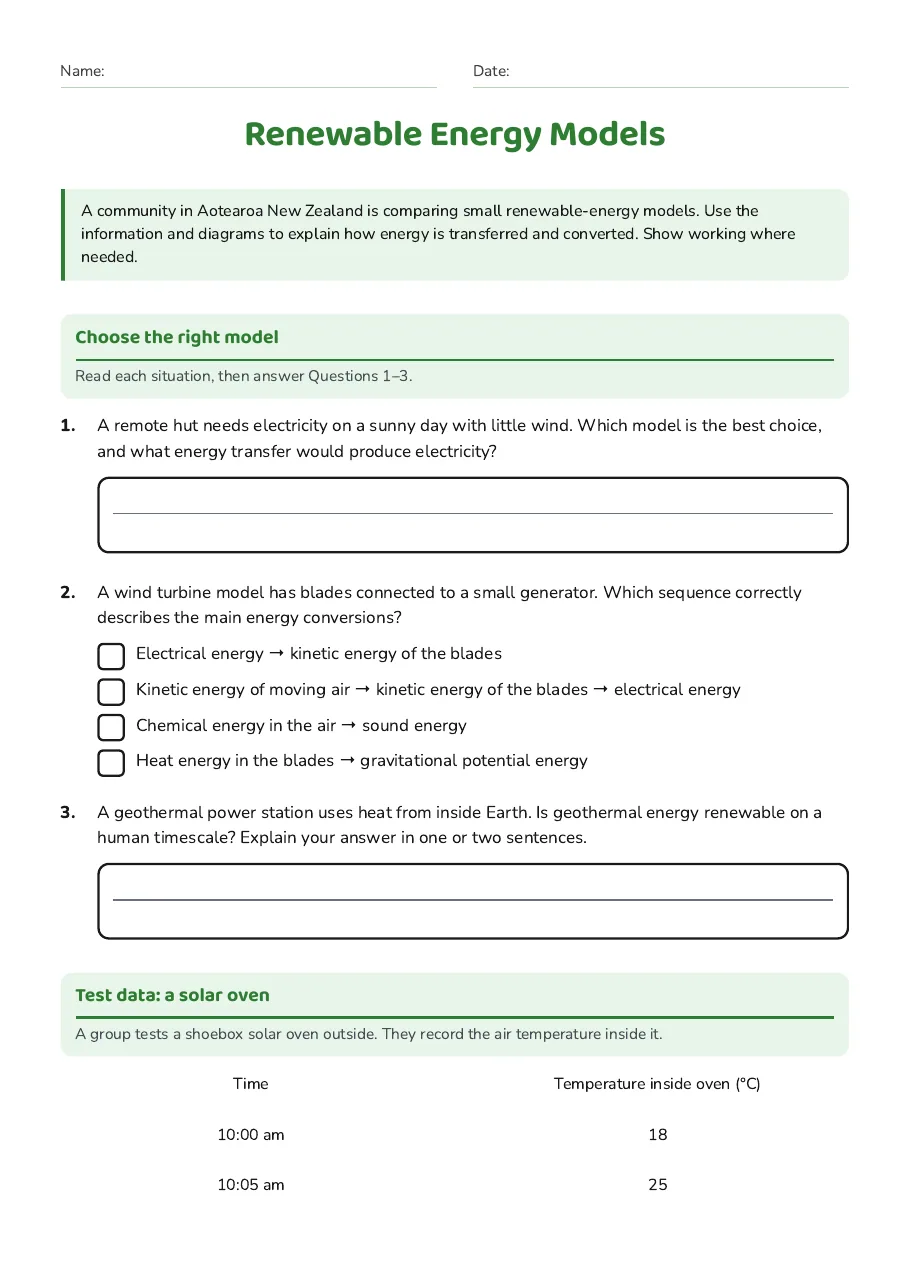
A community in Aotearoa New Zealand is comparing small renewable-energy models. Use the information and diagrams to explain how energy is transferred and converted. Show working where needed.

Choose the right model

Read each situation, then answer Questions 1–3.

1.A remote hut needs electricity on a sunny day with little wind. Which model is the best choice, and what energy transfer would produce electricity?
2.A wind turbine model has blades connected to a small generator. Which sequence correctly describes the main energy conversions?
  • Electrical energy → kinetic energy of the blades
  • Kinetic energy of moving air → kinetic energy of the blades → electrical energy
  • Chemical energy in the air → sound energy
  • Heat energy in the blades → gravitational potential energy
3.A geothermal power station uses heat from inside Earth. Is geothermal energy renewable on a human timescale? Explain your answer in one or two sentences.

Test data: a solar oven

A group tests a shoebox solar oven outside. They record the air temperature inside it.

Time

Temperature inside oven (°C)

10:00 am

18

10:05 am

25

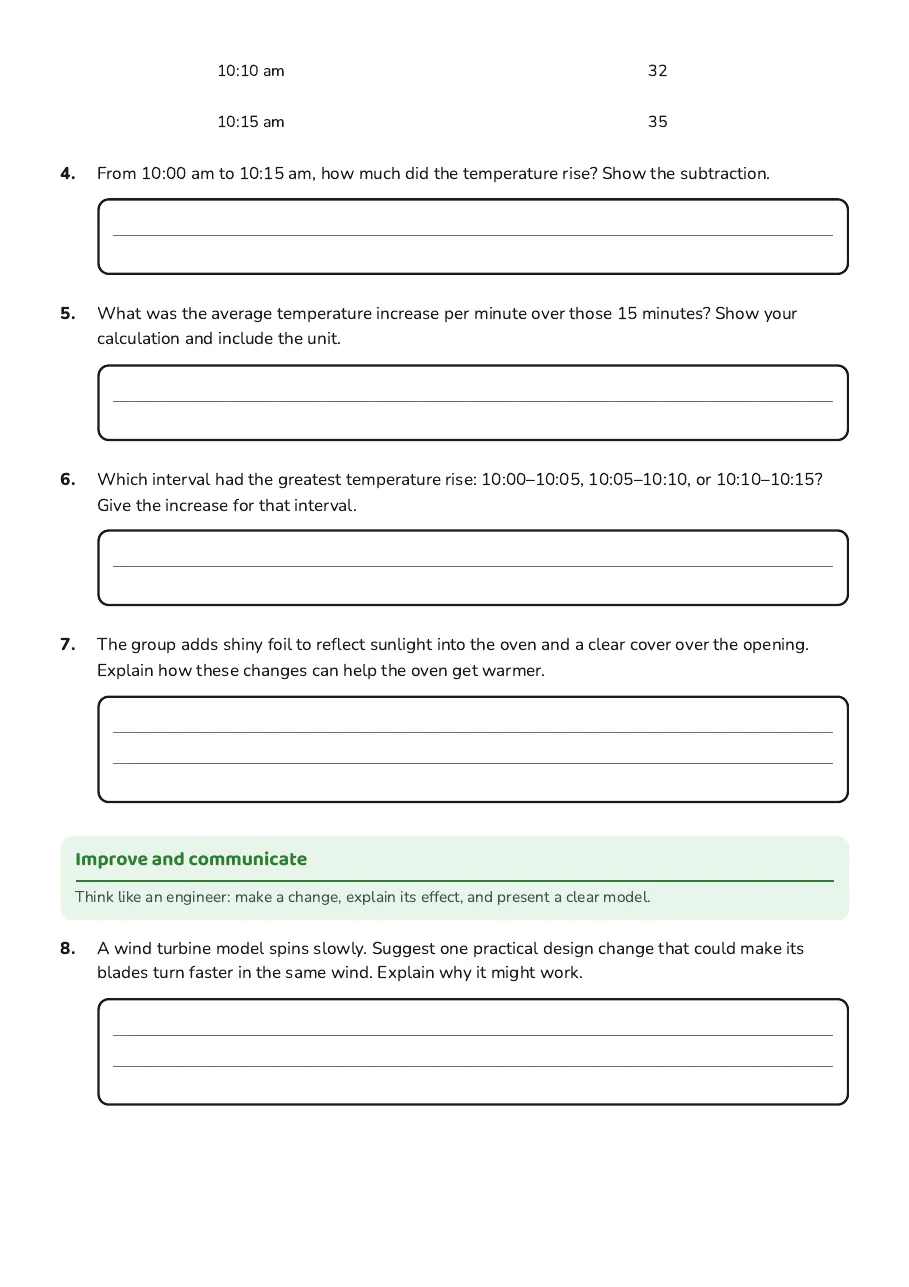
10:10 am

32

10:15 am

35

4.From 10:00 am to 10:15 am, how much did the temperature rise? Show the subtraction.
5.What was the average temperature increase per minute over those 15 minutes? Show your calculation and include the unit.
6.Which interval had the greatest temperature rise: 10:00–10:05, 10:05–10:10, or 10:10–10:15? Give the increase for that interval.
7.The group adds shiny foil to reflect sunlight into the oven and a clear cover over the opening. Explain how these changes can help the oven get warmer.

Improve and communicate

Think like an engineer: make a change, explain its effect, and present a clear model.

8.A wind turbine model spins slowly. Suggest one practical design change that could make its blades turn faster in the same wind. Explain why it might work.
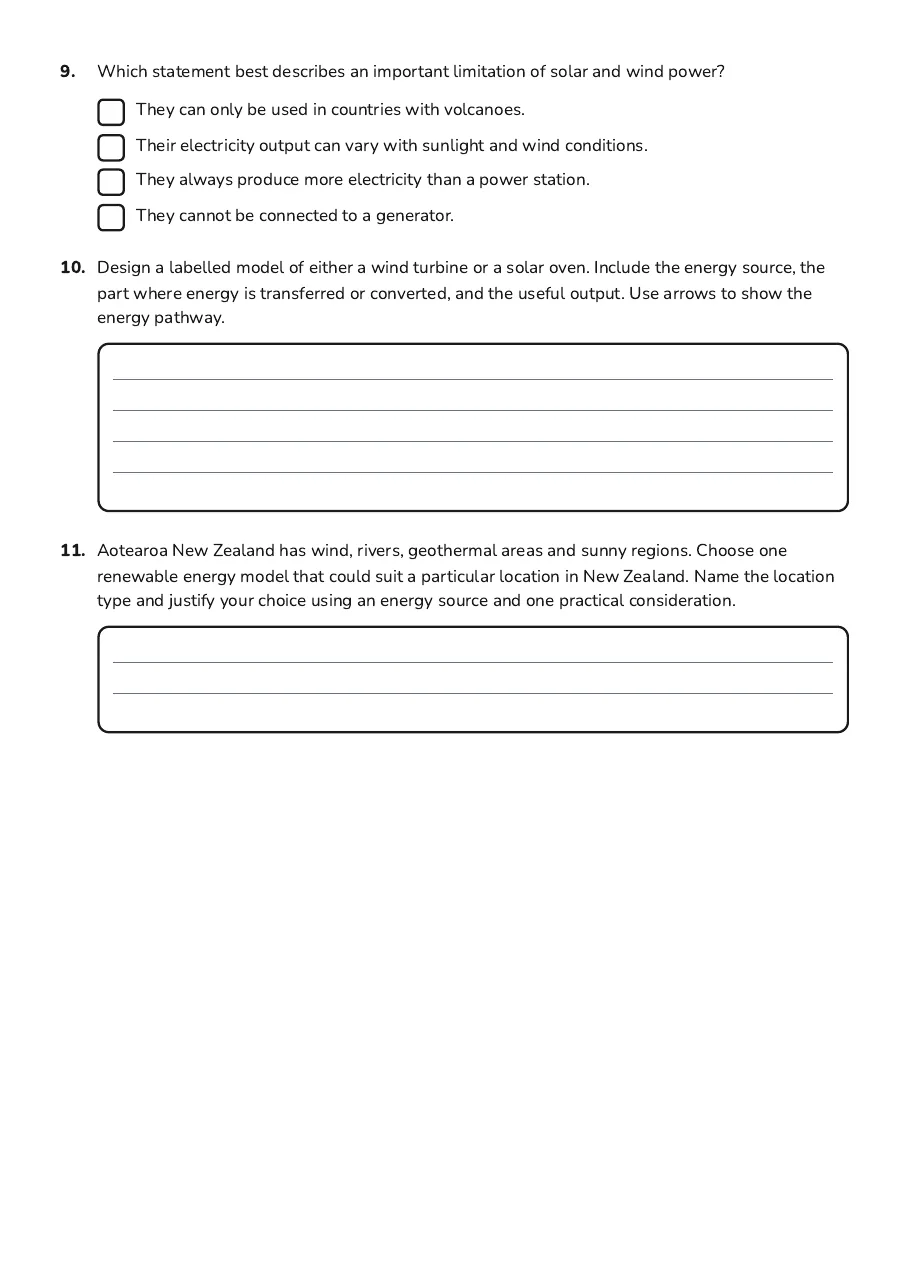
9.Which statement best describes an important limitation of solar and wind power?
  • They can only be used in countries with volcanoes.
  • Their electricity output can vary with sunlight and wind conditions.
  • They always produce more electricity than a power station.
  • They cannot be connected to a generator.
10.Design a labelled model of either a wind turbine or a solar oven. Include the energy source, the part where energy is transferred or converted, and the useful output. Use arrows to show the energy pathway.
11.Aotearoa New Zealand has wind, rivers, geothermal areas and sunny regions. Choose one renewable energy model that could suit a particular location in New Zealand. Name the location type and justify your choice using an energy source and one practical consideration.

3 printable pages

  • Year 8 renewable energy worksheet with model choices, wind turbine energy conversions and a New Zealand context.

    Page 1

  • Solar oven temperature data table and questions about temperature change, heat transfer, and improving renewable energy models.

    Page 2

  • Engineering design questions and a labelled drawing task for wind turbines or solar ovens.

    Page 3

About This Worksheet

Free in Kuraplan

Sign up free, grab the PDF, and customize it for your class.

Print-Ready

Formatted for standard paper. Clean layout, easy to read.

AI-Generated

Created with Kuraplan's AI, designed for real classroom use.

For Teachers & Parents

Use in classrooms, for homework, tutoring, or homeschool.

Need a custom version of this worksheet?

Kuraplan's AI generates custom worksheets in seconds — differentiated for every learner, aligned to your curriculum.

Generate Custom Worksheets — Free
No credit card Curriculum-aligned Under 60 seconds